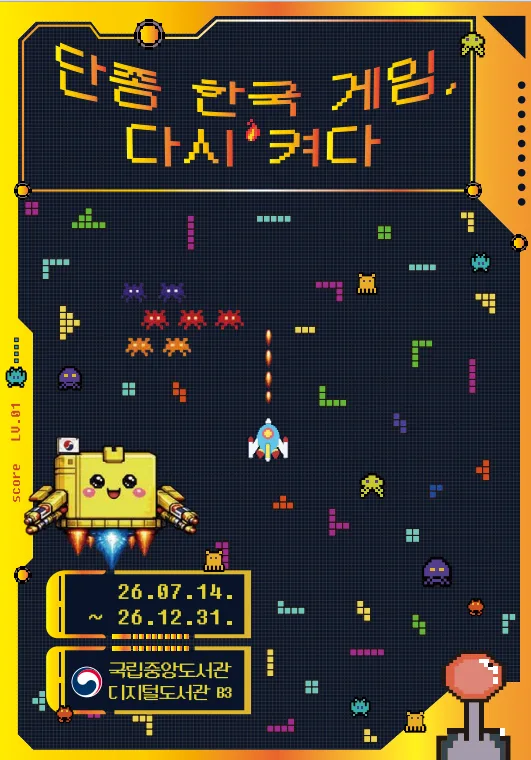
The National Library of Korea is holding the special exhibition Discontinued Korean Games, Powered On Again at its Digital Library from July 14 to December 31, 2026. The exhibition includes four game magazines, six manuals, and three games stored on floppy disks, all collected by the library since the early 1980s. It is organized into five sections, beginning with “The Library Collects Games” and continuing through records of unreleased and discontinued games, the history of Korean games, preservation activities, and hands-on game experiences.
At first glance, the exhibition may appear to be a retro showcase that offers visitors a chance to revisit older games that have long been difficult to access. There is certainly pleasure in encountering games and storage media from one’s childhood and experiencing their original controls and displays once again. Yet what the exhibition itself emphasizes is not nostalgia, but documentation. The National Library of Korea describes games as “recorded heritage containing the technology, imagination, and culture of an era,” and presents the preservation treatment of obsolete media, data extraction, and digital restoration alongside the games themselves.
At this point, the significance of the exhibition extends beyond the fact that several old games have been made playable again. Games have often been regarded as products that disappear from the market once they have been released, consumed, and are no longer sold or supported. When physical editions go out of print, consoles become obsolete, or online servers shut down, users may no longer be able to access them. A game that is no longer sold or operated by its company naturally becomes a thing of the past.
However, disappearing from the market does not mean that a game’s historical value disappears with it. Older games contain traces of the computer technologies, graphical styles, development methods, distribution structures, and approaches to play of their time. Bringing a game back into view is therefore not only an attempt to restore a discontinued product temporarily. It is also a way of rereading the traces of Korea’s game industry and digital culture that remain within it.
The most important question raised by this exhibition, then, is not simply which games are on display. The more fundamental issue is what kind of material a game should be understood as. If games are records of the technology, culture, and creative conditions of an era, what does it mean to preserve them?
From Commercial Content to a Public Record
Games are fundamentally commercial content produced and distributed through the market. Developers create games, while users purchase physical copies, create accounts, and access services. For a long time, decisions about whether a game would continue to be operated or preserved were left to the companies that produced and owned it.
Within this structure, the lifespan of a game largely coincided with its lifespan as a product. When sales declined, physical production stopped. When the cost of support became difficult to sustain, updates and online services ended. If a developer closed down or was acquired, even the location and ownership of the original materials could become difficult to determine. From an industrial perspective, this is a natural product life cycle.
From the perspective of cultural documentation, however, the issue looks different. A game remains evidence of the society and technology of its time even after it is no longer sold. Its graphics and sound reveal the aesthetic sensibilities and production techniques of a particular period. Its genres, rules, characters, and narratives reflect contemporary trends and values. Its packaging, advertisements, magazine articles, and strategy guides show the language through which the game was introduced and the ways in which it was consumed.
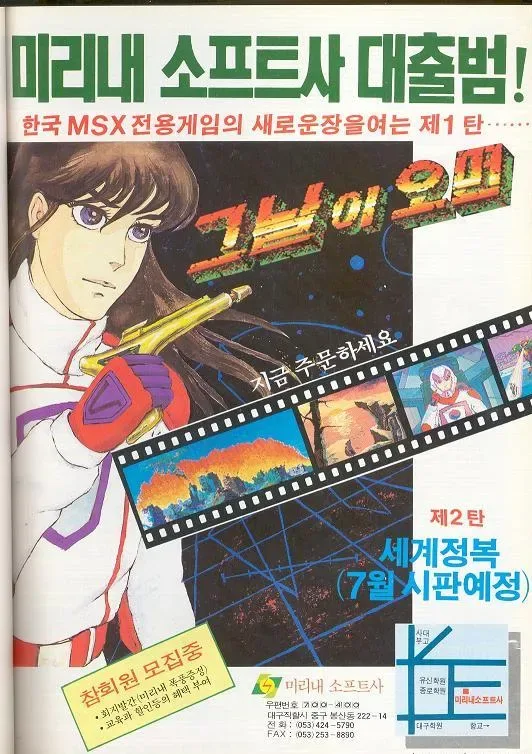
Nor are commercially successful games the only ones that matter. Cancelled projects, market failures, and games that remained in service for only a short period can also show what possibilities the industry attempted to explore and what limitations it encountered. Advertisements and interviews concerning games that were never released are likewise records of what developers at the time hoped to create. This is why the exhibition includes not only released titles, but also unreleased games that survive only through traces in magazine advertisements and articles.
One such example is When That Day Comes, an unreleased shooting game known only through advertisements in game magazines from the 1990s. For this exhibition, the game has been reconstructed with artificial intelligence and presented publicly for the first time. A game that had existed only as a single advertisement has, in a sense, been given form again.
The National Library of Korea’s decision to collect and exhibit such materials suggests a gradual change in how games are understood. This should not be overstated as an official designation of commercially produced games as national cultural heritage, nor as a formal declaration by the Republic of Korea recognizing the cultural status of games. A single exhibition also does not mean that a national system for game preservation has been completed.
Even so, it is significant that a national institution has explicitly identified games not merely as entertainment, but as digital recorded heritage worthy of preservation. This suggests that games are beginning to be treated not only as the memories of particular companies and players, but as materials that public institutions should collect, classify, and pass on to future generations.
The commercial and cultural lifespans of games must therefore be distinguished. When a company stops selling or operating a game, its life as a product has ended. Yet the technical, industrial, and cultural information contained within that game does not lose its value at the same moment. The role of the library is to connect these two lifespans. It gathers games that have become difficult to access through the market and brings together scattered magazines, manuals, advertisements, and articles so that they can once again be studied and interpreted. In this way, a game ceases to be a product whose existence is determined solely by whether it can still be run. It becomes a public record of how Korea’s digital culture was formed.
Games Cannot Be Preserved as Executable Files Alone
What, then, must be collected in order to preserve a game? The first answer that comes to mind is the executable file. The program itself, along with its graphics, sound, maps, scenarios, and other data, must survive if the contents of the game are to be examined.
Yet obtaining an executable file does not mean that the game has been fully preserved. A game is not content that can be appreciated simply by viewing a file. It is a medium that runs on particular hardware and operating systems and operates through user input. Even when the same data survives, it cannot be run if the required reading device no longer exists or the operating system no longer supports it. In the case of games that require online servers or account authentication, the client files alone may not even allow the player to proceed beyond the title screen.
The materials required for game preservation can broadly be divided into three layers.
The first consists of the data that makes up the game itself. This includes executable files, graphical and audio resources, maps and dialogue, save data, patch files, and individual builds. Where possible, source code, design documents, and other development materials are also important. A completed game alone does not reveal the technical decisions and creative judgments through which it was produced. Even games with the same title may differ between their original release and final updated versions, while domestic and overseas editions, as well as PC and console versions, may constitute distinct materials. Preserving only a single representative file makes it difficult to trace how a game changed over time.
The second layer is the environment in which the game operated. This includes operating systems, hardware specifications, graphics and sound drivers, storage media and peripheral devices, and methods of screen output. Depending on the game, not only keyboards and mice but also specialized joysticks, controllers, consoles, and displays may form an important part of the experience. Even if an older game is converted so that it can run on a modern computer, differences in aspect ratio, resolution, input response, and sound output may produce an experience unlike the original. This is why the exhibition presents not only the physical storage media, but also their conservation treatment, data extraction, and digital restoration. The mere physical survival of a floppy disk or CD-ROM does not guarantee continued access to the game contained within it.
The third layer consists of surrounding records that explain the meaning of the game. These include packaging, manuals, game magazines and advertisements, strategy guides and reviews, developer interviews, and gameplay footage. Such materials provide information that is not contained within the game files themselves. They reveal the audiences to whom the game was marketed, the features regarded as innovative at the time, the points at which users struggled, and the ways in which they played.
Manuals, in particular, are not merely accessories that explain the controls. They often contain information about the world, rules, and characters that the game itself was unable to explain fully. Magazine advertisements and articles show how developers wanted their games to be understood, while strategy guides and reader submissions reveal how players interpreted and shared their experiences.
Even if a game can technically be run again, the experience of its original period cannot be fully restored. Strategies that were initially unknown, slang and unofficial rules created by players, and relationships formed through online communities and guilds all existed outside the program itself. Playing a game alone today, after every strategy has been documented, is not the same experience as playing it at release, when large numbers of users were still exploring and exchanging information, even if the same files are being used.
Ultimately, a game does not survive as a single file. It is only through the combination of program, machinery, documents, and player activity that a complete game experience takes shape. To preserve games as public records, preservation must therefore include not only the finished work, but also the conditions under which it was created, operated, and received.
What It Means to Power a Game On Again
The exhibition’s use of artificial intelligence to reconstruct the unreleased game When That Day Comes raises the question of what such preservation actually entails. This is not a case in which a completed original was discovered and restored in its existing form. It is closer to a new implementation produced with contemporary technology using materials preserved in old magazine articles and advertisements. It is clearly meaningful as a way of helping visitors understand and experience a lost game. Nevertheless, the restoration of an original and a reconstruction based on historical records must be distinguished.
What matters in preservation is not only how naturally the final result functions. It is also necessary to record which elements are grounded in historical materials and which have been filled in through contemporary interpretation and generative technology. Without such information, future users may mistake reconstructed scenes for features that actually existed in the original game. Distinguishing originals, recovered versions, and reconstructions, and documenting the process behind each, does not diminish the value of the exhibition. On the contrary, it demonstrates what the work of game preservation involves. Preservation is not simply the revival of the past exactly as it was. It is closer to managing the boundary between what remains in the record and what has been lost.

In this sense, Discontinued Korean Games, Powered On Again is not an exhibition demonstrating that the preservation of Korean games has been completed. Rather, it is a point of departure that reveals how easily games have disappeared and how different the task of preserving them is from placing a handful of physical objects in display cases. More important than the fact that the national library is exhibiting games is the fact that it has begun to include them within the range of records a library should handle and to explore methods for preserving them.
At the time of their release, games are products competing in the market. Yet the technology, design, industrial decisions, and player experiences accumulated within them do not disappear simply because sales have ended. A game’s cultural and historical life may continue after its commercial life has ended. By bringing older games and their related materials back into public view, the National Library of Korea has begun to distinguish between these two lifespans.
Powering a game on again does not simply mean running an old program. It means preserving the machine on which it operated, the technology and rules through which it was made, and the experiences people created within it, so that the future can read them again.