Open-Source AI, Fake News, Automated Hacking, Spam and Social Threats Emerging
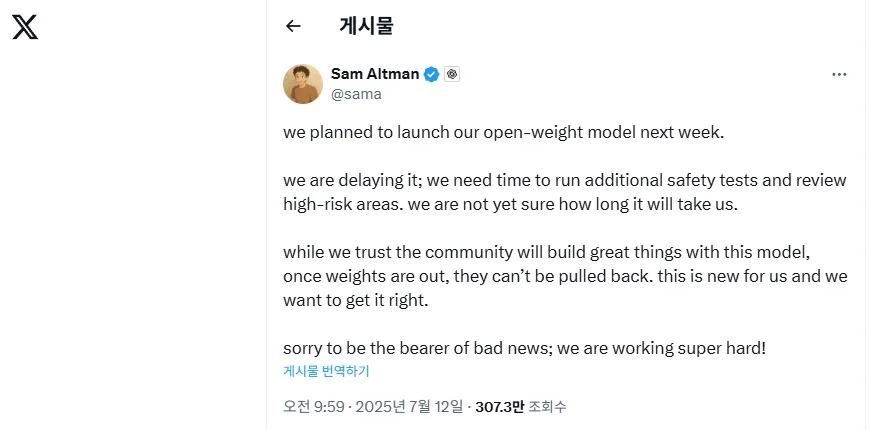
OpenAI again delayed the release of the anticipated open model -- indefinitely. The model to be released would have been practically the first genuine open-source AI from OpenAI in several years -- downloadable and freely usable by anyone. However, OpenAI decided to delay release to an indefinite timeframe, with "responsible release" as the difficult underlying challenge. OpenAI CEO Sam Altman July 12 (local time): "Additional safety testing and examination of high-risk areas are needed" -- "I will not set a release schedule this time" posted on X. Altman explained "model weights, once released, cannot be retrieved" and "since this is a first-time experience, we have no choice but to be more cautious." The open-model safety problem: (1) Loss of control -- once weights are public, OpenAI cannot update, patch, or restrict the model; malicious actors can fine-tune it to remove safety training; (2) Scale amplification -- the same model simultaneously runs on millions of servers worldwide; any safety failure is not an isolated incident but a systemic one; (3) Weaponization potential -- a capable open model enables automated influence operations (disinformation at scale), automated vulnerability discovery and exploitation, and voice/image synthesis for fraud; the "open model" is not wrong in principle -- Meta Llama and Mistral demonstrate that open models can be responsibly released; the specific concern is a more capable model in OpenAI frontier range where the potential for harmful use scales with capability.