TVs and smartphones have long pushed display technology in a familiar direction: larger, brighter, and sharper screens. Smart glasses are no different in their need to present information clearly, but they come with an additional requirement. They have to place information in front of the user’s eyes while still remaining light, comfortable, and natural enough to wear like ordinary glasses.
Meeting that requirement is more difficult than it may seem. Simply shrinking the image-generating component is not enough. Smart glasses also need optical components that create light, control its direction, and deliver it to the user’s eyes. As these components become larger, the lenses and frames tend to become thicker and heavier as well. Designing a display for smart glasses therefore involves more than fitting a small screen into a pair of glasses. Resolution and brightness matter, but so does the ability to reduce the supporting optical hardware and integrate it naturally into the eyewear.
What Can a 150nm Mirror Change?
TDK has been jointly developing retinal projection technology with QD Laser since 2020. Over the years, the companies have gradually advanced the technologies used to generate and control images, including full-color laser modules, high-resolution control devices, and RGB light sources. In 2022, they unveiled binocular retinal projection smart glasses using an ultra-compact full-color laser module. In 2024, TDK demonstrated a full-color laser control device aimed at resolutions above 4K, and in June this year, the companies expanded their collaboration on next-generation RGB light sources and optical engines.
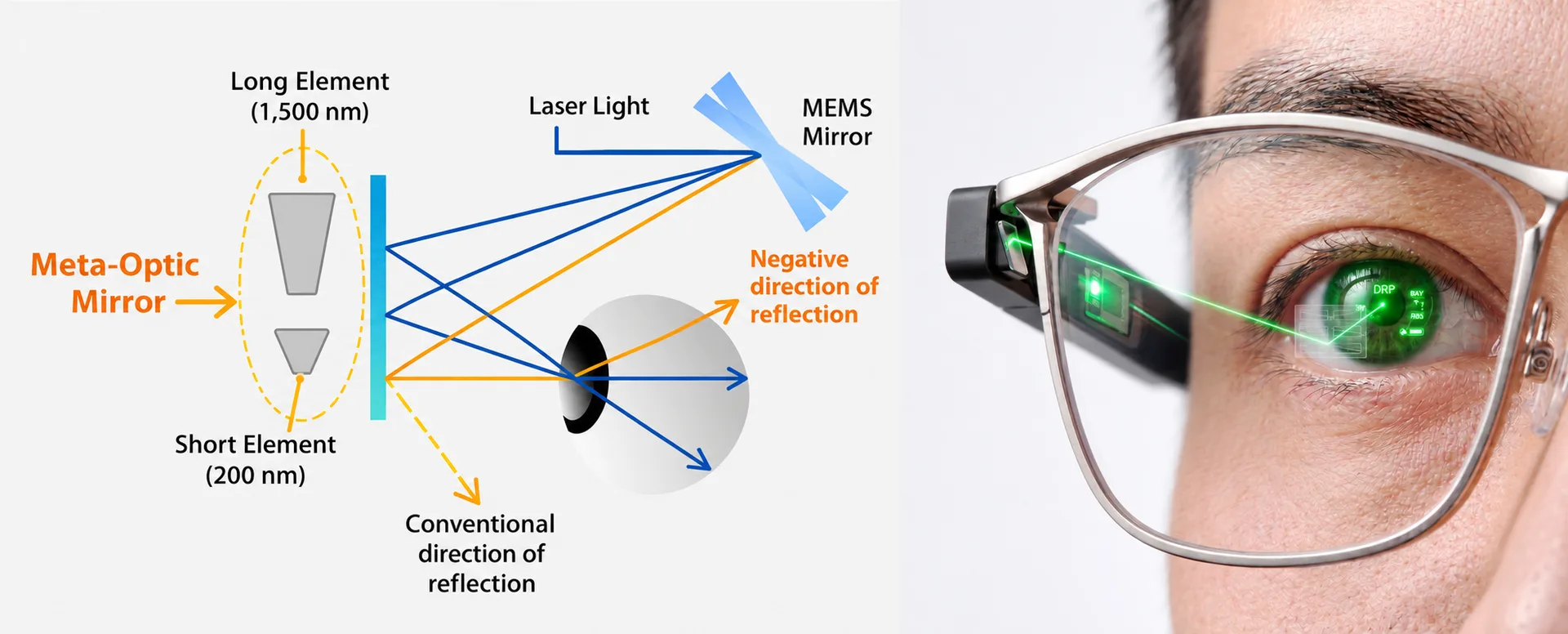
Then, on October 2, TDK introduced a new Direct Retinal Projection (DRP) technology designed to make the optical structure of smart glasses thinner. What changed was the way light is delivered to the eye. Rather than requiring the user to look at a separate screen, the system controls laser light through an optical path and projects the image directly onto the retina. Conventional retinal projection systems require a curved reflective structure in front of the eye to redirect the laser light. Because that structure occupies physical space, however, it can make it more difficult to design smart glasses that are thin and unobtrusive enough to resemble ordinary eyewear.
TDK replaced that component with a flat “meta-optic mirror” that can be embedded inside the lens. The mirror is approximately 150 nanometers thick and contains nanoscale reflective structures arranged differently across its surface, allowing it to redirect laser light even while remaining flat. According to TDK, the mirror has a visible-light transmittance of about 80% and can be integrated directly into an eyeglass lens.
Previously, projecting an image onto the retina required a separate reflective structure positioned in front of the eye. TDK’s approach moves that function inside the lens, reducing the amount of optical hardware protruding beyond it and creating more room for thinner, more natural-looking smart-glasses designs. In this sense, the 150nm meta-optic mirror simplifies the optical structure required for retinal projection while preserving the basic projection method itself.
From a ‘Panel’ to a ‘Function’
When we think of a display, we usually imagine a visible surface. A television has a panel, and a smartphone has a screen. Users look directly at that physical surface, and the content appears within its boundaries. That is also why screen size, resolution, and brightness have long served as familiar measures of display performance.
Smart glasses cannot simply reproduce this structure. There is little room in front of the eyes for a large panel or a bulky optical system, which makes the efficient transmission and control of light increasingly important. This is one reason technologies such as waveguides, which guide light through thin lenses, and metasurfaces, which use nanoscale structures to control the direction of light, continue to be actively researched in the AR and XR fields. Lenses and optical structures are no longer merely supporting the display; they are becoming directly involved in the process of creating the image.
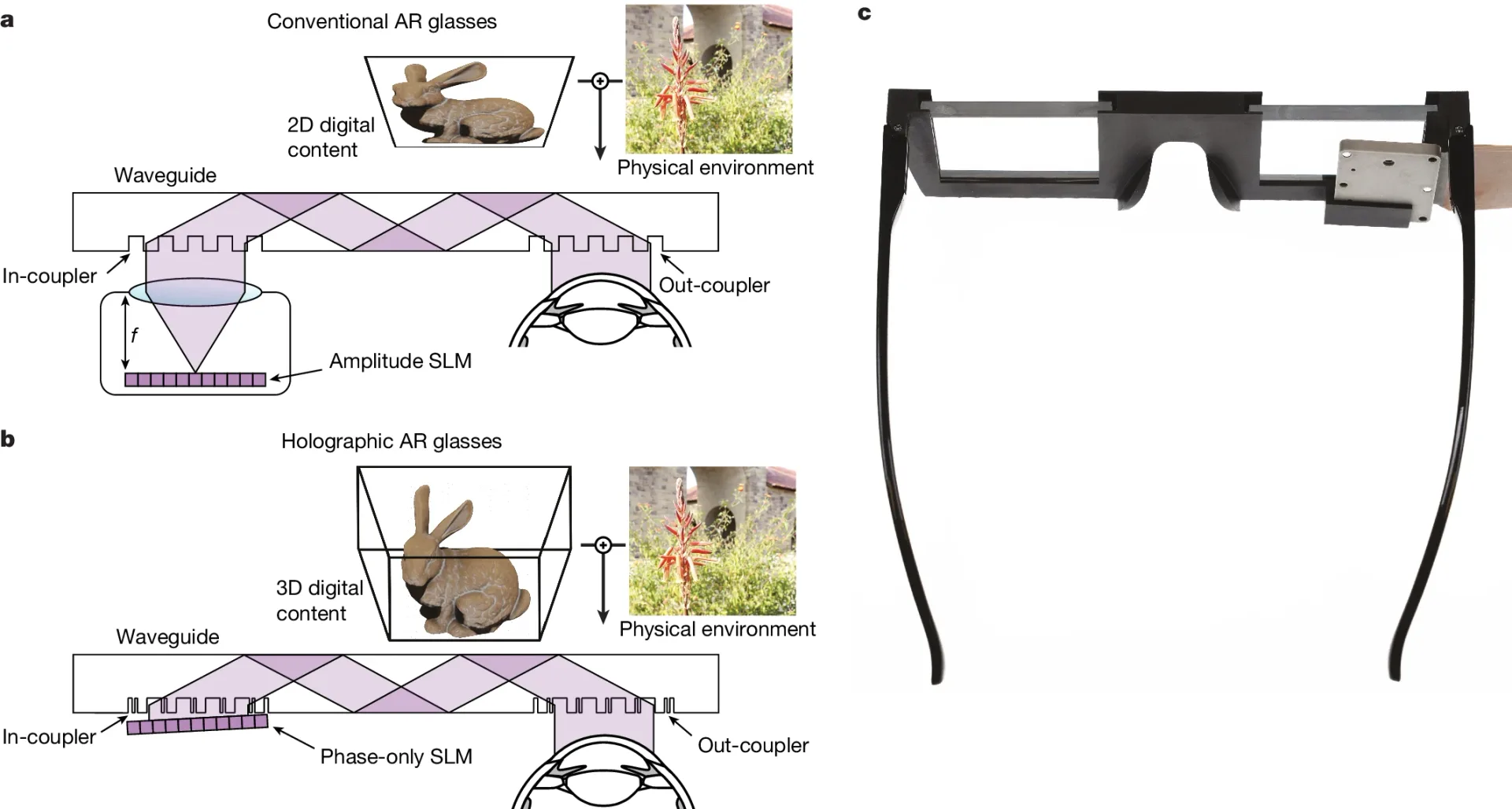
TDK’s meta-optic mirror is another example of this shift. A function that previously required a separate reflective structure is now moved into the lens itself, allowing the lens to take on the additional role of controlling the direction of light. Rather than remaining clearly separated into a screen, lens, and optical hardware, these elements are increasingly working together as part of a single image-forming system.
That change may also affect how displays are evaluated. For smart glasses, resolution and brightness remain important, but so does the ability to deliver the same information through a thinner and lighter optical structure. The challenge is no longer simply to make the screen larger, but to integrate the functions required to produce an image more naturally into the lens.
As a result, it is becoming harder to define a smart-glasses display as a single panel. Light generated by the source is controlled by the lens and optical structures before being received by the user’s eyes, with the entire process forming the display experience. The visible “screen” may occupy less physical space, while its functions are distributed across a broader set of components.
Information in Front of Our Eyes Becomes More Personal
Another feature TDK highlights is reduced “image leakage.” In other words, the system is designed to make it difficult for someone facing the wearer to see the image being delivered to the user’s eyes. Smartphone and laptop screens are physically exposed, meaning people nearby can often see the same information. With retinal projection, however, a pair of glasses may look ordinary to others while presenting an entirely separate layer of information within the wearer’s field of view. The location of the information effectively moves from the surface of the device into the user’s own vision.
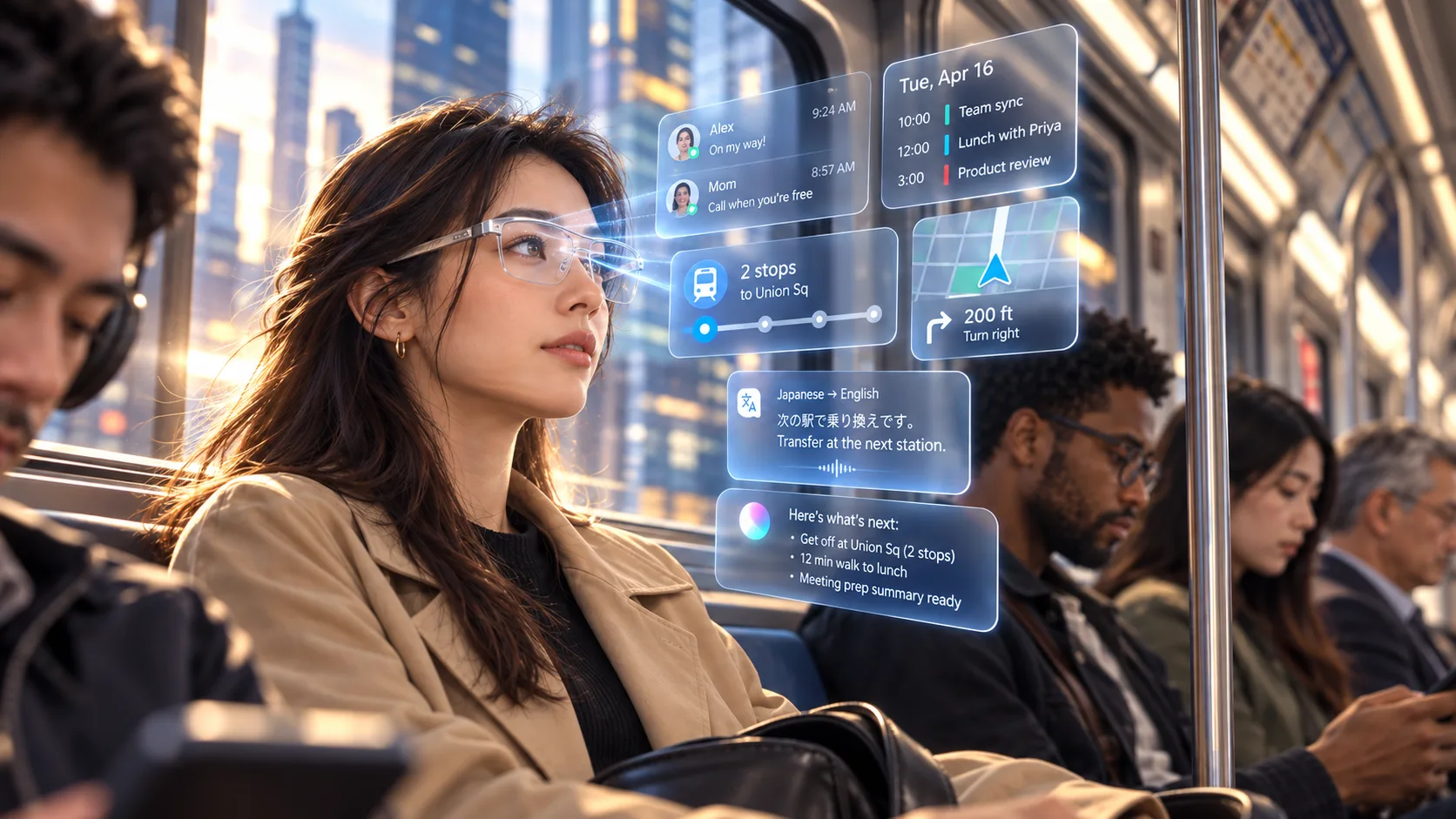
If this characteristic can be implemented reliably in commercial products, smart glasses could handle a much broader range of information. Beyond relatively public information such as navigation directions or real-time translation, users could view messages, schedules, work-related information, or AI-generated responses directly within their field of vision. Smart glasses could therefore develop beyond small devices that simply display information and become personal interfaces continuously connected to the wearer’s view.
Smart glasses also reveal two different sides of the privacy issue. Outward-facing cameras have drawn criticism because people nearby may not easily know when they are being recorded. Displays directed toward the wearer, by contrast, are moving toward keeping the user’s own information hidden from others. Within the same device, the camera records the outside world, while the display can conceal what the wearer sees.
That possibility, however, does not mean the technology is ready to become an everyday product. TDK’s current meta-optic mirror demonstration produces monochrome images, and full-color operation and mass production still need to be achieved. Retinal projection itself also faces technical challenges, including maintaining a stable image as the user’s eyes move, securing sufficient brightness and optical efficiency, reproducing color accurately, and ensuring long-term stability and eye safety. Even so, the technology offers a glimpse of where smart-glasses displays may be heading. With televisions and smartphones, the performance of the screen itself has traditionally been the central concern. With smart glasses, the ability to make the optical structure behind that image thinner and more naturally integrated into the device is becoming just as important.
We have long thought of a display as a single “screen.” With retinal projection, however, the image is no longer produced by one panel alone; the light source, lens, optical structures, and the user’s eyes all contribute to the visual experience. If images can be viewed without looking at a separate screen, the more important question may eventually become not how large the display is, but how naturally information can be blended into the user’s field of view.
Ultimately, the next generation of displays may not be defined by screens that keep getting larger, but by screens that gradually disappear.