Apple is reportedly cutting more than 200 jobs across teams related to Siri, Vision Pro and associated software.
According to reports citing Bloomberg, the cuts affect the Vision Pro organization as well as Siri and related software teams. More than 200 positions are said to be affected, with roughly 100 tied to the Vision Pro group and another 100 linked to Siri and software teams. On the Vision Pro side, Apple is reportedly largely shutting down a gaming-focused team and reducing the group responsible for immersive video production. On the Siri side, the restructuring appears connected to a shift toward a new AI-based architecture, which requires different expertise.
This should not be read as a simple headcount adjustment.
It is a signal of where Apple is slowing down and where it may be preparing to bet again.
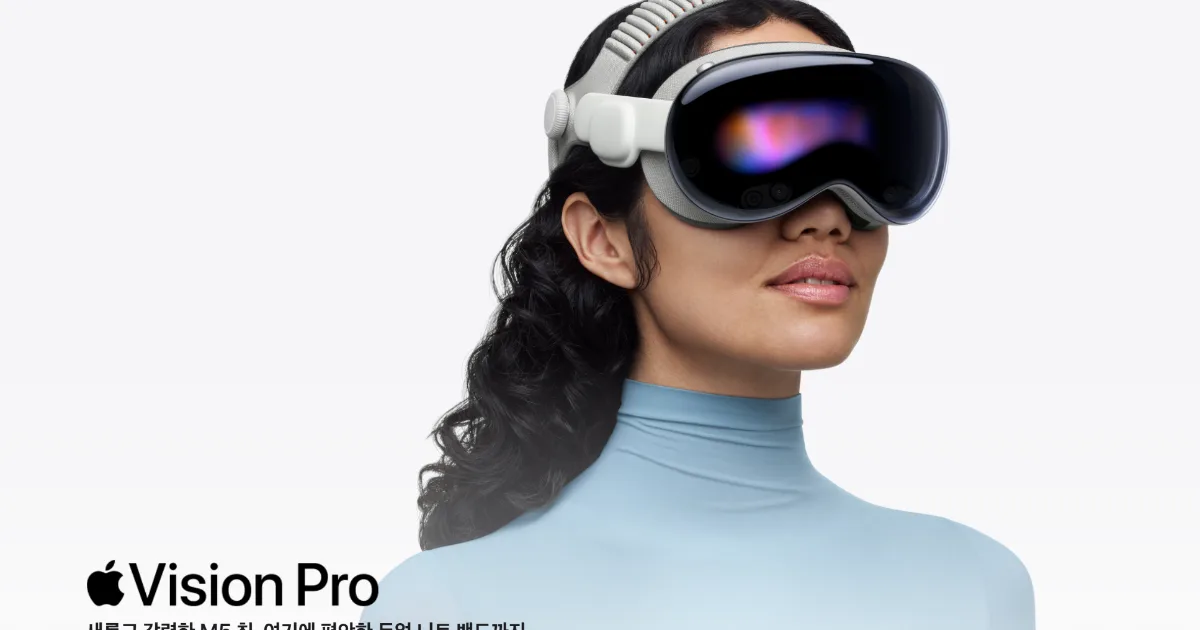
Vision Pro was Apple’s high-end spatial computing device, launched as a new computing platform. But it did not quickly open a mass market. Siri, meanwhile, has long been Apple’s voice assistant across its ecosystem, but it has been criticized for falling behind in the generative AI era.
These two areas are now being shaken at the same time.
One is the first-generation Vision Pro strategy.
The other is Siri’s legacy architecture.
Apple does not appear to be abandoning spatial computing. Nor is it eliminating Siri. Instead, it seems to be reducing investment in content- and gaming-led Vision Pro expansion while shifting attention toward more practical next-generation devices, including smart glasses. Siri, too, appears to be undergoing organizational redesign so it can fit a new AI-based structure.
In other words, this is both a retreat and a redeployment.
Apple is not giving up on spatial computing or voice assistance.
It is revising the first approach.
Vision Pro’s Problem Was the Market, Not the Technology
Vision Pro was technically impressive.
Its high-resolution displays, sophisticated sensors, eye tracking, hand gestures, spatial interface and immersive video experience all reflected Apple’s product craftsmanship. But the market response was different from what Apple experienced with the iPhone, AirPods or Apple Watch.
The problems were clear.
The price was high.
The weight and comfort burden were real.
The content ecosystem was not deep enough.
There was not yet a strong everyday reason to use it.
The device was astonishing to try, but the reason to buy it was limited.
Vision Pro was closer to a product that showed the future. But consumers do not pay $3,499 simply to experience the future. A device must solve concrete needs in everyday life. In work, entertainment, communication, gaming or creation, Vision Pro has not yet become essential for the mass market.
That is why the reported cuts to Vision Pro gaming and immersive video are symbolic.
Apple initially tried to make Vision Pro into a new content platform. Spatial video, immersive content and gaming could have become differentiators. But content production is expensive, while the installed base remains limited. If there are not enough device owners, developers and producers have less incentive to invest. If content is scarce, consumers have less reason to buy the device.
This is the classic chicken-and-egg problem of a new platform.
Apple surely understands this.
But reducing internal content and gaming teams suggests that Apple has lowered its expectations for a content-led expansion strategy around the first generation of Vision Pro.
Apple Is Not Abandoning Vision Pro. It Is Rethinking the Form.
The layoffs do not necessarily mean Apple is giving up on spatial computing.
Reports suggest that Apple continues to develop Vision Pro and visionOS. Some reporting has also pointed to future, thinner or lighter models, with a next-generation Vision Pro possibly arriving around late 2028.
The important issue is form factor.
Vision Pro is an immersive headset. The user wears it on the face and blends the external world with digital content. But this form is still heavy for mainstream consumers. Smart glasses, by contrast, are more everyday objects. They can be worn like ordinary glasses while offering notifications, cameras, voice assistance, light display features and AI support.
Meta’s Ray-Ban smart glasses have shown the possibility of this direction. Consumers may respond first to lightweight wearable AI devices rather than full immersive computing. A device does not need to occupy the entire field of view to be useful. Taking photos, asking questions by voice, receiving information and connecting with AI in daily life may be enough to create value.
If Apple transfers Vision Pro technologies into smart glasses, the strategy changes.
From an ultra-premium immersive headset
to something lighter,
cheaper,
used more often,
and centered around AI.
The layoffs may therefore signal not the end of Vision Pro, but Apple’s recalculation of the next form of spatial computing.
Apple may see more promise in AI glasses that blend into daily life than in a computer worn heavily on the head.
The Siri Cuts Matter More
The Siri side may be even more important than the Vision Pro cuts.
Vision Pro is still an early product. Failure, correction and redirection are expected. Siri is different. Siri is an interface spread across the Apple ecosystem. It connects users to Apple devices through the iPhone, iPad, Mac, Apple Watch, HomePod and CarPlay.
But in the generative AI era, Siri has been widely seen as a weakness.
Users have experienced models such as ChatGPT, Gemini and Claude carrying on natural conversations and performing complex tasks. Siri, by comparison, has often felt trapped in the older voice-assistant model. It has limited question understanding, struggles with multi-app tasks and makes limited use of user context.
Apple needs to rebuild Siri.
It can no longer be only a voice-command processor. It must become the execution layer of Apple Intelligence. It must understand context on the user’s device, manipulate apps, protect personal data and perform real work.
That may be difficult to solve as a simple extension of the old Siri organization.
The new Siri needs a structure that combines large language models, on-device AI, personal context, app actions, privacy-preserving cloud computation and real-time voice interaction. That also means the required expertise changes.
The Siri-related layoffs should therefore be read less as simple cost cutting and more as organizational redesign.
Apple is moving from the old Siri toward an AI-native Siri.
Apple’s AI Dilemma
Apple faces a distinct dilemma in the AI era.
It is strong in devices, operating systems, app ecosystems, semiconductors, security and privacy. But the early lead in generative AI went to model-centered companies such as OpenAI, Google, Anthropic and Meta. Apple announced Apple Intelligence, but the market does not generally see Apple as leading the AI race.
Apple’s strength is not necessarily the model alone.
Its strength is product integration.
AI enters the iPhone.
AI enters Mac workflows.
Siri controls apps.
Personal data stays on device when possible.
Private Cloud Compute is used when necessary.
Users experience AI without complex setup.
But for this strategy to work, Siri must be strong.
If Siri cannot become the face of Apple Intelligence, Apple’s AI strategy risks remaining a bundle of features. Writing tools, summaries, image generation and notification management are useful, but not enough. Users ultimately want an interface that can do what they want. On the iPhone, the most natural AI interface is still Siri.
That is why Siri’s reorganization is central to Apple’s AI strategy.
If Apple is cutting certain roles while creating new ones around Siri and related software, it may be admitting that the old voice-assistant skill set is not enough for the generative AI era.
For Apple, Siri is not optional.
It is a foundation that must be fixed.
The Direction Matters More Than the Number
Compared with Apple’s overall headcount, 200 job cuts may not be enormous.
But layoffs at Apple are still notable. The company has long carried an image of cautious hiring, careful internal movement and relatively limited public restructuring. That makes the affected organizations more important than the scale.
Vision Pro.
Siri.
Intelligent Systems Experience.
AI-related software teams.
These are all connected to Apple’s future interfaces.
Where Apple cuts reveals how it is thinking strategically. Vision Pro gaming and immersive video are being reduced. Siri’s older structure is being redesigned. Software groups that deliver AI features to Apple devices are also affected. At the same time, Apple has said new roles will be created as part of the change.
This looks less like pure reduction and more like role replacement.
Apple may need fewer people tied to internal content production, gaming or legacy voice-assistant operations, and more people suited to AI architecture, next-generation devices, smart glasses, on-device models and agentic interfaces.
Strategic change often appears first in the org chart.
These layoffs suggest that Apple’s next decade of interface strategy is not simply an extension of first-generation Vision Pro or legacy Siri.
Vision Pro and Siri Are Actually the Same Problem
At first glance, Vision Pro and Siri look like different businesses.
Vision Pro is hardware.
Siri is a software interface.
But from Apple’s future perspective, they connect to the same question:
How will users interact with computers in the next era?
Vision Pro tried to answer with hands, eyes and spatial interfaces. Siri tried to answer with voice. Generative AI answers with conversation, context and task execution. Smart glasses answer by combining cameras, voice and information in the field of view.
These are competing candidates for the future interface.
Vision Pro’s problem was that the form was too heavy.
Siri’s problem was that the intelligence was too old.
Smart glasses and an AI-native Siri could recombine the two.
Imagine lightweight glasses, Siri as the voice interface, a camera that understands the surrounding environment, AI that interprets context and information delivered through voice or a small display. In that scenario, Vision Pro’s spatial-computing vision could return in a more everyday form.
That is why cutting some Vision Pro teams while investing in AI and new devices can be read as a shift toward this future.
The future may not be one headset.
It may be an AI-powered wearable interface.
Why Apple Is Scaling Back Content Production
Immersive video was one of Vision Pro’s key differentiators.
Apple tried to create experiences that only Vision Pro could deliver: sports, performances, documentaries, nature and entertainment in immersive formats. But internal production is expensive. The equipment, production methods, editing and distribution differ from conventional video. If the device base is small, recovering that investment is difficult.
Reports that Apple is reducing its immersive video team reflect this reality.
Content is needed, but large-scale internal production may not make economic sense. Apple could instead lean more on third-party developers and producers. This is a common platform strategy: show the possibility with first-party content, then encourage the ecosystem to follow.
With Vision Pro, however, the ecosystem does not appear to have developed quickly enough.
The same applies to gaming.
Games were a potential killer use case for VR and AR devices. But Apple has never behaved like a traditional console gaming platform. Given Vision Pro’s price, installed base, controller ecosystem and developer incentives, building a dedicated gaming market may have been difficult.
Apple now appears to be lowering its emphasis on making Vision Pro a gaming and immersive-content platform and redirecting resources toward longer-term next-generation devices.
The Contrast With Meta
Apple’s move also contrasts with Meta’s strategy.
Meta’s Ray-Ban smart glasses have gained traction in a lighter AI wearable category. They show that even without being full AR headsets, glasses with cameras, voice AI and everyday wearability can find a market.
Apple began with Vision Pro, a much more advanced and premium spatial-computing device. The technology was stronger, but the price, weight and usage frequency made mainstream adoption harder.
The approaches were different.
Meta built market habits with a lighter product.
Apple introduced a premium product to define the future of computing.
For now, the market seems friendlier to Meta’s approach. Consumers may respond first to daily convenience rather than full immersion. In the AI era, glasses that let users ask questions by voice and understand the surrounding world may feel more natural than a headset that occupies the entire field of view.
That is why reports of Apple shifting more attention toward smart glasses matter.
Vision Pro was a technology testbed.
Smart glasses may be the market entrance.
The Signal to Developers
The Vision Pro cuts also send a signal to developers.
If Apple reduces internal gaming and immersive video teams, short-term expectations for a Vision Pro-specific content ecosystem may weaken. Developers will need to reconsider how much to invest in Vision Pro-only apps.
Platform ecosystems are sensitive to platform-owner signals.
When Apple pushes hard, developers move.
When Apple slows down, developers wait.
VisionOS is not disappearing. Apple is still likely to develop Vision Pro and successor devices. But the near-term expectation of rapid content- and gaming-led expansion may be weaker.
Developers may need to look more broadly across the Apple ecosystem: iOS, macOS, visionOS and AI features working together.
The key question is whether Apple will grow visionOS as an independent platform or redefine it as an extended interface connected to iPhone, Mac, Siri and smart glasses.
For developers, the better strategy may be less about a Vision Pro-only market and more about Apple Intelligence and wearable interfaces as a whole.
What Korean Companies Should Notice
This report has implications for Korean companies as well.
First, the XR market remains difficult. Technical excellence alone does not create a market. Price, comfort, content, usage frequency and ecosystem must align. If even a premium device like Vision Pro struggles with mass adoption, XR hardware and content strategies should be approached carefully.
Second, AI voice interfaces are becoming more important. Siri’s redesign is a problem every device company will face. Existing voice assistants must be rebuilt for the generative AI and agent era. Korean telecom companies, electronics makers and automakers should redesign voice assistants as AI execution interfaces, not simple command processors.
Third, smart glasses deserve renewed attention. Lightweight everyday AI wearables may open the market before full XR headsets do. Cameras, voice, translation, navigation, work assistance, real-time search and personal-assistant functions can create practical value.
Fourth, content strategy must match hardware adoption. Immersive video and spatial content are expensive. If the installed base is small, the business case is weak. Content companies must look at both platform roadmaps and user scale.
Fifth, AI transition changes workforce structure. Even a company as large as Apple is realigning roles around Siri and Vision Pro. Korean companies should not treat AI transformation only as employee education or tool adoption. They must examine which roles will shrink and which new roles will be created.
Apple’s Next Battleground Is the AI Device
Apple remains a powerful company.
Its iPhone ecosystem, Apple Silicon, App Store, services revenue, privacy brand and hardware design capabilities are hard to replicate. But in the transition to generative AI and wearable interfaces, Apple must find its next battleground.
That battleground may not be the general-purpose model race alone.
Rather than competing only at the very front of model performance against OpenAI, Google or Anthropic, Apple’s advantage may lie in integrating AI deeply into devices, operating systems, personal data, privacy and wearable experience.
Apple’s key questions are these:
Can Siri be rebuilt for the ChatGPT era?
Can Vision Pro’s technology be transferred into lighter everyday devices?
Can AI understand personal context while preserving privacy?
Can Apple define the interface after the iPhone?
The layoffs appear to be part of Apple’s internal adjustment to those questions.
Roles that no longer fit are reduced. New roles are created. First-generation Vision Pro’s content strategy is lowered. AI-native Siri and next-generation wearables receive more attention.
Apple’s next innovation may not come from a better headset alone.
It may come from a smarter Siri and a lighter AI device.
Layoffs Are Not Just Retreat. They Are a Rewriting of Priorities.
Apple’s reported cuts across Siri and Vision Pro teams are not merely layoff news.
They show Apple rewriting its future interface strategy.
Vision Pro was technically powerful, but its high price, comfort burden and limited content ecosystem prevented rapid mass-market adoption. Siri was once a core interface across Apple devices, but in the generative AI era, its old structure is no longer enough.
Apple is therefore realigning both areas at once.
In Vision Pro, it is reducing internal investment in gaming and immersive video. In Siri, it is changing roles and expertise for a new AI architecture. At the same time, Apple appears to be shifting more resources toward AI and new devices, including the possibility of smart glasses.
This does not mean Vision Pro is dead.
It may mean that the spatial-computing technology Vision Pro introduced is being redirected into more practical forms. And the Siri cuts do not necessarily mean the end of Siri. They may mean the redesign of Siri.
Apple’s challenge is clear.
It must find the next interface after the iPhone.
It must overcome the perception that it is behind in generative AI.
It must turn Vision Pro’s futuristic technology into mainstream usability.
It must transform Siri from a voice assistant into an AI execution layer.
This organizational change is an early step in that shift.
Apple is not cutting the future.
It is cutting the old structure that tried to build the future in the wrong form.