On June 30, 2026, Wemade founder and board chairman Park Kwan-ho signed a stock purchase agreement to sell all of his shares. The transaction covers 13,350,738 shares, equivalent to a 39.33% stake. The price is 68,910 won per share, bringing the total transaction value to 920 billion won. The buyer is Neopulse, an investment platform. If the deal closes as planned, Park’s ownership stake in Wemade will fall to 0%.
Seen only in numbers, this is a large-scale 920 billion won equity transaction. But the weight of the deal lies less in its size than in its structure. Park is not simply reducing part of his stake. He is fully ending his ownership relationship with the company he founded.
There are several common ways for a founder to step back from a company. A founder may resign as CEO but remain as board chairman. They may sell part of their stake to secure cash while retaining control. Or they may establish a professional management structure while remaining the largest shareholder. Park’s choice does not closely resemble any of these.
He is not merely stepping away from day-to-day management. He has chosen to sell his entire stake. Once the transaction closes, Park will remain Wemade’s founder and former largest shareholder, but he will no longer have a place within its ownership structure. That is why this agreement is closer to the starting point of Wemade’s move beyond its founder-led era than to a simple stake sale.
A Deal That Is Not Yet Complete
Still, the deal has not yet been completed. What has been confirmed so far is that the stock purchase agreement was signed on June 30. The 92 billion won down payment was paid on the day of the agreement, but the remaining 828 billion won is scheduled to be paid on October 30. The expected date for the change of largest shareholder is also October 30.
In other words, Wemade’s control did not immediately transfer upon the announcement. The agreement has been signed, but the actual transfer of shares and management control still requires further procedures. Once the balance is paid, Park’s shares and accompanying rights will be transferred to Neopulse. After that, when directors designated by Neopulse are appointed at an extraordinary general meeting of shareholders, the transfer of management control will effectively be completed.
There is one more condition. Wemade disclosed that the agreement will take effect only if preceding conditions, including approval of the business combination filing, are satisfied or waived. In other words, payment of the balance, an extraordinary general meeting, and regulatory approval still remain. The direction of the deal has been set, but legally, the transaction is not yet complete.
Park also made this point clear in a letter to employees. He explained that the deal would only be executed after final procedures and payment of the balance, adding that nothing would change immediately and that he would continue to take responsibility for the company until then. He also said that once the procedures were complete, he would take a step back and support the company’s growth.
Therefore, it would not be accurate to describe this event simply as a “CEO resignation.” Park has not immediately left the company. Rather, he has chosen an exit with a defined timing and set of conditions. What matters is not the change in title, but the structure that remains afterward. Once the transaction is completed, the founder’s stake will become 0%, and Wemade will move into a different structure through a new largest shareholder and a newly composed board.
Why Now?
Why, then, was the agreement made now? To answer that question, it is necessary to look at how the legal disputes surrounding the Mir IP were resolved in the six months leading up to the deal. Wemade’s core asset remains the Mir IP, and uncertainty over the value of that IP had long been one of the company’s biggest variables.
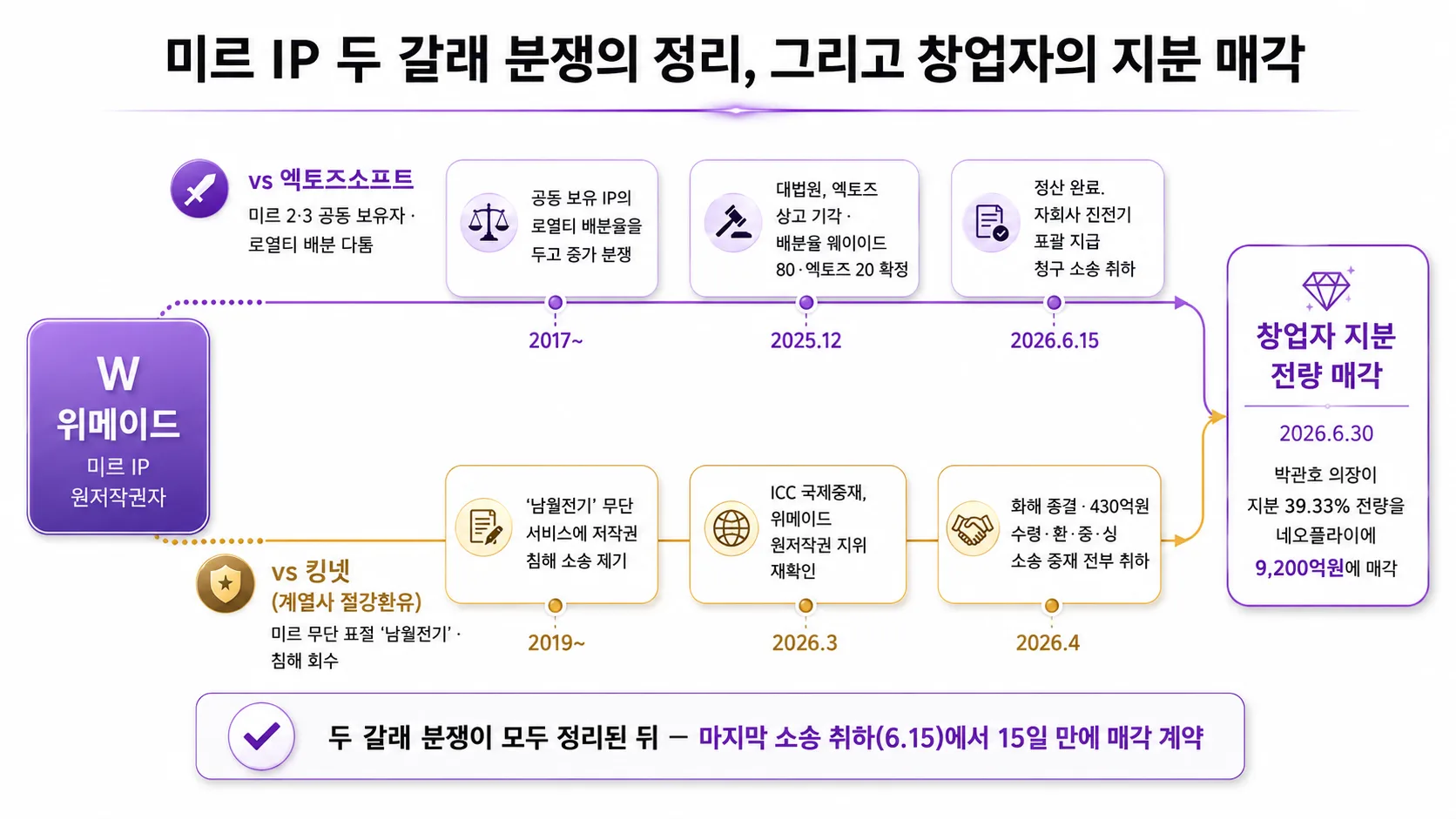
Fifteen days passed between the withdrawal of the final lawsuit and the signing of the agreement. That timeline matters. The founder’s agreement to sell his entire stake was announced immediately after the legal uncertainty surrounding the Mir IP, which Wemade had carried for years, was resolved.
Intellectual property under dispute tends to be discounted in valuation. When rights are unstable, buyers are likely to lower the price and factor in future royalty issues or litigation costs as risks. By contrast, once an IP dispute is resolved, the asset becomes easier to price. The clearer the rights structure becomes, the more concretely its future revenue potential can be calculated.
In this case, the structure of the China business was especially important. The Supreme Court ruling did not only confirm the royalty revenue-sharing ratio. It also ruled that Wemade’s transfer of Chinese copyright rights to its subsidiary ChuanQi IP through a physical division was legitimate. In other words, the issue was not only how money would be divided. A legal basis was also established for how the Mir IP business in China could be operated.
This is why some in the industry interpreted the sale as a move to clear contingent liabilities and legal risks in advance of a major transaction, thereby proving the value of the Mir IP. A company with unresolved disputes and a company that has settled those disputes cannot be valued in the same way. If the core asset of the deal is the Mir IP, then resolving its rights structure may have been close to a prerequisite for the sale.
Of course, sequence does not automatically prove causation. It has not been disclosed when the sale negotiations began, or whether the dispute resolution came before or after the sale preparations. The buyer may have demanded that the disputes be settled while negotiations were already underway, or the sale talks may have gained momentum after the disputes were resolved. What can be confirmed is that the two events occurred very close together.
Still, the close timing is clear. Park’s stake sale appears less like a decision made when Wemade was at its weakest, and more like one made shortly after the legal uncertainty around the Mir IP had been resolved and its value could be explained. Wemade came to the negotiating table not as a company still burdened by disputes, but as one whose core asset rights had been clarified.
Why Chinese-Linked Capital?
The emergence of Chinese-linked capital as Wemade’s new controlling force is unlikely to be a coincidence. If this deal is described only as “Chinese capital buying a Korean game company,” the more important reason is obscured. The key is not the buyer’s nationality, but where Wemade’s most important asset, the Mir IP, has created the greatest value.
The Mir IP originated in Korea, but the market where it left its largest commercial memory and generated its greatest revenue was China. Therefore, the capital most willing to value the Mir IP aggressively was likely to be capital connected to the Chinese market.
The Market Where Mir’s Value Was Built
Park Kwan-ho stated in his letter to employees that the Mir IP continues to create enormous value in China. Wemade’s stated basis for the 920 billion won valuation is closely tied to this point. The deal price was explained as being grounded in the Mir IP’s proven and continuing revenue-generating power in China through subsidiaries such as ChuanQi IP. Neopulse also cited Wemade’s MMORPG development capability and the strong competitiveness of the Mir IP in China as reasons for its investment.
This point matters. The price of this deal cannot be explained solely by Wemade’s current stock price as a listed company. What the buyer saw was not simply Wemade’s short-term performance, but something closer to the business opportunity that the Mir IP could create again in China.
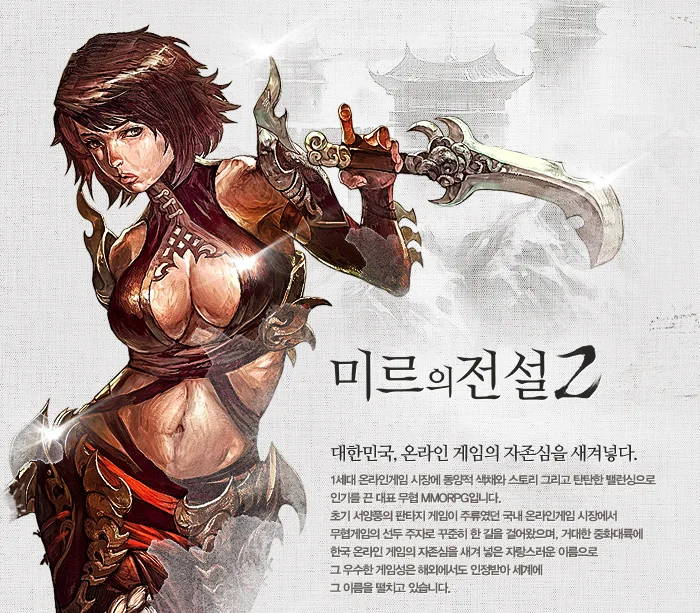
The Legend of Mir 2 has surpassed 200 million cumulative users worldwide, and a significant share of those users came from China. In China, the game was distributed under the name “Chuanqi,” or “Legend,” and went on to generate numerous derivative and licensed games. To Korean players, Mir may be remembered as an old domestic MMORPG. In the Chinese market, however, Chuanqi is closer to a genre memory of its own. The name of Wemade’s China IP subsidiary, ChuanQi IP, is also part of this history.
In the end, Chinese-linked capital was not merely one of several possible buyers. It was also in a position to calculate the value of the Mir IP in China more concretely than others. If Mir is still an IP that can generate money in China, then the party most capable of reflecting that possibility in the price would naturally be capital that understands the Chinese market.
The Half That Was Already Under Chinese Capital
The meaning of this deal becomes clearer when looking at the rights structure of the Mir IP. The intellectual property rights to The Legend of Mir 2 and 3 have long been jointly held by Wemade and Actoz Soft. The prolonged dispute between the two companies over royalty distribution also stemmed from this joint ownership structure.
But Actoz Soft was already acquired in 2004 by China’s Shanda Games, now Shengqu Games. In other words, one side of the Mir IP rights had been under a Chinese-capital company for more than 20 years. Wemade was the other side that had maintained an independent position within that structure.
Wemade’s securing of the 80-to-20 royalty distribution ratio at the Supreme Court, and its recovery of royalties from China’s Kingnet, were both based on that independence. Wemade had long claimed its share of the revenue that the Mir IP generated in China. And shortly after that legal uncertainty was resolved, Park signed an agreement to sell his entire Wemade stake to Neopulse.
Once the transaction closes, the structure of the Mir IP will change significantly. One rights holder, Actoz Soft, was already a company under Chinese capital. The other, Wemade, will also come under the control of Chinese-linked capital. The two pillars that make up the Mir IP will both fall within the influence of Chinese capital.
This is different from a simple investment. The presence of Chinese capital in the Korean game industry is not new. Chinese-linked capital is already a major shareholder in companies such as Krafton, Netmarble, and Shift Up. But in most cases, it has remained in the position of a second-largest shareholder or strategic investor. It may be involved in China market entry and publishing partnerships, but that is different from directly assuming management control as the largest shareholder.
Wemade’s case is more direct. Neopulse is not simply a financial investor. Once the deal closes, it is expected to become the largest shareholder, with management control also set to transfer. That is why this deal belongs to the familiar flow of Chinese-linked capital investing in Korean game companies, but its nature is much stronger. The buyer is entering not merely as an investor, but in a position closer to that of a new owner.
Who Is the Buyer?
Then what kind of company is Neopulse? According to public disclosures, Neopulse is a Korean corporation established in October 2025. It is based in Gangseo-gu, Seoul, and its CEO is Chen Wei. Its stated business is the management of private collective investment vehicles. Its revenue last year was 0 won.
On the surface, it is a Korean corporation. But its ownership structure gives it a different character. Neopulse is 100% owned by Shengsong Investment, a Hong Kong-based company. A domestic company less than a year old and with no operating track record is carrying out a 920 billion won acquisition backed by an overseas parent company. Rather than a typical operating company, it appears closer to a special purpose vehicle established or used for this deal.
This is why its relationship with Alibaba has drawn attention. Some media outlets described Neopulse as an Alibaba affiliate or as an investment platform connected to Alibaba. Wemade also explained that Neopulse is an investment platform with close ties to Alibaba and major Chinese game companies.
Still, a line needs to be drawn here. What can be confirmed from public disclosures is that Neopulse is 100% owned by Hong Kong-based Shengsong Investment. It cannot be confirmed from the disclosures alone that Alibaba directly controls Neopulse. Therefore, rather than stating that “Alibaba acquired Wemade,” it is more accurate to describe the deal as an acquisition by Hong Kong-linked capital that presents networks with Alibaba and other major Chinese companies.
This distinction is not minor. Overstating the substance of the deal may make the article sound stronger, but it weakens accuracy. What can currently be confirmed is that Neopulse is a Korean corporation, that above it sits a Hong Kong company, and that Wemade has presented networks with major Chinese game and platform companies as a basis for future growth.
Why Was the Price 3.6 Times the Market Price?
The price also reveals the nature of the deal. The price of the shares Park agreed to sell is 68,910 won per share. On June 30, the day the deal was disclosed, Wemade’s closing share price was 19,330 won. By simple calculation, the buyer is paying about 3.6 times the market price.
Of course, a management-control premium is common in deals where control is transferred. Acquiring the largest shareholder’s stake is not simply buying shares; it is securing decision-making power over the company. But the gap in this deal is large enough that it is difficult to explain only as a normal control premium.
The stock market prices Wemade based on the company’s current performance, growth outlook, investor sentiment, and risks. By contrast, the price Neopulse agreed to pay can be seen as reflecting both management control and the China-related business opportunity of the Mir IP held by Wemade. In other words, the Wemade seen by the stock market and the Wemade seen by the buyer were not the same.
The market evaluated Wemade as a game company. Neopulse appears to have placed greater value on the Mir IP inside it, especially the possibility of again using the Chuanqi IP in China. This is why the same company could be assigned very different prices. The current value of a listed company and the strategic value of an IP do not always appear as the same number.
In the end, the answer to the question “Why Chinese-linked capital?” returns to the Mir IP. The place where Mir made the most money was China, one side of its rights structure was already under Chinese capital, and the remaining side, Wemade, has also chosen to transfer management control to capital that values the revenue potential of the Chinese market most highly. This deal is less about Chinese capital acquiring a Korean game company than about the control of a Korean-made IP with its greatest value in China shifting toward Chinese-linked capital.
What Is the 920 Billion Won Price For?
The total value of this deal is 920 billion won. In numerical terms, it is the price of Park Kwan-ho’s 39.33% stake in Wemade. But it is worth asking what exactly this price evaluates. The meaning of the deal changes depending on whether the price is attached to Wemade’s current performance as a listed company, to a management-control premium, or to the China-related business potential of the Mir IP.
Wemade explained that the 920 billion won corporate valuation reflects the continuing revenue-generating power and value of the Mir IP in China, proven through subsidiaries such as ChuanQi IP. It also said the valuation reflects future growth potential from AI integration and global distribution synergies. Neopulse, too, cited Wemade’s MMORPG development capability and the Mir IP’s strong competitiveness in China as reasons for its investment.
The direction presented by both sides has two axes. One is the expansion of the Mir IP in the Chinese market. The other is the evolution toward AI-based future games. Wemade also announced plans to introduce AI technology across game development, next-generation graphics, digital humans, and live services. Park likewise said in his letter to employees that AI is changing both the way games are made and the way they are played, and that Wemade must become a company that leads the trend rather than one that is pulled along by it.
However, these two grounds are different in nature. The Mir IP’s revenue in China is close to a record of performance that has already been generated. The licensing business of ChuanQi IP, the royalty-sharing ratio confirmed through legal disputes, and the derivative and licensed game structures that have continued in China all serve as evidence. By contrast, AI integration and global distribution synergies remain at the planning stage. The direction has been presented, but whether it will translate into actual revenue and profit will have to be proven through execution by the new management.
Therefore, the most concrete asset that can currently be confirmed is the Mir IP. What Wemade, Neopulse, and Park all emphasized in common was Mir’s value in China. AI was presented as the language of future growth, but the most realistic basis supporting the deal price is the revenue Mir has generated in China and the business potential it may create there again.
In this sense, it is difficult to see the 920 billion won simply as the price of Wemade shares. It is the price of management control, and also the price attached to the right to expand the Mir IP in China. If the stock market evaluated Wemade as a listed company with current performance and risks, Neopulse placed greater value on the strategic asset inside it. In the end, what the buyer purchased was not only Wemade’s present, but Mir’s next possibility in the Chinese market.
Of course, the buyer’s actual intention cannot yet be determined. Whether AI is a substantive investment motive or a future vision emphasized in the announcement is difficult to judge at this stage. There is still time before the balance is paid, and the business combination review and new board composition have not yet been completed. The true direction of this deal will be revealed not by the contract, but by what kind of management Neopulse appoints and which businesses it moves first after the transaction.
What Changes, and What Does Not
In his letter to employees, Park Kwan-ho said Wemade was like a child to him. He also said that, like a parent sending a grown child into the wider world, he would take a step back and support its growth. He added that he was certain Wemade’s best days were still ahead.
That expression is close to the official sentiment of the deal. The explanation is that the founder is not abandoning the company, but sending it into a larger market. But from the perspective of the ownership structure, the choice is very clear. Once the transaction is completed, Park’s stake in Wemade will become 0%, and Neopulse will become the largest shareholder. When directors designated by Neopulse are appointed at an extraordinary general meeting, management control will also pass to the new controlling party.
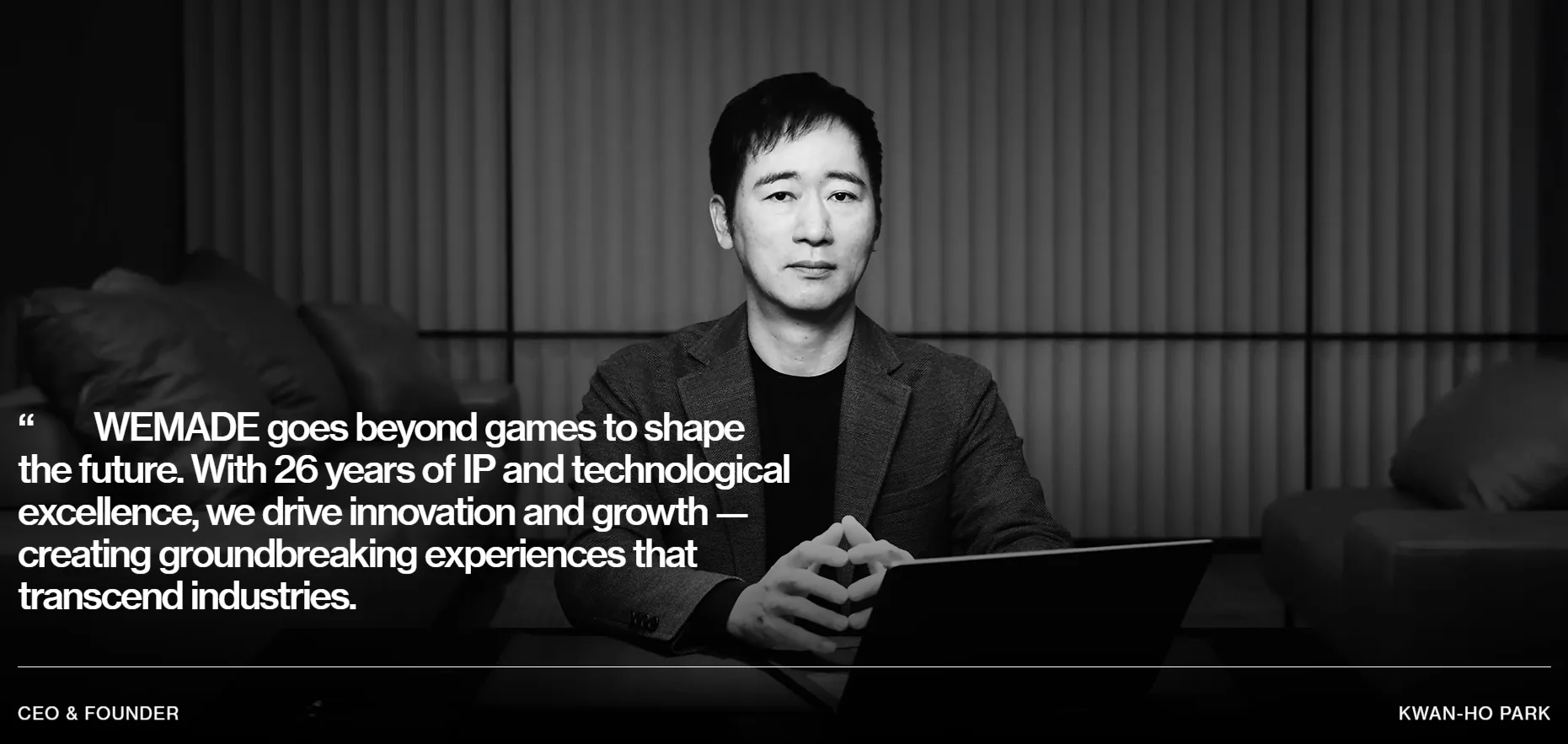
What changes is not only the largest shareholder. The structure in which the founder remained inside the company and exercised influence will also end. Wemade was the company Park Kwan-ho built, and it stood for a long time at the center of disputes and expansion surrounding the Mir IP. Once the transaction closes, however, Wemade will no longer be a company under the founder’s ownership. It will be a company that must set its new management direction under the influence of Chinese-linked and Hong Kong-linked capital.
The rights structure of the Mir IP will also change. Actoz Soft was already under Chinese capital, and once the deal closes, Wemade will also come under Neopulse’s control. As a result, the two main rights holders that make up the Mir IP will both fall within the influence of Chinese capital. The control of an IP that originated in Korea will become more directly connected to the Chinese market that generated its largest revenue.
What does not change is the core market of the Mir IP. China remains the market where Mir has left its greatest commercial memory, and it is also the basis for explaining the 920 billion won price. The company’s largest shareholder and management will change, but the market toward which this IP is directed will not.
What changes is who designs that market. Until now, Wemade acted as a Korean game company asserting its rights to the Mir IP and recovering revenue from the Chinese market. Going forward, Wemade will play that role as a company whose largest shareholder is Chinese-linked capital. The IP and the market may remain the same, but the center of decision-making will change.
That is why this deal cannot be reduced to a simple sale or investment. On one hand, it is the founder’s choice to entrust the company’s next stage to outside capital. On the other, it is an event in which the control of the Mir IP shifts toward capital closer to the Chinese market. As Wemade without Park Kwan-ho begins, the Mir IP also meets a new owner.
Why did the founder sell his entire stake? The answer lies, ultimately, in Mir. The place where Mir created its greatest value was China, and the party that most actively calculated that value in this deal was capital connected to the Chinese market. Once this deal closes, Mir can no longer be explained only as an IP that a Korean game company exported to China.
At the moment Wemade begins without its founder, the next chapter of the Mir IP will be written under the capital of the market that made it grow the most.