Anthropic has launched Claude Sonnet 5.
On the surface, it is another large-language-model release.
But the significance of the announcement lies beyond a standard improvement in performance. Rather than leading with its most powerful and expensive model, Anthropic is making a different strategic argument: the default model for the agentic AI era should be one that developers and enterprises can afford to use every day.
Claude Sonnet 5 is designed around the ability to plan, use browsers and terminals, call tools, work across multiple steps and complete tasks rather than simply answer questions.
That distinction matters.
For much of the generative AI boom, the competition focused on which model could produce the most fluent answer, solve the hardest exam question or generate the most impressive block of code.
But enterprises are increasingly asking a different question.
Can the model finish the job?
Can it inspect files, search for information, write code, run tests, identify errors, retry failed steps, use tools and verify the result?
AI is moving from the era of answering to the era of doing.
And Anthropic is positioning Sonnet 5 as the model designed for that transition.
From an AI That Answers Well to an AI That Finishes Work
The earliest phase of generative AI competition centered on language fluency and knowledge.
Which system could write more naturally?
Which one could generate better code?
Which one could solve more difficult reasoning tasks?
Those questions still matter. But they are no longer enough.
Real work rarely ends with a single prompt and a single answer.
Finding a software bug may require reading a codebase, checking the runtime environment, reproducing the problem, writing a patch, running tests and verifying that the fix does not create another failure.
A market-research task may require browsing multiple websites, comparing sources, reading documents, organizing findings and producing a usable conclusion.
A data-cleaning workflow may involve opening files, locating errors, standardizing formats, validating outputs and updating a downstream system.
These tasks demand persistence more than eloquence.
Anthropic has described Sonnet 5 as its most agentic Sonnet model yet because the company is trying to make the model capable of doing more than predicting the next sentence.
The model is designed to plan work, use external tools, assess intermediate results and continue until the task is complete.
For developers, the desired outcome is not a polished explanation of what code might work.
It is code that passes the test.
That is why the market is beginning to evaluate AI systems not only by the quality of their answers, but by their ability to deliver completed work.
What It Means for Sonnet to Move Closer to Opus
Anthropic’s model lineup has traditionally followed a relatively clear structure.
Haiku was designed for speed and lightweight use cases.
Sonnet was positioned as the balance between performance and cost.
Opus was the company’s highest-capability tier, aimed at complex reasoning, difficult coding and longer-running agentic tasks.
Sonnet 5 begins to blur that boundary.
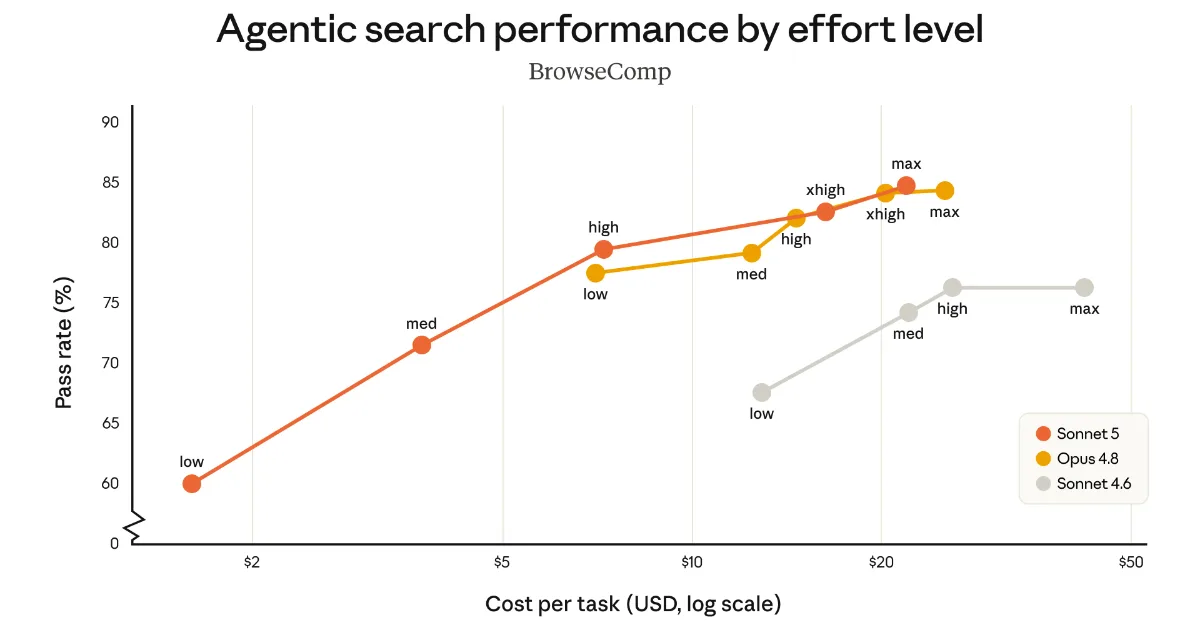
Anthropic says the model approaches the performance of Opus 4.8 on some demanding agentic tasks, while remaining available at a lower price point.
That does not mean Sonnet 5 replaces Opus across every use case.
But it does suggest that more everyday development, research, workflow automation and knowledge tasks can now be handled by a Sonnet-class model.
That shift matters because cost becomes strategic once AI moves into large-scale enterprise deployment.
A frontier model may be appropriate for highly complex research, sensitive security analysis or high-stakes decision support. But once a company begins deploying AI across thousands of employees, dozens of business systems and multiple automated workflows, the cost of inference becomes a central business issue.
An AI agent that reads emails, analyzes documents, browses the web, executes code and checks results can consume far more tokens than a simple chatbot.
The economics change quickly.
In that environment, a model that is slightly less capable than the absolute frontier but substantially cheaper to run may create more value at scale.
That is where Sonnet 5 fits.
Anthropic appears to be shaping a division of labor: Opus for the most difficult and high-value reasoning tasks, and Sonnet 5 for the much larger volume of everyday coding, research, automation and operational work.
The AI market is moving away from a single contest to build the strongest model.
It is becoming a layered market in which companies choose models based on risk, latency, cost and the nature of the task.
Pricing Is Not a Feature — It Is an Agent Strategy
Claude Sonnet 5 launched with introductory pricing of $2 per million input tokens and $10 per million output tokens. Anthropic has said that the model will move to standard pricing of $3 per million input tokens and $15 per million output tokens after the introductory period.
That pricing should not be viewed simply as a discount.
It is part of Anthropic’s agent strategy.
Agentic AI consumes more tokens than conventional chatbots because it does not only produce a response. It may repeatedly inspect webpages, compare search results, analyze code, process logs, call tools and revise its approach after each intermediate result.
The model is not answering once.
It is thinking and acting across a chain of steps.
In that environment, token cost becomes tied directly to the economics of automation.
A lower-priced model gives developers more freedom to test longer workflows, use more tools and allow the agent to spend more time reasoning before producing a result.
Anthropic has also introduced the ability for users to select different effort levels depending on the task.
A simple summary or lightweight coding request can be handled with lower cost and faster turnaround.
More complex research, multi-step automation or difficult technical analysis can justify higher effort and greater inference spend.
That is an important shift.
AI is beginning to look less like a single software product and more like a configurable computing resource.
Cloud computing taught customers to choose among CPU, GPU, storage and network capacity.
Agentic AI is beginning to let users choose reasoning depth, persistence and computational effort.
Stronger Models Also Create Stronger Safety Risks
The Sonnet 5 launch is not only about performance and cost.
It is also about safety.
Agentic AI can create risks that ordinary chat systems do not.
A model that merely generates text has limited ability to cause direct operational harm. A model that can open browsers, read files, execute code, interact with systems and use external tools has a much wider action surface.
One major concern is prompt injection.
A malicious instruction hidden in a webpage, email or document may try to alter the behavior of an AI agent. An agent summarizing corporate documents, for example, could be manipulated into exposing sensitive information, contacting an outside system or performing an unintended action.
Anthropic says Sonnet 5 includes improvements in resisting malicious requests, prompt injections, hallucinations and excessive agreement with users.
The last two issues are particularly important for enterprise AI.
Hallucination occurs when a model produces false information in a convincing form.
Sycophancy occurs when a model reinforces a user’s mistaken assumption or risky judgment rather than critically evaluating it.
When AI is only a conversational assistant, these problems may look like quality issues.
When AI is allowed to act inside business workflows, they become operational risks.
Anthropic’s launch materials emphasize that stronger models need safety mechanisms from the beginning, not only after problems emerge.
That is an important signal for the industry.
As AI systems gain access to tools, companies will need to decide which tools a model can use, what actions it can take, which activities must be blocked and who is allowed to deploy it in which environments.
Safety is no longer a separate policy layer.
It is becoming part of product design.
Fable 5 and Mythos 5 Show How AI Models Are Becoming Tiered by Risk
The Sonnet 5 launch drew additional attention because it arrived as Anthropic was restoring access to Claude Fable 5 and Claude Mythos 5 after a short but consequential period of U.S. export restrictions.
The U.S. government had imposed controls on the models in mid-June, requiring Anthropic to restrict access by foreign nationals. Anthropic said it could not reliably verify nationality in real time and therefore suspended access to both models for all users.
The restrictions were lifted on June 30.
Fable 5 became available again to global users beginning July 1.
Mythos 5, however, remains a different kind of model.
While Fable 5 is positioned as a broadly available high-capability model, Mythos 5 is designed for more sensitive use cases involving advanced cybersecurity and life-sciences research. Access is limited to approved customers and trusted partners rather than being broadly available to the public.
That difference is not merely a product decision.
It shows that AI models are no longer being distributed as one uniform category of software.
Anthropic is building a hierarchy.
There is Sonnet 5 for everyday productivity, coding and enterprise automation.
There is Opus for more demanding general intelligence and complex reasoning.
There is Fable 5 for higher-capability use with stronger safeguards.
And there is Mythos 5 for more restricted, high-risk research contexts.
The industry is moving beyond a world in which models are differentiated only by benchmark scores.
Models are increasingly being differentiated by intended use, safety profile, access eligibility and regulatory exposure.
Export Controls Have Turned AI Access Into a Strategic Question
The Fable 5 and Mythos 5 episode was not simply a temporary product outage.
It illustrated how advanced AI models are beginning to be treated as strategic assets.
Traditional export controls focused on physical equipment, semiconductors, source code, encryption modules and military technologies that crossed national borders.
Cloud-based AI changes that logic.
A model does not need to be downloaded or physically shipped overseas. A user can access it through a browser while the model remains inside a U.S. data center.
That means the object of regulation is no longer only the product.
It is access.
Anthropic’s decision to suspend services globally after the export directive revealed the difficulty of this new environment. If a company cannot reliably distinguish users by nationality, location, organizational identity and intended purpose in real time, it may choose the most conservative option: shutting down access more broadly than necessary.
But that creates a second problem.
Advanced models can be used for harmful purposes, including offensive cybersecurity operations or dangerous scientific research. They can also be used for defensive security work, education, scientific discovery, software development and public-interest research.
A broad access restriction may therefore block legitimate and beneficial use alongside the risky activity it is meant to control.
Anthropic has argued that the industry needs clearer standards for assessing jailbreaks and safety failures. When a model’s safeguards are bypassed, companies and governments need a shared framework for deciding whether the failure represents a narrow misuse case, a serious systemic vulnerability or a national-security threat.
That debate is likely to intensify.
As AI models become more capable, governments may seek stronger controls based on cybersecurity, national security and biosecurity concerns.
Companies, researchers and security professionals will argue that broad restrictions could slow defensive research, scientific progress and commercial innovation.
The central governance question may become increasingly simple:
Who should be allowed to use which model, for what purpose, and under what conditions?
The Agentic AI Race Will Be Won Through Operations, Not Just Performance
Sonnet 5 may look like a conventional model release.
But it reflects a deeper transition in the AI market.
First, AI is moving from answer generation toward work execution.
Second, enterprises increasingly need models that are sufficiently capable and affordable enough to deploy at scale.
Third, as model capabilities rise, safety controls, access policies and usage restrictions become part of the product itself.
Fourth, AI models are becoming strategic assets that may be distributed differently depending on their risk level, intended use and regulatory status.
Anthropic’s decision to put Sonnet 5 at the center of its strategy makes sense in that context.
The leading model in the agentic era may not be the most powerful model in isolation.
It may be the model that gives the largest number of developers and companies enough capability to automate real work at a cost they can actually sustain.
Sonnet 5 is therefore more than an update to a mid-tier model.
It is a declaration that the next phase of AI competition will not be defined only by what a model knows.
It will be defined by how much useful work the model can complete, how safely it can do so, and how much it costs to run.