X has begun connecting cashtags to actual trading behavior.
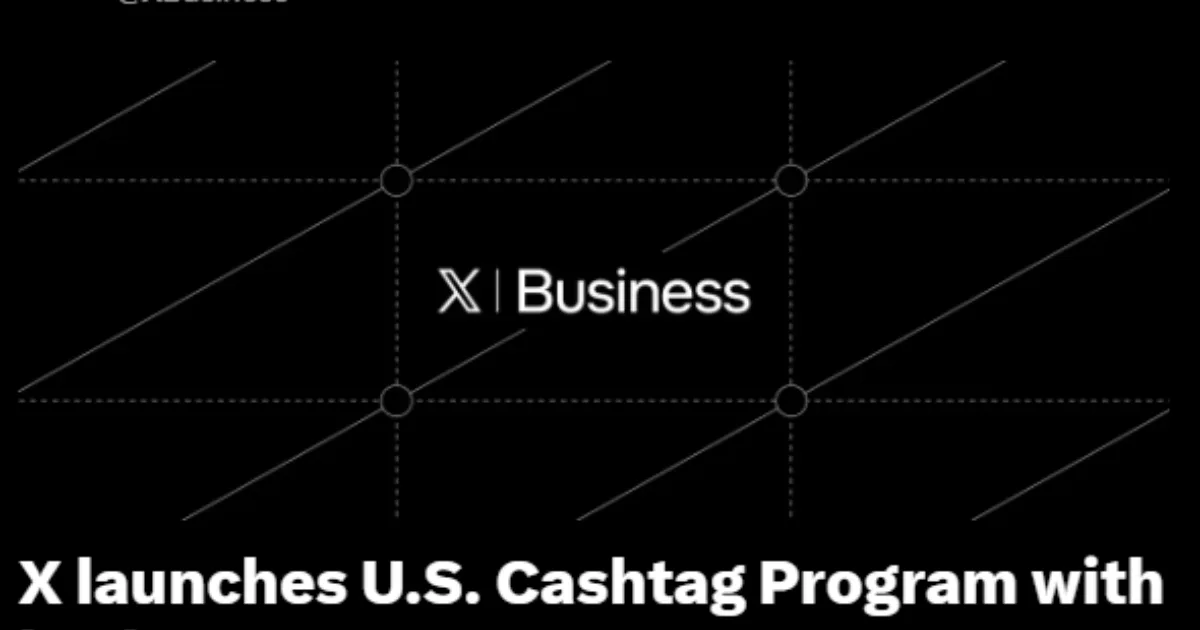
The company has launched the X Cashtag Partner Program in the United States. The core of the program is to connect financial conversations taking place on X with the trading functions of participating brokerages and exchanges. Initial launch partners include Interactive Brokers, Moomoo, Gemini, Kraken and Coinbase.
Cashtags have long been an important grammar of financial conversation on X.
When users place a dollar sign before a ticker or asset symbol, such as $TSLA, $AAPL or $BTC, that symbol becomes more than simple text. It becomes a clickable entry point into financial information. Users can tap a cashtag to view price charts and related posts. X has now added a “Trade” option to that flow.
A user can now discover a stock or cryptocurrency on the X timeline, check the surrounding conversation, and then move to a participating brokerage or exchange to log in, sign up or complete a trade.
On the surface, this looks like a feature update.
But the meaning is larger than that. X is moving from being a place where financial conversations happen to becoming a starting point for financial action.
For years, X has been a place where real-time financial information and investor sentiment gather. Corporate earnings, interest rates, cryptocurrency prices, ETF approvals, short-selling debates, meme stocks, macroeconomic indicators and CEO remarks have all spread in real time. Many investors read the market mood on X, discover stocks and assets there, and check how other investors are reacting.
But the next action usually happened outside X.
Investors opened a brokerage app, typed a ticker into the search bar, checked the chart and placed an order. X was a space for discovery and conversation, while trading belonged to another platform.
This program attempts to reduce that gap.
As X’s cashtag structure suggests, the distance between a ticker symbol on the timeline and the market itself is becoming shorter. Users who see or post a ticker can move to the asset page, view real-time charts and related conversations, and then trade through a participating broker.
In this structure, X does not execute the trade directly.
The trade takes place on the participating brokerage or exchange. After tapping “Trade” on X, the user is redirected to the partner’s mobile app or web environment, where the user logs in, opens an account if needed and completes the transaction.
X becomes a gateway connecting financial conversation to brokerage trading screens.
This point matters.
X is not immediately becoming a brokerage.
X is not directly executing orders.
But X is moving closer to the front end of investor behavior.
In financial services, the front end matters.
Which asset does an investor first discover?
Which information and conversation does the investor see first?
Which button does the investor tap, and where does that button lead?
Which broker appears as an available option?
These points of contact can influence investment behavior. X is trying to turn that layer into a platform.
The program also connects to X’s broader “everything app” ambition.
X has long positioned itself as more than a social media platform, aiming to include messaging, content, video, payments, commerce and financial functions. The cashtag trading connection is a concrete example in the financial domain. It connects the process of seeing a conversation, checking information and taking action into one flow.
From a financial-platform perspective, X has several powerful advantages.
The first is real-time speed.
Markets react to news, and X is one of the places where both news and reaction spread fastest. Corporate executives’ remarks, policy announcements, macroeconomic data, cryptocurrency issues, memes and rumors can move quickly across X. Cashtags organize these real-time conversations by asset.
The second is conversation.
Investment apps show prices and charts. X shows people’s interpretations and emotions. Expectations, anxiety, mockery, conviction and disagreement around a stock or asset all appear in the timeline. This is a different type of market signal from a polished research report.
The third is discovery.
Many individual investors get investment ideas not from stocks they were already tracking, but from assets they happen to see in the timeline. Cashtags structure that moment of discovery. When a ticker repeatedly appears in conversation, users can tap it to check the price and related posts.
The fourth is conversion.
The newly added “Trade” button shortens the path from discovery to action. X can connect the time users spend in financial conversations to user acquisition for trading platforms. For participating brokers, X becomes an investor-acquisition channel.
But this structure also carries risks.
The closer financial conversation and trading buttons become, the greater the possibility of impulsive trading. Assets that become popular on the timeline are not necessarily good investments. Meme stocks, rapidly rising tokens, rumor-driven tickers and highly volatile assets may receive more attention on X.
If users can move to a trading screen immediately after seeing posts and a price chart, reaction speed may come before information verification.
That is the central issue in combining financial platforms with social platforms.
Social media maximizes attention.
Financial trading requires caution.
Social platforms encourage real-time reaction.
Investing requires judgment and risk management.
As the two areas move closer together, platforms must handle user protection, information quality, promotional content, potential market manipulation and conflicts of interest more carefully.
Cashtags directly connect public conversation with market prices.
Large volumes of posts about a specific asset, influencer-style recommendations, paid promotion, bot activity and coordinated pumping may gather around cashtags. When a trade button is attached to that environment, the influence of conversation can translate more directly into action.
X’s challenge is therefore not merely providing a trading connection.
What information appears on cashtag pages?
How are related posts ranked?
How are advertisements distinguished from ordinary posts?
Are investment-risk disclosures sufficient?
On what basis are partner brokers selected?
When cryptocurrencies, stocks and ETFs appear in similar flows, do users sufficiently understand the differences in risk?
These questions may become increasingly important.
In this program, X leaves final execution to participating brokers and exchanges. From a regulatory perspective, that structure can reduce X’s burden. Account opening, know-your-customer checks, order execution, asset custody and trading-compliance obligations belong to each brokerage or exchange partner.
But the user’s first click and initial information consumption happen on X.
That makes it difficult for X to avoid the responsibilities of a financial-information platform. In a market such as the United States, where securities and cryptocurrency regulations are complex and overlapping, the balance between free expression, investor protection and platform responsibility becomes important.
The partner composition is also meaningful.
Interactive Brokers and Moomoo connect to traditional financial trading, including stocks and ETFs. Gemini, Kraken and Coinbase are cryptocurrency exchanges. This shows that X sees cashtags not only as a gateway to stocks and ETFs, but as an asset-conversation hub that includes cryptocurrency.
Financial conversation on X has long been friendly to crypto.
Bitcoin, Ethereum, meme coins, NFTs, exchange news and regulatory developments have spread quickly on the platform. It is therefore natural that exchanges such as Coinbase, Kraken and Gemini are included among the first partners. At the same time, the inclusion of Interactive Brokers and Moomoo shows that the program is not limited to crypto, but also targets traditional financial assets.
X’s cashtags now have three functions.
Asset discovery.
Market conversation exploration.
Trading connection.
When these three functions combine, X can control the upper funnel of financial behavior. Users discover market issues on X, read other users’ interpretations, check price charts and then move to a broker. The broker processes the account and order, but the investment idea may begin on X.
The program also matters from an advertising and business perspective.
The fact that the program was announced through XBusiness suggests that this is not only a product feature, but part of a broader business partnership and advertising ecosystem. Financial firms want to capture users at the moment when market interest appears. Cashtags are a clear signal of that interest.
For example, a user who taps $BTC and views related posts is showing interest in cryptocurrency. A user who repeatedly views $TSLA is showing interest in a specific stock. X can potentially expand these interest signals into brokerage partnerships and advertising products.
This raises questions around privacy, ad targeting and the boundary of financial regulation.
Financial interests can be sensitive data. Which tickers a user views, which assets a user searches for and which broker a user clicks are all commercially valuable signals. Transparency will be needed around how this data is used and how it affects advertising and recommendation systems.
Financial-product advertising is also different from ordinary consumer-goods advertising.
Investment losses are possible. Risk levels vary by product. Regulatory disclosures are required. As X strengthens financial-platform functions, its advertising review, partner management and risk-disclosure systems will also need to become more sophisticated. X’s own financial-services advertising policy already treats financial institutions, brokerages, investment firms and crypto-related promotions as regulated advertising categories, reflecting the sensitivity of this area.
The user experience is also interesting.
Traditional investment apps begin when users open the app. X’s cashtag trading connection begins inside the conversation flow users are already watching. That changes the starting point of financial behavior. It shifts the starting point from the investment app to the social feed.
This could especially affect younger retail investors and active online investing communities.
These users often get investment ideas from real-time posts, influencer opinions, community reactions, memes and chart screenshots rather than traditional research reports. X is absorbing that behavior pattern into a product feature.
But the easier a platform makes trading, the more important investor education and risk awareness become.
Discovery should be easy.
But misunderstanding should not be easy.
Action can be fast.
But judgment still needs time.
Balancing those requirements will be the long-term challenge of the X Cashtag Partner Program.
For brokerage partners, the opportunity is significant.
Financial firms face high customer-acquisition costs. If users can move from a space where they are already discussing investments to account opening and trading, conversion efficiency may improve. This is particularly natural for crypto exchanges, which fit well with X’s real-time culture.
But partners also face reputational risk.
If overheated stock or crypto trading driven by social-media attention leads to losses, brokers and exchanges may also face criticism. Questions may arise over whether users received sufficient risk disclosures, whether trades occurred in an appropriate context and whether the interface encouraged impulsive behavior.
X also needs to preserve platform neutrality.
Whether a particular broker is displayed more prominently, how partners are ordered and what choices users receive all matter. In finance, even small interface differences can influence user choice.
According to descriptions of the program, users who tap supported cashtags can view price charts and related posts, then select “Trade” to move to a participating broker. The key is not that orders are completed inside X, but that X becomes an entry point into the brokerage experience.
This structure looks like a compromise between regulation and business expansion.
Rather than directly taking on trading licenses and order-execution responsibilities, X connects users to partners that already have licenses and infrastructure. Partners use X’s user flow. Users see conversation and information on X, while actual trades are completed at financial institutions or exchanges.
In effect, X is taking an intermediate step toward becoming a financial platform.
The first stage was financial conversation.
The second stage was cashtag-based price information.
The third stage is this trading connection.
In the future, the structure could expand to more asset classes, more brokers, more sophisticated charts, news, research, alerts, portfolio integration and payment functions. Of course, that will depend on regulation, partnerships and user demand.
There are also implications for Korea.
In Korea as well, investment communities and trading apps are largely separated. Stock discussions take place on portals, communities and social platforms, while actual trading happens inside securities apps. X’s experiment shows a model that brings these two layers closer together. Korean platforms and brokerages may also have to consider how to connect investment conversation, real-time information and trading conversion.
But in Korea, financial-consumer protection, investment-solicitation rules, advertising review, illegal stock-tip groups and unfair-trading surveillance would be crucial variables. As social media and trading functions move closer together, monitoring false information, stock recommendations and potentially manipulative posts becomes more important.
The X Cashtag Partner Program is therefore not a simple feature update.
It is an experiment in turning social media into a gateway for financial behavior.
It tries to connect the flow from conversation to information, from information to judgment, and from judgment to trading across one platform and its partner ecosystem.
If it succeeds, X may become not only a place where real-time financial sentiment gathers, but a key acquisition channel for the brokerage ecosystem. If it fails or becomes controversial, it may become a case study in the risks of financializing a social platform.
The key issue is clear.
Can X balance the speed of investment conversation with the caution required for financial trading?
Adding a “Trade” button to cashtags is easy.
Managing the behavior and responsibility that button creates is much harder.
X’s next challenge is not merely connecting trades.
It is connecting trust.