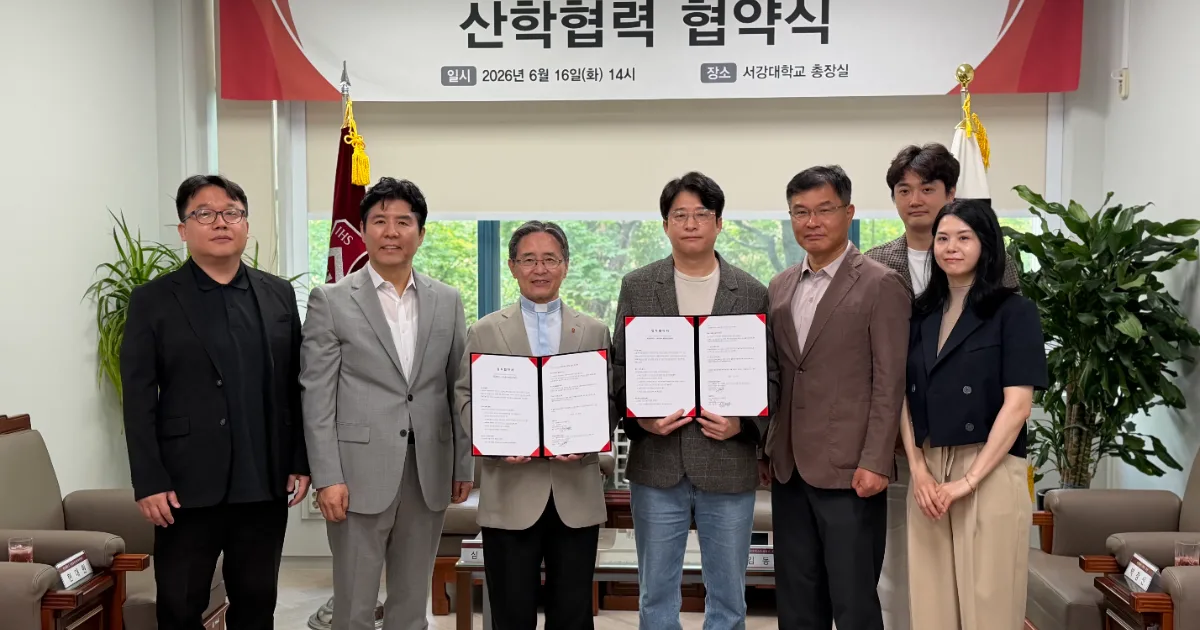
Sogang University (President Shim Jong-hyuk) and KOSDAQ-listed content company Episode Company (CEO Kim Dong-ha) signed an industry-academia memorandum of understanding (MOU) on June 16 focused on AI content collaboration. Driven by Sogang's Graduate School of Virtual Convergence (Dean Hyun Dae-won), the agreement goes beyond a routine institutional declaration. At a pivotal moment when artificial intelligence is rewriting the grammar of content production, the partnership is drawing attention for its ambition to build an integrated industry-academia ecosystem — one that connects education, research, patent filing, and commercialization in a single, continuous chain.
The rise of generative AI is reshaping the content industry at every level. According to the latest report from the Korea Creative Content Agency (KOCCA), the adoption of generative AI among content businesses continues to accelerate, and given the central role that creation and production play in the sector, the shift is manifesting not as job displacement but as a fundamental transformation of tasks. In other words, AI is not replacing people — it is changing how content gets made. Against this backdrop, longstanding concerns that university education has failed to keep pace with the speed of industry change have grown louder, and the Graduate School of Virtual Convergence's decision to partner with Episode Company reads as a concrete response to that gap.
The signing ceremony was held at Sogang University's presidential reception room. Representing Sogang were President Shim Jong-hyuk, Dean Hyun Dae-won of the Graduate School of Virtual Convergence, and Research Professor Park Sun-ho. From Episode Company, CEO Kim Dong-ha, Chairman Park Chang-shin, CMO Jeong Gyeong-seok, and Episode Media Division Head Song Eun-ho attended and signed the agreement. The presence of senior leadership from both organizations signaled that neither party is treating this as a formality. "AI is rewriting the rules of the content industry," President Shim said at the ceremony, "and the talent to lead that change comes from education rooted in the real world." He added that the partnership would give students the experience of translating research outcomes into actual industry applications.
The agreement is structured around four pillars. First, the two institutions will jointly design and operate a practical, skills-oriented curriculum in AI-based content and media, with industry professionals directly involved in course development — closing the distance between theory and practice for graduate students. Second, they will collaborate on government-funded research projects and joint industry-academia initiatives, creating a pathway for real-world industry challenges to drive academic research agendas. Third, the partners will conduct joint research and co-file patents in AI content technology across video, animation, and gaming. Fourth, the agreement includes a commercialization link connecting graduate students' research outcomes to Episode Company's actual business operations — giving researchers the experience of seeing their work deployed in the field, while giving the company a channel to expand its R&D pipeline.
Episode Company is regarded as the only fully integrated content company in South Korea, with in-house capabilities spanning content production, celebrity management, commerce, and IP licensing. The company, which holds particular strengths in AI-driven animation and music production, has formally pivoted from its origins as a children's content company toward a comprehensive IP enterprise encompassing film, drama, web content, and commerce. It has also made clear its intention to move away from simple licensing arrangements. "Simply supplying IP is not a model that leads to sustainable growth," a company representative has stated. "We aim for a structure where we retain IP ownership and business rights, then pursue joint ventures with local partners." The approach is widely interpreted as a bid to apply a Disney-style model — one in which the rightsholder directly controls content assets and maximizes their value — to global markets. The company has already developed and distributed IP in China through a joint venture with state-owned Baoli Group, and its animated film Delivery Hero opened across China. In terms of management structure, CEO Kim Dong-ha, who comes from distribution giant Showbox, oversees business execution and distribution, while Chairman Park Chang-shin focuses on IP strategy and subsidiary coordination — a deliberate separation of operational and strategic responsibilities.
Sogang University's Graduate School of Virtual Convergence is a specialized institution dedicated to developing next-generation media content talent through AI and virtual convergence technology. It researches media environments built on emerging technologies — including AI content, the metaverse, and extended reality (XR) — and works to translate that research into practical application. The fact that the Graduate School led this MOU rather than the university at large underscores that this is not a broad institutional partnership but a strategically focused one, targeted squarely at the intersection of AI and media content.
South Korea's IP industry continues to grow on the strength of its brand power and deeply engaged fan base, but structural vulnerabilities persist. Over-reliance on overseas revenue streams, a production-house-centric business model, and limited capabilities in global distribution and licensing remain recurring challenges. Internalizing AI production technology is one of the keys to overcoming these structural constraints. By leveraging AI, companies can reduce production costs and timelines while delivering content competitive enough for global markets — and accelerate the cycle from production to IP expansion. This is precisely why the Sogang-Episode Company agreement carries significance beyond a simple education deal.
The two institutions have stated their intention to build an integrated industry-academia model that runs from education through research, patent filing, and commercialization. For this model to deliver real results, genuine collaboration channels between student researchers and working professionals must be established, and clear agreements on revenue sharing from co-filed patents and commercialization pathways will need to follow. The virtuous cycle begins not with a signed agreement, but with sustained project-by-project collaboration. Even so, this MOU points accurately in the direction South Korea's AI content industry needs to travel — past the limits of education disconnected from practice and research that never reaches commercialization, toward a model where universities and companies move together as a single ecosystem. The faster AI transforms how content is made, the more valuable that ecosystem will become.