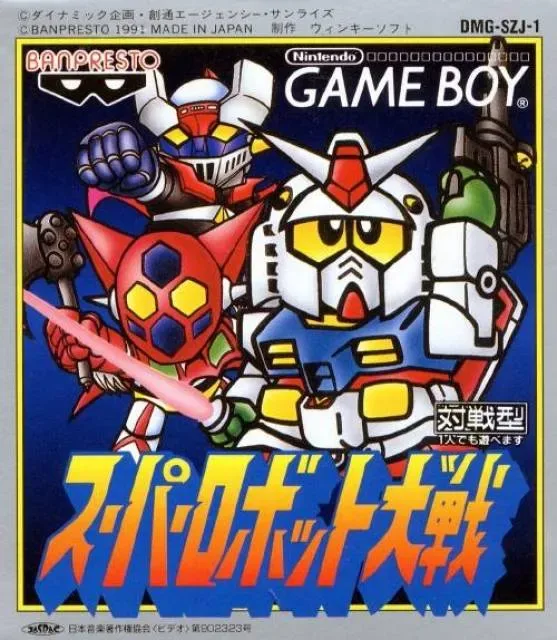
'Super Robot Wars,' which first launched for the Game Boy on April 20, 1991, marks its 35th anniversary in 2026. Built around the idea of bringing characters and mecha from different robot anime into a single crossover game, the series has continued across multiple platforms and generations.
https://www.suparobo.jp/srw_lineup
The anniversary year has also brought a series of new developments. A 35th-anniversary livestream was held on August 1, while 'Super Robot Wars Y' received a free update and the paid 'Anniversary Expansion Pack.' At the same time, a remaster of 'Super Robot Wars Z2: Destruction Chapter,' originally released for the PSP in 2011, was announced, alongside creator interviews and other anniversary events.
What Has Not Changed in 35 Years
When discussing the history of a long-running IP, change and innovation often come first. Graphics evolve, new systems are introduced, and games move from one platform to another in order to keep pace with their time. 'Super Robot Wars' has gone through many of those changes as well.
But looking at its 35-year history from the opposite direction, what may matter just as much is not what the series kept changing, but what it chose not to change too easily.
At the center of 'Super Robot Wars' has always been the experience of bringing different works together. Mecha from separate fictional universes, such as 'Mazinger Z,' 'Getter Robo,' and 'Mobile Suit Gundam,' fight on the same battlefield, while characters from different series become part of a shared story. The appeal has never been limited to collecting popular robots. A defining part of the series has been creating encounters and relationships that could never happen in the original works.
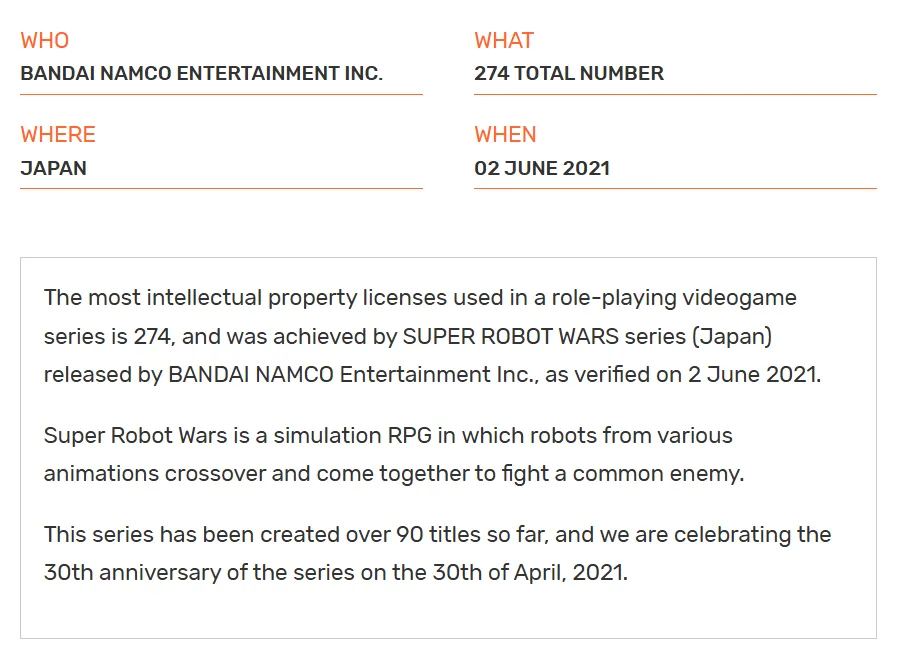
The scale of that crossover grew considerably over time. By 2021, the series had used 274 licensed IPs, and that same year Guinness World Records officially recognized 'Super Robot Wars' as the RPG videogame series with the most IP licenses. Bringing different works together had become more than a feature; it had become part of the series' identity.
https://www.guinnessworldrecords.com/world-records/618936-most-intellectual-property-licenses-used-in-a-role-playing-videogame-series
The 35th-anniversary DLC remains closely tied to that long-standing appeal. The 'Anniversary Expansion Pack' for 'Super Robot Wars Y' adds combination attacks involving characters and mecha from different works. Official announcements also highlighted battle animations built around cross-series attacks and original situations that never appeared in the source anime.
Even after 35 years, the question the series presents to players remains much the same:
“What would happen if these two works really met?”
Platforms have changed, graphics have evolved, and both combat and progression systems have been revised many times. Yet the experience of placing different works within the same world and creating new relationships between them has remained. In that sense, the longevity of 'Super Robot Wars' may owe as much to knowing what to preserve as to knowing what to change.
Preserving that core experience, however, is not the same as continuing to make it in the same way. As crossover scale, battle presentation, voice work, platform support, and service requirements become more complex, the work required to produce the same recognizable 'Super Robot Wars' experience also changes.
The core experience may have endured for 35 years, but the process and burden of creating it could not remain the same.
The Same 'Super Robot Wars,' but a Different Production Burden
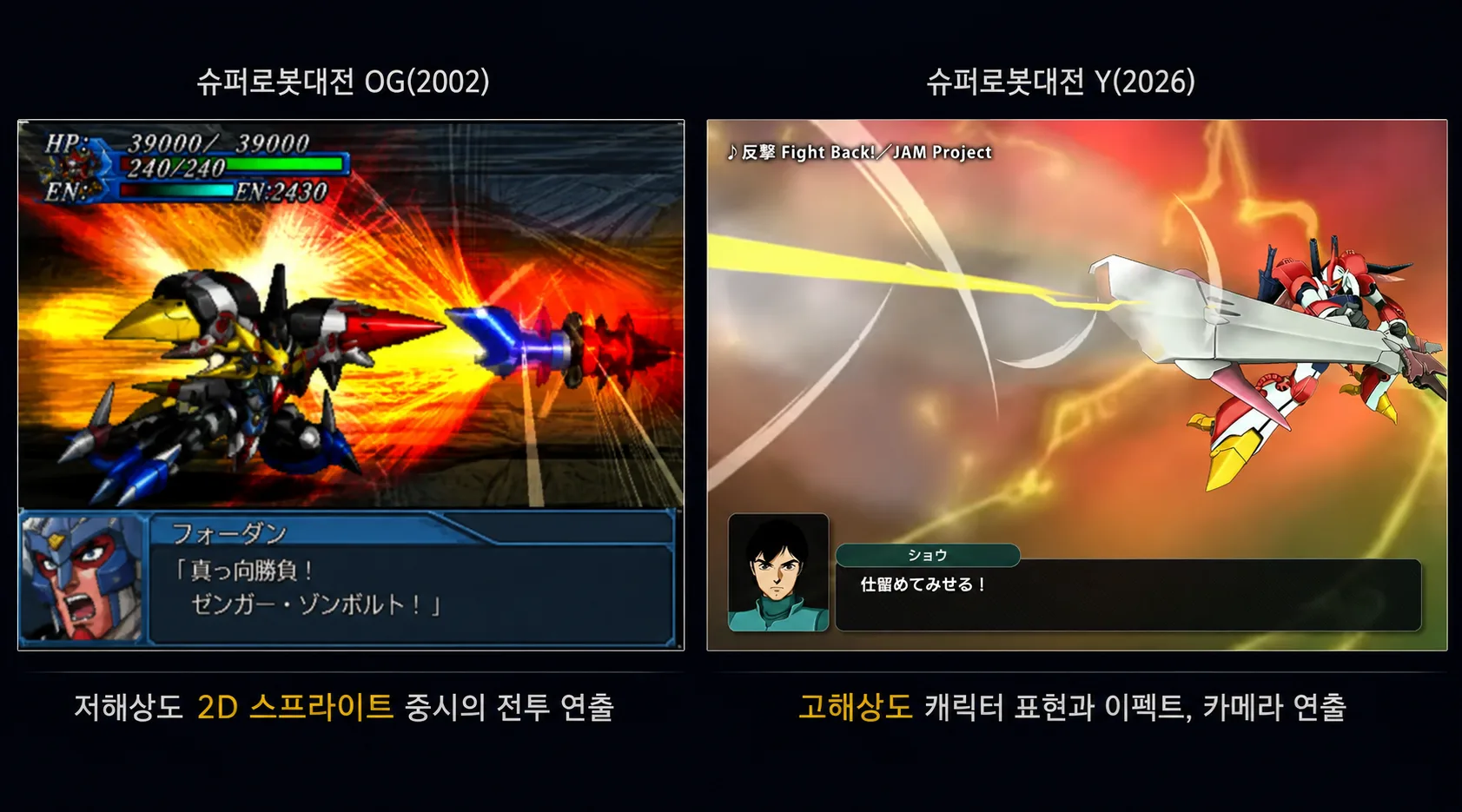
The change is visible first in the scale of production. In the Game Boy and 16-bit console era, characters and battles had to be represented within strict limits on resolution and storage. As console hardware improved and player expectations rose, battle animations became longer and more elaborate. Voice acting became standard, individual mecha and weapons received more specialized animation, and support for multiple platforms, languages, DLC, and post-launch updates became increasingly common.
'Super Robot Wars' also carries the additional complexity of being a crossover series. Adding one participating title does not simply mean adding a new character or machine. That work has to be placed within the larger scenario, relationships with characters from other works must be constructed, and battle animation, voice, music, settings, and expressions associated with each IP all have to be coordinated.
As the scale and requirements of each title accumulate, the issue is no longer limited to producing individual pieces of content. Maintaining the development environment that supports such a complex production process over the long term becomes important as well. During the development of 'Super Robot Wars Y,' that issue came clearly into view.
https://www.suparobo.jp/srw_lineup/srw_ogps/chara/31.html
https://www.youtube.com/watch?v=LpTu_X_5zx8
According to producer Kota Toma, the series had continued to modify and expand a proprietary game engine originating around the 'Alpha' series, using it through 'Super Robot Wars 30.' Over time, however, the repeated addition and modification of features created a structure in which the burden became concentrated on particular engineers, raising concerns that serious technical problems could eventually emerge. The development team therefore decided to move to the general-purpose Unity engine in order to continue producing the series.
The important point is that this was not simply a matter of replacing an old engine with a newer one. For a team that had spent nearly two decades working within its own development environment, moving to a new engine created a different kind of workload. Developers had to learn Unity's specifications and workflows, while also identifying and documenting the detailed 'Super Robot Wars' behaviors that had previously been taken for granted within the proprietary engine.
The old engine contained not only functions but also production methods specific to the series. Moving to Unity therefore meant more than changing software. It required adapting long-established development practices to a new foundation. And during the same period between '30' and 'Y,' changes were also taking place among the people and organizations surrounding the series.
Four Years of Change in Technology, People, and Organization
'Super Robot Wars 30' was released on October 28, 2021, while 'Super Robot Wars Y' launched on August 28, 2025. The two titles were separated by nearly four years. As discussed above, that period included the transition from the proprietary engine to Unity. But technology was not the only thing that changed.
Takanobu Terada, who had served as one of the series' long-standing producers, left the Bandai Namco Group in 2021. Having been deeply involved with 'Super Robot Wars' since the 1990s, he later continued his relationship with the series as a freelance supervisor. The role of one of its most prominent long-term creators therefore changed in the same year that '30' was released.
The development organization was also restructured during this period. B.B. Studio, which had been responsible for developing 'Super Robot Wars,' became a wholly owned subsidiary of Bandai Namco Studios through a group reorganization in 2024. In 2025, it was renamed Bandai Namco Forge Digitals. The development organization itself was not newly created, but its corporate affiliation and structure changed during the same period.
Between '30' and 'Y,' then, the series saw an engine transition, a change in the role of a long-standing producer, a corporate reorganization of its developer, and a company name change. These developments had different backgrounds and should not be treated as parts of a single planned transition. Still, the fact that changes involving technology, people, and organization occurred within the same period is worth noting.
Such changes matter in a long-running IP because production knowledge does not exist only in engines or documents. Decisions about how different works should be combined, how far source material can be adapted, and what kinds of battle presentation feel recognizably like 'Super Robot Wars' are also accumulated within the people and organizations that have worked on the series for years.
For that reason, introducing new people and technologies is only one part of the challenge. Just as important is how accumulated experience is carried forward. For a long-running IP, changes in technology and organization are not simply replacements; they also raise the question of whether established production knowledge can survive in the next environment.
An IP That Can No Longer Be Explained by New Releases Alone
Looking at the series around its 35th anniversary, it is difficult to explain its current activity through a single new release.
At the center is the already-released 'Super Robot Wars Y,' which has received a free update and the paid 'Anniversary Expansion Pack.' The expansion includes 33 additional missions—25 main story missions and eight Front missions—along with 12 new weapons and five additional playable mecha. Set after the main game, it adds new battles and content on top of an already established production base.
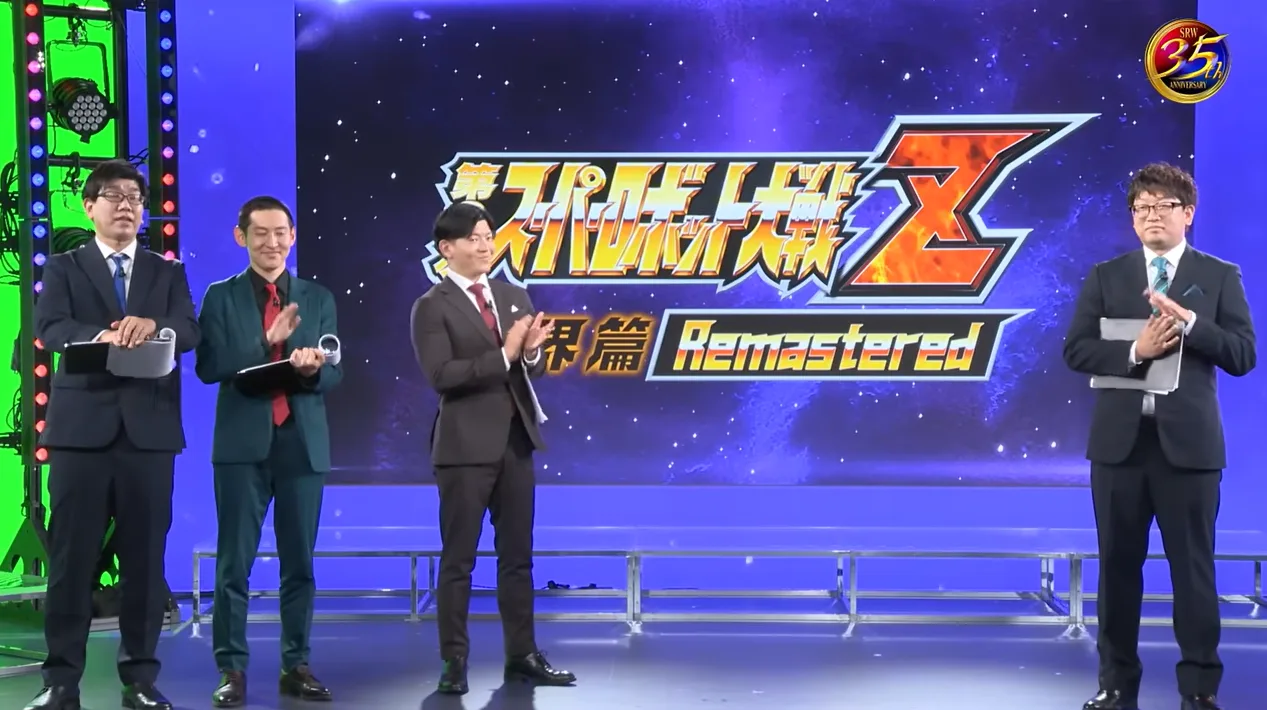
At the same time, an older title is being brought back into the present. A remaster of 'Super Robot Wars Z2: Destruction Chapter,' originally released for the PSP in 2011, is now in development. According to the information released so far, its battle animations will be presented at higher resolution and its UI will be adjusted for current play environments.
https://www.youtube.com/watch?v=Wzg95gSEkd4
As a result, content around the 35th anniversary is moving on several levels at once: additional content for 'Y' and a remaster of an older title. There is not enough evidence to say that Bandai Namco designed these as part of a single long-term content strategy. The 'Anniversary Expansion Pack' is also the final additional DLC for 'Y,' so its timing may simply have aligned with the anniversary.
Even so, the current pattern shows that the series now reaches its audience through more than entirely new releases. A new title introduces new systems and participating works. DLC and updates expand content on an existing base. A remaster makes an older title accessible again on current platforms and within contemporary play environments. Each serves a different role and operates at a different scale.
As development intervals grow longer, these different forms of content take on greater significance. When package releases cannot appear as frequently as they once did, DLC and updates can extend the active life of an existing title, while remasters can reconnect older works with the present market. The points of contact between an IP and its audience become more layered even during periods without a completely new game.
The remaster of 'Super Robot Wars Z2: Destruction Chapter' is particularly notable in this regard. An older game is not only an object of nostalgia; it is also a completed work built through a substantial production process. If it can be adapted for current environments, the history of a series becomes not only something to preserve but also an asset that can be brought back into use.
Maintaining a long-running IP, then, is not simply a matter of continually adding new works. It also involves finding ways to connect accumulated content with the present while continuing to create something new.
The Conditions for Longevity After the 35th Anniversary
Kota Toma, the current producer of 'Super Robot Wars Y,' also discussed future development cycles in a media interview in August 2025. There was a time when new 'Super Robot Wars' titles appeared at close to an annual pace, but he explained that the game development environment has changed too much to return to that same rhythm even after the transition to Unity is complete. At the same time, he said the new development environment had established a foundation for continuing the series.
Seen in that light, the recent changes appear less about restoring the release frequency of the past and more about creating the conditions needed to keep producing future titles even as development intervals grow longer.
Long-running game IPs are often explained through loyal fan bases, brand recognition, popular characters, and nostalgia. All of these are important assets, and 'Super Robot Wars' would have struggled to survive for 35 years without its established audience and its distinctive position as a crossover of multiple robot franchises. But an IP remaining in people's memories is not the same thing as continuously producing new games.
New titles require a development environment capable of delivering the experience fans expect, as well as a production structure capable of coordinating multiple licenses and storylines. Accumulated production knowledge also has to be carried into new development environments and new generations of creators.
In that sense, the conditions for longevity do not exist only within the content itself. What is made matters, but so does whether the technology, organization, and production methods required to keep making it can be sustained.
The years following '30' brought changes to the development environment, the roles of key creators, and the organization around the series. At the 35th anniversary, additional content for 'Y' appeared alongside the return of an older title through remastering. These developments should not be treated as elements of a single long-term strategy, but together they show that the way the series continues is no longer identical to the way it operated in the past.
None of this guarantees long-term success. Moving to a general-purpose engine does not automatically reduce development burdens, and remastering an older game does not necessarily bring in new players. In the case of 'Y,' the process of moving away from the long-established development environment itself required a significant amount of time.
For that reason, the meaning of the 35th anniversary is difficult to reduce to the idea that the series can now simply produce more games again. The more important question is how to keep the next title possible when returning to the production pace of the past is no longer realistic.
The conditions for longevity in 'Super Robot Wars' therefore look somewhat different after 35 years. Preserving the core experience still matters, but so does adapting the technology and organization that support it, while finding ways to make use of content accumulated over decades.
The 35th anniversary of 'Super Robot Wars' is not only an occasion to look back on what the series has achieved. It can also be seen as a case study in the production conditions an established IP may need in order to keep being made in the years ahead.