On August 4, 2026, the $55 billion acquisition of Electronic Arts (EA) was completed. A consortium of Saudi Arabia's Public Investment Fund (PIF), Silver Lake, and Affinity Partners acquired the company, taking EA off the Nasdaq and into private ownership. Existing shareholders received $210 in cash per share, and Andrew Wilson retained his position as Chairman and Chief Executive Officer.
What EA emphasized in announcing the close was growth and innovation. Wilson said the company would invest boldly and accelerate innovation alongside its new partners, and PIF likewise stated it would support long-term growth and innovation. Silver Lake's Egon Durban went a step further, saying the firm would invest actively in AI's potential to improve game development and player experience.
When the acquisition plan was first made public last year, attention centered on what room going private might give EA in development and investment. The expectation was that a company freed from the share-price and quarterly-earnings pressures that come with being listed could invest in games and technology over a longer horizon.
That possibility has not disappeared now that the deal has closed. But the freedom EA gained came with another condition attached from the start: the financing structure that made a $55 billion acquisition possible.
The $18 Billion Left Behind the $55 Billion
Not all of the $55 billion purchase price came from PIF, Silver Lake, and Affinity Partners' own capital. When the deal was announced in September 2025, the acquiring consortium committed roughly $36 billion in equity, with the remainder covered by debt financing arranged by JPMorgan. Up to $20 billion in debt financing was committed at the time, of which approximately $18 billion was structured to be drawn during the closing process.
In March 2026, the specific structure of that acquisition financing became visible to the market. It included more than $8 billion in leveraged loans, over $6.6 billion in high-yield bonds, and a separate $3.25 billion loan held by banks. Orders exceeded $45 billion. Among the factors drawing that demand was confidence that the recurring revenue generated by EA's sports licenses and its subscription and live-service businesses could support debt of this scale.
At this point, the meaning of going private shifts somewhat.
EA is no longer a company that must explain its share price to the market every quarter. In its place, however, it must sustain cash flow stable enough to carry a large acquisition financing package. Where short-term pressure from the equity market has receded, a new burden in the form of substantial debt remains.
The point here is not that EA cannot service that debt. Nor can the actual financing terms be reduced to a single interest rate — the loans and bonds sold in March were priced under different terms depending on their type.
What matters is that with debt of this size in place, where capital gets allocated has become a more consequential question than before.
And the acquiring consortium had been presenting that calculation to investors before the deal even closed.
$700 Million — What Gets Cut
In March 2026, while selling the debt financing needed for the EA acquisition to investors, the consortium presented a calculation showing that EA's annual earnings could be improved by roughly $700 million. The argument was that even while carrying substantial debt, adjusting the cost structure and improving operational efficiency could lift profitability by that amount.
That $700 million, however, does not all represent costs to be newly cut going forward. The calculation combined accounting adjustments — treating certain development expenses already incurred as one-time costs — with efficiency plans to actually lower expenses over the next two to three years. The figure is therefore less a single restructuring target than a projection of profitability improvement, blending accounting adjustment effects with anticipated future cost savings.
So how is the $700 million composed?
First, approximately $263 million consists of research and development costs already incurred on Battlefield 6 and Skate. With both titles released, the consortium concluded that development spending of the same magnitude would not recur, classified the amount as a one-time cost, and added it back into the adjusted earnings calculation. This does not mean $263 million will be newly saved going forward; it is an accounting adjustment applied to development spending already made that was judged non-recurring.
The efficiency plans actually to be pursued over the next two to three years therefore amount to roughly $400 million: about $100 million from AI-driven efficiency, about $30 million from reduced public-company costs, about $100 million from portfolio review and optimization, and about $170 million from organizational efficiencies.
In short, the "roughly $700 million" presented to investors is closer to the sum of an accounting adjustment for $263 million in already-spent R&D and approximately $400 million in efficiency gains the company says it will generate through actual operations.
What matters here is that the actual efficiency plans are not concentrated in one place. The largest share of the $400 million is the $170 million in organizational efficiencies, but $100 million each is allocated to AI adoption and portfolio review, with $30 million in reduced public-company costs on top.
The phrase "organizational efficiencies" has prompted discussion of possible further workforce adjustments, but the materials currently available do not support connecting it directly to a headcount figure or the downsizing of any specific organization. What is more clearly confirmed is that EA is simultaneously reexamining not only its people and organizational structure but also how it uses technology and how its game portfolio is composed — all through the lens of cost and revenue.
The next question, then, is not how much will be cut. It is what gets cut, and what continues to receive funding.
To Decide What to Cut, You Must Decide What to Keep
A company cutting costs does not cut every business at the same rate. Determining where to reduce spending requires judging, conversely, which businesses will continue to receive capital.
EA holds several businesses that generate relatively recurring, stable revenue. There are sports franchises like EA Sports FC and Madden NFL, live services like Apex Legends, and major IP such as Battlefield and The Sims capable of extended content expansion. In the acquisition financing process itself, EA's sports licenses and recurring revenue structure were assessed as strengths capable of supporting large-scale debt.
For a company carrying substantial debt, businesses of this kind can take on greater significance than before, because a business with continuous incoming cash and a project that generates revenue only after years of development spending operate on different timetables for capital recovery. This does not mean EA will focus solely on existing IP and live services. The consortium has, in fact, continued to emphasize long-term investment and technological innovation since the deal closed.
AI stands out here. Egon Durban, co-CEO of the U.S. private equity firm Silver Lake, directly cited AI's potential to improve game development and player experience in the announcement of the deal's completion. In the efficiency plans presented to acquisition financing investors, meanwhile, a target of roughly $100 million in cost improvement through AI was included. AI appears on one side as an object of new investment and on the other as a means of lowering costs.
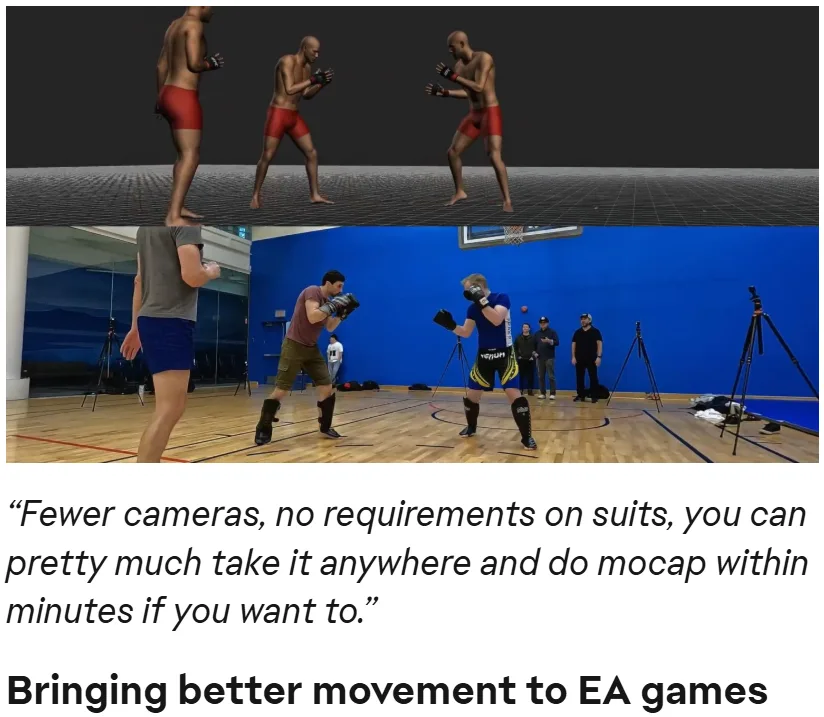
The AI- and computer-vision-based markerless motion capture technology EA introduced on August 7 is another example of this dynamic. It captures movement while reducing the constraints of conventional methods that require markers or specialized suits attached to the body, improving both the flexibility and the quality of animation production. There is, however, no basis for connecting this technology directly to the $100 million in AI efficiency cited in the financing materials. What matters is that EA views AI from both directions at once — as a technology that expands development capability and as a means of raising production efficiency.
The same applies to the portfolio. The forward-looking efficiency plans include roughly $100 million in "portfolio review and optimization." This cannot be taken to mean the cancellation of specific games or the downsizing of studios. But at a game company, reviewing the portfolio ultimately borders on reassessing which games and IP will continue to receive development funding.
Ultimately, what matters at the new EA is not only how much cost is cut. Where costs are reduced, and which games and technologies the capital freed up is then redirected toward, is more likely to reveal the company's direction going forward.
The New EA's Identity Will Show in Where the Money Moves
When the EA acquisition plan was made public last year, the question was relatively simple: could EA make games more freely after leaving the stock market?
Now that the deal has closed, the question can be made more specific. EA became a private company through a $55 billion acquisition, but more than $18 billion in acquisition financing was mobilized in the process. And in the course of persuading investors, an adjustment of roughly $263 million in R&D costs was bundled with approximately $400 million in future efficiencies to present a potential annual profitability improvement of about $700 million.
That much can be verified in figures. How those figures will actually change EA's games and organization, however, has not yet been determined.
What to watch going forward is not a single layoff number. It is how the $170 million in organizational efficiencies is actually carried out, which games and IP the $100 million portfolio review translates into investment decisions on, and how AI-related development investment expands alongside the $100 million in AI-driven efficiency.
Cutting costs and investing in new games or technology are not mutually exclusive. Capital freed up by reducing costs on one side can be redirected into another business. Conversely, a company can concentrate capital in existing businesses that generate stable revenue while reducing the weight of projects with distant payback horizons or high uncertainty.
Which it will be remains unknown. But what kind of company EA becomes is more likely to show first in the direction capital actually moves than in the word "innovation" emphasized in the closing announcement. Watching what is cut, what is kept, and what receives new investment will also reveal which businesses and technologies the new owners value most highly at EA.
What the freedom EA gained will produce is not yet knowable. But the new owners' calculations regarding that freedom have already begun.


