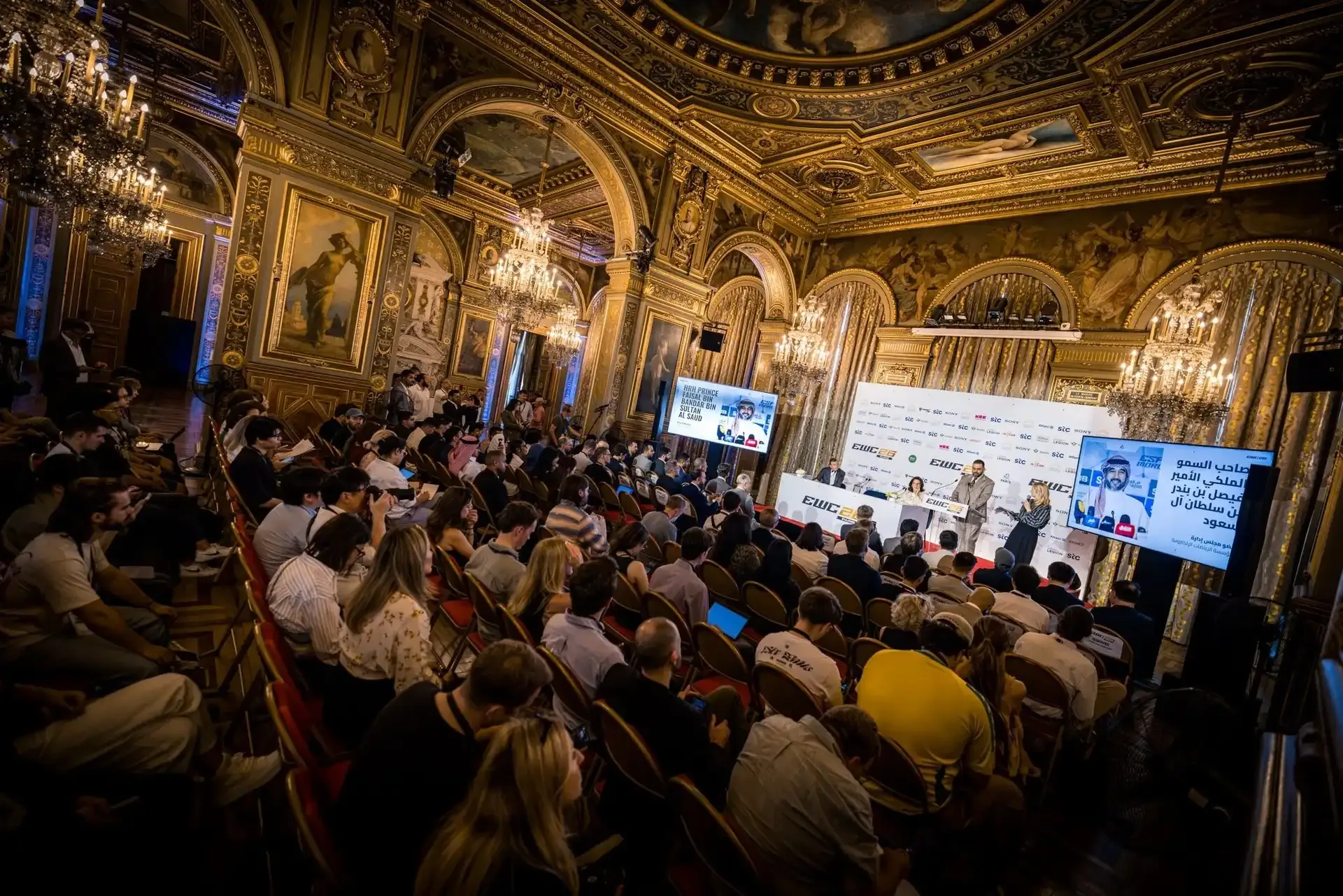
The 2026 Esports World Cup, or EWC, has opened in Paris, France. The tournament itself began on July 6, but its official starting moment came on July 8, with an opening press conference at Paris City Hall and an opening ceremony later that evening at La Seine Musicale. The press conference was attended by Paris Mayor Emmanuel Grégoire, Esports World Cup Foundation CEO Ralf Reichert, Prince Faisal bin Bandar bin Sultan, and French Sports Minister Marina Ferrari. The opening ceremony featured performances by DJ Snake, Aya Nakamura, Theodora, and Mosimann.
What makes this year’s EWC notable is not simply its scale. The 2024 and 2025 editions were held in Riyadh, Saudi Arabia, and Gamers8, the event’s predecessor, was also centered in Riyadh. This year, however, the tournament is being held outside Saudi Arabia for the first time. With the host city shifting to Paris, EWC no longer looks like a large esports event tied to a single region. Instead, it presents itself as a global event where cities, governments, broadcasters, clubs, and fandoms all move together.
[Image position: EWC 2026 opening press conference at Paris City Hall]
The tournament runs for seven weeks, from July 6 to August 23. Its total prize pool is $75 million, making it one of the largest single esports events in the world. According to official announcements, more than 200 clubs from over 100 countries and more than 2,000 players will take part. The event features 25 tournaments across 24 games. The reason there is one more tournament than there are games is that Mobile Legends: Bang Bang is split into two competitions: the Mid Season Cup and the Women’s Invitational.
The main venue is Paris Expo Porte de Versailles. It is a major exhibition center that has hosted Paris Games Week and was also used as a major venue during the 2024 Paris Olympic and Paralympic Games. For EWC 2026, the venue brings together competition stages, broadcast operations, fan experiences, and festival spaces. This shows that the event has been designed not merely as a schedule of matches, but as a seven-week urban event.
The scale of the qualification process was also significant. According to the foundation, more than 1.5 million players took part in 330 Road to EWC qualifying events. At the finals level, the tournament may look like a 2,000-player event, but behind it is a long qualification structure connecting regional qualifiers, publisher-run competitions, and international circuits. This is why EWC is positioning itself not as a one-off invitational event, but as a season-like platform that links multiple games and regions.
Broadcast scale is another point EWC emphasizes. This year’s tournament is being broadcast in 160 countries and in more than 40 languages, with over 100 broadcast and OTT partners including DAZN, FOX Sports, France Télévisions, TV5 Monde, L’Équipe, Eurosport, HBO Max, and CBS Sports Network. More than 7,000 hours of live programming will be produced during the event, and the number of approved co-streamers has expanded to as many as 5,000. This shows EWC trying to embrace both traditional sports broadcasting networks and streamer-centered viewing culture.
The return of Cristiano Ronaldo and Magnus Carlsen as global ambassadors can be read in the same context. By placing two figures associated with football and chess at the front of the event, EWC signals that it does not want to remain only within the boundaries of a pure gaming tournament. It is trying to bring traditional sports, online competition, streaming culture, and club brands onto one stage. Still, the most important key to understanding this year’s EWC is not its prize pool or its ambassadors, but the way it ties all of its competitions into a single club leaderboard.
The Core of the Tournament: The Club Championship
A typical esports tournament is organized around a specific game. A League of Legends tournament is watched by League fans, and a VALORANT tournament is watched by VALORANT fans. Counter-Strike, PUBG, Tekken, Street Fighter, and Rocket League all have their own audiences, histories, and competitive languages. When the game changes, the players change, the fandom changes, and the tradition of the tournament changes as well.
EWC adds another layer to that structure. It crowns champions in each individual game, but it also combines results from multiple games at the club level. This is the Club Championship. In other words, EWC is both a tournament that selects the world’s best teams in each game and a competition that asks which club has the broadest competitive strength across multiple titles.
This year’s Club Championship spans 25 tournaments across 24 games. Teams that place near the top in each title earn club points, and those points are accumulated at the club level. In most titles, the official point distribution is 1,000 points for first place, 750 for second, 500 for third, 300 for fourth, and 200 each for fifth through eighth. In competitions where placements are divided more precisely down to eighth place, such as battle royale titles, the points are split into 200 for fifth, 150 for sixth, 100 for seventh, and 50 for eighth. In either format, finishing outside the top eight means earning no points on the Club Championship leaderboard.
There are two additional conditions. To be included in the Club Championship standings and prize distribution, a club must place in the top eight in at least two different tournaments. To become the overall champion, a club must win at least one tournament. This means that consistency across multiple titles matters, but at least one outright victory is also required. EWC is not simply asking clubs to participate widely; it is asking them to combine breadth with the ability to win.
There are also limits on multiple rosters. Even if a club sends multiple players or rosters into the same competition, only the best result counts toward the club’s points. From this year, clubs must also confirm their point-eligible rosters by April 30 and complete player registration by May 25. These rules are designed to reduce controversies around last-minute signings or temporary roster moves made purely to secure points.
The prize distribution makes this structure even clearer. Of the total $75 million prize pool, $30 million is allocated to the Club Championship, with the top 24 clubs sharing that amount. The winning club receives $7 million. Individual tournament prize pools still matter, but at the center of EWC is a club-level race. This year’s Club Championship prize pool has increased from last year’s $27 million to $30 million.
What this structure demands from clubs is not simply the ability to win one game. It demands the ability to operate competitively across multiple titles. A strategy focused on one high-prize event works differently from a strategy built around consistent high placements across several games. But from the perspective of club points, a win is worth 1,000 points regardless of the title. In that sense, EWC takes competitions with different prize pools, histories, and levels of prestige, and recombines them under a single club identity.
Past results show how this structure works in practice. Team Falcons won the 2025 Club Championship with 5,200 points, followed by Team Liquid with 4,200 points and Team Vitality with 4,050 points. Team Falcons also won in 2024, making them the club that has so far used EWC’s club competition structure most effectively.
The Club Partner Program points in the same direction. The 2026 EF Club Partner Program selected 40 clubs, whose combined fanbase was described as exceeding 300 million people. Selected clubs can receive base funding and performance-based support, but being part of the program does not guarantee qualification for the EWC finals. Each club still has to qualify separately through the competitions for each title.
This point matters. EWC is not asking clubs for competitive strength alone. It is also asking whether they can expand across titles, gather fans, create content, and maintain a brand across multiple game ecosystems. That is why the Club Championship is more than a leaderboard. It is closer to an operating model that shows how esports clubs may grow in the future.
The 24 Battlegrounds Where Clubs Compete
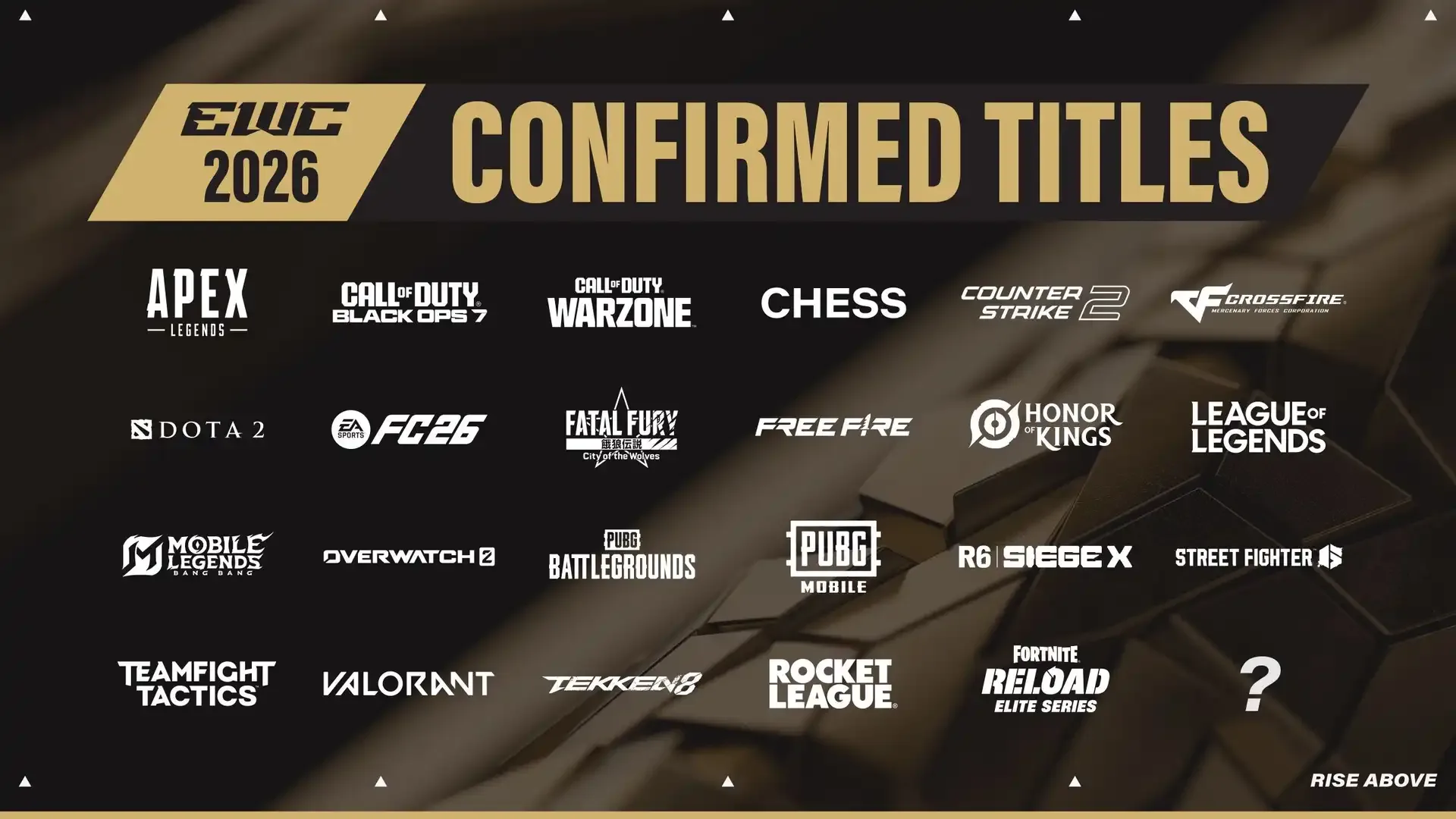
This year’s EWC title lineup is broad. It includes FPS and shooter games, MOBAs, battle royale games, fighting games, sports games, racing, strategy, and chess. Seen as a list, it does not look like an attempt to represent the full history of esports genres. Rather, it seems to reflect where global audiences are currently concentrated.
장르 | 종목 |
|---|---|
FPS·슈팅 | VALORANT, Counter-Strike 2, Call of Duty: Black Ops 7, Call of Duty: Warzone, Rainbow Six Siege X, CrossFire, Overwatch 2 |
MOBA | League of Legends, Dota 2, Mobile Legends: Bang Bang, Honor of Kings |
배틀로얄 | PUBG: BATTLEGROUNDS, PUBG MOBILE, Apex Legends, Free Fire, Fortnite |
격투 | TEKKEN 8, Street Fighter 6, FATAL FURY: City of the Wolves |
스포츠·레이싱 | EA SPORTS FC 26, Rocket League, Trackmania |
전략·기타 | Teamfight Tactics, Chess |
[EWC 2026 games by genre]
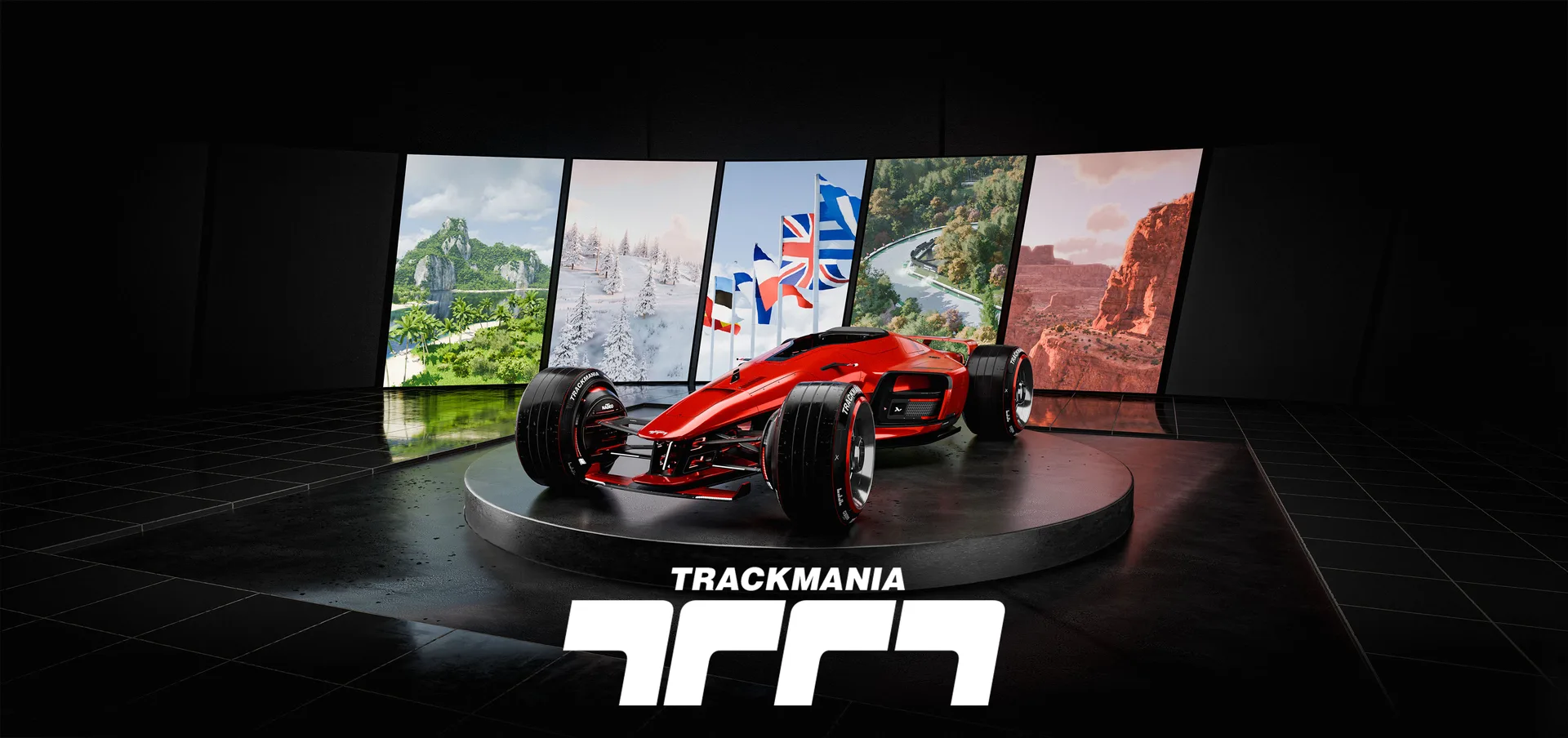
This year’s lineup includes Fortnite and Trackmania. Fortnite returns through a Reload-style competition, while Trackmania fills the racing slot. StarCraft II, by contrast, is not part of the official lineup. As a result, there is no traditional real-time strategy, or RTS, genre at this year’s EWC. This is why the tournament appears to prioritize current audience scale and global expandability more than the historical symbolism of esports genres.
The weight of mobile titles is also notable. PUBG MOBILE, Free Fire, Mobile Legends: Bang Bang, and Honor of Kings are all deeply connected to mobile or mobile-centered markets. These titles bring in audiences from regions such as China, Southeast Asia, the Middle East, and South America, which do not always overlap with the traditional PC-centered esports audience. The lineup shows that EWC is not aimed only at esports fans in North America and Europe. It is also targeting mobile-first markets.
The inclusion of chess can be understood in the same context. Chess is not a video game, but in the age of online platforms and streaming, it has absorbed many elements of esports-style broadcasting. This also connects with the choice to bring Magnus Carlsen in as an ambassador. EWC is trying to position itself not narrowly as a “video game tournament,” but more broadly as a form of digitally consumed competitive entertainment.
Still, a broad lineup does not mean every genre is included. This year’s title list shows both what EWC includes and what it leaves out. Mobile and streaming-friendly titles are strongly represented, while a historically important genre like RTS is absent. That choice explains the character of EWC well. This is not a stage built to commemorate the past of esports. It is a stage designed to bring the titles that can currently generate the largest audiences into a club-based competition.
Paris Hosting: Expansion or Relocation?
EWC 2026 was originally scheduled to take place in Riyadh. This year, however, the tournament moved to Paris. The official announcement emphasizes the Paris hosting itself and the event’s international expansion, while foreign media have reported that conflict in the Middle East and the resulting risks around travel and operations were part of the background to the relocation. In that sense, the Paris edition seems less like a fully planned stop on a global tour and more like a move brought forward by international circumstances.
That does not mean Paris looks like a temporary replacement. Paris has experience hosting large international events, and Paris Expo Porte de Versailles has handled both gaming events and major sports events. In recent years, France has hosted esports events across League of Legends, VALORANT, Rocket League, Fortnite, and other titles, and the density of local clubs and fandoms is high. The move may have been sudden, but Paris could receive this event because the city was already, to some extent, prepared for it.
The foundation describes the Paris edition as part of EWC’s international expansion. Ralf Reichert has said that EWC aims to become a global platform moving across major cities, while Prince Faisal emphasized that EWC was born in Saudi Arabia and that Riyadh would remain its home and foundation. Together, these remarks suggest two things at once: the event’s origins remain tied to Riyadh, but EWC is also trying to move beyond Riyadh.
The Paris edition has left behind a clear image. The French government and the city of Paris did not treat the event merely as a private gaming event. At the opening press conference, the French sports minister said that the country would announce a national esports development strategy for 2026 to 2030 this autumn, and major broadcast partners including France Télévisions joined the event’s coverage. The host city changed, but the result was that EWC created a scene where esports met urban and national-level industrial policy.
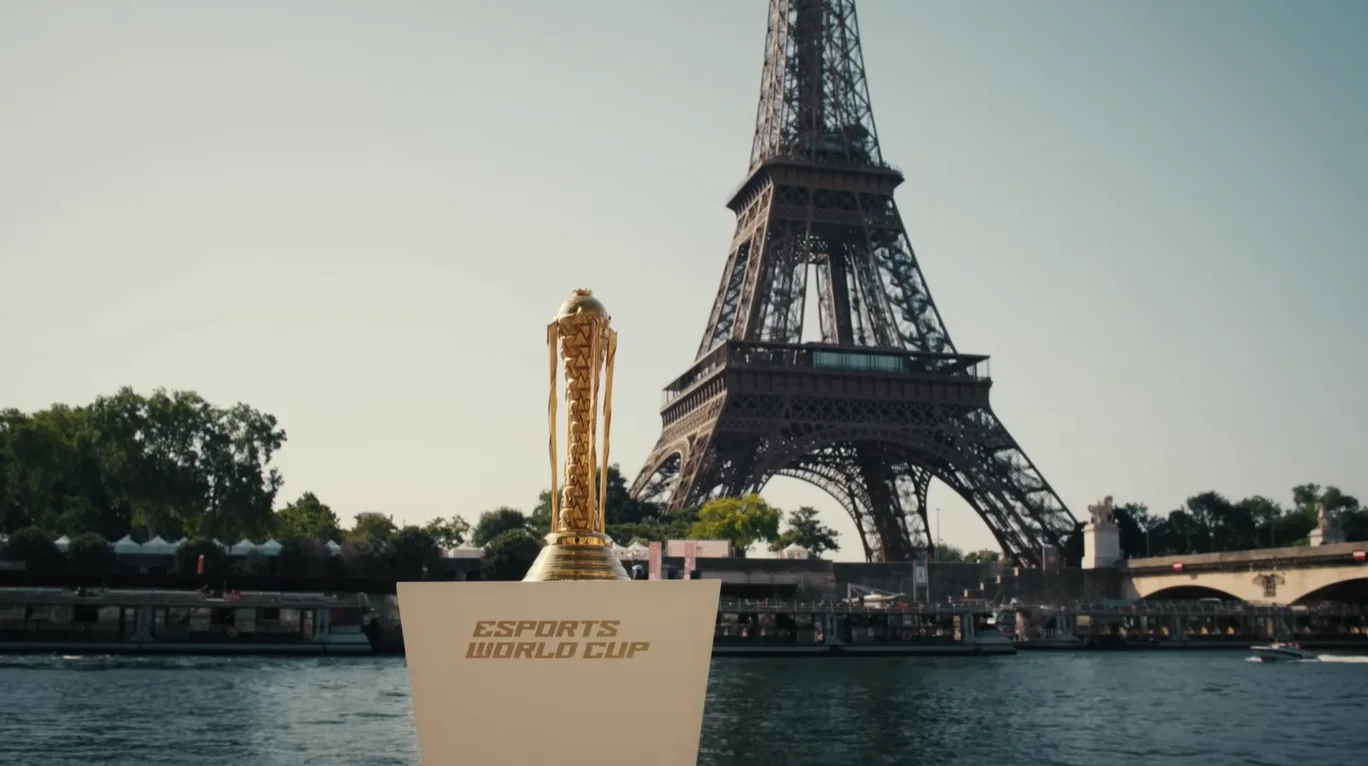
Of course, moving the event to Paris does not erase the controversies surrounding EWC. Although the tournament is operated by the Esports World Cup Foundation, it is difficult to separate it from Saudi Arabia’s national investment strategy in games and esports. French media have also covered the Paris edition in the context of esports cooperation between France and Saudi Arabia, while some figures continue to raise concerns about sportswashing and transparency.
For that reason, the Paris edition carries two meanings at once. One is that EWC has moved outside Saudi Arabia and expanded as a global event. The other is that the expansion continues to raise questions about the capital and national strategies behind it. An introductory article does not need to dwell on this controversy at length, but it is also difficult to explain this year’s EWC while erasing it completely.
Korean Clubs and EWC
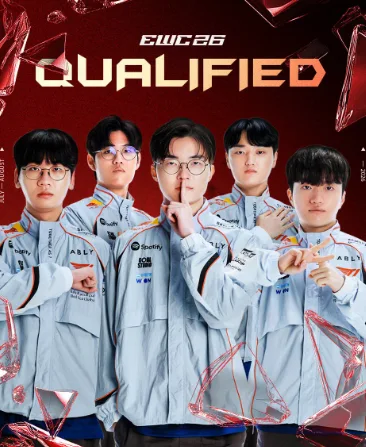
For Korean fans, the first title that stands out is naturally League of Legends. This year’s LoL competition runs from July 15 to 19 and features 16 teams. Gen.G qualified as the defending champion of EWC LoL, while T1 secured its place by defeating Dplus KIA 3-1 in the Korean regional qualifier. Dplus KIA ultimately received Korea’s fourth slot, and with Hanwha Life Esports also joining the lineup, four LCK teams will appear on the EWC LoL stage.
But for Korean clubs, EWC is not only a LoL tournament. To understand this event properly, it is necessary to look beyond performance in a single title and focus on club-level operations. A LoL championship is worth 1,000 club points, but so is a win in a fighting game, a racing game, or chess. Titles with different prize pools and different fanbase sizes are recombined under the same rules on the club leaderboard.
This structure is both familiar and unfamiliar to Korean clubs. What is familiar is competition among strong teams. T1, Gen.G, Hanwha Life Esports, and Dplus KIA have already built extensive international experience through League of Legends. What is unfamiliar is that their results no longer end as results in a single game. At EWC, a club’s ability to move across multiple titles becomes another form of competitive strength.
This direction can also be seen in comments from the leadership of T1 and Gen.G. T1 COO Ahn Woong-ki said the organization would study the success formulas of Falcons and Team Liquid at EWC, while also mentioning multi-title expansion and Faker’s global influence. Gen.G CEO Arnold Hur described the club not simply as an esports team, but as an education platform, a media company, and a consumer brand, and viewed the Club Partner Program as a device that accelerates the growth of an already functioning business model.
Both comments point in the same direction. EWC’s Club Championship does not ask clubs only whether they can win one game. It asks whether they can operate across multiple titles, expand their fandom, and present themselves as broader brands in front of sponsors and publishers. That is why Korean clubs need to read EWC not simply as an international tournament, but as a test of their business model.
This does not mean every club should force itself into multi-title expansion. If anything, EWC gives each club a question of choice. Which titles should it place at the center? Which regional fandoms should it grow? Can the brand built through LoL be transferred to other games? And can that expansion bring in new audiences without weakening the existing fandom? These are the questions Korean clubs face at this year’s EWC.
What Is EWC?
EWC 2026 in Paris is a tournament that crowns the world’s best across 24 games. But that alone is not enough to explain the event. The core of this year’s EWC lies in the way it takes those many titles and ties them back together through a single club leaderboard. Each game is played independently, but the results are combined once again under the name of the club.
That is why EWC is both a tournament for individual game champions and a stage that shows how wide a battlefield esports clubs can handle. The $30 million attached to the Club Championship is not just prize money. It is a mechanism that pushes clubs to think about multi-title operations, fandom expansion, and brand growth at the same time.
The move to Paris was closer to a result of geopolitical circumstances than a fully planned expansion. Even so, the tournament has created a scene where esports events meet urban and national-level industrial policy. The city of Paris has stepped in as a host city, the French government has signaled a national esports strategy, and global broadcasters and OTT platforms are participating in the coverage.
What EWC shows is not simply the sum of competitions across different games. It shows how esports is expanding into club competition and urban event industries. It also shows the opportunities and questions that come with that expansion.
The most important question to ask while watching this year’s EWC in Paris can be narrowed down to one point. Of course, it matters who wins each title. But the larger question is this: will future esports clubs remain teams that represent a single game, or will they become comprehensive brands that move across multiple games and fandoms? EWC 2026 has placed that question on the stage in Paris.


