![[Paper Review] Generational Differences in Acceptance of AI in Advertising](https://metax-images-bucket.s3.ap-southeast-2.amazonaws.com/articles/thumbs/1780226972622-광고.webp)
[MetaX] The core argument of the paper is that generational acceptance of AI characters in advertising differs sharply depending on how the ambiguity between human and machine is handled. The authors use audience-centered analysis and generational expectancy violation as new analytical axes. They also connect the uncanny valley effect directly to the decline of advertising immersion, empirically revealing psychological patterns that operate differently across generations.
Generational Differences in Acceptance of AI in Advertising |
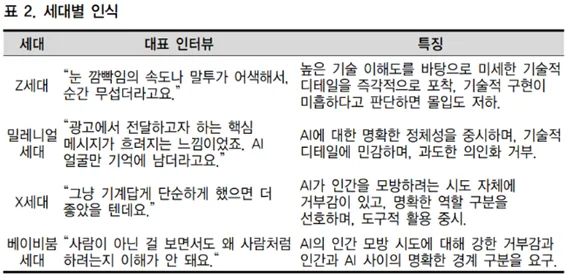
Each generation interprets AI advertising by different standards.
Generation Z: Although Gen Z may seem likely to be unconditionally tolerant of AI because they are familiar with it, they are in fact the quickest to detect subtle technical awkwardness. Small elements such as the speed of eye blinking, rhythm of speech, shifts in vocal tone, and facial wrinkles can break their immersion. They are not sensitive to the mere existence of AI, but to implementations that still feel insufficiently natural. Because they are familiar with the technology, their expectations are also high, and disappointment comes quickly when those expectations are not met.
Millennials: Millennials acknowledge the technological innovation of AI, but they also ask why AI is necessary within the advertisement. What matters to them is not whether AI was used, but whether the use of AI fits the message. If viewers remember only the AI face and not the advertising message, the advertisement may be technically impressive but has failed as communication. This generation accepts the presence of AI, but reacts critically when AI overwhelms the purpose of the advertisement.
Generation X: Generation X questions the very act of AI imitating humans. Their response tends to be: “Machines should remain machine-like. Why should they smile and express emotions like humans?” For them, AI is closer to a functional tool than an object of emotional identification. Therefore, they can accept AI when it performs a clearly defined role, but discomfort increases the moment AI tries to appear human.
Baby Boomers: Baby Boomers respond to AI’s imitation of humans with even stronger caution. In particular, when AI characters appear in areas where human judgment and emotion are considered important, such as life insurance, trust, care, and protection, they are likely to interpret this as an unnecessary change or an intrusion into the human domain. For this generation, the problem is not merely a lack of technical perfection. A more fundamental question is at work: “Why should AI enter this area at all?”
The Practical Mechanism of the Uncanny Valley Seen Through Three Advertisement Cases
The paper verifies its theoretical hypothesis through three actually broadcast AI-based advertisements. It provides concrete implications by showing that the number of AI characters and the density of facial expression changes influence the level of discomfort perceived by audiences.
• Samsung Life Insurance, “The Beginning of Good News”
Produced entirely with AI and using more than 10,000 generated images.
Result: This advertisement caused the highest level of psychological anxiety and discomfort across all generations.
Reason: The problem lay in the setting, which featured many characters resembling Koreans and expressing a wide range of emotions. Gen Z viewers identified defects such as awkward intonation and unnatural behavior within the highly polished visuals, which interrupted their immersion. Older viewers expressed instinctive discomfort at what seemed like an attempt to replace humans.
• LG Uplus, “Youth Plan with ixi”
Used a cartoonish and humorous avatar.
Result: This advertisement generated relatively low discomfort and received positive responses from Millennials and Generation X.
Reason: Instead of depicting the AI character realistically, the advertisement gave it cartoon-like distortion and genre-based distance. Audiences perceived the human and machine domains as clearly separated, allowing them to accept the advertisement’s purpose of humor and originality without cognitive confusion.
• Nongshim, “Dayplus Postbiotics”
Featured a single character rendered in an intentionally exaggerated illustration style.
Result: This advertisement was devalued or ignored by both younger and older generations.
Reason: Even with only one character, an excessive density of emotion and facial expression can intensify discomfort. Gen Z regarded this as a lack of technical completion, while Generation X and Baby Boomers criticized the exaggerated technique for making the intended message of a health beverage ambiguous.
Half-hearted humanization is the endpoint of immersion.
The conclusion of the study is that the success or failure of AI advertising does not depend simply on technological spectacle or on how closely AI resembles humans. The strategy advertisers should adopt must be clear: either fully human-like or clearly artificial intelligence-like. A state in which AI vaguely resembles a human but reveals subtle flaws is the worst-case scenario in marketing. The moment the audience’s brain experiences identity confusion, the advertising message meant to open their wallet evaporates, leaving only the unnatural face and voice of AI in memory.
Therefore, when targeting young digital-native generations, advertisers must secure cutting-edge technical precision capable of perfectly controlling even eye blinking and consistency of vocal tone, thereby achieving emotional harmony. Conversely, when targeting older generations that reject uncertainty, excessive anthropomorphism and emotional mimicry should be boldly removed. Positioning AI strictly as a useful tool that transparently delivers information is the way to minimize audience uncertainty and protect both brand trust and advertising immersion.
[METAX = Reporter Ryu Sung-hoon]