![[Paper Review] The Illusion and Compromise of AI Ethics](https://metax-images-bucket.s3.ap-southeast-2.amazonaws.com/articles/thumbs/1780729840630-윤리_copy.webp)
[MetaX] AI literacy education has often been conducted under the assumption that a deeper understanding of how artificial intelligence works, or greater knowledge of ethical principles, will lead to better judgment. The study “The Effect of AI Literacy on AI Ethics: A Scenario-Based Analysis” by Ha Ju-hye, Kim Sung-ji, and Oh Chang-hoon (2025) empirically demonstrates that this assumption is an illusion. The paper drags declarative discourse on AI ethics down into the muddy reality of practice and observes how human judgment is compromised and collapses.
The Gap Between Knowledge and Action: Guidelines as Armchair Theory
Previous studies by McNamara et al. (2018) and Vakkuri et al. (2020) have persistently pointed out the “action gap”: declarative ethical guidelines have no real impact on practitioners’ actual decision-making. In other words, ethics understood in the mind does not necessarily translate into action at one’s fingertips.
The central finding of this paper is that the key force that bridges this gap is not “knowledge of AI ethics” or “understanding of technical principles.” Across all eight ethical themes, the only variable that consistently had a positive effect was the ability to directly use and apply AI.
The power to translate abstract ethical principles into actual behavior comes from practical experience—holding the technology in one’s hands and controlling it directly. This suggests that the paradigm of ethics education must shift from teaching “what is right” to training people in “how to handle” AI.
The Paradox of the Medical and Weapon Scenarios
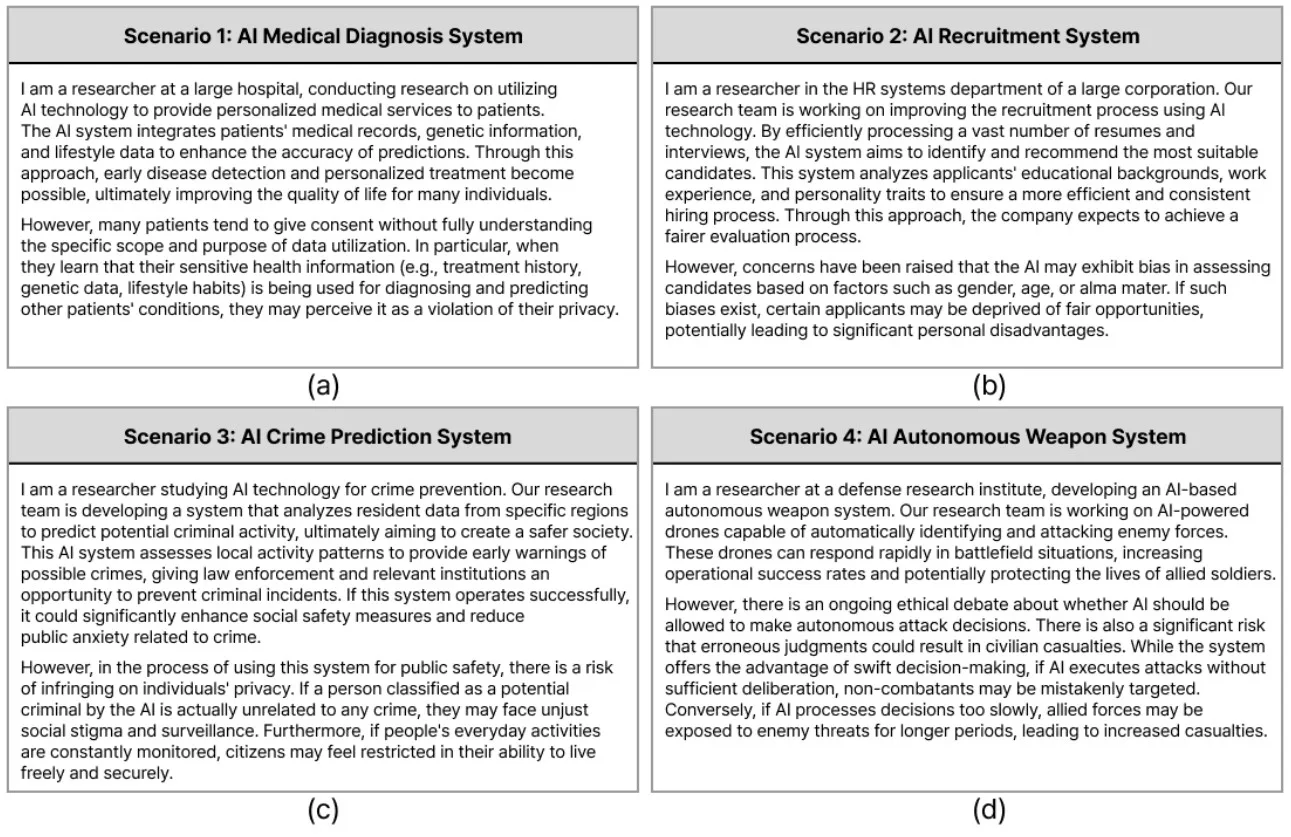
The paper collected data through four scenarios: medical AI, hiring AI, crime prediction AI, and autonomous weapons. In the process, findings emerged that ran counter to intuition.
• Medical scenario: The group with higher AI ethics competency showed a negative effect on the “Safety and Security” item for medical AI (β = -0.1696). The paper suggests that respondents may have regarded safety and security in medical AI as already somewhat guaranteed. In other words, because they expected the medical field to be strongly managed by legal and institutional systems, they may have paid more attention to issues such as privacy, data misuse, and the use of sensitive information than to safety itself.
• Autonomous weapon scenario: The more respondents understood the concepts and operating principles of AI, the more negatively they responded to “Transparency and Explainability” in autonomous weapon systems (β = -0.096). Because they understood the blind spots and complexity of the technology, they judged that demanding perfectly human-understandable explainability from AI in the extreme environment of the battlefield—where life and death are at stake—was itself unrealistic.
The Clearer the Benefits of Technology Become, the Weaker Ethics Becomes
The most interesting part of the paper lies in the relationship between agreement with each scenario and the ethical themes. Except in the medical scenario, higher levels of agreement with the adoption of technology in the hiring, crime prediction, and autonomous weapon scenarios tended to correspond with a lower perceived importance of ethical issues.
*Hiring: In the hiring scenario, the benefits of “consistency and efficiency in evaluation” through automated document screening are emphasized. This efficiency led respondents to overlook the principles of fairness and non-discrimination (β = -1.6970), privacy (β = -1.3154), and the promotion of human values (β = -1.2696), all of which the system could potentially undermine.
*Autonomous weapons: In the autonomous weapon scenario, practical values such as “rapid strikes” and “protection of allied lives” are presented. Respondents who agreed with this scenario showed significantly negative attitudes toward key ethical principles, including human control over technology (β = -2.2141), transparency and explainability (β = -2.1694), and accountability (β = -1.6600).
Ultimately, when efficiency and benefit appear tangible and certain, users reduce or compromise with the ethical collapse hidden behind them.
AI Ethics Is a Matter of Practical Literacy
The paper shifts AI ethics from a matter of knowledge to a matter of practical literacy. What matters is whether people can judge how AI should be applied in real situations, who benefits from that application, and who is exposed to risk.
AI ethics education must move beyond declarative instruction that simply states, “fairness, transparency, and accountability are important.” Instead, it should lead people to discuss concrete scenarios: what kinds of data are sensitive when using medical AI; who is harmed when hiring AI produces bias; what rights are weakened when crime prediction AI justifies surveillance in the name of public interest; and how far human control must be maintained in autonomous weapon AI.
The ability to use AI well is not merely a technique for improving productivity. To use it well, one must also doubt it well. To apply it well, one must also judge the conditions under which it should not be applied.
[METAX = Reporter Ryu Sung-hoon]