AI is now able to rapidly generate code, art, sound, and even early planning drafts. This means that the barrier to “implementing” a game is falling quickly. If everyone has access to similar tools, then where does a game company’s competitive edge come from?
The 2026 Nexon Developers Conference, or NDC 26, held from June 16 to 18 around Nexon’s Pangyo headquarters in Gyeonggi Province, confronted this question head-on.
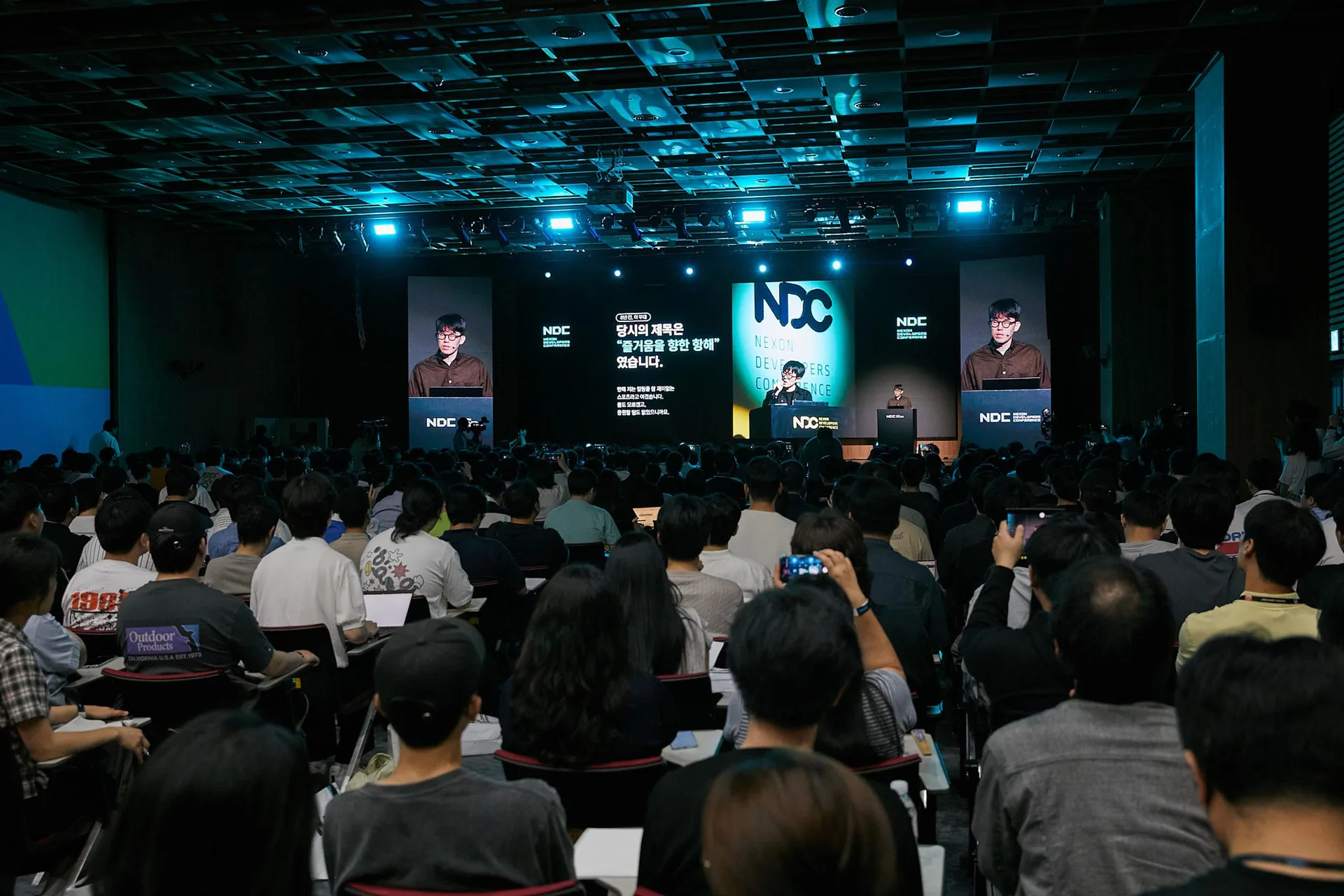
The focus of this year’s event was clear. Around 10,000 visitors attended the sessions, while online livestreams recorded more than 63,000 views. The conference was built around the premise that AI is already becoming a common tool in day-to-day production, with sessions centered on real applications and practical know-how from the field. Nexon significantly expanded its AI-related sessions, and Nexon Japan CEO Lee Jung-hun described the shift toward AI as an unavoidable current in his opening remarks. The message was clear: change itself has already become a constant in the industry.
In an Era Where Implementation Is Easier, What Do We Compete With?
The keynote by Kang Dae-hyun, co-CEO of Nexon Korea, most clearly captured the central question of the event. Its title was “In an Era Where Implementation Is Easier, What Do We Compete With?” The premise was direct: when the ability to make things becomes more common, the real variable must lie somewhere beyond implementation itself.
Kang’s answer was the concept of “context capital.” He defined it as assets that can only be accumulated over time, such as the know-how a development team has built, the relationship it has formed with users, and the culture of its community. The core point was that such accumulated context cannot simply be bought with money. Unlike code or assets that AI can help reproduce, context shaped by time is difficult to catch up with in a short period.
Kang went a step further by introducing the idea of the “compound interest of context.” Context does not merely accumulate in proportion to time; its value grows as different layers of context become connected. Like compound interest in finance, context gains momentum when accumulation and connection reinforce each other, and this becomes a source of competitiveness in the AI era. From this perspective, development know-how, user relationships, and community culture are not separate assets. When the worldbuilding accumulated by a long-running IP, the user community surrounding that IP, and the operational data and judgment built through live service all connect, they form a moat that latecomers cannot easily replicate.
What made this concept particularly interesting was that it functioned as a framework running through the entire event. The sessions at NDC 26 demonstrated three major forms of context capital from different angles: accumulated development know-how, data refined through live operations, and the long-standing relationship between IPs and users.
① Know-How — The Power of Accumulation, Including Failure
The first form of context capital was the know-how that development teams build through trial and error. The most symbolic example was “Blue Archive Postmortem — From the Perspective of a Game Director,” presented by Cha Min-seo, producer at Nexon Games’ RX Studio. Although the session dealt with the development story of a global hit, its core value lay in the fact that it was not a promotional success story. Instead, it was a candid review of what worked and what did not.
Cha cited the establishment of a clear “vision build” and adherence to schedule as key success factors. Early in development, the team created a five-minute prototype covering the flow from opening to combat, allowing the entire team to share a common direction. This also made it possible to delegate authority more quickly. As a result, the team was able to move from the start of development in April 2018 to the Japanese launch in February 2021, roughly 34 months later, while keeping to schedule — an uncommon achievement for a new IP. At the same time, Cha openly discussed missteps, including unexpectedly high traffic and early server stability issues.

What this session revealed was not just the final result, but the organizational ability to record and revisit what succeeded and what went wrong. The same message appeared in the multi-studio session by Nexon Games CEO Park Yong-hyun. He explained that developing multiple games simultaneously was both an extension of the company’s RPG expertise and a strategy for exploring new genres and experiences in response to market change. The view that the experience gained across multiple projects is itself an asset shows that, while AI may write code, it does not replace the judgment of what to try and what to abandon.
② Data — Context That Only Live Operations Can Build
Among the three forms of context capital, the event placed the greatest emphasis on the second: the context refined into data through live game operations. The session “In the Age of AI, What Is Nexon Preparing Through Data?” drew long lines on the second day and translated Kang’s idea of context capital into its most concrete form.
The session began by overturning a common assumption. Many might expect that, since AI can solve everything, data will naturally follow. What Nexon found in the field was the opposite. The company noted that many organizations say their internal data is not yet ready for AI, and emphasized that while AI models may evolve quickly, data containing the context of a company’s own games and services cannot be replaced. Regardless of how fast AI technology changes, data is something a company can continue to hold onto. In that sense, the real battleground of the AI transition is not the model, but the data.
The concrete example supporting this argument was Nexon’s company-wide data platform, Monolake. To break down “data silos,” where data had been stored separately by each game and was not easily shared, Nexon integrated game, platform, and business data into a single platform while building standardized data pipelines and governance. As a result, the time required to query more than 45 billion game logs generated daily, amounting to around 100TB of data per day, was reduced from two hours to about five minutes. During the process, storage costs were cut by 25 percent and performance improved by more than 17 times. These figures made clear the sheer scale of data that only a company with long-term, large-scale live service experience can possess.
What matters is that this data was not merely stored as a record. It translated directly into the speed of live operations. In the past, operations or customer support teams had to request data extraction from the development team and wait for the results. As more teams gained direct access to data, response times to users improved significantly. Nexon even cited community reactions suggesting that “Nexon has finally started working,” showing how data assets can be converted back into user relationships.
The next step is Monolake 2.0. If 1.0 was about making data easier for people to use, 2.0 aims to create an “AI-ready data” environment in which AI can understand and use the meaning and context of the data on its own. To achieve this, Nexon is focusing on ontology-based structuring, adding precise meanings to individual datasets, defining relationships between data, and embedding the key judgment criteria used by teams in the field. On top of this foundation, the company is developing AI Search, which generates reports through natural language queries; functions that automatically analyze the causes of changes in revenue or concurrent users; and proactive agents that detect anomalies before people manually check the metrics. Nexon is also internally testing hyper-personalized services in which AI identifies users who are unable to clear a specific boss or analyzes character behavior patterns to provide tailored support.
The case of Embark Studios, which took the stage on the same day, made the density of live operations data even clearer. The studio behind ARC Raiders shared how it tracks and analyzes the trajectory of every bullet in the game. Collecting and analyzing the enormous amount of data generated in real time during play, then using it to refine the game, is work that only the operator of the service itself can perform. It cannot be bought from outside, nor can AI simply produce it on behalf of the company. This particular texture of data repeatedly emerged as the core of context capital.
The external experts who joined the discussion pointed in the same direction. Because large language models can generate inaccurate information, the accuracy of data and its semantic context become crucial. Without a strong data foundation, AI cannot produce meaningful results. Anyone can use the same good model, but the “materials” that allow that model to produce meaningful answers cannot be purchased later or created all at once. As data accumulates and becomes standardized and connected, its value grows. In this sense, live operations data is the area where the compound interest of context becomes most visible.
③ IP and Relationships — Rediscovering Worlds Built by Time
The third form of context capital was the long-standing relationship between IPs and users. The session “From Legacy to Platform — How NEXON Replay Revives Beloved IPs” dealt directly with this point. It shared the background and decision-making process behind opening IPs to outside creators, including ended services such as EverPlanet and Tactical Commanders, as well as live titles such as The Legend of Darkness, Asgard, and Elancia.
What stood out was that Nexon did not simply choose to open IP usage rights. Without proper standards, opening old IPs could result in low-quality content or even disappoint fans who had long waited for the return of the originals. To prevent this, Nexon introduced a system for safely reviewing original materials and provided guidelines based on understanding of the original works and live operations experience. The idea was that revival only becomes meaningful when an IP worth reviving, the fans who have waited for it, and the operational know-how accumulated over time come together. This was perhaps the most direct example of context capital: a world and fandom built by time becoming an asset in their own right.
This perspective also appeared in the final-day discussion. The session examined how game companies, creators, and fans should connect in an environment flooded with short and fast-moving content. Ultimately, the discussion returned to the question of how long-term relationships with users can be treated as assets. The scene outside the lecture halls delivered the same message. NEXTAGE, a game art exhibition opened to the public for the first time in seven years, along with hands-on zones using Nexon IPs and live music performances, all served as ways to reveal the cultural context that games have accumulated over time.
What Should Be Accumulated?
Of course, the theory of context capital does not explain everything. It can be read as a logic that justifies the advantage of large companies that have survived for a long time. If AI moves deeper into user analysis and community management, parts of that context may also become reproducible. And when accumulated context hardens into inertia, an asset can quickly become a shackle. Whether what time has created becomes a moat or a constraint ultimately depends on the hands that manage it.
Still, the direction is clear. Recording failure through postmortems, refining live operations data so AI can read it, and reawakening dormant IPs — the sessions at NDC 26 were saying the same thing from different stages. Competitiveness is no longer divided simply by “what can be made.” Making things has become easier for everyone. The real gap emerges from what has been accumulated, and how that accumulation is connected and turned into compound value. AI is not a tool that creates context on its own. It is a tool that amplifies the context already built.
Lee Jung-hun’s opening remark compressed all of this into a single idea: no matter how much technology changes, users ultimately remember and return to games that are fun. And in an era where everyone holds the same tools, the difference lies in the judgment of what to make.
The tools already belong to everyone.
What a company builds with those tools, and how it connects what it has built, will define its competitiveness.