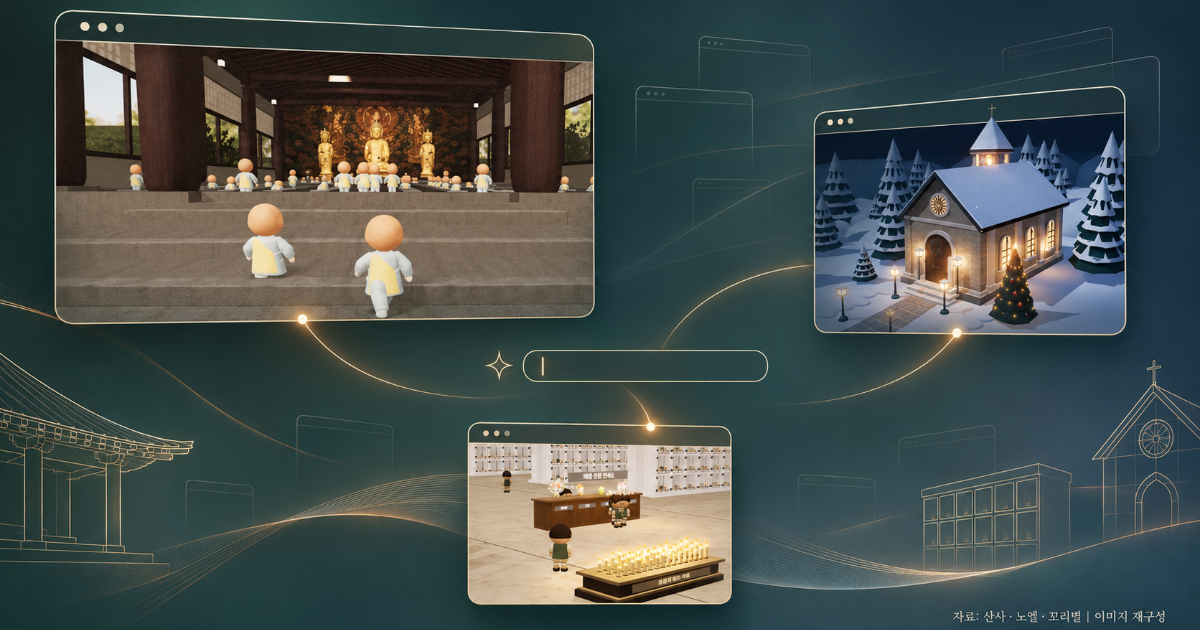
AI-assisted coding is helping individuals build places for prayer, rest and remembrance, where visitors can spend time together without having to talk.
Enter a Buddhist hall, choose a cushion and bow. Other people are sitting nearby, but there is no need to speak. Open another link and you can light a candle at a cathedral or walk around a chapel in the snow. There are saunas, walking paths and places to remember a pet. The virtual spaces attracting attention in South Korea are places to drop into for a while, closer to an everyday retreat than a vast city.
The interest that gathered around Sansa, an online Buddhist temple, has spread to other religious settings and leisure spaces. Yonhap News Agency and MBN have reported on how Sansa began and what visitors do there. Kookmin Ilbo has examined individuals using AI to build virtual spaces, while ChosunBiz has covered the spread of pilgrimage routes and saunas alongside the costs of keeping them running. Across this coverage, two changes emerge: how individuals build virtual spaces and how visitors use them to rest.
A place built for one person draws a crowd
Sansa began with its creator's own need for somewhere to rest. In an October 31 interview with Yonhap, Park Jin-won, an English graduate looking for work, said he wanted to spend time at a temple but lacked the time and energy to visit one. He used AI-assisted vibe coding to build an online version. Park said it had received 600,000 visitors over the preceding three days. That was a creator-reported figure; counts published at different times should not be added together.
Visitors move around the hall as young monk avatars, sit on cushions and turn prayer beads. In its October 31 coverage, Maeil Business Newspaper highlighted Sansa's lack of a chat function. People share the hall without the pressure to start a conversation or reply.
Speaking to MBN on November 1, Park also described an experience in which people do not talk but feel less alone. The same report featured InPeace, an online Catholic setting, and Saebyeok Yebaedang, or Dawn Chapel, an online Christian church. Alongside virtual church interiors, it showed visitors praying while wearing chapel veils. Interest was spreading beyond the Buddhist setting.
Different places, different ways to take part
Other religious spaces have their own character. Metamoa, a directory of virtual spaces, describes Online Basilica as a place to light candles and pray together in front of a virtual St. Peter's Basilica. Noël Chapel offers a snowy Christmas setting that visitors can explore as avatars. Quiet Light Church is also listed on Vibe Chart, another directory.
These places should not all be treated as the same kind of religious service. Some emphasize prayer gestures; others foreground architecture and seasonal atmosphere. An independently built virtual chapel also needs to be distinguished from worship provided online by an established religious institution. Religious imagery alone does not establish who operates a site or whether it has an official affiliation.
The actions are easy to understand. In the Buddhist hall, visitors bow. At the cathedral, they light candles. In a chapel, they walk around or stay awhile. Familiar activities become part of the interface alongside the building itself. Visitors can understand what to do before reading detailed instructions.
Beyond religion: Water, walking and remembrance
The range extends to other activities. ChosunBiz's November 3 report described online pilgrimage routes, saunas, campsites and fishing spots. Metamoa also lists Swimpick, a virtual pool for watching the water, alongside camping spaces and online study rooms.
Kkoristar, a pet memorial, gives visitors somewhere to keep memories. Its official description explains that photographs and letters can be stored in memorial compartments, with options to light candles and offer chrysanthemums. It also includes walking and petting features. Kookmin Ilbo reported on November 2 that the creator's experience of losing a cat prompted him to build a place where others could share their memories.
These services serve different purposes, yet each offers somewhere to spend a little time in a shared digital setting. Praying, watching water and leaving a letter need no competition or reward. For people planning such spaces, the interest suggests a question worth asking: what kind of time do visitors want to spend there, alongside anything they might hope to achieve?
AI expands what an individual can attempt
Vibe coding has helped make projects such as Sansa and Kkoristar possible. A creator describes the desired features in ordinary language, then runs and revises code produced by AI. AI handles some of the work of turning an idea into software, giving individuals more scope to try an initial version.
Kkoristar's creator told Kookmin Ilbo that he built the site in a day using ChatGPT. Yonhap's interview also establishes Sansa as an AI-assisted project. Those accounts do not provide a development timetable for every virtual space. The tools and development times for the other sites have not all been independently established.
An everyday need or a memory someone wants to keep can give a project its starting point. A creator can test a service around one small activity without first planning a platform with every possible feature. Familiar elements such as a temple cushion, a candle or a walking path help explain how to use it.
Speed alone does not explain a service's value. A quick launch still leaves the creator with the question of why people would stay. The same building can feel very different depending on how other visitors appear, how loud the sound is, how simple the controls are and whether chat is available. Coverage of Sansa's creator and visitor experience repeatedly returns to the decision to leave chat out.
A directory of places to drop into
Directory services provide a way to discover these spaces. Metamoa collects virtual places accessible through a browser. Vibe Chart lets people search and browse spaces made by independent creators. Visitors can follow their interests to different web addresses rather than remain in one large world.
The listed sites may use different technologies and need not be connected to one another. A directory helps visitors find projects scattered across separate addresses. Creators get a way to reach people after launch, while visitors have somewhere to look for their next stop.
Here, being able to understand a space on arrival may matter more than its size or number of features. A wish to pray briefly, study alone while sensing other people's presence, or write to a pet offers a specific reason to visit. These examples support that interpretation, but they do not establish longer-term motivations or return rates. Those need further evidence.
Keeping a place open takes more than building it
As traffic grows, so does the work of running a site. Yonhap described Sansa increasing its capacity as traffic grew and adding a donation feature to help cover server costs. ChosunBiz also identified server bills and visitor retention as challenges for individually built spaces.
A service hosting people at the same time needs ongoing maintenance. If it stores photographs and letters, the operator also needs to decide how to back them up and handle deletion requests. Reducing initial implementation time with AI does not remove responsibility for outages, stored records or operating costs.
It is too early to read the current interest as a recovery for the metaverse industry as a whole. Visits and individual users are different measures, as are a brief surge of attention and steady return use. Temples, churches, saunas and memorials nevertheless show more people building virtual spaces for a wider range of purposes. AI makes it easier to start. Whether people keep returning will depend on how carefully those places are run.