In the age of AI, a data center is no longer a quiet building full of servers.
It is a large industrial facility that consumes massive amounts of electricity, requires water, demands investment in the power grid, and affects local air quality, noise and land use. At the same time, it is digital infrastructure that supports biotechnology, finance, defense, high-performance computing and advanced research.
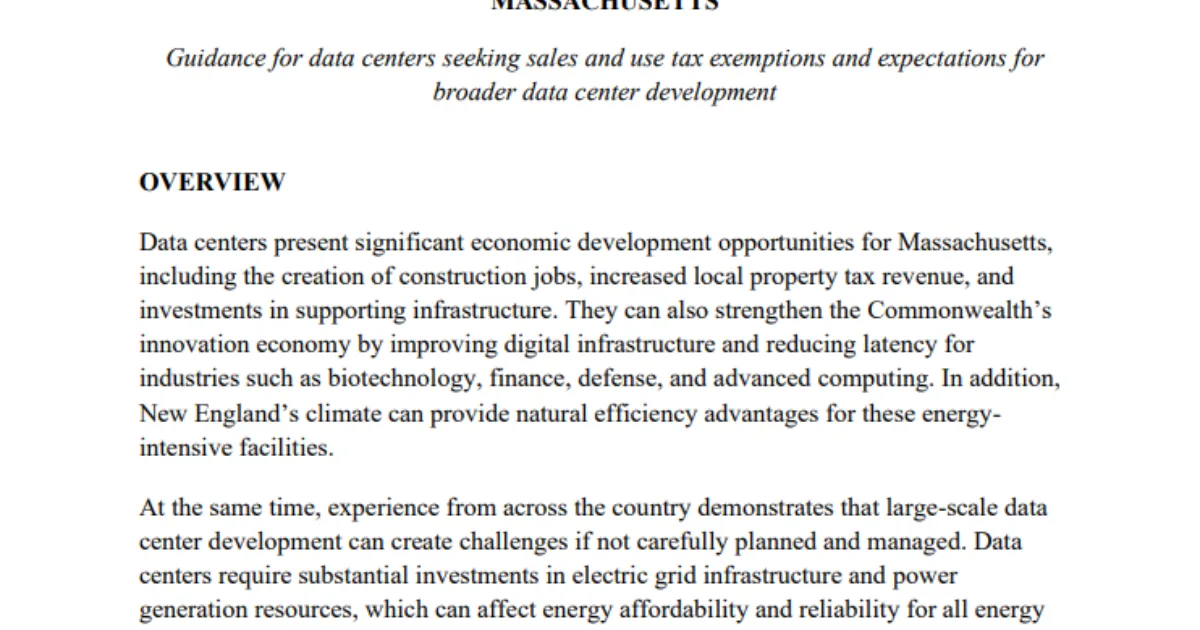
The responsible data center development and operations framework released by the Commonwealth of Massachusetts confronts this duality directly.
The Healey-Driscoll Administration recognizes that data centers can create opportunities through construction jobs, local property-tax revenue, infrastructure investment and stronger innovation economies supported by lower latency. It also notes that New England’s climate can provide natural advantages for the efficiency of energy-intensive facilities. But the framework also warns that large-scale data centers can require significant investment in the electric grid and generation resources, while creating burdens for energy prices, reliability, climate, the environment, public health and local communities.
The core issue is balance.
Massachusetts is not saying data centers should be blocked.
But it is also not saying they should be welcomed without conditions.
It recognizes economic growth and innovation, while also requiring protection for residents, businesses and local communities.
The framework sets explicit expectations for data center developers seeking sales and use tax exemptions under Massachusetts law. It also serves as a standard for state agencies and local governments evaluating data center proposals, for policy discussions with the legislature and municipalities, and for actions by the Department of Public Utilities within its existing authority.
This shows that the center of gravity in data center policy is changing.
In the past, competition to attract data centers focused largely on tax incentives, land, electricity prices and permitting speed. Regions offered incentives to attract investment from major cloud and AI companies. But after the AI boom caused data center demand to surge, the question changed.
Who will pay for grid expansion?
Where will clean electricity come from?
Will rising electricity costs be shifted onto ordinary consumers?
Who has priority in water use during drought?
Who bears the air-pollution burden from diesel backup generators?
What benefits does the local community actually receive?
How much information about energy, water and jobs must companies disclose?
Massachusetts’ answer is clear.
The costs and burdens of data center development, operations and incremental energy and water needs should not be borne by Massachusetts electricity customers, communities or residents. Instead, they should share in the benefits of economic opportunity, job creation, strengthened grid and infrastructure reliability, and local tax revenue.
The first principle is “Bring Your Own Clean Energy.”
New data centers should not worsen energy-supply shortages, wholesale electricity prices or greenhouse gas emissions. They should instead accelerate clean-energy deployment. To do that, data centers should supply or directly procure the electricity required to serve their load in a way that is consistent with Massachusetts climate laws and clean-energy requirements.
Specifically, developers are expected to bring or fund clean-energy generation sufficient to meet 100% of the data center’s demand. That generation should be on-site, connected to ISO-New England, or able to deliver power into ISO-New England, and it should meet the eligibility requirements of the state’s Clean Energy Standard. Data centers should also participate where possible in statewide clean-energy procurement mechanisms and prioritize on-site clean-energy deployment. If there is a timing gap between new clean-energy resources and the data center’s load growth, mechanisms such as a fund to protect ordinary ratepayers may be considered.
This principle is highly significant.
The electricity demand of AI data centers has become one of the most sensitive issues facing power grids. When a data center arrives as a large new load, transmission and distribution upgrades may be required, and additional generation resources may be needed. If those costs are reflected in electricity rates, ordinary households and small businesses may end up paying for the expansion of AI infrastructure.
Massachusetts is trying to prevent that.
If a data center wants to consume large amounts of electricity, it must bring clean electricity to match that demand. The message is that simply drawing power from the existing grid and shifting the cost of new generation and transmission to society as a whole is no longer acceptable.
The second principle is energy efficiency, flexibility and power-system optimization.
New data centers should work with ISO-NE and electric utilities to avoid worsening stress on the transmission and distribution system. They should operate in ways that avoid unnecessary infrastructure expansion and improve grid efficiency. To do so, they should follow best practices for energy-efficient design and operations, participate in demand-response and load-flexibility programs, and deploy solar power, storage and advanced energy-management systems to reduce the need for additional grid capacity.
The state also suggests that data centers can work with communities and utilities to support distributed-energy aggregations such as networked geothermal systems, microgrids and virtual power plants. These approaches can reduce peak demand, avoid infrastructure expansion and provide benefits to local grids and energy consumers.
Here, the data center’s role is not that of a simple consumer.
It should not operate only as a large load that burdens the grid. It should operate as a resource that supports the grid. That changes the paradigm of data center operation. A facility whose goal was once simply to receive reliable electricity must now become part of grid stability and demand management.
The third principle is local air quality and public health.
A data center may look like a space filled only with servers, but in practice it includes backup generators, cooling equipment, substations and transportation and construction activity. Diesel backup generators in particular can become sources of local air pollution and noise.
Massachusetts states that host communities and nearby communities should not experience increased exposure to harmful air pollutants. Data centers should use alternatives to diesel-based backup generation where technically feasible and consider cleaner alternatives such as solar power, storage and fuel cells. They should also minimize noise and localized air-pollution impacts and mitigate cumulative impacts.
This connects to environmental justice.
If a data center enters a community that already carries a heavy pollution burden, additional air pollution and noise are not simply inconveniences. They become cumulative health risks. Massachusetts points to tools such as MassEnviroScreen to identify and mitigate cumulative burdens.
The fourth principle is water use and infrastructure protection.
AI data centers can require significant water for cooling. Depending on the location, cooling methods may include air cooling, liquid cooling, wastewater reuse or closed-loop systems, but the impact of large facilities on local water supply, wastewater treatment and water quality can be substantial.
Massachusetts states that communities should not experience water shortages or additional system costs because of data center operations. The development, siting and operation of data centers should not strain or threaten local or regional water systems and supplies, wastewater systems, water quality or aquatic habitats. Necessary operating and infrastructure costs should be paid by developers and should not lead to increased costs, reduced reliability, or lower water quality or service levels for existing customers.
Developers must specifically demonstrate sufficient water availability and infrastructure capacity without harming existing users or development plans. They must also explain how they will respond to drought-related measures. They should provide or fund water-infrastructure upgrades, risk-mitigation investments or alternative solutions needed to address additional water use or water-quality impacts caused by the facility.
They should also use water-efficient cooling technologies and reuse strategies, including closed-loop systems, best available control technology, wastewater reuse and reclaimed water where appropriate. They should prevent contamination of drinking-water sources and avoid adding pollution loads to receiving waters or creating additional treatment burdens for existing systems. Where necessary, they should also secure sufficient wastewater-treatment and pretreatment capacity.
This section reveals one of the most concrete conflicts around AI infrastructure.
Data centers are digital industries, but their foundations are physical. Chips consume electricity, and cooling deals with water and heat. The cloud is invisible, but the facilities that make it possible are built on local rivers, water systems, wastewater-treatment plants and power grids.
The fifth principle is labor and jobs.
Data centers receiving public incentives should create good employment opportunities and labor benefits for Massachusetts residents. The state identifies expectations such as the use of project labor agreements or labor peace agreements, local hiring, workforce training, support for registered apprenticeship programs, safe working conditions and long-term employment opportunities with fair wages and benefits.
Jobs often appear in debates over data center attraction.
During construction, a data center can create significant employment. But the number of permanent operating jobs may be smaller than that of a manufacturing plant. Therefore, the real question is how durable the economic benefits for the community will be, and what kinds of wages and training they will produce.
The Massachusetts framework does not look only at the investment amount. If public incentives are provided, the project should offer local workers good jobs and training opportunities. This means the state treats data centers as a tool of regional economic development, while also asking about the quality of work.
The sixth principle is community benefits and participation.
Communities that host data centers should share in the value created and have a meaningful role in project development. The state says data centers should be developed and sited in a way that does not worsen existing inequities, and that community benefits should align with the needs and future plans of the host community.
To achieve this, early, transparent and continuous community engagement and communication are necessary. This includes communication with residents, nearby municipalities and regional planning agencies. Developers should work with local stakeholders to establish community-benefit plans and agreements, avoid adding burdens to communities with disproportionate historical and current social and public-health burdens, and provide meaningful benefits beyond simple mitigation, such as local investment, infrastructure improvements and community services.
This goes to the heart of data center siting conflicts.
State governments and companies describe data centers as innovation infrastructure. But local residents may first experience electricity costs, water stress, noise, construction traffic, land-use changes, visual impacts and environmental burdens. If the benefits are abstract and the burdens are concrete, opposition grows.
Community participation therefore cannot end with a formal public hearing.
Residents’ concerns must be heard, necessary data must be disclosed, and the benefits that will actually remain in the community must be negotiated. Data centers are global infrastructure for cloud companies, but their physical costs are borne by specific localities. That is why communities must be at the negotiating table.
The seventh principle is local economic development and innovation leadership.
The economic benefits data centers bring to local communities should extend beyond construction and lead to sustained and broad-based economic development. Massachusetts also notes that data center sites may have had alternative high-value uses. Therefore, data center development should strengthen the state’s innovation leadership, support local and in-state companies that benefit from low-latency computing, contribute to the local tax base and long-term local economic activity, and prioritize partnerships with Massachusetts-based suppliers and industries.
This perspective matters.
Data centers use large sites and power infrastructure. In some areas, that land could also be used for housing, manufacturing, research and development, logistics, renewable energy or public facilities. It is therefore not enough to say simply that investment is coming in. Policymakers must ask whether a data center fits the region’s long-term economic strategy.
Massachusetts has industries such as biotechnology, finance, defense and advanced computing. If low-latency computing infrastructure genuinely supports innovation in those sectors, the value of data centers increases. If the facility remains a server warehouse disconnected from the region, its economic spillover may be limited.
The eighth principle is transparency.
The state says that to maintain public trust and demonstrate compliance with expectations, data center developers should provide the information needed for state agencies, municipalities and communities to make informed decisions about development and operations. In particular, the framework states that state agencies, municipalities and communities should avoid entering into nondisclosure agreements, regardless of whether tax incentives are involved.
That is a strong sentence.
Data center development often involves confidentiality, justified by trade secrets, security and competition over locations. But if a large-load facility affects local electricity, water, air, noise, jobs and taxes, residents and municipalities need to know key information. A nondisclosure agreement should not become a device that hides public decision-making.
The information to be disclosed is also specific.
Location, size, physical footprint and expected expansion.
Annual and peak electricity demand and gas demand.
On-site fossil-fuel use.
Energy- and water-efficiency measures.
Annual and peak water consumption and water sources.
Plans for toxic-use reduction and wastewater management, including lists of hazardous materials used, stored, discharged or transferred off-site.
Whether multiple grid interconnection requests have been submitted.
Construction and post-construction employment, wages, supply-chain demand and opportunities.
Independent verification and certification.
This means Massachusetts intends to treat data centers as facilities with major public impacts.
AI and cloud companies may see data center locations and capacity as strategic information. But for local communities, the relevant information affects electricity, water, air, noise, employment and taxes. If a facility receives public incentives or uses local infrastructure, a certain level of disclosure and verification is necessary.
Finally, the framework addresses not only data centers, but fairness for all “large loads.”
Regardless of whether a data center receives a sales and use tax exemption, it should be subject to similar standards, along with other large-load customers, in Department of Public Utilities regulatory proceedings and utility rate structures. All large loads should be developed responsibly in accordance with the state’s climate, clean-energy, land-use, environmental, equity and economic-opportunity requirements.
On the electricity side in particular, reliability and cost-allocation structures must be designed so that interconnection, stranded investment and infrastructure costs associated with large loads are not shifted to ordinary ratepayers. This reflects the reality that data center electricity demand can change the cost structure of the entire local grid.
This framework matters because it may change the direction of competition to attract data centers in the United States.
AI competition is data center competition. Data center competition is electricity competition. Electricity competition, in turn, becomes a question of local communities, the environment, water and ratepayer burden. If state governments focus only on attracting data centers unconditionally, grid costs and environmental burdens can fall on residents.
Massachusetts offers another path.
Data centers may come.
But they must bring clean electricity.
They must not shift grid costs onto the public.
They must not overuse water.
They must reduce diesel pollution and noise.
They must create good jobs for local workers.
They must consult communities and share benefits.
They must disclose information and accept independent verification.
This is a new social contract for data centers.
If AI infrastructure is essential to society, that infrastructure must also carry social responsibility. Cloud and AI services earn money from users around the world, but the costs of data centers are borne by the power grids, water systems and residents of particular communities. Those communities are therefore entitled to demand protection and compensation.
The implications for Korea are significant.
Demand for AI data centers, cloud centers, large-scale AI infrastructure and GPU clusters is also growing in Korea. Local governments view data centers as opportunities for regional economic development, expanded tax revenue and digital-industry foundations. But grid capacity, transmission investment, renewable-energy procurement, cooling-water use, resident complaints, noise, waste heat and pollution from emergency generators may all become larger issues.
Korea is a country where grid constraints and local acceptance are especially important.
If data centers concentrate in the Seoul metropolitan area, pressure on the power grid increases. If they are dispersed to other regions, questions arise around electricity, telecommunications, talent and customer access. Renewable-energy power-purchase agreements and grid interconnection are also not easy. Water use and local acceptance may differ sharply by region.
The Massachusetts framework poses one question to Korean local governments as well.
What do we require when we attract data centers?
Do we look only at investment?
Only at tax revenue?
Only at job numbers?
Or do we also ask about grid costs, clean-energy procurement, water use, public health, community benefits and transparency?
Attracting AI data centers is not simply industrial policy. It is energy policy, environmental policy and regional policy. When one data center enters a region, the grid, water, land, employment, taxes and local acceptance move together.
Korea therefore needs more refined standards for attracting data centers.
First, it must clarify who pays the cost of grid interconnection for large loads.
Second, it should require new data centers to present clean-energy procurement plans.
Third, it should require prior disclosure of water use, cooling methods and wastewater-treatment plans.
Fourth, it should assess local environmental impacts such as emergency generators, noise and heat emissions.
Fifth, it should specify local employment, supply-chain participation and resident benefits.
Sixth, facilities receiving public incentives should carry information-disclosure and post-operation reporting duties.
Above all, cost shifting must be prevented.
If grid expansion for AI infrastructure is paid for through general electricity rates, the public may effectively subsidize the infrastructure expansion of AI companies. If water infrastructure is expanded but local residents bear the cost, the benefits and burdens of data centers become unbalanced. If tax breaks are granted while local benefits remain unclear, the legitimacy of public policy weakens.
The Massachusetts principle targets precisely this point.
Data center growth is possible.
But that growth must be responsible.
Ordinary consumers and local communities should not carry the costs.
Clean energy, grid reliability, water, public health and local benefits must be designed together.
In the AI era, infrastructure competition is no longer a question of who can build the most servers.
It is a question of who can build them responsibly.
Data centers make invisible digital services possible, but they themselves are highly physical facilities. They consume electricity, use water, occupy land, make noise, emit heat and alter local power grids. An AI industrial policy that ignores this physical reality cannot be sustainable.
Massachusetts has brought that reality into a policy document.
AI needs data centers to grow.
Data centers need community trust to grow.
To earn community trust, costs and burdens must be shared transparently, and responsibility must be clear.
The message of the framework is ultimately simple.
AI infrastructure is not free.
Someone generates the electricity, someone provides the water, and someone lives next to the facility.
Data centers must therefore be responsible for the resources they consume and the burdens they create.
The question in data center competition is changing.
Not “How quickly can it be built?”
But “Who pays the cost, and who receives the benefit?”