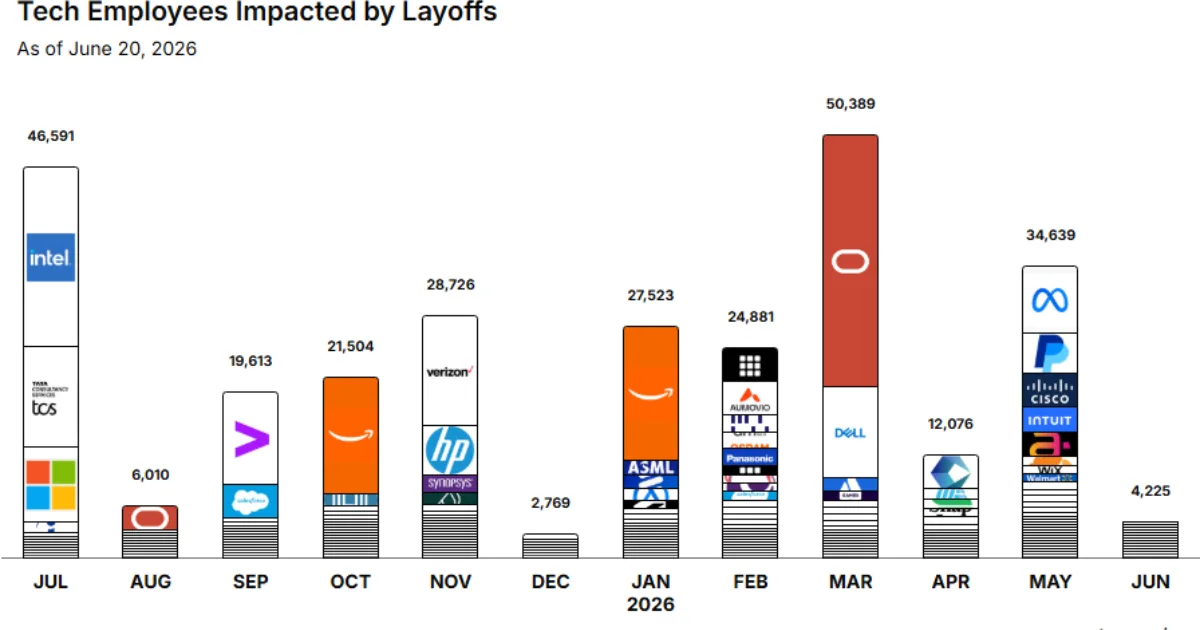
Tech layoffs are accelerating again in 2026. By June 20, technology companies worldwide had announced 404 layoff events affecting 153,733 employees, equivalent to an average of 899 jobs lost per day. In all of 2025, the technology sector recorded 783 layoffs affecting 245,953 workers, or about 674 people per day.
With less than half the year completed, the pace of job cuts is already running ahead of last year’s rate.
At first glance, the numbers suggest that the “tech winter” of 2022 and 2023 may be returning. But the nature of the current layoffs is different. Earlier job cuts were largely framed as corrections to pandemic-era overhiring. The layoffs of 2026 increasingly look like part of a broader redesign of how technology companies operate in an AI-driven economy.
Companies are not merely reducing headcount to lower expenses. They are shrinking traditional organizations to free up capital for AI infrastructure, data centers, high-performance chips, model development, AI agents and automation systems. Alongside layoffs, companies are freezing hiring, reducing management layers, restructuring overseas operations, consolidating business units and selectively recruiting AI specialists.
The key question for the technology industry is no longer whether AI eliminates jobs. A more accurate question is this: when companies redesign themselves around AI, which roles disappear first, and which workers become newly valuable?
899 Jobs a Day: Layoffs Are Becoming a Permanent Operating Model
One of the defining features of the 2026 layoff cycle is that it is not driven only by a small number of dramatic, one-time mass layoffs. Instead, companies are increasingly conducting rolling layoffs: repeatedly reviewing teams, consolidating functions, eliminating certain roles and selectively hiring in areas they consider strategically important.
In the past, large job cuts often followed a clear event — weak earnings, a merger, a failed acquisition or the closure of a major business line. Today, companies are more likely to adjust their workforces continuously. Teams are merged, layers are removed and some jobs disappear while new positions are created elsewhere.
Recent cases illustrate the trend. Online travel company lastminute.com said it would cut about 400 jobs, or roughly 25% of its workforce, as part of an AI transition. Game developer Bungie has reportedly planned cuts affecting around 400 workers, while Ubisoft has continued to reduce headcount through studio closures and restructuring. Robinhood announced plans to cut about 290 jobs, or 10% of its workforce, in an effort to simplify organizational layers.
The pattern extends across fintech, gaming, e-commerce, software-as-a-service, electric vehicles, health technology and advertising technology. This suggests that the trend is not simply the result of a downturn in one industry. It reflects a broader change in the operating model of technology companies.
In earlier cycles, layoffs were concentrated among startups facing funding shortages. Today, even companies with growing revenue and strong business performance are cutting staff. Robinhood, for example, emphasized its business momentum while announcing job reductions, arguing that it needed a faster and simpler organizational structure.
That distinction matters. When companies cut jobs because business conditions are weak, hiring may return as the economy recovers. But when layoffs are justified by AI-driven productivity gains and structural efficiency, companies may not rehire at the same scale even if revenue improves.
AI Investment Creates a Trade-Off Between Payroll and Infrastructure
Technology companies in 2026 are facing two conflicting pressures.
The first is the need to invest heavily in AI to avoid falling behind competitors. The second is the need to ensure that those investments do not damage profitability or weigh too heavily on stock prices.
AI competition is no longer limited to software features. It has become a capital-intensive race involving data centers, GPUs, networking, power supply, cooling systems, model training, inference costs and security infrastructure. Companies cannot simply add an AI feature to an existing product. They must demonstrate to investors that enormous infrastructure spending will eventually translate into revenue and profit.
In this environment, payroll becomes one of the easiest costs to adjust. Data center construction and GPU procurement are often tied to long-term contracts and supply chains. Organizational layers, duplicated roles and hiring plans can be changed much more quickly.
This makes AI-era layoffs less about the simple replacement of people by machines and more about reallocating money from labor costs to AI infrastructure. Companies may reduce operations, administrative functions and support roles while paying higher salaries to recruit AI researchers, data engineers, AI product managers, infrastructure operators, cybersecurity specialists and AI-focused sales teams.
This is why layoffs and hiring can happen simultaneously. Overall headcount may decline, but the composition of the workforce changes. The challenge is whether existing employees can move quickly enough into the new roles companies are trying to fill.
Is AI the Cause of Layoffs — or the Language of Restructuring?
AI now appears frequently in layoff announcements. Companies often say that AI adoption is changing workflows, improving efficiency and forcing them to reconsider the role of existing teams. But it would be inaccurate to blame every layoff on AI alone.
Many factors are working together: the aftereffects of pandemic-era overhiring, high interest rates, a tougher funding environment, slower consumer spending, advertising market volatility, weaker enterprise software growth, post-merger duplication and the withdrawal from overseas markets.
Robinhood, for example, emphasized flatter management layers and operational efficiency rather than AI itself. Shopee has reportedly cut staff in app development, product and commercialization functions as part of a broader reorganization that includes AI adoption. lastminute.com has placed AI transformation more directly at the center of its workforce reduction strategy.
The distinction is important. In some companies, AI is genuinely reducing workloads. In others, it functions more as management language that justifies cost cuts and business restructuring.
Even where AI is not the direct cause, it is still changing the logic of layoffs. In the past, revenue declines were often the central trigger for job cuts. Today, companies are increasingly asking whether the same output can be produced with fewer people because of AI. Employment stability is shifting from being tied mainly to revenue growth toward being tied to expected productivity.
The Middle Layer of Organizations May Face the Greatest Pressure
The parts of an organization most likely to face pressure during AI-driven restructuring are those built around repetitive tasks and middle-level coordination.
Scheduling, report writing, basic data analysis, customer inquiry classification, content drafting, marketing operations, recruiting support and internal document organization are all areas where generative AI and automation tools can be deployed quickly.
But the more significant impact may fall not only on repetitive work, but on middle management. If AI can summarize information, assign tasks, manage calendars, monitor performance and automate reporting, the need for multiple layers of approval and coordination may decline.
This is why companies increasingly say they want to “flatten” their organizations. The goal is to reduce the number of managers, shorten decision-making processes and give a smaller number of high-performing employees broader responsibility.
As AI improves the productivity of individual contributors, roles centered on collecting, relaying and coordinating information across multiple layers may become less important.
This could polarize the technology labor market. On one side will be highly skilled workers who can design AI systems, control them and apply them to customer or business problems. On the other side will be operations, support and mid-level coordination roles where automation can spread quickly.
The dividing line may not be simply between people who use AI and people who are replaced by AI. It may be between people who can use AI to take on greater responsibility and judgment, and people whose roles remain easy to standardize and automate.
Gaming, Travel and E-Commerce: AI Restructuring Takes Different Forms
The current layoff wave is not limited to software companies.
In gaming, rising development costs, longer production cycles, uncertainty around blockbuster releases, large-project concentration and studio consolidation are all contributing to job cuts. Layoffs at Bungie, Ubisoft and other game developers are not caused by AI alone. They are also linked to project failures, rising production budgets and intense competition in live-service gaming.
Still, AI is changing the cost structure of the industry. As automation expands into art production, quality assurance, localization, customer support, community management and marketing content creation, game companies may attempt to maintain production and operations with fewer workers.
In travel, AI is being applied to customer support, product recommendations, price comparison, booking changes and marketing automation. lastminute.com’s large-scale layoffs suggest that AI may be used not merely as an assistant, but as a tool for restructuring customer-facing and operational teams.
In e-commerce, AI is transforming product listings, search, recommendations, advertising operations, seller support and customer service. Shopee’s workforce reductions suggest that AI adoption can affect not only development teams, but also product planning, commercialization and market operations.
AI restructuring therefore takes different forms across industries. In one sector, it appears as production automation. In another, it reshapes customer service. Elsewhere, it is tied to project cancellation and changes in capital allocation.
The common thread is that companies are increasingly viewing headcount not simply as an asset required for growth, but as a cost structure that can be redesigned around AI.
The Age of Layoffs Followed by Rehiring
Another important feature of the 2026 technology labor market is the coexistence of layoffs and recruitment.
Companies may cut large numbers of employees while continuing to hire in AI research, cloud infrastructure, cybersecurity, data engineering, sales and industry-specific AI consulting. But displaced workers cannot necessarily move directly into those new roles.
Employees who previously worked in product operations, customer support, general software development, marketing, HR or management may need significant retraining and career reconstruction before they can transition into AI infrastructure, model development, advanced data roles or cybersecurity.
Even within the same company, the gap may widen between workers who can move into new AI-related roles and those who are pushed outside the organization. Companies may give greater authority and compensation to a smaller number of employees who can use AI effectively, while applying hiring freezes, outsourcing, contract conversion or layoffs to roles seen as highly automatable.
This change raises a broader labor-market question. It may no longer be enough to learn basic coding or become familiar with AI tools. Workers may need to develop the ability to verify AI-generated outputs, understand customer, operational and regulatory context, manage risks and make accountable decisions.
In the AI era, competitive advantage may depend less on operating a particular tool and more on turning AI output into real business performance while managing its risks.
Looking Beyond the Numbers
Layoff trackers provide an important measure of the temperature of the technology industry. But headline figures alone cannot capture the full picture. Different tracking platforms define “technology companies” differently, may count only publicly announced layoffs, and often miss unreported cuts, attrition and hiring freezes.
Still, the direction of the 2026 trend is clear.
Technology companies are no longer proving growth simply by adding more employees. Increasingly, corporate value is being judged by whether companies can generate higher revenue, launch products faster and produce stronger AI investment returns with fewer people.
AI may not eliminate jobs all at once. But it is changing the way companies hire, manage and evaluate workers. Layoffs are where that transformation becomes most visible.
The layoffs of 2026 are both a signal of economic pressure and a signal of structural transition. Companies are experimenting with operating models designed to produce more output with fewer employees through AI. Whether that experiment leads to sustainable productivity gains or deeper labor-market instability and polarization remains uncertain.
But one thing is clear: the future of technology employment will be judged less by how many people a company hires, and more by which workers it retains, which tasks it automates, and who ultimately bears the cost and responsibility of that transformation.