For years, competition in the artificial intelligence semiconductor industry has centered on building faster and more powerful chips.
The ability to perform more computations, train larger AI models, and process more requests within a given period has traditionally defined semiconductor performance.
But as AI evolves beyond answering questions into autonomous agents capable of performing actual work, a different set of challenges is emerging.
When AI systems execute multiple tasks simultaneously, process enormous documents, and interact with external applications, increasing computational performance alone cannot solve every problem.
Sometimes the bottleneck is the speed at which data can be retrieved.
When multiple AI agents process large volumes of information, memory capacity may become insufficient.
In finance, healthcare, and government, protecting sensitive information during AI processing is a critical concern.
Expensive computing resources may also remain idle while AI agents wait for responses from external systems.
Google has introduced a new strategy to address these changing requirements.
On November 9, 2026, the company announced the addition of TPU 8tx and TPU 8i Max to its eighth-generation Tensor Processing Unit portfolio.
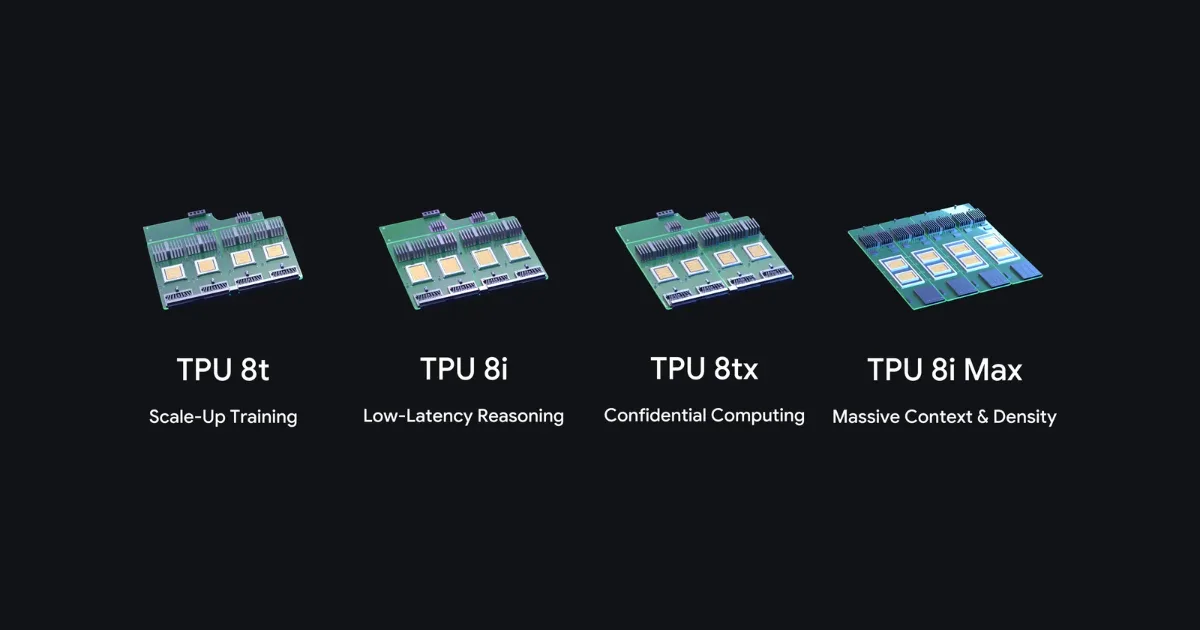
Together with TPU 8t and TPU 8i, introduced in April, Google has now presented four TPU systems within a single year.
Each serves a different purpose.
TPU 8t is designed for large-scale AI model training.
TPU 8i focuses on low-latency inference.
The newly announced TPU 8tx emphasizes confidential computing for sensitive data.
TPU 8i Max targets AI workloads requiring extensive context processing and memory resources.
Through these four systems, Google intends to address a broader range of computing requirements, from AI training and real-time inference to sensitive-data processing and large-scale agent operations.
What makes the announcement particularly interesting is Google's emphasis on the word "system" rather than simply introducing new semiconductor chips.
The company is signaling that combining chips with memory, networking, and software is becoming as important as improving the performance of individual processors.
AI semiconductor competition is shifting from a race to build the single most powerful chip toward a contest over who can assemble the most efficient computing systems for different AI workloads.
1. Why Are AI Agents Changing Semiconductor Requirements?
Early generative AI services had relatively straightforward operating patterns.
A user entered a question.
The AI model processed the input and generated a response.
The central computational task involved interpreting the input and predicting subsequent tokens.
AI agents operate differently.
Consider a software development agent assigned to repair errors in a large software project.
The agent must first read the relevant code.
It needs to identify where errors occur and understand how different files are connected.
It may then execute tests, examine the results, and revise the code.
As the task continues, the agent must retain and reference information collected during earlier steps.
If multiple agents collaborate, they may also need to share their task states and intermediate results.
In such environments, computing power is not the only important resource.
Memory capacity is needed to store and retrieve extensive context.
Fast networking is necessary to transfer information between processors.
Systems must also manage computing resources efficiently while agents wait for external tools to complete their operations.
This helps explain why Google described the transition from human-scale computing to agent-scale computing.
AI agents can perform more complex work, but they also introduce resource-management challenges that traditional computing systems were not always designed to address.
The competitiveness of AI accelerators may therefore increasingly depend on how much useful work they can complete, rather than simply how many operations they can theoretically perform per second.
2. Why Did Google Create Four TPU Systems Within One Generation?
Google's latest announcement expands its eighth-generation TPU lineup into four distinct systems.
TPU System | Primary Role | Key Characteristics |
|---|---|---|
TPU 8t | Large-scale AI model training | Training performance and energy efficiency |
TPU 8i | Real-time inference and reasoning AI | Low latency and efficient inter-chip communication |
TPU 8tx | AI processing involving sensitive information | Hardware-based confidential computing |
TPU 8i Max | Long-context processing and large-scale agents | Expanded compute, memory bandwidth, and rack density |
Google explained that the four systems do not all require entirely new semiconductor designs.
That distinction is important.
Developing a new chip involves designing enormous numbers of transistors and preparing manufacturing processes.
Semiconductor development requires substantial time and investment.
By comparison, changing how existing chips are connected and how memory and networking resources are configured can potentially be accomplished more quickly.
Google describes its approach as building computers around chips.
Rather than creating entirely new silicon for every requirement, the company combines existing chips with different supporting technologies to create purpose-built systems.
For example, TPU 8tx uses the same underlying silicon as TPU 8t.
However, it combines that silicon with security capabilities and low-latency networking to support a different category of workload.
TPU 8i Max combines two TPU 8i chips within a single package.
This expands computational and memory resources to support long-context processing.
The strategy is significant because AI computing requirements are changing rapidly.
Designing a completely new semiconductor for every emerging need could take years.
Modifying system configurations around existing chips could allow companies to respond more quickly.
Google argues that this modular approach could enable new specialized computing systems to be delivered within months rather than years.
However, the announcement did not disclose detailed comparative figures establishing actual development-time reductions or cost savings.
3. Why Does TPU 8tx Emphasize Security Inside the Processor?
TPU 8tx is one of the most interesting systems in Google's new lineup.
The company said it was designed for enterprises and government organizations handling sensitive information.
Data can generally be encrypted while stored.
It can also be encrypted while traveling across networks.
But when a computer processes that data, the relevant information must be made available for computation.
Protecting data during processing therefore presents an additional challenge.
TPU 8tx addresses this requirement through hardware-based confidential computing.
According to Google, the system is designed to protect and isolate sensitive information and AI model weights even while computations are being performed.
The system uses the same silicon as TPU 8t and combines it with fifth-generation AMD EPYC CPU hosts.
It also incorporates Google's low-latency Boardfly network.
Google claims that the configuration can reduce latency by up to a factor of two compared with TPU 8t while producing negligible performance degradation.
However, reducing latency by up to a factor of two does not mean that every AI workload will run exactly twice as fast.
Performance improvements depend on workload characteristics, system configuration, and measurement conditions.
Supporting hardware-based confidential computing also does not eliminate every risk of data leakage or cyberattack.
Confidential computing is designed to protect information against particular threat scenarios.
Overall system security still depends on access controls, software security, operational configurations, and other safeguards.
Nevertheless, the strategic change is clear.
Google is treating security not merely as an additional software feature, but as a consideration incorporated into the design of AI computing systems themselves.
4. What Does Enterprise AI Need to Process Sensitive Information?
For AI to become deeply integrated into enterprise operations, it must be able to use internal organizational data.
Most important business activities cannot be completed using public internet information alone.
Financial institutions handle customer transactions and internal risk-management records.
Healthcare organizations maintain sensitive patient information.
Government agencies process administrative information that may not be publicly accessible.
AI could improve productivity by working with these information sources.
But doing so creates concerns about data protection.
When AI models operate in external cloud environments, enterprises often want to know where their information is processed and who may be able to access it.
TPU 8tx is designed to address some of those requirements.
Google says enterprises can perform model fine-tuning, distillation, and reinforcement learning without moving sensitive information to a separate cluster.
Consider a company seeking to improve an AI model using proprietary internal documents.
In some environments, the company might need separate infrastructure for model training and production inference.
If the same system can support model customization and inference, it could reduce data movement and operational complexity.
However, the actual cost savings must be evaluated in real enterprise environments.
Compliance with national regulations also cannot be determined by encryption features alone.
Data residency, access permissions, audit logs, operational responsibility, and other legal and technical conditions remain important.
TPU 8tx is best understood as an attempt to provide a technical foundation for addressing these requirements.
5. Why Did TPU 8i Max Double Memory Resources?
While TPU 8tx focuses on security, TPU 8i Max addresses memory-related challenges.
As AI agents undertake more complicated tasks, they may need to reference large quantities of information simultaneously.
Examples include analyzing the entire codebase of a complex software project or processing several hours of video.
Memory requirements can also increase when multiple agents collaborate and exchange information.
Even when a processor has sufficient computing power, the overall system may slow down if memory cannot supply the required data quickly enough.
This is commonly described as the "memory wall."
To address the issue, Google combined two low-latency TPU 8i chips within a single package.
According to the company, this doubles computational performance, SRAM resources, and high-bandwidth memory (HBM) bandwidth compared with a single TPU 8i.
The system therefore expands both computing capability and memory performance.
That balance is important.
Faster processors deliver limited benefits if the data they need cannot be supplied quickly enough.
Increasing computing power and memory capabilities together can help alleviate this constraint.
Google also emphasized the ability to deploy more computing capacity within existing rack space.
Physical space and power availability are limited resources in data centers.
However, doubling computing and memory resources does not guarantee that every AI workload will run twice as fast.
Actual performance depends on model characteristics, context length, memory access patterns, and system configuration.
6. Why Does Memory Matter in the Era of Million-Token Contexts?
As AI models support increasingly long contexts, new applications are becoming possible.
Earlier systems primarily handled relatively short exchanges of questions and answers.
Today, organizations want AI to work with hundreds of pages of documents, large software repositories, lengthy videos, and multiple information sources simultaneously.
But long-context processing requires extensive management of intermediate computational results and state information.
One important example is the key-value cache, or KV cache.
Transformer-based language models use KV caches to store information associated with previously processed tokens.
This allows them to avoid repeating certain calculations when generating subsequent tokens.
As context length increases and more users are processed concurrently, memory requirements for KV caches can grow substantially.
Simply acquiring more powerful processors may not resolve the resulting bottlenecks.
Memory capacity, memory bandwidth, and data transfer speed become critical factors.
This helps explain why Google designed TPU 8i Max for long-context processing.
However, the ability to process one million tokens and the ability to accurately understand and use every piece of information within those tokens are different capabilities.
The former concerns the amount of input that the model and its supporting infrastructure can process.
The latter concerns actual reasoning accuracy and information utilization.
Google's announcement focused primarily on the infrastructure requirements associated with the first challenge.
7. Why Is Google Competing Differently from Nvidia?
Nvidia has maintained a powerful position in the AI semiconductor market for years.
Its competitive advantages extend beyond GPU performance.
The company has built a broad software ecosystem around CUDA while investing heavily in networking and integrated system design.
Google's TPU represents an important alternative within this market.
TPUs evolved from Google's experience operating its own AI services.
They were initially developed for internal workloads such as speech recognition and translation.
Their use subsequently expanded to training and running Gemini models and supporting AI services offered to Google Cloud customers.
More recently, Google has begun extending its TPU business toward deployment in customers' own data centers.
According to Google, the TPU customer base now approaches 100 organizations.
These customers include large AI model developers, financial trading companies, retailers, and universities.
The development suggests that TPUs are evolving from specialized processors used primarily within Google into commercial infrastructure available to external customers.
However, a customer count approaching 100 does not establish how much of Nvidia's GPU market Google has replaced.
Standalone TPU revenue, market share, and customer-level usage volumes have not been disclosed.
Nevertheless, the competitive direction is becoming clearer.
Rather than simply reproducing the general-purpose capabilities of GPUs, Google is combining specialized computing systems with software optimized for particular AI workloads.
The approach represents an attempt to establish differentiated alternatives in the AI infrastructure market.
8. PyTorch Support May Be More Important Than the New Chips
The commercial competitiveness of an AI accelerator depends on more than hardware performance.
It also depends on how easily developers can use it.
Even an exceptionally fast processor may be difficult to adopt if running existing AI models requires extensive code modifications.
AI developers already rely on established tools and software environments.
PyTorch is among the most widely used.
Many AI research and development projects are built using PyTorch.
Consequently, the ability to run existing PyTorch workloads efficiently is important for any new accelerator platform seeking widespread adoption.
Google announced that it had released TorchTPU as open-source software.
The company said TorchTPU is intended to support running PyTorch code and Hugging Face models on TPUs without requiring developers to rewrite their code.
Google also expanded support for open-source inference engines, including vLLM and SGLang.
This development is more than a matter of convenience.
When AI software is tightly integrated with a particular hardware ecosystem, moving to another processor architecture creates switching costs.
Google is attempting to reduce those costs.
However, the claim that code can run without rewriting does not guarantee universal compatibility or identical performance across every custom operation and model architecture.
Actual deployment environments still require validation of supported features and optimization levels.
Nevertheless, improving developer accessibility is clearly an important component of Google's strategy to expand TPU adoption.
9. AI Is Beginning to Optimize the Semiconductors That Run AI
Google is also using artificial intelligence in the development and operation of its TPU systems.
The announcement included a new collection of open-source TPU agent tools.
These tools are designed to connect with AI coding environments such as Claude Code, Cursor, and Google Antigravity.
Developers can use natural language to receive assistance with configuring TPU environments, diagnosing performance bottlenecks, and optimizing custom kernels.
In effect, AI is being used to optimize the systems that execute AI.
The objective is to reduce the specialized knowledge and repetitive work required to operate advanced AI infrastructure.
Google also explained that DeepMind's AlphaChip reinforcement learning system has been used in semiconductor design.
The company presented examples in which Gemini helped shorten chip layout tasks from several weeks to a matter of hours.
These developments suggest that different parts of AI technological progress are becoming increasingly interconnected.
More capable AI models can assist in designing and optimizing semiconductors and computing systems.
Improved semiconductors and systems can then support the development and operation of more capable AI models.
This feedback loop could accelerate technological development.
However, reducing the duration of particular design tasks does not mean the entire semiconductor development process becomes proportionally shorter.
Chip design and manufacturing still involve many additional stages.
10. When AI Agents Are Waiting, Data Centers May Be Wasting Money
Another important part of Google's announcement concerns technology beyond semiconductor hardware.
The company introduced Agent Compute Engine.
AI agents use computing resources differently from conventional inference services.
Consider an AI agent requesting information from a database.
The agent may need to wait for the database response.
It might also execute an external program and wait for that program to finish.
Some tasks may require human approval, leaving an agent waiting for minutes or even hours.
If computing resources remain allocated throughout these waiting periods, substantial inefficiencies can arise.
Google introduced a mechanism intended to automatically suspend idle agent sessions and restore them when execution resumes.
The objective is to reduce wasted computing capacity.
This could become increasingly important as the number of AI agents grows.
In environments with large numbers of concurrently running agents, even short waiting periods may accumulate into substantial resource costs.
The economics of AI agents therefore depend on more than inference speed.
Efficient management of computing resources during periods of inactivity also matters.
Google did not disclose a specific average cost reduction attributable to Agent Compute Engine.
Actual savings will depend on waiting times, workload characteristics, and resource usage patterns.
11. Why Does TPU Sync Connect Different Memory Resources into One System?
Google also introduced another software technology called TPU Sync.
TPU Sync is designed to manage state information associated with AI models.
Its central principle is to use multiple memory and storage resources together rather than relying exclusively on the fastest memory attached to GPUs or TPUs.
The architecture connects TPU high-bandwidth memory, host computer DRAM, and shared storage within a hierarchical memory system.
For example, not every piece of KV cache data needs to remain permanently in expensive HBM.
Less frequently used information can potentially be transferred to another memory tier and retrieved when needed.
Google said TPU Sync can reduce KV cache transfer latency and time to first token (TTFT) by more than 90%.
That represents a significant performance claim.
However, it does not mean that the total response time of every AI service will decline by 90%.
The reported improvement concerns particular data-transfer and initial-response latency measurements.
Actual results will vary according to the model, system configuration, and context length.
Nevertheless, TPU Sync illustrates the growing importance of memory management in agent-based AI workloads.
Improving how data is stored and transferred can increase system efficiency even without simply increasing raw computational performance.
12. Google Is Also Changing Data Center Connectivity Through Software
Google is improving how TPU systems are connected and operated.
Two important technologies are Cloud Pathways and GKE Dynamic Slicing.
Cloud Pathways is intended to support the management of multiple TPU systems as a larger computing environment.
Google aims to make distributed execution technologies developed while operating Gemini available to external cloud customers.
GKE Dynamic Slicing allows physical TPU resources in a data center to be assembled into different logical configurations.
The approach uses optical circuit switching, or OCS.
When a large workload requires extensive computing capacity, TPU resources can be connected to create a larger system.
Conversely, a large pool of resources can be divided into smaller configurations assigned to independent tasks.
Google claims this approach can reduce workload startup times by up to a factor of five and accelerate failure recovery by up to a factor of 4.5.
These figures should be understood as performance claims measured under particular configurations and conditions.
Nevertheless, the strategic significance is clear.
The competitiveness of AI data centers depends not only on which processors they contain, but also on how flexibly those processors can be connected and assigned to actual demand.
Physical hardware may remain fixed in a data center.
But software can change how those resources are organized and utilized.
Google is attempting to turn this flexibility into a competitive advantage.
13. Why Is Google Expanding TPU Deployment into Customer Data Centers?
TPUs were not originally designed primarily for sale to outside companies.
They were developed to support Google's internal AI workloads.
Today, they are used not only for Gemini but also by Google Cloud customers.
The company is now expanding toward arrangements in which customers can deploy TPUs within their own data centers.
This represents a significant change in Google's AI infrastructure business.
Historically, customers generally accessed TPU computing capacity through Google Cloud.
The emerging strategy creates an additional option for customers seeking to use TPU systems within their own infrastructure.
That could appeal to large enterprises and government organizations that prefer to control their data and computing environments directly.
Customers with particular requirements concerning data processing locations and operational authority may also be interested.
Confidential computing systems such as TPU 8tx are particularly relevant to these needs.
However, the availability of customer-site deployments, contractual arrangements, and geographic coverage may vary.
It would therefore be premature to conclude that TPUs are universally available for purchase and installation in the same way as ordinary server components.
What has been established is Google's intention to expand TPU deployments beyond its internal services and Google Cloud.
This could broaden its competitive overlap with Nvidia and other AI accelerator providers.
14. Is Google's Real Competitive Advantage Integrated System Design?
Looking across Google's announcement, one common theme emerges.
The company is not discussing semiconductor performance alone.
TPU 8tx emphasizes security.
TPU 8i Max focuses on memory bandwidth and computing density.
TorchTPU addresses developer accessibility.
Agent Compute Engine seeks to reduce wasted resources during idle periods.
TPU Sync improves memory hierarchy and data movement.
Cloud Pathways and Dynamic Slicing allow distributed computing resources to be organized more flexibly.
Each technology addresses a different potential bottleneck within an AI system.
Google brings them together under its broader AI Hypercomputer strategy.
Rather than developing models, processors, networks, memory, and software independently, the company seeks to design these components with one another's requirements in mind.
Google has collaborated with DeepMind on TPU design for years.
It now says it is placing greater emphasis on the requirements of external customers as well.
Such collaboration allows the computational characteristics of actual AI models to influence processor and system design.
Conversely, AI models and software can be optimized around the characteristics of new computing hardware.
The potential advantage is higher efficiency for particular workloads.
But this approach also introduces challenges.
As systems become more closely optimized for proprietary hardware, maintaining compatibility with broader development environments becomes increasingly important.
Google's expanded support for TorchTPU and open-source software can be understood as an effort to reduce that problem.
15. Utilization Could Determine the Economics of AI Infrastructure
AI semiconductors and data centers require enormous capital investment.
Companies must acquire advanced processors and build networking and storage infrastructure.
They also need electricity and cooling systems.
For these investments to generate attractive financial returns, the resulting resources must be used efficiently.
An important measure is utilization.
When expensive processors sit idle, the economic productivity of invested capital declines.
Conversely, completing more useful work with the same infrastructure can improve the cost structure.
Several technologies in Google's announcement address this issue.
Agent Compute Engine seeks to reduce wasted computing resources while agents are waiting.
TPU Sync aims to make memory transfers more efficient.
Dynamic Slicing allows computing resources to be assembled in configurations appropriate for each workload.
TPU 8i Max seeks to deliver greater computational capability within the same rack space.
All these approaches are intended to increase the amount of useful work completed using limited data center resources.
This illustrates an important change in the AI industry.
A processor with the highest theoretical performance is not necessarily part of the most economically efficient computing system.
What matters is the throughput and cost achieved when processing real customer workloads.
The competitiveness of AI infrastructure providers may therefore increasingly be measured by overall operational efficiency rather than the specifications of individual chips alone.
16. Could Google's TPUs Challenge Nvidia's Position?
Google's expanded TPU portfolio makes its competition with Nvidia more visible.
However, the announcement does not establish that the market leader has changed.
Google said its eighth-generation TPUs improve training performance and inference price-performance compared with previous generations.
According to the company, TPU 8t provides up to 2.7 times the training performance of its predecessor.
TPU 8i offers an 80% improvement in inference price-performance.
However, these figures compare Google's new systems with its own previous-generation products.
They are not direct comparisons against the latest Nvidia GPUs under identical testing conditions.
They therefore cannot establish that TPUs outperform Nvidia hardware across all AI workloads.
Semiconductor competitiveness also depends on software support, customers' existing investments, and switching costs.
Nvidia has spent years developing its GPU and CUDA ecosystem.
For Google to expand its external customer base, it must demonstrate not only strong TPU performance but also the ability to support existing AI development environments.
That is why TorchTPU and compatibility with open-source inference engines are important.
The announcement suggests that Google is not attempting to replace Nvidia with a single alternative processor.
Instead, it is trying to build an alternative AI infrastructure ecosystem through workload-specific systems and integrated software.
AI Semiconductor Competition Is Moving Beyond Chips Toward Complete Systems
Google's latest announcement expands its eighth-generation TPU lineup into four systems.
TPU 8t for AI training.
TPU 8i for low-latency inference.
TPU 8tx for confidential computing involving sensitive information.
TPU 8i Max for long-context processing and memory-intensive workloads.
Each system targets a different category of AI work.
The diversity of this lineup reflects how rapidly AI applications are changing.
Not every company needs to train a large AI model from scratch.
Some organizations use existing models to deliver services.
Others need to customize models using sensitive internal information.
Still others are developing systems in which multiple AI agents perform complex business operations.
These activities place different demands on computing infrastructure.
As a result, configuring systems around specific workloads may become more important than attempting to serve every requirement with a single processor design.
Google is responding by strengthening an approach that combines semiconductors, memory, networking, and software.
However, commercial success will depend on additional factors.
Developers must be able to use the systems easily.
Compatibility with existing software must be demonstrated.
Customers need evidence that the technology reduces costs in real business environments.
Many of Google's reported performance improvements are based on configurations and measurement conditions defined by the company.
Further validation will be necessary to determine whether comparable performance and economic benefits can be achieved across diverse enterprise workloads.
Nevertheless, the central message is clear.
AI semiconductor competition no longer ends with building a faster chip. Increasingly, the question is what kind of computer can be built around that chip—and how much real work it can perform safely and efficiently.
When AI systems primarily answered human questions, executing models quickly was a central priority.
But as AI expands into agents that use multiple tools, perform long-running tasks, and handle sensitive information, the design of the entire computing system is becoming increasingly important.
Google's TPU announcement represents an attempt to address that transformation.
The winners of the next phase of AI infrastructure competition may not be determined by semiconductor benchmark tables alone.
A more important measure could be how effectively companies integrate computing, memory, networks, security, and software to reduce customer costs and improve productivity.
And in that competition, Google is placing its bet not simply on the performance of individual chips, but on its ability to design complete computing systems around the way AI actually works.