A license plate is public information.
A vehicle’s plate on a public road can be seen by anyone. Police can see it. Other drivers can see it. It may be captured by a camera outside a store. For a long time, that fact supported a familiar legal argument: people have a reduced expectation of privacy in the movements of vehicles visible on public roads.
But the question has changed.
Is it the same thing for a police officer to happen to see a plate once, and for an automated license plate reader system to record vehicle locations across the country, store them in a searchable database, and allow an investigator to retrieve a month of travel history with a few clicks?
A federal court in Oklahoma said no.
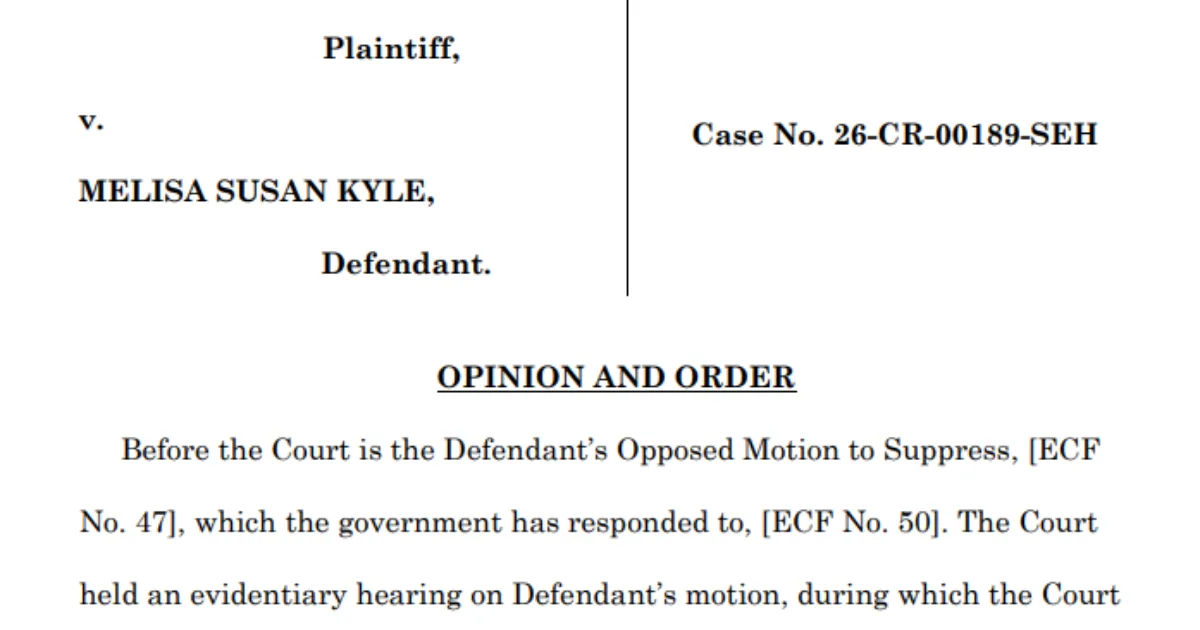
On October 1, 2026, the U.S. District Court for the Northern District of Oklahoma granted the defendant’s motion to suppress in United States v. Melisa Susan Kyle. The court held that the initial traffic stop was justified, but that the officer unlawfully prolonged the stop. More importantly, the court found that the officer’s query of historical vehicle-location information through automated license plate reader systems was a warrantless search under the Fourth Amendment.
The case began with a Mazda SUV.
Tulsa County Sheriff’s Deputy Freddie Alaniz was working drug interdiction near a highway. His patrol vehicle was equipped with an external camera that could read passing license plates. That camera was connected to automated license plate reader, or ALPR, networks that collect plate numbers along with dates, times and locations.
According to reports on the ruling, Alaniz had access to at least two ALPR systems, Flock and VehicleManager. These systems differ in features, but their core function is similar: they collect and organize information about where vehicles are captured on public roads and make that information available to law enforcement users.
The record did not clearly resolve every question about how long the data was stored or which entities stored it.
But at the time of the case, Alaniz could access at least 30 days of vehicle-location records across multiple states. He could not access California data, but he could see records captured in other states. The court found that the query returned more than 50 records of the vehicle’s movements across multiple states over roughly a month.
One evening, Alaniz was parked along the highway watching passing traffic.
A Mazda SUV with a California license plate drove by. The patrol-car camera read the plate, and Alaniz began following the vehicle. The court viewed the California plate as essentially the only reason he began focusing on the Mazda.
At the same time, Alaniz queried the plate in the Flock system.
The search reason was entered as “traffic violation” and “investigation.” But at that moment, the only fact he knew was that the vehicle had a California plate. The query showed that the Mazda had traveled from Locust Grove, Oklahoma, toward the California-Arizona border, stayed briefly, and was heading back toward Missouri.
Alaniz then stopped the vehicle.
He believed the driver had failed to signal 100 feet before changing lanes and had followed another vehicle too closely. The court held that the following-distance violation supplied an objective basis for the traffic stop. So the initial stop was lawful.
The problem came next.
Alaniz asked the driver, Melisa Kyle, for her license, insurance and registration, and told her he would not issue a ticket. Kyle explained that the vehicle was a rental and that she had gone to California for a few days. Alaniz brought Kyle to the passenger seat of his patrol vehicle, asked her to look for the rental-car information and continued questioning her about the trip. At the same time, he continued checking the ALPR systems.
Kyle’s explanation was this.
She had gone to California for a few days, stayed about two nights, and visited people she had not seen in a long time. After separating from her husband, she had begun traveling because she felt she could now go places on her own. When asked when she left, she mentioned Monday, Tuesday and Wednesday while apparently counting back through the days. The court viewed this not as suspiciously changing her story, but as a natural effort to recall the timing.
Kyle said she stayed in Needles, California, and visited a cousin in Bullhead City, Arizona. Those two places sit close to each other across the Colorado River near the California-Arizona border. The court found that this account made geographic sense and matched the ALPR information showing travel near the Arizona-California border, which actually supported the credibility of her explanation.
Alaniz issued a warning and returned Kyle’s license.
At that point, the traffic stop should have been over.
But Alaniz asked if she would answer more questions. He said he worked highway criminal interdiction and explained that short round trips to California were often associated with bulk drug transportation. He asked for consent to search the vehicle. Kyle refused. Alaniz then said he would detain her and requested backup so a drug-detection dog could be deployed around the vehicle. Kyle later said there was a small amount of marijuana in the vehicle. After the dog alerted, the vehicle was searched and Kyle was arrested.
The court separated the issues.
First, the initial traffic stop was justified.
Second, the continued detention after the traffic mission ended was not justified.
Third, the ALPR query itself raised a separate Fourth Amendment problem.
The first issue was the prolonged traffic stop.
Under the U.S. Supreme Court’s decision in Rodriguez v. United States, a traffic stop cannot be prolonged beyond its original traffic-enforcement mission without independent reasonable suspicion of criminal activity. Once the license and registration have been checked and the traffic matter is resolved, the driver must be allowed to leave unless new, specific grounds justify continued detention.
The Oklahoma court found that Alaniz did not have such reasonable suspicion.
The government pointed to several circumstances: the short California trip, luggage, cigarettes, the rental car, nervousness and Kyle’s later statement about marijuana. The court considered those factors one by one and then collectively, but found them insufficient.
Kyle’s trip may have been unusual, but unusual is not the same as criminal.
The court reasoned that driving a long distance to briefly visit family may not be ordinary, but it does not automatically suggest crime. Kyle said she went to see people she had not seen in a long time and that she enjoyed the drive. The court cited the familiar idea that traveling by car to see the scenery is not a crime.
The luggage was not decisive either.
Kyle explained that she had bought clothes and other items for her children during the trip and bought bags because carrying everything in plastic bags was inconvenient. The court acknowledged that the luggage may have seemed like a lot, but said that luggage on a long trip does not by itself create reasonable suspicion. Police experience matters, but it is not a blank check for turning innocent facts into suspicion.
The same was true of cigarettes, the rental car and nervousness.
A smoker smoking during a traffic stop is not especially suspicious. Using a rental car does not itself create reasonable suspicion. Many drivers are nervous when stopped by police. The court found that Kyle may have been talkative and somewhat scattered, but she was generally calm, answered questions appropriately and did not show extreme or sustained nervousness.
The marijuana statement came too late.
Sequence mattered. Kyle mentioned marijuana only after Alaniz said he would continue detaining her. That later statement could not retroactively justify the decision to prolong the stop. Reasonable suspicion must exist at the moment detention is extended. Facts discovered after an unlawful extension cannot make the extension lawful after the fact.
The court’s point was clear.
Kyle’s conduct and travel plans may have been consistent with drug transportation, but they were also consistent with the behavior of many innocent travelers. Reasonable suspicion must do more than describe facts that could fit both innocent and criminal conduct. It must provide a concrete basis for separating the suspect from a broad group of innocent people.
The court found the government had not done that.
So the detention after the license was returned was unconstitutional, and the evidence obtained after that point had to be suppressed.
But the more far-reaching part of the ruling concerned ALPR.
The court held that Alaniz’s use of the ALPR systems was a Fourth Amendment search. That is significant. Many lower courts have been reluctant to treat ALPR use as a search, often reasoning that vehicles travel on public roads and license plates are publicly visible.
This court put a limit on that logic.
The court considered the older Supreme Court case United States v. Knotts, where the Court held that a person had no reasonable expectation of privacy in the movement of a vehicle from one place to another on public roads. But the Oklahoma court distinguished Knotts. That case involved a simple beeper used to track one trip. It did not involve a nationwide, long-term, searchable database of historical vehicle movements.
Instead, the court gave more weight to the logic of Carpenter v. United States and related location-data cases.
In Carpenter, the Supreme Court held that acquiring historical cell-site location information was a Fourth Amendment search. The key idea was that people have a reasonable expectation of privacy in the “whole of their physical movements.” The Oklahoma court found that historical ALPR searches can implicate the same concern when they allow police to reconstruct a person’s movements over time.
Of course, ALPR data is not as precise as cell-phone location data.
A phone follows a person into homes, hospitals, political offices, religious sites and private spaces. ALPRs generally record vehicles on public roads. But the court did not treat that difference as decisive. Alaniz had access to roughly a month of location history and more than 50 sightings across multiple states. That was not a single public observation. It was retrospective reconstruction of movement.
The court saw this as close to indiscriminate mass surveillance.
ALPR systems do not necessarily begin by targeting a particular suspect. Networked cameras capture information about every vehicle that passes. Later, when police enter a plate number, the system reveals historical location records. In that structure, many vehicles are tracked first, and the suspect is chosen afterward. Reports on the decision said the judge described the use of the system as a form of “indiscriminate mass surveillance.”
The court used an intuitive distinction.
If a friend or family member says, “I saw your car near the store last week,” that is socially expected. But if someone, especially the police, says, “We tracked your vehicle for the last 30 days, have detailed records and photographic evidence of where it was, and can share that information with law enforcement agencies across the country,” that is a different matter.
That difference is the heart of the case.
Being visible once in public is not the same as having public movements accumulated, searched and shared over time. Privacy harm is not determined only by whether each individual fact is public. It also depends on how much information is collected, how long it is stored, how easily it can be searched and how widely it can be combined.
The court also recognized that ALPR data can reveal sensitive patterns of life.
A couple visiting a fertility clinic, a person who frequently goes to a bar or casino, or someone visiting a particular doctor, lawyer, political group or religious site may leave traces through vehicle-location records. Much of the information may be ordinary, such as commuting. But ordinary information becomes revealing when collected in bulk over time. The court asked why the government should be in the business of continuously collecting everyone’s movements and retrieving them later when needed.
This ruling reflects a shift in how courts are thinking about surveillance technology.
In the past, whether information was visible in public carried great weight. But digital systems turn publicly visible facts into persistent, automated databases. The court’s reasoning suggests that public visibility alone is not enough. When technology can reconstruct a person’s physical movements over time, Fourth Amendment protections may be triggered.
In this case, the ALPR query began with a very thin basis.
Alaniz searched the plate because the vehicle had a California plate. The court found that the search was not supported by probable cause and was done without a warrant. Therefore, the ALPR search violated Kyle’s Fourth Amendment rights.
The consequence was suppression.
The court found that the ALPR search led to the later traffic stop, search and arrest. Alaniz began following the vehicle while querying the ALPR systems, and that process ultimately led to the evidence. Because the government did not establish an exception to the exclusionary rule, the court suppressed the evidence obtained after the ALPR search as fruit of the poisonous tree.
The implications are not small.
First, ALPR cannot be treated merely as plate-reading technology.
An ALPR is not just a camera that reads a license plate. When many cameras are connected, when data is stored, searched and shared across agencies, it becomes vehicle-location tracking infrastructure. The issue is not one photo. The issue is historical location records.
Second, movement on public roads is not an unlimited surveillance target.
A person driving on a road cannot expect complete secrecy. But that does not mean the government may automatically database every movement and search it later. The constitutional difference lies between “the car was visible in public” and “the government can easily reconstruct a month of travel.”
Third, law enforcement’s use of surveillance technology needs prior controls.
ALPR can help investigate crime, find missing people and locate stolen vehicles. The court did not deny those benefits. But usefulness does not justify unlimited access. The more powerful the technology, the more important warrants, access standards, retention limits, audit logs and purpose restrictions become.
Fourth, surveillance technology is becoming networked.
In this case, Alaniz’s own patrol-car camera fed information into ALPR systems. It is not only fixed roadside cameras. Mobile police cameras also become part of the data network. Reports on the decision noted the court’s concern that more road signs, buildings, patrol cars and even drones could be folded into similar systems in the future.
This ruling also gives countries outside the United States something to think about.
Korea has dense vehicle-related data systems: road CCTV, license plate recognition, local government control centers, highway toll systems, parking entry and exit records, private security cameras, insurance data and rental-car records. Each system may have a different purpose. But when combined, they can reconstruct a person’s movements with significant detail.
The issue is not the technology itself.
The technology can be useful. It can support criminal investigations, traffic management, stolen vehicle detection and disaster response. The real issue is purpose limitation and access control.
Who can search the data?
On what legal basis?
How long is it retained?
How is it shared with other agencies?
Are search logs audited?
Is a warrant or court approval required?
The Oklahoma ruling matters because the court looked beyond technical convenience and examined the structure of privacy.
A plate is visible.
A road is public.
But a month of movement is different.
A single sighting may be public observation.
A long-term location database is surveillance infrastructure.
The court drew a line there.
ALPR is a powerful tool for police. But the more powerful the tool, the clearer its constitutional limits must be. In this case, Alaniz followed a vehicle and queried ALPR records because it had a California plate. The court said that was not enough to open a window into a person’s month-long travel history.
The core of the ruling is simple.
Even public information can change character when it is collected at scale and over time in a way that reconstructs a person’s life.
One license plate may be public.
But a record showing where that plate has been for the past 30 days is a movement history.
And a person’s movement history is not something the Fourth Amendment allows the government to inspect lightly without a warrant.