The prediction that artificial intelligence will replace human jobs has been around for years.
Yet it has been difficult to determine how much work AI actually performs inside companies, how it changes employees' responsibilities, and whether it affects hiring.
Companies adopting AI frequently report productivity improvements. But few disclose detailed internal data showing how much productivity has increased, whether recruitment has declined, or what new responsibilities employees have assumed.
Now, a company that develops AI has released its own internal data.
On October 16, 2026, Anthropic published a research report titled How Employment Is Changing at Anthropic. The study examined the company's employment records, AI usage, employee productivity metrics, surveys, internal communications, calendar data, and hiring evaluations, alongside interviews with 17 employees.
The researchers viewed Anthropic, one of the companies most actively using AI, as a potential early indicator of the organizational and employment changes that may emerge across other businesses.
The findings are striking.
As of August 2026, AI agents directly used by Anthropic employees accumulated execution time equivalent to six times the working hours of human employees.
The share of junior employees in technical departments fell from 21% in early 2025 to 14% in 2026. Over the same period, junior technical employees' share of new technical hires declined from 27% to 9%.
Meanwhile, the amount of code produced per engineer increased approximately fivefold compared with six months earlier.
As AI performed more work and employee productivity increased, the company was also changing how it recruited people and what capabilities it expected from them.
But the most interesting finding lies elsewhere.
Although AI agents were working for far more hours than employees, operational bottlenecks did not disappear.
Instead, the process of human employees reviewing AI-generated outputs, approving actions, and issuing subsequent instructions emerged as a new bottleneck.
It is difficult to understand this transformation simply by saying that AI is replacing people.
In organizations where AI performs work, the role of humans is changing fundamentally.
It Is Almost as If Each Employee Has Six AI Agents Working Behind Them
Anthropic's internal data illustrates how rapidly AI agents are reshaping corporate work.
According to the report, March 2026 marked the first time that the combined execution time of autonomous and conversational AI agents operating inside the company exceeded total human employee working hours.
By August, the execution time of conversational AI agents and subagents directly used by employees alone had reached six times human working hours.
This does not mean that every Anthropic employee literally employed six AI workers.
The researchers aggregated the time AI agents spent reasoning or using tools. Waiting periods exceeding 30 minutes were excluded, while human working hours were estimated by multiplying employee headcount by a standard 40-hour workweek.
AI execution time and human working hours therefore cannot be directly compared as equivalent measures of economic value or productive output.
Nevertheless, the underlying transformation is clear.
The amount of work performed by AI within the company is growing much faster than the amount performed directly by humans.
The most significant changes have occurred in software development.
At Anthropic, AI agents write code, conduct repetitive tests, fix bugs, and maintain infrastructure code. Multiple agents also collaborate on large-scale tasks such as converting extensive codebases from one programming language to another.
The organization has evolved beyond delegating isolated tasks to AI.
It is increasingly structured around multiple agents processing substantial workloads simultaneously.
Nor is the role of AI agents limited to engineering.
Some agents check employees' calendars and messages, schedule meetings, and organize to-do lists.
Others prepare briefings about upcoming meetings, identifying participants and explaining the purpose of each session.
Inside the company, AI is becoming more than a chatbot that answers questions.
It is becoming an active participant in operational workflows.
Why Did Junior Technical Hiring Fall to One-Third of Its Previous Share?
The employment effects of AI adoption were particularly visible among junior technical workers.
Within Anthropic's technical departments, junior employees accounted for 21% of the workforce in early 2025.
By 2026, that proportion had declined to 14%.
Junior employees' share of new technical hires fell from 27% to 9%.
In relative terms, the proportion of new technical hires going to junior workers had shrunk to one-third of its previous level.
This shift was already becoming apparent internally in early 2026.
According to the report, discussions about reduced demand for junior employees began in core technical departments in January.
Teams making extensive use of Claude were increasingly able to delegate tasks such as code writing and bug detection to AI.
By April, engineering and research organizations had lowered the priority of hiring relatively junior technical workers.
In a management survey conducted that month, approximately one-third of machine learning managers and one-fifth of software engineering managers said they were reducing hiring because of AI.
But an important distinction must be made.
This does not mean that Anthropic's total number of technical employees declined.
Anthropic is a rapidly growing company, and its technical workforce continued to increase in absolute terms.
However, other business functions, including sales, finance, and recruiting, expanded even faster.
As a result, the share of employees working in technical departments fell from 61% to 56% over one year.
Technical jobs were not simply disappearing.
Instead, the composition of the workforce and the company's hiring priorities were changing as the business expanded.
The implications for junior workers, however, deserve separate attention.
Companies can use AI to assist or automate the work of existing employees while assigning tasks previously performed by junior workers to AI systems.
If foundational tasks such as writing code, conducting tests, researching information, and organizing documents are automated, employers may have less reason to recruit entry-level workers.
This is not merely a question of how many jobs exist today.
It raises the question of how tomorrow's experienced professionals will be developed.
Skilled engineers do not begin their careers as skilled engineers.
They acquire expertise by writing relatively simple code, correcting errors, and gradually understanding complex systems.
If AI replaces those early-career activities, companies must answer a new question.
Where will junior employees gain experience?
This is one of the most important labor-market implications of the Anthropic report.
A Fivefold Increase in Engineering Output: Was AI Really Responsible?
Anthropic reported substantial increases in employee productivity following the adoption of AI.
The most dramatic changes appeared in software development.
By mid-2026, the number of code commits recorded per engineer had increased approximately fivefold compared with six months earlier.
Legal teams processed more contracts.
Sales employees closed more customer deals.
Accounting and finance functions also recorded higher throughput.
However, these findings require careful interpretation.
A fivefold increase in code commits does not necessarily mean that the business value of software or the productivity of developers increased by exactly the same amount.
Anthropic itself was also expanding at an extraordinary pace.
As more customers arrived and business opportunities grew, sales performance might have improved independently of AI adoption.
The researchers considered this problem.
They compared employees who adopted AI coding agents with those who had not yet done so and tracked individual employees over time.
The analysis included 192 engineers who adopted AI coding agents and 74 who did not adopt them during the study period.
The results showed a pronounced increase in code output following agent adoption.
The researchers also examined software quality.
They compared human-written code with AI-agent-written code produced by the same employee during the same month and within the same code directory.
They used several proxy measures of quality, including the proportion of code deleted within 90 days, code removed during bug fixes, whether commits were entirely reverted, and indicators associated with skipped tests or suppressed errors.
Across these measures, the researchers found no clear differences between AI-generated code and code written directly by humans.
But this does not establish that AI and human code are identical in every dimension of quality.
The researchers acknowledged that some factors remain difficult to measure, including the complexity of software defects, long-term maintainability, and actual business outcomes.
They also could not completely rule out the possibility that employees adopting AI tools were already more proactive or were preparing for new projects.
The study therefore demonstrates a strong relationship between AI adoption and increased output, but the entire observed increase should not be interpreted as the pure causal effect of AI.
Even with those limitations, the practical significance is considerable.
AI agents are moving beyond tools that save employees small amounts of time.
They are substantially expanding the volume of work that an individual employee can handle.
Employees Who Were Not Developers Have Started Building Software
Another important finding is that coding is no longer exclusively the responsibility of software developers.
Anthropic reported rapid growth in the number of employees who previously did not write code but were now building their own software with AI coding tools.
Among non-developer employees, coding-focused AI-agent sessions rose from an average of two per month in August 2025 to 90 per month in May 2026.
That represents a 45-fold increase in approximately nine months.
One sales employee built a sales-management dashboard and pipeline for personal use.
Previously, designing a user interface and connecting multiple tools through MCP had been outside the employee's area of expertise.
With AI, however, the employee said the necessary tool could be created in approximately three to four hours.
This example has important implications for organizational structure.
In the past, a sales department needing a new internal application would have submitted a request to an engineering team.
Developers would then have reviewed the requirements, established priorities, and scheduled the work.
As AI coding agents improve, employees increasingly can build the tools they need themselves.
This may change the traditional structure in which central technology departments handle most software-development requests.
Business employees may implement specific functions with AI, while engineering organizations focus on more complex system architecture, cybersecurity, shared infrastructure, and technical governance.
Changes were also visible within Anthropic's technical departments.
Over the year leading up to April 2026, the proportion of technical employees who had made no code commits in the previous 30 days fell by almost half.
Managers also began producing code more frequently.
The number of commits made by managers doubled.
The traditional distinction between those who develop software and those who manage development was becoming less clear.
This does not necessarily mean that AI is eliminating the role of developers.
Instead, as software-development capabilities spread throughout the organization, the areas requiring specialized engineering expertise are being redefined.
The More Work AI Performs, the More Humans Become the Bottleneck
Yet the expansion of AI agents has created a new problem.
The volume of output generated by AI is growing faster than humans can review it.
Anthropic employees often operate several AI agents simultaneously.
Each agent writes code, researches information, produces reports, or investigates errors.
When a task is complete, the agent reports its results or requests further instructions.
The problem is that all these agents require human attention.
One engineer compared managing multiple Claude agents to looking after young children.
Each agent presents its own request as urgent.
But genuinely important matters and relatively minor issues can demand attention at the same time.
Employees must decide which requests deserve priority.
According to Anthropic's data, approximately 80% of the elapsed time in multi-turn conversational agent sessions consisted of AI waiting for human input rather than actively working.
Even when AI processes more work than humans, it often still needs human judgment to proceed to the next stage.
The researchers also calculated how long it would take employees to read all the text generated by AI.
In both technical and nontechnical departments, conversational Claude sessions were producing enough material that reading all their outputs would require more than half of employees' working hours.
AI-generated information was beginning to exceed the practical processing capacity of human workers.
This creates a new productivity paradox.
The faster AI completes work, the more results humans must review.
The more tasks AI performs simultaneously, the more decisions humans must make.
The more work AI automates, the more humans must determine what should be automated and what still requires direct judgment.
The productivity bottleneck is shifting from the ability to execute tasks toward the ability to make decisions and provide oversight.
The New Human Job Is Making AI Better at Work
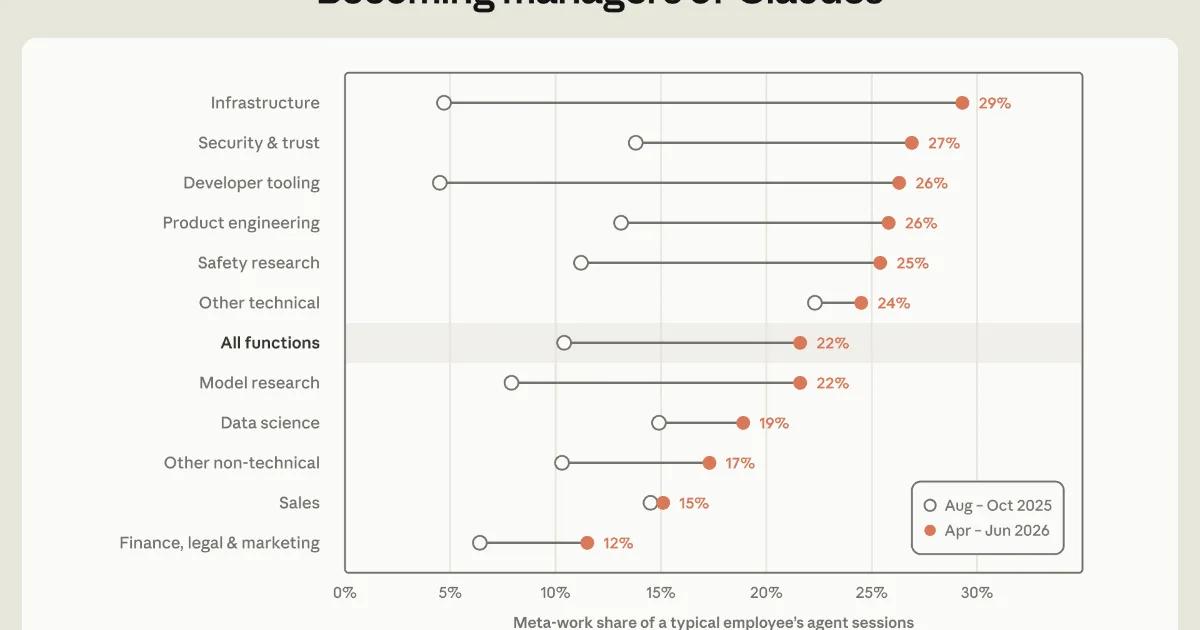
Anthropic describes this emerging category of activity as "meta-work."
Meta-work does not primarily involve producing code or documents directly.
It involves designing and managing the environments and processes that allow AI agents to perform tasks effectively.
Examples include writing task specifications for agents, defining the responsibilities of multiple agents, and designing workflows in which one agent reviews another agent's output.
Meta-work also includes building dashboards to monitor agent progress and establishing systems for detecting errors.
According to the report, meta-work accounted for approximately 10% of all conversational Claude sessions in the fall of 2025.
By spring 2026, its share had increased to 22%.
Employees were spending more time building systems that generate work and less time producing every result directly.
Internal tools for managing AI agents also multiplied rapidly.
The number of persistent instruction documents for agents grew from several hundred in July 2025 to approximately 8,500 one year later.
One engineer created an AI chief of staff to classify and prioritize requests from other agents.
Another employee even prepared performance reviews for a team of Claude agents under their supervision.
Employees are no longer simply giving instructions to AI.
They are becoming managers who design how AI works, evaluate its performance, and improve its processes.
This could reshape the basic division of roles inside businesses.
Traditionally, managers supervised people while individual contributors performed assigned work.
In AI-centered organizations, individual contributors may also supervise multiple agents.
As a result, a single employee could assume responsibilities resembling those of someone running a small team or business unit.
Are Judgment and Autonomy Becoming More Important Than Technical Specialization?
Anthropic's hiring evaluation records revealed another shift.
The researchers analyzed interviewer assessments covering thousands of candidates hired since 2024.
One of the most noticeable changes was increased attention to whether candidates demonstrated the ability to use AI tools creatively.
In 2024, references to AI tool experience appeared in approximately 5% of technical hiring evaluations and 7% of nontechnical evaluations.
By 2026, those proportions had increased approximately threefold and fourfold, respectively.
The ability to use AI tools effectively was becoming a more important factor in hiring decisions.
An even more interesting change appeared in technical candidate assessments.
Among the criteria discussed by interviewers, autonomy and judgment showed the greatest increase.
Meanwhile, references to expertise in specific technical domains declined as a relative share of evaluations.
A similar pattern emerged in nontechnical roles.
Attention to candidates' understanding of customers and the organization's mission increased, while the relative emphasis on specific execution capabilities decreased.
This does not mean specialized knowledge has become unimportant.
Rather, as AI becomes capable of performing specific tasks, the sources of human competitive advantage are changing.
If AI can write code, humans must determine what should be built.
If AI can analyze data, humans must decide which questions are worth asking.
If AI can draft documents, humans must judge whether those documents are appropriate for the organization's objectives and circumstances.
As execution becomes increasingly automated, goal-setting, judgment, and accountability become more important.
More AI Did Not Mean Fewer Human Meetings
If AI automates work, will employees spend less time in meetings?
Anthropic's data suggests otherwise.
An analysis of employee calendars found that median meeting time increased by 20% compared with the previous year.
Among technical individual contributors alone, meeting time increased by 16%.
This runs counter to the intuition that automating work should reduce the time employees spend in meetings.
Several factors may explain the result.
Anthropic itself was growing rapidly, increasing the number of activities requiring collaboration.
At the same time, as AI performed more practical tasks, the decisions requiring human discussion became increasingly important.
Which features should be developed?
Which projects deserve resources?
How should conflicting interests across departments be reconciled?
Who is responsible when something goes wrong?
These questions still require human judgment.
Anthropic employees emphasized in interviews that face-to-face collaboration remained essential.
AI can produce code and documents, but it has not taken over responsibility for the company's overall strategy and priorities.
According to the report, Anthropic's workforce approximately tripled over the preceding year.
Even as the organization expanded, major strategic and team decisions continued to be led by humans through Slack discussions and in-person meetings.
AI agents appeared to add new interactions rather than replace human communication.
An analysis of one department's Slack data found AI agents appearing in almost half of its active public channels.
But the existing structure of human communication did not disappear.
Agent activity was layered on top of human interaction.
This suggests that organizations in the AI era may not simply become smaller operations requiring fewer people.
Instead, as interactions between humans and AI increase, new forms of coordination and management may emerge.
Work That AI Cannot Read Becomes Invisible to the Organization
The report identifies another important characteristic of AI-centered organizations.
Work visibility is becoming more important.
For AI agents to perform tasks effectively, they need access to current organizational information and decisions.
But if important conclusions are reached during face-to-face meetings and never recorded in meeting notes or shared documents, AI cannot know what was decided.
Agents may then rely on outdated documents or old conversations and make incorrect decisions.
Anthropic encountered cases in which employees repeatedly received requests for responsibilities they no longer held simply because their names remained in older documents.
Solving this problem requires organizational decisions and workflows to be recorded in formats that AI can access and interpret.
Meeting outcomes must be documented.
Roles and responsibilities must be kept current.
Policies and operating rules must be reflected in accessible systems.
This is more than a document-management issue.
It is becoming a new operating requirement for organizations that rely on AI to perform work.
In the past, employees depended heavily on information shared verbally or accumulated through personal experience.
In an AI-centered organization, this tacit knowledge can become an obstacle to automation.
Decisions that remain invisible to AI are difficult for AI systems to incorporate into their work.
Organizations may therefore need to record and share more information.
But this creates another challenge.
If employees' activities and communications are extensively recorded to improve visibility, privacy and workplace-surveillance concerns can emerge.
Efforts to make organizations more understandable to AI could also lead to excessive monitoring of employees.
The competitiveness of AI-centered companies may therefore depend not only on model performance, but also on how accurately and securely they manage organizational knowledge.
Where Did Employees Move After AI Took Over Their Tasks?
Anthropic has emphasized internal workforce mobility as part of its response to AI-driven changes in work.
According to the report, employees with at least one year of tenure were approximately 50% more likely to move to another department in a given month in 2026 than in 2025.
Some teams transferred their existing work to AI and moved into new responsibilities.
One representative example came from the product design organization.
The team had been responsible for writing product content, including short greetings and interface messages displayed within Claude.
In spring 2026, however, the team built a context graph designed to help AI agents generate engaging product content.
As a result, AI could perform a substantial portion of the team's previous writing work.
What happened to the human writers?
They shifted away from writing interface copy and toward designing Claude prompts and evaluation systems.
Employees who once wrote sentences intended to influence human behavior were now writing instructions intended to influence AI behavior.
The underlying writing skills remained, but their target changed.
This example suggests that new work can emerge even after AI automates existing tasks.
However, not every employee can transition naturally into a new role.
It is also uncertain whether expertise developed in an existing job will be recognized as equally valuable in a different position.
Outcomes may depend on whether employers have the financial resources and organizational capabilities required to support internal mobility.
Anthropic is a rapidly growing AI company.
Its experience cannot automatically be generalized to businesses facing stagnant growth or pressure to reduce costs.
Protecting Existing Jobs and Creating Opportunities for New Workers Are Different Challenges
Anthropic is also developing an early-warning system to track occupations being transformed by AI.
The approach examines labor demand, productivity, AI task capabilities, and actual AI adoption across different roles to identify jobs most likely to experience change.
The objective is to help existing employees move into other positions where their skills remain useful.
This represents an attempt to address AI-driven change through something other than straightforward workforce reductions.
But the researchers acknowledged an important limitation.
Redeploying existing employees does not solve the problem of declining new hiring.
The reduction in the share of junior technical hires already observed at Anthropic cannot be addressed through internal mobility alone.
Protecting existing workers does little for young people who never receive an opportunity to enter the organization.
Furthermore, if companies feel a strong obligation to retain and redeploy current employees, they may become even more cautious about hiring new workers.
This creates a major employment-policy dilemma in the AI era.
Existing employees need protection.
At the same time, younger generations need opportunities to enter the labor market.
Companies must also consider how productivity gains should be shared with employees.
The report emphasizes the importance of mechanisms that allow workers to participate economically in the benefits of AI adoption.
At Anthropic, broad employee equity ownership is one factor aligning employees' interests with the company's success.
But such arrangements may work particularly well in companies experiencing rapidly rising valuations.
They cannot necessarily be replicated across every business.
The researchers therefore suggested that internal workforce mobility and benefit-sharing should be complemented by government policies supporting retraining and income security.
As AI transforms employment more quickly, individual corporate HR policies may become insufficient to address the consequences.
What Will Corporate Organizational Charts Look Like in the AI Era?
Anthropic's internal transformation offers a glimpse into the future of corporate organization.
Traditional companies are structured around distributing work among multiple people.
Individual contributors perform assigned tasks.
Managers coordinate employees.
Executives determine strategy and allocate resources.
But this arrangement may change as AI agents begin performing more work.
Individual employees may use multiple agents to complete tasks that previously required entire teams.
Instead of executing every activity personally, employees may spend more time designing tasks, reviewing results, and deciding what should happen next.
The distinction between individual contributors and managers becomes less clear.
An individual contributor may effectively operate a team consisting of multiple AI agents.
In this type of organization, competitive advantage may depend less on simply increasing employee headcount and more on how effectively AI is deployed and managed.
But not every task will be replaced by AI.
At Anthropic, face-to-face collaboration, cross-functional coordination, strategic judgment, and accountable decision-making remained human responsibilities.
As AI performs more practical work, human roles may actually become more complex.
Previously, employees were primarily expected to execute their assigned tasks accurately.
In AI-centered organizations, they may increasingly need to synthesize outputs from multiple agents, resolve conflicts between workflows, and make decisions aligned with organizational objectives.
This transformation is also likely to affect workforce development.
The traditional approach of giving junior employees repetitive foundational tasks to build experience may no longer be sufficient.
AI can already perform many of those tasks quickly and at relatively low cost.
Companies must therefore reconsider how junior employees can learn to understand real-world problems, critically evaluate AI-generated results, and design complex work.
The more AI takes over human tasks, the more important it becomes to determine how human capabilities will be developed.
Productivity Revolution or Restructuring of Labor?
Anthropic's research does not support the simplistic claim that AI will eliminate every job.
The company grew rapidly, and its total workforce increased.
The absolute number of technical employees also rose while AI-agent usage expanded dramatically.
Existing employees moved into new roles and produced more output with AI.
But the transformation has not been uniformly positive.
The share of new hires going to junior technical workers declined substantially.
Employees were required to review large volumes of AI-generated material and take on new responsibilities associated with managing AI agents.
As task execution accelerated, organizational expectations for employee productivity also increased.
In Anthropic's internal survey conducted in August 2026, employees estimated that AI could perform an average of 75% of their current work by 2030.
The corresponding response among the general American public was 28%.
These figures represent subjective expectations, not evidence that 75% of the work will actually be automated by 2030.
Nevertheless, the contrast illustrates how rapidly employees who use AI every day perceive the workplace to be changing.
AI adoption is not simply reducing the amount of work humans must do.
Some tasks are automated, but new tasks emerge.
Direct execution may decline while supervision and review increase.
As AI productivity rises, the speed of judgment and level of responsibility expected from humans may also increase.
Understanding labor transformation in the AI era therefore requires examining more than job counts.
It requires attention to the content and intensity of work, the capabilities employees need, and who ultimately receives the benefits of AI-driven productivity growth.
When AI Does the Work, What Is Left for Humans?
Anthropic's report raises a clear question.
In an era when AI agents work for more hours than humans, generate code and documents, analyze data, and perform multiple tasks simultaneously, what role should people play?
Anthropic's experience suggests one answer.
Humans are no longer necessarily the ones who directly execute every task.
Their responsibilities increasingly involve determining what AI should do, providing the necessary information and tools, evaluating results, and making accountable decisions when problems arise.
But this creates a paradox.
As AI becomes more capable, direct technical execution skills may become relatively less important.
Yet good judgment still requires a deep understanding of the work being performed.
To recognize risks in AI-generated code, people need software engineering knowledge.
To verify financial analysis produced by AI, they need to understand accounting and finance.
To evaluate organizational strategies proposed by AI, they need to understand markets, customers, and the realities of their organizations.
Expertise is therefore not disappearing in the AI era.
Its role is changing.
It is moving from expertise primarily expressed through direct execution toward expertise expressed through designing and verifying outcomes.
That leads to perhaps the most important question of all.
How will the next generation develop the judgment required for these responsibilities?
In the past, people built expertise by performing work themselves.
But in organizations where AI handles entry-level tasks, that pathway may become weaker.
This may be one of the most difficult challenges created by the corporate productivity revolution.
Anthropic is already experiencing this transformation.
AI-agent execution time has reached six times human working hours.
The share of junior technical hires has declined.
Code output has increased dramatically.
Employees have begun transferring existing tasks to AI and taking on new responsibilities.
Yet strategy, accountability, and organizational decision-making remain largely in human hands.
This is the reality of work in the AI era illustrated by Anthropic's research.
AI is not eliminating all human work.
But it is already changing what humans are expected to do.
The competitiveness of companies in the AI era may no longer be determined simply by how many people they employ or how many AI agents they deploy. The new advantage may lie in how precisely they design work for AI, how effectively they verify its outputs, and how fairly they distribute productivity gains across the organization and its workforce.
Anthropic's internal data shows that this transformation is not a distant possibility.
It has already begun inside the hiring processes, organizational structures, and daily operations of a company building AI itself.
And it raises a critical question for countless other businesses preparing to adopt AI.
As AI performs more work, what should humans do?
The answer may determine the future of employment and corporate organization in the age of artificial intelligence.