![[Paper Review] Dark Patterns and the Infringement of Consumer Rights](https://metax-images-bucket.s3.ap-southeast-2.amazonaws.com/articles/thumbs/1780728840462-darkPattern.webp)
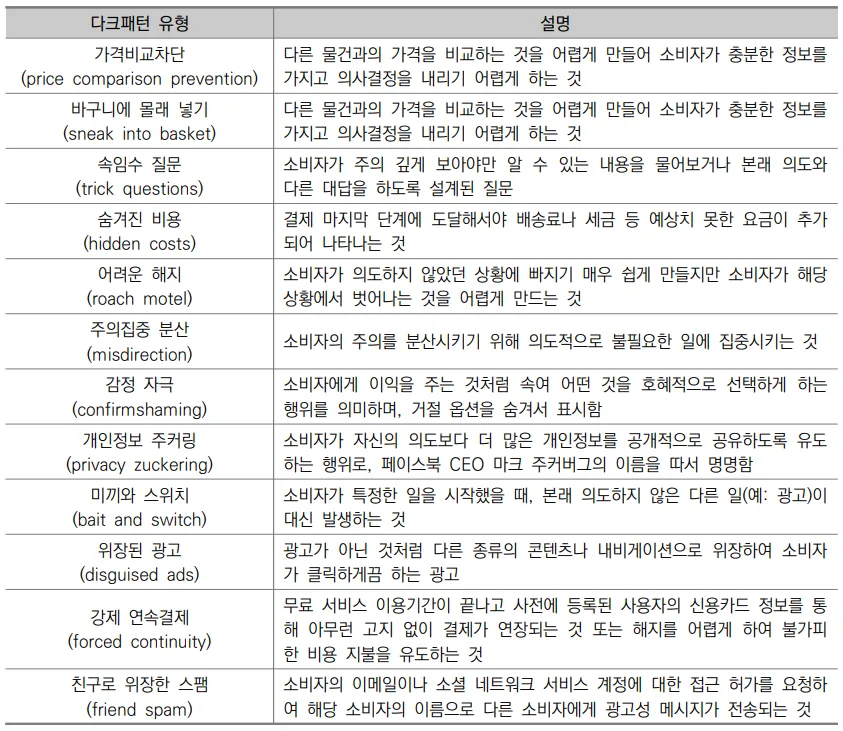
[MetaX] As the market environment has shifted toward digital platforms, deceptive interface designs that subtly exploit consumer psychology and guide users toward outcomes favorable only to businesses—so-called “dark patterns”—have become widespread. This paper examines how dark patterns infringe upon consumer rights and how consumers perceive such violations. The authors conducted non-face-to-face focus group interviews with 31 consumers ranging from their 20s to their 50s and older, all of whom had experience using online services. Before the interviews, they collected 77 cases of dark patterns experienced by the participants.
Consumers feel not simply that they were “deceived,” but that their rights were erased.
When consumers experience dark patterns, they do not perceive the problem merely as having paid more money. Rather, they feel that they were denied information they should have known, that their refusal was not reflected, and that although they appeared to be making a choice, they were in fact being guided. The rights identified as being infringed in the study include the right to information, the right to have one’s opinion reflected, the right to autonomous choice, the right of withdrawal, and privacy. These are also connected to economic and time-related losses, as well as inequality among consumers.
Dark pattern interfaces operate normally. Buttons exist, and consumers appear to have clicked voluntarily. However, the options have already been arranged in ways that benefit the business. The issue captured by the authors lies precisely in the gap between “formal choice” and “substantive choice.” Consumers clicked, but they did not click with sufficient knowledge. They consented, but their consent was not freely given. At the same time, they become trapped in pathways designed to make cancellation difficult.
The prominence of the right to information and the right to express one’s opinion
Discussions of dark patterns usually focus on damages such as hidden costs, forced payments, and obstruction of cancellation. This paper, however, argues that even before those stages, consumers’ right to information and right to have their opinions reflected are already being violated. Participants perceived manipulated reviews, opaque presentation of price information, information hidden in corners, and confusing information layouts as violations of the right to information. They also viewed repeated pop-ups despite having indicated that they did not want them, or situations in which only limited choices were provided, as violations of the right to express one’s opinion.
Dark patterns are not merely devices that cause consumers to make mistaken payments at the final stage. Before that, they deprive consumers of the materials needed for judgment or neutralize consumers’ signals of refusal.
Dark patterns leave “choice” intact while manipulating the structure of choice.
According to the paper, the core problem of dark patterns is that participants saw consumers as appearing to have choice, while the actual scope and content of that choice had already been designed in advance to favor the business. Consumers bear responsibility for the outcome, but businesses create the conditions of choice.
The right of withdrawal and privacy are also shaken as “post-transaction rights.”
The paper views designs that make refunds, cancellations, and service termination difficult as infringements of the right of withdrawal. Under the Electronic Commerce Act, consumers have the right to withdraw from a contract within a certain period, but dark patterns make the exercise of that right itself complicated. Participants recognized procedures that make refunds or cancellations difficult as violations of consumer rights. Furthermore, in the case of dark patterns, it is often ambiguous from what point obstruction of withdrawal can be said to have occurred, which raises the problem that existing laws are not easy to apply.
Some participants viewed dark patterns as operating through the collection and assetization of consumers’ personal information. This is not merely a matter of personal data being collected once. Accumulated data later returns to consumers in the form of personalized designs, ultimately influencing consumers’ own systems of preference. At this point, dark patterns are no longer simply a problem of “this payment right now.” They become mechanisms that intervene in what consumers may come to feel they want in the future.
Dark patterns are harsher on digitally vulnerable groups.
Another important finding is inequality among consumers. Participants were concerned that consumers with lower digital literacy, including older adults, may find it difficult to recognize the commercial intentions embedded in dark patterns and may therefore comply more easily. The study argues that designing online services favorable to businesses by exploiting such generational differences in digital competency constitutes an unreasonable commercial practice, and that these differences should be considered from the service design stage.
This point makes it impossible to view dark patterns merely as a matter of individual attention. The digital environment appears to be equally open to everyone, but in reality, it operates very differently depending on users’ age, experience, literacy, and familiarity with platforms. What may be an easily recognizable “trick” to one person may appear to another as a normal procedure. Therefore, dark patterns do not simply rely on consumer mistakes. They risk becoming structures that monetize differences in consumer competency.
Solutions cannot remain trapped between consumer responsibility and corporate self-regulation.
The improvements demanded by consumers can be organized into four categories: consumers’ own proactive efforts, institutional improvements, businesses’ voluntary improvements, and the raising of social awareness. While the study participants acknowledged the need for consumers to become more informed and capable, they also believed that this alone is insufficient. They argued that the government must play a role in setting directions, creating laws, and monitoring the market, and some also stated that regulation is necessary when false information is provided. At the same time, the study reveals a realistic sense that not everything should be solved through mandatory regulation alone. Instead, while respecting business autonomy, monitoring, warnings, guidelines for damage relief, recommendations, and incentive systems should be implemented together.
[METAX = Reporter Ryu Sung-hoon]