Two U.S. senators have put TikTok directly in the spotlight.
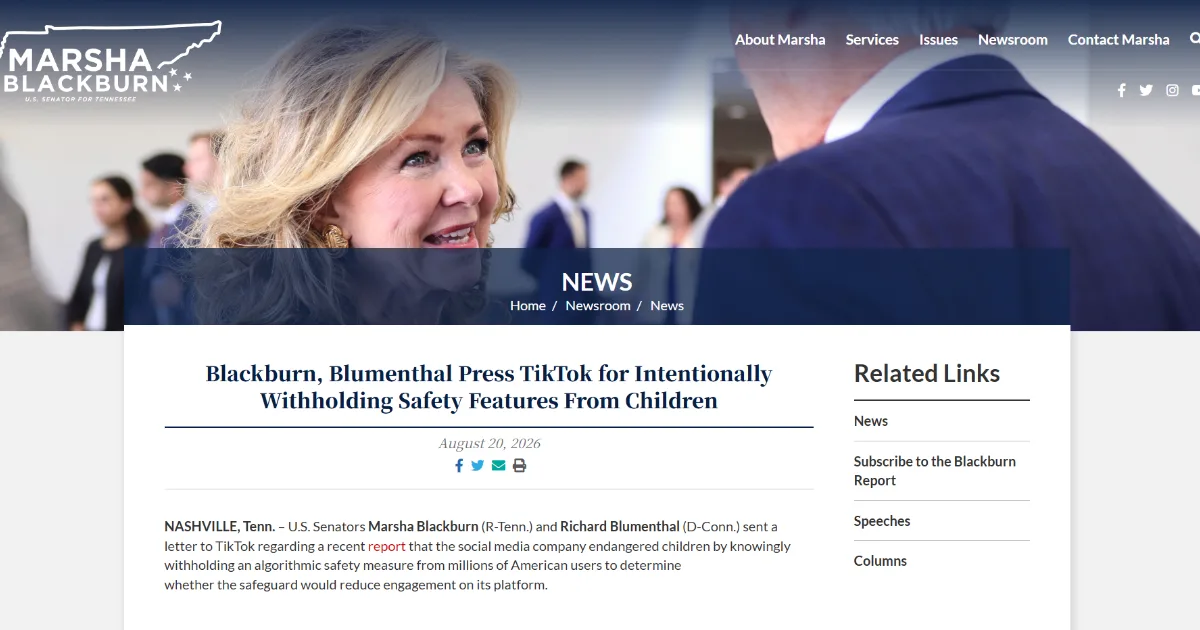
Senator Marsha Blackburn, a Republican from Tennessee, and Senator Richard Blumenthal, a Democrat from Connecticut, sent a letter to TikTok demanding answers over allegations that the company intentionally withheld an algorithmic safety feature from millions of American users.
The issue began with recent reporting. According to Bloomberg reporting cited by the senators, TikTok developed a change to its recommendation algorithm designed to prevent users from being repeatedly exposed to sensitive and potentially harmful content, including sadness, loneliness, extreme dieting, self-harm and suicide-related material. But TikTok allegedly did not apply that safeguard to roughly 10% of U.S. users in order to measure how the safety feature would affect engagement and platform “stickiness.”
That control group reportedly represented about 15 million U.S. users at the time.
More troublingly, the senators say minors were included.
Blackburn and Blumenthal asked TikTok whether it conducted a risk assessment, what the experiment’s results were, how many U.S. users were included in experiments that withheld safety features, and whether children were part of those tests. They also tied the controversy to the Kids Online Safety Act, arguing that this is precisely the kind of platform conduct the bill is meant to address.
This is not simply another platform controversy.
It asks whether a social media company should treat child safety features as product improvements to be deployed, or as experimental variables to be withheld.
More broadly, in an era when recommendation systems decide what users see again and again, it raises a basic ethical question:
Where is the boundary of acceptable platform experimentation?
The Problem Is Not One Harmful Video
The child safety debate around TikTok is not new.
Social media platforms have long faced criticism over the effects of violent, hateful, sexual, self-harm, eating-disorder, extreme dieting, depression, loneliness and suicide-related content on young users.
But the core issue here is not one particular video.
It is repetition.
A single video may be accidental. But when an algorithm reads a user’s reaction and keeps feeding similar content, the situation changes. If a teenager watches a video about sadness and is then shown more sadness; if a lonely user is shown more despair; if a teen watching diet content is pushed toward extreme weight-loss material, the platform is no longer merely a noticeboard.
It becomes a system that can amplify a psychological state.
That is what Blackburn and Blumenthal are focused on.
TikTok publicly said in December 2021 that it was testing ways to avoid recommending too much of the same potentially harmful content. In other words, the company already recognized that repeated clusters of sensitive content could create risk.
But according to the reporting cited by the senators, TikTok did not apply the safeguard to everyone. It allegedly left some users in a control group to test whether the safety measure would reduce engagement.
That may sound like ordinary product experimentation.
But if minors were included, the ethical character changes entirely.
It becomes difficult to avoid the criticism that children’s safety was treated as an experimental variable.
What a 15 Million-Person Control Group Means
The most powerful number in the senators’ letter is 15 million.
TikTok allegedly withheld the safety feature from about 10% of U.S. users, a group that would have represented roughly 15 million people at the time. A/B testing is routine for platform companies. Button colors, feed ranking, notification language, ad frequency, layout and recommendations are constantly tested.
The problem is when the test involves a safety feature.
Testing which interface increases watch time is one thing.
Withholding a safeguard designed to reduce repeated exposure to harmful content is another.
That is especially true if the group includes teenagers.
A safety feature is not an ordinary feature.
A car company could not install seatbelts in only some vehicles and compare crash outcomes. Similarly, if a platform has already recognized a risk and built a protective measure, withholding that measure from some users requires a far higher ethical standard.
Blackburn and Blumenthal criticized TikTok for appearing fixated on whether the safety measure would affect user engagement or stickiness. In their words, TikTok appeared to be trying to “put the price tag on safety.”
That framing is powerful.
Platforms often speak about balancing safety and growth. This allegation asks how that balance actually works inside product experiments.
If a safety feature reduces time spent on the app, will the company still deploy it?
Does protecting minors come before engagement?
The senators are demanding TikTok’s answer.
The Moral Weight of the Chase Nasca Case
The heaviest part of this story is the case of 16-year-old Chase Nasca.
According to Bloomberg reporting cited by the senators and later coverage, Chase was included in a January 2022 backtest experiment in which TikTok’s filter-bubble prevention strategies did not apply to his account by design. The reporting said his account received thousands of videos about suicide, sadness, hopelessness and loneliness before his death in February 2022.
The senators’ letter reportedly said TikTok’s internal review analyzed 7,563 videos Chase watched during the final two weeks of his life. A large share involved sadness or personal struggle, and nearly 10% allegedly violated TikTok’s own policies.
This case raises a powerful social question regardless of the final legal judgment.
Did the platform detect the user’s vulnerable state?
If it did, why did it not stop the repeated exposure?
If a safety feature had been developed, why was it not applied?
What protection standard should have applied once the user was known to be a minor?
Of course, a single tragedy should not be reduced to one algorithmic experiment. Teen mental health is complex, and the causal relationship between platform exposure and real-world harm must be examined carefully.
But the central question in the senators’ letter is not only final legal causation.
It is whether TikTok knew of a risk and still withheld a safeguard from some minors.
That allegation alone changes the platform responsibility debate.
The Risk Was Already Raised in Congress
Blackburn and Blumenthal argue that TikTok had already been warned.
The two senators have been central to congressional scrutiny of children’s online safety. In October 2021, the Senate consumer protection subcommittee held a hearing on child online safety, where TikTok testified about platform safety. Lawmakers raised concerns that social media companies were prioritizing engagement and revenue over children’s well-being, and that recommendation algorithms could push young users toward increasingly harmful content.
The same concerns discussed then — extreme dieting, eating disorders, rabbit holes and algorithmic repetition — are at the center of this controversy.
The senators argue that TikTok cannot plausibly claim ignorance.
The company had been asked about these risks.
It had been asked for research and data.
And if it later included minors in an experiment that withheld a safety feature, the responsibility becomes heavier.
The letter therefore frames the matter not as a technical bug or one-off mistake, but as a decision made after warnings.
The Ethics of Algorithmic Experimentation
Platform companies experiment every day.
A/B testing is the operating system of digital products. Companies test which recommendations increase watch time, which notifications drive more clicks, which feed arrangements create more sharing and which content sequences keep users active. Most users never know whether they are in a test group or a control group.
For ordinary product improvements, that may be acceptable.
Safety features are different.
On platforms used by children and teenagers, withholding or delaying a safety feature raises questions similar to human-subject research ethics. Did the company assess risk beforehand? Did it protect vulnerable populations? Did it monitor harm during the test? Did it have stopping rules? Did it conduct post-test review?
The questions Blackburn and Blumenthal sent to TikTok are close to that framework.
Was a risk assessment conducted?
What were the results?
How many U.S. users were included in experiments that withheld safety features?
Were minors included?
What child-protection standards applied?
What happened when potential harm signals appeared?
This controversy makes it harder to treat social media experimentation as mere product optimization.
Recommendation algorithms can influence mood, attention and behavior. For young users, that influence can be especially sensitive. Platform experiments therefore require higher transparency and accountability.
The Political Force Behind the Kids Online Safety Act
The senators also connect the issue to the Kids Online Safety Act, or KOSA.
KOSA would require covered platforms to design products with children’s safety in mind. Blackburn and Blumenthal argue that the TikTok allegations show why voluntary self-regulation is not enough.
The key idea is a design duty.
The problem cannot be solved only by removing content after harm occurs. Platforms must assess how product design and algorithmic recommendation systems create risk for children and reduce those risks before they become harm.
The TikTok allegations provide KOSA supporters with a powerful argument.
Companies may promise safety publicly while internally testing whether safety measures reduce engagement.
Platforms may say they manage risk, but outsiders cannot see the experiments or data.
Parents and regulators may not know whether children are included in algorithmic control groups.
Internal documents may surface only after tragedy, litigation or journalism.
That is why the senators argue for meaningful transparency and accountability.
Although the letter targets TikTok, the message is aimed at the entire social media industry:
Children’s safety cannot be left solely to corporate goodwill.
TikTok’s Biggest Risk Is Not Only China
In the United States, TikTok has long been debated through the lens of national security and Chinese ownership.
Do U.S. user data and platform control create risks connected to China?
Could the Chinese government exert influence?
Could TikTok shape American public opinion?
Those questions remain central to U.S. politics. But this letter highlights a different kind of risk.
TikTok’s risk is not only foreign ownership.
It is also the way the platform’s recommendation algorithm affects children.
That issue applies not only to TikTok, but to Instagram, YouTube, Snapchat, X, Discord and other major platforms.
One reason TikTok is under bipartisan pressure is that different political camps have different concerns that now converge. Conservatives focus on national security, cultural influence and censorship. Progressives focus on child safety, mental health, platform accountability and privacy. The Blackburn-Blumenthal letter sits at the intersection of those concerns.
Child safety can become a bipartisan issue.
Opaque recommendation algorithms can worry lawmakers across the political spectrum.
And the allegation that a company risked children’s safety for engagement is politically explosive.
TikTok cannot defend itself only on national-security grounds.
It must also explain its internal decisions around algorithmic experiments and child safety.
Recommendation Algorithms Are Not Neutral Delivery Systems
Social media companies often describe themselves as connecting users with content they may like.
But recommendation algorithms are not neutral delivery systems.
They decide what to show more of, what to show less of and where to interrupt a pattern. On short-form video platforms, the recommendation feed largely defines the entire user experience.
Users do not simply view accounts they follow.
The algorithm chooses the next video.
It adjusts the feed based on reactions.
Emotionally intense content may hold attention longer.
Sensitive topics can shape a user’s mental state when repeated.
That is why filter-bubble prevention matters.
A feature that breaks up repeated exposure to potentially harmful content is not a minor convenience. For teenagers, it can be a psychological safety mechanism.
The senators’ argument is that TikTok knew this, developed such a safeguard and still withheld it from some users.
That leads to a fundamental question:
If a recommendation algorithm can create risk, does the platform have an active duty to reduce that risk?
That is also the core of the KOSA debate.
The Moment Safety Is Compared With Engagement
The strongest political frame in this controversy is the idea of placing a price tag on safety.
From a platform’s perspective, every safety feature has a cost. Showing less harmful content may reduce watch time. Breaking up sensitive-content clusters may reduce immersion. Reducing notifications may lower return visits. Limiting nighttime use by teenagers may reduce ad impressions.
So platforms inevitably ask internally:
How much will this safety feature reduce engagement?
That question is not automatically illegitimate. Product changes need measurement.
But for child safety features, the order of questions matters.
The first questions should be:
Does this reduce risk?
Does this make minors safer?
Does this lower the probability of harm?
Does this protect vulnerable users?
Only after that should engagement impact be considered.
Blackburn and Blumenthal appear to believe TikTok reversed that order. Their concern is that the company measured the safety feature primarily through its effect on stickiness.
If that frame spreads, TikTok will not be the only company affected.
Internal experiments around safety features could become central evidence in regulation and litigation across the social media industry.
This Is Not Only an American TikTok Issue
The debate matters beyond the United States.
In Korea as well, teenagers are deeply exposed to short-form video, recommendation feeds and algorithmic content consumption. YouTube Shorts, Instagram Reels, TikTok, Naver and Kakao recommendation systems, gaming platforms and online communities all shape young people’s media environments.
Korean platforms and policymakers face the same questions.
How can repeated recommendation of potentially harmful content to minors be prevented?
How should platforms detect clusters of eating-disorder, self-harm, depression, loneliness, extreme dieting, violence or hate content?
Should minors ever be included in test groups where safety features are withheld?
What ethical standard should apply to child safety features in platform experiments?
Can companies delay safety features because they reduce engagement?
Can regulators require access to internal platform experiment data?
Korea has high levels of smartphone use among teenagers, and short-form content consumption continues to grow. Simple screen-time limits are not enough.
The problem is not only time.
It is direction.
What content follows what?
What emotional state is being reinforced?
How are vulnerable users protected?
Those are the real questions.
The Next Stage of Platform Transparency
The senators’ letter pushes the platform transparency debate into a new stage.
In the past, transparency often meant how many posts were removed, which accounts were suspended or how companies responded to government requests. Now, transparency may also include algorithmic experiments and whether safety features are applied or withheld.
Platforms may increasingly be asked to disclose:
When was a child safety feature developed?
Who received it and who did not?
Were minors included in the control group?
Was a risk assessment conducted before the experiment?
Were harm signals monitored during the experiment?
Which mattered more: engagement metrics or safety metrics?
Were the results externally disclosed?
Why was the safety feature withheld?
This is a highly sensitive area for platform companies.
Algorithmic experimentation is central to product competition, and internal data is often treated as a trade secret. But when experiments involve children’s safety, trade secrecy may not be enough.
The center of platform regulation may move from “What content did you remove?” to “What did you design the system to recommend?”
Children Cannot Be the Control Group for Platform Safety
The TikTok letter from Senators Blackburn and Blumenthal reveals the core of the child online safety debate.
The issue is not simply that harmful content exists.
The issue is whether a platform knew that repeated recommendation of potentially harmful content could create risk and still withheld a safeguard from some users. If minors were included in that control group, the matter becomes not just a product experiment, but an ethical failure of child safety.
TikTok designs user experience through recommendation algorithms. It decides what video comes next, what pattern is interrupted and which topics repeat. For teenagers, those decisions can become more than content preferences. They can become part of a psychological environment.
The senators are asking TikTok three basic questions.
Did the company conduct a risk assessment before withholding the safety feature?
How many U.S. users and minors were included in the experiment?
If the safety feature reduced engagement, what did the company prioritize?
These questions are not only for TikTok.
Every social media platform experiments on users. But children’s safety should not be an experimental variable. If a protective measure has already been developed, putting minors in a control group to compare safety benefits against engagement loss risks destroying public trust.
The limits of self-regulation are visible here.
Platforms can promise safety. But if outsiders cannot see internal experiments and decisions, those promises cannot be verified. That is why bills such as KOSA gain political force. Child safety is moving from corporate goodwill to design duty, transparency and accountability.
In the age of recommendation algorithms, protecting children is not only about deleting harmful content.
It is about interrupting harmful repetition.
It is about detecting dangerous immersion.
It is about protecting minors from unsafe experiments.
It is about asking who monitors whether safety features are actually turned on.
Platforms can compete for children’s time.
They should not compete by testing what happens when children’s safety is turned off.