It is autumn.
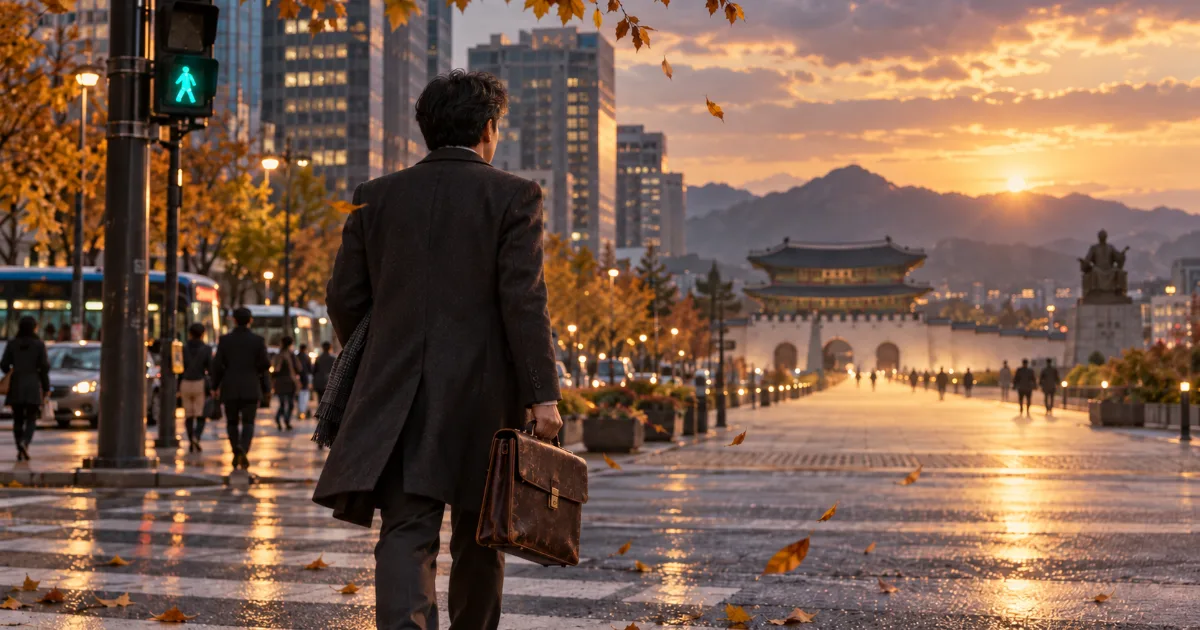
The wind in Gwanghwamun on my way home from work has changed from just a few days ago. During the day, the sunlight is still quite sharp. But once the sun begins to tilt behind the buildings, the air quickly turns cool.
It seems summer does not need as much time to end as I thought.
Standing in front of a crosswalk, waiting for the light to change, I suddenly had this thought.
“My forties are passing like this too.”
When I first turned forty, the number fifty still felt quite far away. Even when I became forty-one, then forty-two, and crossed one year after another, it still felt that way.
But at some point, the number fifty began to grow clearer. Something that had been hidden beyond a distant ridge had somehow appeared at the end of the road I was walking.
And now, here I am, in September at forty-seven. Soon I will be forty-eight. I am now truly at an age where I must begin preparing for fifty.
It is strange.
When I was approaching thirty, even the phrase “a new beginning” made my heart race. Changing jobs, meeting new people, starting something new — all of it brought more excitement than fear.
If something went wrong, I thought I could simply try again. If I fell, I believed I could get back up. I did not have much, and there was not much to lose.
But now, after passing through my forties and looking toward fifty, things are different. I am holding quite a lot in my hands. I have a career I have built over many years. I have a salary that arrives steadily every month. Inside the company, I have colleagues, seniors and juniors with whom I have shared both joys and hardships. I have a place I have made for myself over a long period of time.
And when I come home from work, there is a family waiting for me. A life I must take responsibility for. Above all, I have worked hard for a long time to get here.
“Maybe that is why.”
These days, whenever I think of something new, fear comes before excitement.
“Do I really need to?”
Someone inside me asks.
“Things are fine as they are.”
It is not wrong.
Perhaps this is the most stable period of my life. I now hold, at least to some degree, many of the things I wanted so badly when I was younger.
That is why speaking of a new challenge sometimes feels like a luxury.
People say the economy is difficult. Companies are tightening their belts. When I turn on the news, I hear more worrying stories than hopeful ones. At such moments, I think again.
“In times like these, I should be grateful just to receive a stable salary every month.”
And yet, somewhere deep inside, a small voice keeps speaking.
“Still, couldn’t I do a little more?”
It is an annoying voice. If I pretend not to hear it, it comes back again another day.
“Is this as far as I go? I want to do something a little more meaningful. I want to confirm that I can still grow. I want to be someone needed by someone. I want to prove that the experiences I have accumulated through my life are still useful to the world.”
In the end, I want to be recognized.
It is not only about money. While watching TVING’s original drama Even a Lottery Winner Goes to Work this month, I imagined it too.
“If one day I suddenly won first prize in the lottery and 1.3 billion won appeared in my bank account, would I quit my job and do nothing?”
My answer would probably be no.
Of course, for the first few days, I would sleep in. I would travel. I might turn off the alarm, crawl back under the blanket, and make a fuss about how happy such a morning could be.
But after about a month, I suspect I would start something again. I would open my laptop and write. I would think about a new project. I would meet people and try to make something. Having money would not erase the desire to live as myself.
Human beings have desires that cannot be explained by survival alone. Even after the problem of making a living is somewhat resolved, we still want to be recognized. We want to grow. And someday, we want to become the most ourselves we can possibly become.
Perhaps what Abraham Maslow called “self-actualization” is connected to that very feeling.
The desire to see, through my own life, how far the possibilities inside me can unfold.
But the problem comes next.
To begin something new, I have to put something down.
I think about that often these days. About the fact that human beings have only two hands.
We live while holding many things in those two hands. In one hand, there is stability. In the other, responsibility. For someone, one hand may hold a job, while the other holds family. For someone else, one hand may hold a livelihood, while the other holds a position painstakingly built over many years.
For a long time, we have learned how not to drop what we hold in those two hands. How to keep balance. How not to be shaken. How to maintain things for as long as possible. Then, at some point, that became our life.
But one day, something new appears in front of us. Something we truly want. Something we want to try at least once. Another possibility still remaining inside us. We look at it and, without thinking, reach out our hand.
Then we realize.
“Oh. I have no hand left.”
Both hands are already full.
So we begin taking strange postures. We try somehow to grab the new thing without letting go of anything we are already holding. We support it with an elbow, wedge it between our fingers, press it against our chest. We clench our teeth and think:
“I just have to hold on a little longer.”
I want to do well at work. I do not want to neglect my family. I want to protect my health. I do not want to lose my relationships. At the same time, I want to study something new, keep writing, and seize another opportunity.
I want all of it.
Perhaps desire after forty is born that way. Not because there are so many things we want to have, but because there are now too many things we do not want to let go of.
But if both hands are already full and we force ourselves to hold a third thing, at some point everything becomes unstable. Our wrists begin to hurt. Our arms lose strength. Even a small shock can shake everything we are holding. Trying to gain one more thing, we may end up dropping what we already had.
That is why, before a new challenge, the first thing to decide may not be “What should I do?”
Perhaps the first question should be this:
“What must I put down?”
But this question is difficult. Choosing something new is a matter of hope, but putting something down is a matter of loss.
Letting go of what I have built over a long time. Parting from familiar people. Giving up the number that arrives in my bank account on the same date every month. Seeing the familiar company name disappear from my business card. Just thinking about it makes my heart grow cold.
Of course, putting something down does not always have to be so dramatic. It may mean giving up some weekend time. It may mean giving up sleeping late. It may mean meeting people less often. Or it may mean letting go of the desire to be a good person to everyone, the way I used to try to be.
Perhaps a new life does not begin with a grand resignation or a dramatic decision. Perhaps it begins with these small, quiet acts of letting go.
Life resembles a puzzle.
A life lived for a long time has its own order. What time I wake up in the morning, what time I go to work, whom I have lunch with, what time I come home and spend time with family. The schedule of a week, the spending of a month, even human relationships — all of these find their place to some degree.
Over a long period of time, we have assembled the puzzle called “my life.”
But when one new piece enters, everything changes. To make room for that piece, the existing pieces must move little by little. Some pieces must shift to the side. Some must be taken out for a while. Some must be put down completely. Without that, a new picture cannot be formed.
That may be why change in life always brings a certain disorder.
For a while, an empty space appears. The familiar picture is disturbed. I begin to doubt whether I am going in the right direction. When I was thirty, I called that confusion an adventure. Now that I am in my late forties, I call the same thing risk.
Perhaps aging means looking at the same thing through different words.
In the past, I saw possibility first.
Now, I calculate what I might lose first.
But that does not mean the possibilities inside me have disappeared.
In fact, these days, I sometimes think this: perhaps what I am truly afraid of is not the new road. Perhaps what frightens me more is letting time pass like this without changing anything.
Becoming fifty, then fifty-five, and one day looking toward sixty, thinking:
“Why didn’t I reach out at least once back then?”
“Back then, I still could have done it.”
I do not want my future self to say that to my present self.
But that does not mean I have the courage to put everything down right now. I still hesitate. I look at the numbers in my bank account. I look at my family. I think of the years I have built inside the company. I know how precious the things I have now truly are.
So perhaps I will stand before these questions for a while.
What will I protect?
What will I put down?
And what will I newly hold?
The traffic light turns green. People on their way home begin crossing the street all at once. I take a step forward, then suddenly look down at my two hands. In one hand is my bag. In the other is my phone. Both hands are full.
I laugh.
Perhaps there is a reason human beings have only two hands.
That we cannot have everything.
That in order to hold something new, we sometimes have to put something down.
And that putting something down does not always mean losing it.
Perhaps it simply means emptying one hand in order to hold the next thing.
Now I am preparing for fifty. Fear is a little larger than expectation. Still, in one corner of my heart, a small expectation remains.
Will another momentum come to my life?
Is there still a version of me I have not yet met?
Can I live doing something a little more truly my own?
I do not have the answers yet.
But perhaps it is fortunate that I am still asking these questions. It means I still have expectations for my own life.
And someday, if something truly new appears before me, I hope I will recognize it.
I hope I will know what I must put down in order to hold it.
And even if I am afraid, slowly, I hope I will be able to open one hand.