Why must a car travel on a road?
It sounds like an obvious question. Cars move on wheels, and wheels need to make contact with the road. The force generated by an engine or electric motor is transmitted to the ground through the tires. No matter how powerful a vehicle is, it becomes difficult to accelerate or change direction once friction with the ground disappears.
For decades, automakers have competed within this physical constraint. They developed more powerful engines and motors, improved tire grip, and refined aerodynamic designs to keep vehicles firmly planted on the road.
Elon Musk, however, posed a different question.
Must a car always depend on the ground? What if a vehicle could control its own movements even after its wheels had left the road?
On October 15, 2026, Tesla presented one experimental answer at a SpaceX testing facility in McGregor, Texas.
It was the second-generation Tesla Roadster.
The Roadster unveiled that day was more than an exceptionally fast electric supercar. The vehicle climbed a massive curved structure, continued moving while suspended upside down, then dropped into the air, rotated its body, and landed on its wheels.
In another demonstration, it jumped over several Tesla vehicles.
Tesla also presented an acceleration figure of just 0.81 seconds from a standstill to 60 miles per hour, or approximately 96.6 kilometers per hour.
The demonstrations resembled aerospace engineering experiments more than conventional automotive testing.
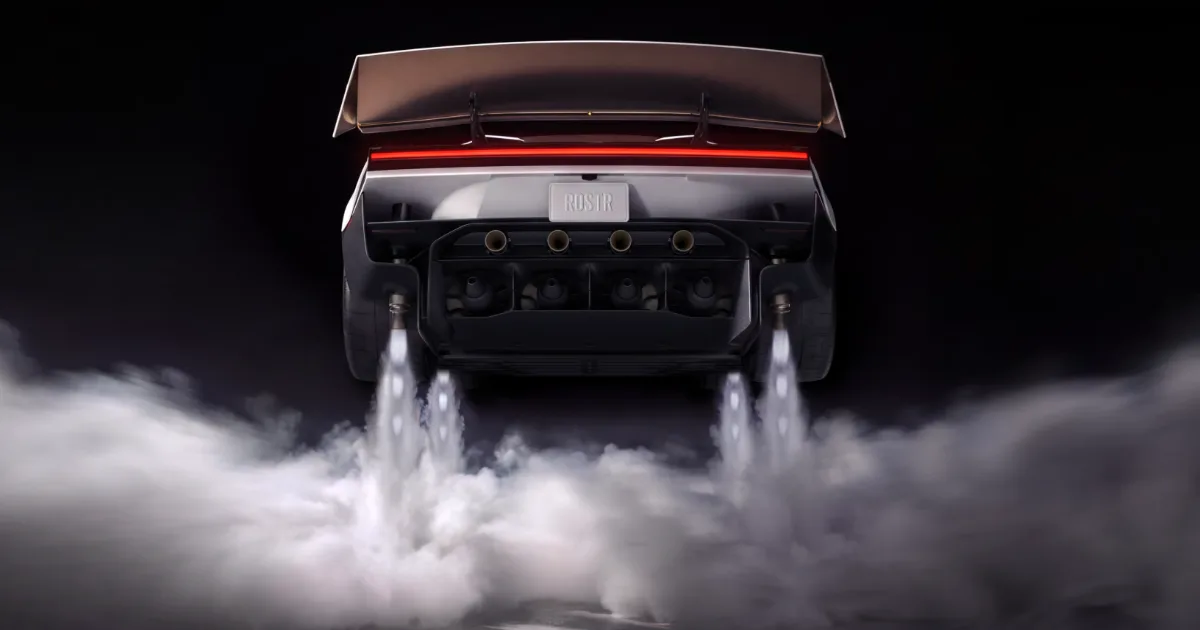
Tesla said the Roadster incorporated cold-gas thrusters developed in collaboration with SpaceX, along with an active suction system beneath the vehicle. According to the company, combining rocket-inspired propulsion with air-pressure control made movements possible that would be extraordinary for a conventional automobile.
But one distinction is essential.
The Roadster did not eliminate gravity. Gravity acted on the vehicle throughout the demonstrations. Tesla generated forces strong enough to counter gravity in specific directions and controlled the forces and rotational motion acting on the vehicle in midair.
The real significance of the unveiling is not the invention of an anti-gravity car.
It is the demonstration that automotive motion can potentially extend beyond tire-ground interaction to a system combining propulsion and active control.
From the Electric Supercar Promised in 2017 to a Rocket-Propelled Car in 2026
The Roadster's story began in 2017.
When Tesla introduced the second-generation Roadster, it promised to overturn conventional perceptions of electric vehicles.
The proposed specifications included acceleration from zero to 60 mph in 1.9 seconds, a top speed exceeding 250 mph, or approximately 402 km/h, and a driving range of 620 miles, or roughly 998 kilometers, on a single charge.
The objective was clear.
Tesla wanted to demonstrate that electric vehicles could be more than efficient means of transportation. They could also become the fastest cars in the world.
But production was repeatedly delayed.
Originally targeted for 2020, the project experienced prolonged setbacks involving battery technology, vehicle development, and changes in Tesla's business priorities.
Meanwhile, the automotive industry changed considerably.
Electric vehicles' exceptional acceleration is no longer unfamiliar. High-performance EVs already compete with internal-combustion supercars. Simply reducing the time required to accelerate from zero to 100 km/h is no longer enough to shock the market.
In 2026, Tesla returned with something beyond speed.
The new Roadster was introduced in three versions: Performance, Thrust, and Rocket.
Performance is a two-seat model intended for conventional road driving.
Thrust is a high-performance version equipped with rear-mounted cold-gas thrusters.
Rocket is a single-seat model fitted with thrusters positioned around the vehicle, enabling aerial maneuvers.
Tesla presented an estimated driving range of approximately 300 miles, or 483 kilometers, and a top speed exceeding 230 mph, or 370 km/h, for all three versions.
One notable change is the reduction in estimated range from the 620 miles announced in 2017.
This reflects a shift in the vehicle's development direction.
Initially, Tesla focused on using batteries and electric motors to surpass the performance records of conventional supercars.
This time, the emphasis has shifted toward new forms of movement enabled by propulsion systems.
The Roadster has evolved from an exceptionally fast electric vehicle into an experimental automobile combining EV technology with rocket-inspired engineering.
Driving Upside Down: Generating Suction Stronger Than Gravity
One of the most striking moments in the Roadster demonstration was the vehicle driving upside down.
The car climbed a curved structure and remained attached even after passing beyond the vertical section.
For a conventional automobile, such a maneuver would be nearly impossible.
Ordinarily, gravity presses a car toward the road. The vehicle's weight contributes to the normal force between the tires and the surface, and tire friction depends on that normal force.
But when a car hangs upside down, the situation reverses.
Gravity pulls the vehicle away from the structure.
To remain attached, the car must generate a force strong enough to oppose gravity.
Tesla's solution was an underbody suction-fan system.
By rapidly removing air from beneath the car, the fans create a pressure difference between the underside of the vehicle and the surrounding atmosphere.
The relatively higher external air pressure presses the vehicle toward the surface.
The essential idea is to generate tire grip actively rather than relying only on the vehicle's weight.
Conventional high-performance cars use aerodynamic designs to create downforce by controlling airflow above and below the body.
Generally, these aerodynamic effects increase as vehicle speed rises.
A suction-fan system, by contrast, can generate a pressure difference independently of forward speed.
If sufficient suction is available, the vehicle can remain attached to a surface even while traveling slowly or standing still.
Tesla said the system could generate suction equivalent to approximately 2 G.
This is not simply a technique for taking corners faster.
It is an approach that can maintain contact with a surface even as the vehicle's orientation and direction of movement change.
Of course, using fans to generate automotive downforce is not an entirely new invention.
Motorsport has previously experimented with fan-assisted downforce systems.
Tesla's distinctive application lies in extending the concept beyond high-performance driving into extraordinary maneuvers such as traveling upside down.
That is how the seemingly gravity-defying demonstration was achieved.
Strictly speaking, Tesla did not neutralize gravity.
It generated an additional force capable of opposing it.
Rotating in Midair: How SpaceX Technology Changes Vehicle Motion
Another remarkable demonstration involved the Roadster rotating while airborne.
After leaving the ground, the vehicle changed orientation, returned to an upright position, and landed on its wheels.
The central technology behind this maneuver is the cold-gas thruster.
Cold-gas thrusters expel highly pressurized gas through nozzles.
Unlike conventional chemical rockets, which generate thrust through combustion, cold-gas systems use the reaction force produced as compressed gas expands and escapes.
The underlying principle is Newton's third law of motion.
When gas is expelled in one direction, an opposing force acts on the vehicle.
Depending on the placement and orientation of the nozzles, this force can propel the car forward, lift it, or rotate its body.
Tesla said the Rocket version was equipped with ten cold-gas thrusters. The unveiling also referenced a compressed-air storage system with a total capacity of 600 liters.
The reason for installing such devices on a car is straightforward.
Conventional automobiles depend almost entirely on their wheels to control motion.
Acceleration, braking, and cornering all rely on contact between the tires and the road.
But once a vehicle becomes airborne, its tires can no longer transmit force to the ground.
Thrusters change that limitation.
They allow a vehicle to generate force in a selected direction and alter its orientation without making contact with a surface.
This resembles attitude-control techniques used in aerospace engineering.
However, the technology has physical limitations.
The force generated by cold-gas thrusters depends on the pressure and volume of stored gas, exhaust velocity, and nozzle design.
Once the compressed gas has been depleted, the system must be recharged.
Producing intense force for a short period is fundamentally different from sustaining flight.
What Tesla demonstrated was the ability to jump and control vehicle attitude in midair.
It did not demonstrate an aircraft capable of sustained flight between cities.
Understanding this distinction is essential to evaluating the Roadster's technical achievement accurately.
Acceleration in 0.81 Seconds: The Physical Limits of the Human Body
At the unveiling, Tesla presented a demonstration result showing acceleration from a standstill to 60 mph in 0.81 seconds.
Sixty miles per hour is approximately 26.8 meters per second.
Assuming the vehicle reached that speed in 0.81 seconds, its average acceleration would be approximately 33.1 meters per second squared.
Compared with Earth's gravitational acceleration of approximately 9.81 meters per second squared, that is close to 3.4 times gravity.
Actual instantaneous acceleration can vary throughout the run.
Therefore, this figure represents an average calculated from the announced time and speed. It does not directly establish the maximum acceleration experienced by passengers.
Nevertheless, 0.81 seconds is an extraordinary figure in automotive engineering.
Improving acceleration requires not only powerful propulsion but also the ability to convert that force into actual vehicle movement.
In conventional automobiles, tire friction is often the limiting factor.
No matter how powerful an electric motor becomes, the available acceleration is constrained if the tires cannot transfer enough force to the ground.
The Roadster proposes a different solution.
It adds force generated by thrusters to the driving force transmitted through the tires.
Instead of simply increasing motor output, Tesla is expanding the mechanism through which a car accelerates.
Yet performance figures alone cannot establish practical usefulness.
Extreme acceleration can impose considerable physiological stress on passengers.
The vehicle structure, battery, drivetrain, tires, and braking system must withstand exceptionally high loads.
Noise and high-pressure gas flows generated by the thrusters could also affect the surrounding environment.
Most importantly, the 0.81-second figure was presented during a public demonstration.
It should not be treated as a production-vehicle performance figure independently reproduced under standardized conditions.
The more important point is not the record itself.
It is that Tesla changed the conventional propulsion architecture of an automobile to achieve it.
The Roadster Took to the Air, but It Is Not Yet a Flying Car
Musk has spoken about flying cars for years.
The latest Roadster unveiling attracted attention because it translated some of those ideas into observable vehicle movements.
But it would be premature to describe the Roadster as a fully developed flying car.
Momentarily becoming airborne and sustaining controlled flight are entirely different engineering challenges.
For a vehicle to make a short jump, it needs enough force to overcome gravity momentarily.
Sustained flight, however, requires continuous lift or thrust sufficient to support the vehicle's weight.
It also requires stable control over direction, altitude, and orientation.
A system for landing safely during emergencies would be essential.
The Roadster demonstration did not validate all these requirements.
Its time in the air was limited, and the maneuvers took place in a specially prepared testing environment.
Whether similar movements can be performed safely on ordinary roads or in complex urban environments remains a separate question.
Conventional automobiles are designed around road-traffic regulations.
Aircraft, by contrast, must satisfy aviation safety rules, airspace management requirements, operational controls, and emergency-response standards.
If the Roadster were to evolve into a genuine flying car, it would need to address both regulatory domains.
At this stage, the Roadster's significance lies less in the commercialization of flying cars and more in demonstrating how a ground vehicle can acquire new movement capabilities through auxiliary propulsion.
Tesla demonstrated short aerial maneuvers, not unrestricted flight.
That distinction matters.
Why Would Tesla Build Such a Car?
The announcement also raises a business question.
Why would Tesla integrate rocket propulsion into an electric supercar whose development has already been delayed for nine years?
The Roadster is unlikely to transform Tesla's sales volume.
It is an expensive sports car, and production volumes are likely to be limited.
Compared with Tesla's mainstream vehicles, its direct contribution to overall revenue may be modest.
Musk himself indicated during the presentation that the Roadster was not financially significant to Tesla.
So why build it?
The first reason is technological symbolism.
Automakers sometimes develop vehicles designed less to generate high sales volumes than to showcase their engineering capabilities.
These are known as halo cars.
A halo car pushes a company's technology and design philosophy to their extremes, strengthening the image of the brand as a whole.
The Roadster fits this category.
During the early growth of the electric vehicle industry, Tesla differentiated itself from traditional automakers through exceptional acceleration and innovative user experiences.
But as EVs became more common, that distinction weakened.
Established manufacturers now produce powerful electric cars using advanced motors and batteries.
To generate another technological shock, Tesla needed to demonstrate something different from conventional high-performance EVs.
The Roadster serves that purpose.
The second reason is the technological convergence between Tesla and SpaceX.
Tesla is an automobile manufacturer, while SpaceX is an aerospace company.
They grew in different industries, but both tackle demanding engineering challenges.
Tesla has developed expertise in batteries, electric motors, power electronics, and vehicle-control software.
SpaceX has accumulated knowledge in rocket propulsion, attitude control, high-pressure systems, and iterative testing.
The Roadster provides an experimental platform where these engineering domains intersect.
However, technological cooperation should not be confused with a merger or organizational integration between the companies.
What the unveiling demonstrates is the application of aerospace technologies to vehicle design.
The third reason concerns Tesla's future industrial identity.
By 2026, Tesla has increasingly positioned itself as more than an electric vehicle manufacturer, emphasizing autonomous driving, robotaxis, and humanoid robots as future growth priorities.
Against that backdrop, the Roadster serves as a reminder that Tesla is still exploring the technological possibilities of the automobile itself.
Musk also presented the Roadster as a vehicle representing the final era of human-driven cars.
The implication is that even in a future shaped by autonomous driving, a machine that allows humans to experience extraordinary performance behind the wheel may retain a special appeal.
This creates an interesting contrast within Tesla's vision.
On one side, Tesla is developing robotaxis that do not require human drivers.
On the other, it is unveiling a Roadster that pushes the experience of human driving to an extreme.
The Roadster is less about transportation efficiency than about the driving experience and the limits of automotive engineering.
How Far Is a Technology Demonstration from a Production Vehicle?
Despite the spectacular unveiling, significant challenges remain.
The largest is mass production.
During the announcement, Tesla presented 2028 as the target year for Roadster production.
That would mean production beginning eleven years after the vehicle was first introduced in 2017.
Given the repeated schedule delays, however, the new target must still be treated as an objective rather than a certainty.
There are also considerable technical challenges.
An extreme downforce system based on suction fans must account for vehicle structure, road conditions, debris intake, noise, energy consumption, and failure response.
Cold-gas thrusters require validation of high-pressure storage safety, recharging methods for repeated operation, component durability, and possible hazards from the direction of gas exhaust.
The ability to become airborne, even briefly, introduces situations not covered by conventional automotive safety design.
What happens if one or more thrusters fail?
How does the vehicle recover from an unexpected rotation in midair?
How is the impact of landing absorbed?
These questions are critical.
A demonstration can rely on a controlled environment and predetermined conditions.
A consumer vehicle must operate safely across a much wider range of circumstances.
Successfully performing an extreme maneuver in a test environment and making that capability safe for ordinary customers are fundamentally different achievements.
Price and maintenance costs also remain major questions.
Tesla announced reservation deposits of $50,000 for the Performance version and $250,000 for the Thrust version.
The Rocket version was introduced on an invitation-only basis.
These figures represent reservation conditions, not final vehicle prices.
Final selling prices, actual production volumes, and maintenance expenses have not yet been firmly established.
There is therefore still insufficient information to assess the Roadster's commercial prospects with confidence.
Economics and Safety May Be Greater Obstacles Than Gravity
The most important distinction in the Roadster debate is between technical feasibility and economic rationality.
The fact that a car can leap into the air is fascinating.
But whether cars need to move that way is a different question.
For everyday transportation, consumers generally prioritize safety, convenience, energy efficiency, and reasonable prices.
Midair rotations and extreme acceleration do not directly address those needs.
In ordinary road environments, they may even be dangerous or unnecessary.
Nevertheless, not every technological experiment must be economically efficient from the beginning.
Extreme engineering projects can reveal the limitations of existing designs and stimulate new technical approaches.
Even if the Roadster's suction and propulsion systems are unlikely to appear in mainstream automobiles, their underlying principles may have implications for active vehicle-body control, thrust distribution, and attitude control under extreme conditions.
Precise motion control is becoming increasingly important as AI and robotics enter the physical world.
Humanoid robots, autonomous mobile systems, and drones all use sensors to perceive their environments and actuators to control movement.
It would be premature to assume that Roadster technologies will transfer directly into those industries.
But the project encourages a broader understanding of automobiles: not simply as wheeled transportation devices, but as physical platforms combining multiple propulsion and control systems.
The New Question Raised by the 2026 Roadster
The Roadster delivered different messages in 2017 and 2026.
In 2017, the message was that an electric vehicle could become the fastest car in the world.
In 2026, the message was that an automobile may not always need to depend solely on its tires and the ground.
The difference reflects a possible new direction in automotive engineering.
Traditional automotive competition has concentrated on improving engines, motors, batteries, transmissions, vehicle bodies, and tires.
Tesla added another dimension in the latest Roadster.
Through compressed-gas thrusters and suction fans, it demonstrated a vehicle capable of actively generating and controlling forces both while in contact with the ground and while airborne.
Whether this approach will become a standard feature of future automobiles remains unknown.
It may be limited to specialized high-performance vehicles or purpose-built mobility systems.
Yet the technology attracts attention because it challenges a basic physical assumption underlying conventional car design.
It demonstrates that automotive movement need not be governed exclusively by the traction available between tires and the ground.
That is why the Roadster represents more than another high-performance EV.
Tesla's Real Challenge Is Not Gravity, but the Definition of a Car
The Roadster unveiling has inspired descriptions of a car that defies gravity.
Physically, however, that expression is largely symbolic.
The Roadster could move upside down because its suction fans generated forces opposing gravity.
It could rotate in midair because compressed-gas thrusters applied force and torque to the vehicle.
It could land back on its wheels because those movements were appropriately controlled.
Gravity remained present throughout.
Tesla did not eliminate gravity.
It demonstrated a method of generating and controlling new forces within the physical world in which gravity continues to operate.
So what is the essence of this unveiling?
It is a challenge to the definition of the automobile.
Tesla presented the possibility that a car could be more than a machine that travels along roads on wheels.
Under certain conditions, it could use independent propulsion systems to leave the ground and control its movement in the air.
But something being technically possible does not automatically make it valuable as a consumer product.
For the Roadster to be recognized as the beginning of a new automotive era, Tesla must move beyond dramatic demonstrations and establish safety, economic viability, repeatability, and production capability.
Whether the 2028 production target becomes reality will also be a critical test.
Nevertheless, the unveiling leaves one question unmistakably clear.
How fast can a car travel?
More fundamentally, how can a car move?
Through the Roadster, Tesla is asking the second question.
The laws of gravity cannot be changed.
But within those laws, the ways in which automobiles move may be reimagined.
Tesla's challenge to gravity is not an attempt to defeat the laws of physics. It is an engineering effort to generate forces that counter gravity and redefine how an automobile can move.
Whether that experiment can move from a controlled test facility onto real roads is now something Tesla must prove.