"Why must a car travel on a road?"
Come to think of it, that is a rather strange question.
A car is a machine that moves on wheels. Its wheels must make contact with the road for it to move forward, change direction, or stop. Friction between the tires and the ground is essential to the conventional operation of an automobile.
For decades, automakers have competed within this fundamental principle.
They developed more powerful engines, designed more efficient electric motors, reduced vehicle weight, and engineered tires to grip the road more firmly.
In a sense, the history of the automobile industry has been a history of improving the relationship between cars and the ground.
Airflow has also been an important subject of research.
The faster a car travels, the more aerodynamic drag it encounters.
But when airflow is properly controlled, it can also generate downforce that presses the vehicle toward the road.
Engineers have used this force to improve stability at high speeds and help cars maintain traction while cornering.
And yet, Tesla seems to have approached the basic assumptions of automotive engineering a little differently.
Must a car always remain attached to the road?
What if a car could control its movements even after its wheels had left the ground?
The demonstration of Tesla's second-generation Roadster on October 15, 2026, brought these questions to mind.
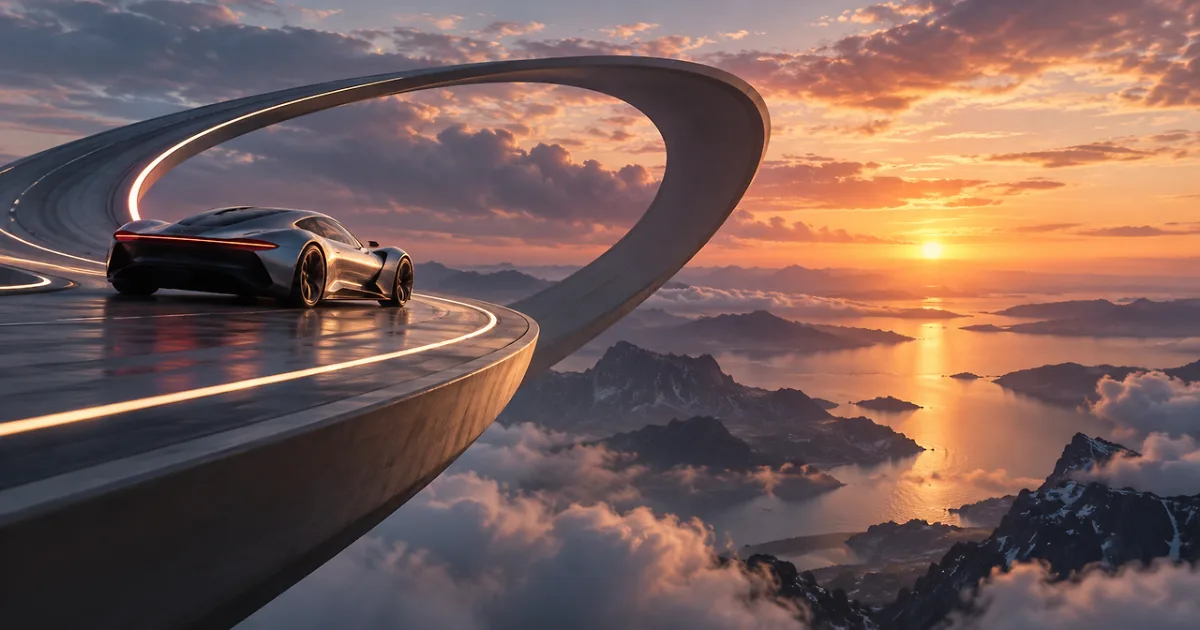
At a SpaceX testing facility in Texas, the Roadster began moving toward a massive curved structure.
It climbed the structure, passed beyond the vertical section, and continued moving while suspended upside down.
Moments later, the car dropped from the structure, rotated its body in midair, and landed back on its wheels.
In another demonstration, it leaped over several other vehicles.
It looked less like a conventional automobile demonstration and more like an experimental landing maneuver by a spacecraft.
Tesla also presented an acceleration figure of 0.81 seconds from a standstill to 60 miles per hour, approximately 96.6 kilometers per hour.
Of course, these were demonstration results released by Tesla. They should be distinguished from independently verified performance records for production vehicles.
But what made the unveiling interesting was not simply that another acceleration record had been shortened.
The demonstration invited us to reconsider the ways in which a car could move.
In other words, rather than remaining entirely within the competition to build faster cars, Tesla appeared to be questioning the fundamental mechanics of automotive movement.
Tesla Did Not Eliminate Gravity. It Created Another Force.
Watching the Roadster move upside down, one could almost imagine that gravity had disappeared.
But gravity remained exactly where it had always been.
Throughout the demonstration, it continued pulling the vehicle toward the center of the Earth.
Tesla was not attempting to eliminate gravity.
It was attempting to generate another force capable of opposing it.
At the center of this approach was an active suction system beneath the vehicle.
In a conventional car, the vehicle's weight presses the tires against the road.
The resulting normal force and friction enable the car to accelerate, brake, and change direction.
High-performance vehicles also take advantage of airflow.
At high speeds, air creates resistance to movement.
But automakers have never viewed air solely as something to avoid.
By refining vehicle bodies, wings, and spoilers, engineers reduce aerodynamic drag while generating downforce that pushes the car toward the road.
Downforce helps the tires maintain stronger contact with the surface, improving stability during high-speed driving and cornering.
In other words, high-performance cars can use aerodynamic forces generated during motion to increase grip.
The limitation is that conventional aerodynamic downforce depends heavily on vehicle speed.
When a car moves slowly or remains stationary, generating substantial downforce becomes difficult.
Tesla approached the problem differently.
It used suction fans.
By removing air from underneath the vehicle, the fans create a pressure difference.
The relatively higher surrounding air pressure then presses the car toward the surface.
If the fans can produce a sufficiently strong pressure difference, the vehicle can generate considerable grip even without moving quickly.
Tesla stated that the Roadster's suction system could generate force equivalent to approximately 2 G.
That figure, however, comes from the manufacturer and requires independent verification.
Using fans to increase automotive downforce is not an entirely new concept.
Motorsport has experimented with fan-assisted traction systems in the past.
What made the Roadster demonstration remarkable was the application of this principle to a vehicle moving while suspended upside down.
A different technology was responsible for changing the vehicle's orientation in midair.
That technology was the cold-gas thruster, an approach connected to SpaceX's aerospace engineering expertise.
Cold-gas thrusters expel highly pressurized gas through nozzles, producing force through the resulting reaction.
Unlike conventional chemical rockets that burn propellant, cold-gas systems use the expansion of compressed gas.
When gas is expelled in one direction, an opposing force acts on the vehicle.
Depending on the position and direction of the nozzles, that force can move the vehicle forward, push it upward, or rotate its body.
Tesla said the Rocket version would use ten cold-gas thrusters and introduced a large compressed-gas storage system.
However, the ability to maneuver in midair does not automatically make a car a flying vehicle.
Compressed gas is consumed during operation.
Producing powerful thrust for a brief moment is different from remaining airborne and flying safely over extended periods.
Sustained flight requires continuous force sufficient to support the vehicle's weight.
It also requires stable control over direction and orientation, along with safety systems capable of responding to unexpected situations.
What the Roadster demonstrated was not the completion of a freely flying automobile.
It was the possibility of short aerial maneuvers and attitude control that are unusual for conventional cars.
But I noticed something else.
Tesla had not abandoned all the established technologies of the automobile.
It continued using wheels and electric motors while adding forces and control methods that are not normally part of automotive design.
Gravity had not changed.
What had changed was how the car moved under the influence of that force.
And that led me to an interesting thought.
Perhaps some of the things we have regarded as limits were not imposed by the laws of nature themselves.
Perhaps they were limits created by the methods we had become accustomed to using.
Why Did a Car Return Nine Years Later Looking So Different?
The second-generation Tesla Roadster was first introduced in 2017.
At the time, Tesla wanted to challenge the public perception of electric vehicles.
EVs were widely associated with environmentally friendly and efficient transportation.
But when people thought about exceptional automotive performance or the pleasure of driving, they still tended to imagine internal-combustion sports cars from manufacturers such as Ferrari, Lamborghini, and Porsche.
Tesla wanted to challenge that perception.
When the second-generation Roadster was unveiled in November 2017, the proposed specifications were extraordinary.
Tesla announced a target of accelerating from zero to 60 mph in 1.9 seconds, exceeding 250 mph in top speed, and traveling as far as 620 miles—approximately 998 kilometers—on a single charge.
These were not performance figures verified in a production vehicle.
They were goals Tesla said it intended to achieve.
Nevertheless, they were remarkable ambitions at the time.
The numbers alone were enough to suggest that electric vehicles might match or surpass the performance of conventional supercars.
But Tesla's plans did not unfold as expected.
Production, originally scheduled for 2020, was postponed repeatedly.
Customers waited while development continued.
In the meantime, the automotive industry changed rapidly.
Electric vehicles were no longer unfamiliar.
High-performance EVs with powerful electric motors became increasingly common.
The instant acceleration characteristic of electric drivetrains became an area in which numerous automakers competed.
What had shocked people in 2017 no longer seemed quite as extraordinary nine years later.
Against that backdrop, Tesla presented a different vision for the Roadster in 2026.
At the unveiling, the company introduced three configurations: Performance, Thrust, and Rocket.
The concept combined the existing electric drivetrain with an active suction system and cold-gas thrusters to expand the vehicle's range of possible movements.
The driving-range target also changed.
In 2017, Tesla had proposed 620 miles on a single charge.
In 2026, the announced figure was approximately 300 miles.
At first, I found this puzzling.
Technology had advanced over nine years, yet the driving-range target had become shorter.
Of course, several factors could have contributed, including changes to the battery configuration, vehicle design, and the additional weight of new equipment.
It would be unreasonable to attribute the change to one specific cause without further evidence.
But one thing was clear.
The capabilities Tesla chose to emphasize had changed.
In 2017, Tesla wanted to prove that an electric vehicle could outperform an internal-combustion supercar.
In 2026, it was asking whether a car must remain attached to the road and whether it could control itself after leaving the ground.
The question had shifted.
From How fast can a car travel?
To How far can we expand the ways a car moves?
I found that distinction fascinating.
Technology does not always advance simply by achieving higher performance within an existing framework.
Automakers have spent decades increasing engine power, shortening acceleration times, and improving fuel efficiency and driving range.
Those efforts remain important.
They are essential measures of how effectively a car performs as a means of transportation.
But watching the Roadster rotate in midair led me to think differently.
A car capable of traveling at 300 km/h and a car capable of controlling its orientation in the air possess fundamentally different abilities.
A higher top speed does not enable a vehicle to change its direction while airborne.
Conversely, even a vehicle that cannot travel particularly fast might be able to produce new movements in the air if it possesses an independent propulsion system.
Tesla was exploring not merely how much better a car could perform, but what additional abilities a car might possess.
Of course, a new capability is not necessarily a useful one.
Not every vehicle needs to perform aerial maneuvers.
Whether those maneuvers could create practical value on real roads remains to be demonstrated.
Nevertheless, Tesla's decision to explore a different possibility rather than simply improve familiar automotive performance is worth examining.
It has raised a new question for the automotive industry and the broader mobility market.
Perhaps technological progress requires more than finding better answers.
Sometimes, we also need to reconsider whether we are still asking the right questions.
When the Boundaries Between Cars and Spacecraft Begin to Blur
Another aspect of the Roadster that intrigued me was the use of aerospace technology in an automobile.
Tesla manufactures cars.
SpaceX develops rockets and spacecraft.
Although both companies are led by Elon Musk, they operate in very different industries.
Cars travel on roads.
Spacecraft leave Earth's atmosphere and travel into space.
The environments in which these technologies operate, and the problems they must solve, are substantially different.
But when the Roadster left the ground and began maneuvering in the air, technologies developed separately by the two industries found a point of intersection.
Rockets and spacecraft face similar challenges when controlling their orientation and direction in space.
Although the industries differ, both must solve problems involving the control of movement.
The Roadster applied techniques developed in aerospace engineering to challenges that could not easily be addressed through conventional automotive engineering alone.
As a result, Tesla demonstrated an attempt to expand the range of movement possible for a car.
This made me reconsider how technological boundaries are established.
We classify automotive engineering and aerospace engineering as separate disciplines.
Universities divide them into different academic departments.
Companies organize their research and development activities around distinct technical fields.
These divisions are necessary for developing expertise.
But real-world problems do not always follow the disciplinary boundaries we have created.
When a car needs to maneuver in midair, aerospace engineering may become relevant.
Building a robot capable of moving like a human requires not only mechanical engineering but also artificial intelligence, cognitive science, and materials science.
Solving complex urban problems may require combining geospatial information, transportation engineering, data analytics, public administration, and policy.
Ultimately, what matters is not which discipline a technology belongs to.
What matters is the problem we are trying to solve and which kinds of knowledge are needed to solve it.
Tesla's broader business strategy presents another interesting contrast.
The company emphasizes autonomous driving and robotaxis as important future growth opportunities.
It envisions a world where people can reach their destinations without driving themselves.
Yet at the same time, it is developing the Roadster to push the experience of human driving to an extreme.
One is a car that does not require driving.
The other is a car designed to make the experience of driving extraordinary.
At first glance, these seem like opposing directions.
But viewed differently, both technologies attempt to change the relationship between humans and automobiles.
Robotaxis challenge the assumption that people must personally operate a vehicle during transportation.
The Roadster explores how far the experience of controlling an automobile might be expanded.
One seeks to reduce the burden of movement.
The other seeks to enrich the experience of movement.
I began to realize that technological progress does not always reduce the role of humans.
Some technologies perform tasks we previously had to do ourselves.
Others allow us to experience things we could never do before.
Even when technologies advance, the value they provide to people can be very different.
The Roadster is also better understood as a symbolic vehicle demonstrating Tesla's technological ambitions than as a mainstream product expected to generate a large share of sales.
In the automotive industry, such a vehicle is often called a halo car.
A halo car does not need to be the manufacturer's best-selling model.
Its purpose can be to demonstrate which technologies the company is exploring and what direction it intends to pursue.
Of course, symbolic value does not guarantee commercial success.
What is technically possible is not always what consumers need.
Extreme performance does not automatically translate into safety or economic viability.
Nevertheless, there is a reason companies sometimes pursue technologies that cannot be justified by immediate sales alone.
Maintaining an existing business is not always enough to secure future competitiveness.
Improving familiar technologies remains necessary.
But occasionally, the solution to a problem may lie in an entirely different industry.
This also requires changing how we think about technology.
Whenever a new technology appears, our first question is often what it can do.
But the longer I study technology, the more I feel there is another question we should ask first.
What problem are we actually trying to solve?
And are we insisting on familiar methods simply because they are the ones we have always used?
Just as the Roadster brought spacecraft technology into the automobile, solutions to some problems may come from fields that initially seem unrelated.
Watching the demonstration, I found myself thinking about the purpose of expertise.
Perhaps the reason our accumulated knowledge remains valuable is not so that we can remain confined within our own disciplines.
Perhaps its real value lies in helping us connect our experience to a wider world.
Why Is Something Easy in a Virtual World So Difficult in Reality?
Making a car fly in a virtual world is not particularly difficult.
In games or virtual-reality environments, cars can fly through the air or pass through walls.
Gravity can be reduced or removed entirely.
A virtual vehicle can be programmed to rotate in midair and land perfectly.
But real automobiles are different.
A real car has mass.
It interacts with air and friction, experiences gravity, and contains components exposed to heat and vibration.
Sensors produce errors.
Control commands take a finite amount of time to become physical movements.
The pressure generated by suction fans can vary depending on road conditions.
Cold-gas thrusters depend on the amount and pressure of the gas stored within them.
If these factors are not adequately considered, an experiment that succeeds perfectly in a virtual environment may fail in reality.
Yet it is neither practical nor safe to test every dangerous situation using a real vehicle.
Such experiments can be extremely expensive.
If they fail, the vehicle may be damaged, and people may be injured.
That is why simulation matters.
By representing the physical characteristics of a real vehicle through mathematical models, engineers can calculate how it might behave under different conditions.
What happens if a thruster activates slightly later than expected?
How does the vehicle rotate if its center of gravity changes?
Can it still land safely if one component fails?
Analyzing these situations in a virtual environment can help identify risks before physical testing and improve the development process.
Digital twins take this idea a step further.
A digital twin is a technological approach that represents a real object or system digitally and uses models and real-world data to understand its condition or analyze potential changes.
This is different from merely creating an accurate visual reproduction.
A digital twin is not simply a detailed three-dimensional image.
Rendering a car with extraordinary visual precision does not mean the model can accurately predict how that car will move.
The model must describe the vehicle's weight and center of gravity, propulsion forces and torque, tire characteristics and contact conditions, and the responses of its control systems.
And it must do so at a level that can be validated against real-world behavior.
Imagine creating a virtual Roadster to simulate an aerial rotation.
It would be easy to assume that the model perfectly represents the laws of physics.
In practice, however, simulations depend on approximations and assumptions.
At precisely what moment does each thruster activate?
How much force does it generate?
How does the surrounding airflow affect the vehicle's rotation?
How does the center of gravity change as compressed gas is consumed?
If one nozzle activates later than expected, in which direction will the vehicle rotate?
Answering these questions requires mathematical models, experimental data, and a detailed understanding of the real system.
Even more important is the process of validating the model.
If a simulated result differs from what happens in a physical experiment, researchers must investigate why.
They must revise incorrect assumptions, account for missing variables, and reassess uncertainty.
Experiment in the virtual environment.
Validate in the real world.
Then improve the virtual model.
As this cycle continues, the digital representation can become a more useful tool.
Of course, this does not mean a digital twin can predict every possible situation accurately.
Reality is always more complex than any model.
We cannot reproduce the physical world perfectly.
What we can do is improve our decisions by building models that explain the most important variables and relationships sufficiently well.
This brings me back to the meaning of virtual convergence.
For a long time, we have emphasized the ability of virtual worlds to provide experiences different from reality.
But perhaps virtual worlds do not need to exist simply as places where we escape the physical world.
They can also become environments where we safely examine experiments that would be difficult to conduct in reality, analyze situations that have not yet occurred, and use the results to make better real-world decisions.
This applies not only to automobiles but also to cities, industrial facilities, robots, and autonomous mobile systems.
When artificial intelligence is added, these systems may also help analyze relationships between objects in space and support decisions in changing environments.
Geospatial information represents the location and structure of the physical world.
Digital twins model the state and behavior of systems.
Spatial intelligence concerns the ability to understand spatial relationships and use them to support actions and decisions.
These technologies are distinct, but they can intersect through a shared objective: understanding and making better use of physical space.
However, the conclusions produced by virtual environments do not automatically become correct answers in reality.
Models cannot capture every real-world condition.
Data contains errors and omissions.
AI-generated judgments can also be wrong.
What matters, therefore, is not how spectacularly we can recreate a virtual world.
It is how far we can trust the conclusions derived from that world.
I believe this is where the real potential of virtual convergence lies.
Not in creating another world to replace reality, but in developing new ways to understand reality more deeply.
What Limits Do We Really Need to Overcome?
The Roadster demonstration was undeniably impressive.
But showing that a car can rotate in midair and proving that such a feature is necessary on public roads are two entirely different things.
How can the safety of compressed-gas storage systems be ensured?
Can a vehicle remain controllable if one or more thrusters fail?
Should aerial maneuvers even be permitted on ordinary roads?
There are many challenges between demonstrating extreme performance and producing a vehicle that ordinary people can safely use.
Digital twins face a similar question.
Even if we create a virtual city so visually realistic that it is almost indistinguishable from an actual city, what should count as success if that system does not help solve real urban problems?
Technology may begin by demonstrating what is possible.
But to create value in the real world, possibility must be tested against safety, economic viability, and actual human needs.
The more I study, the more I realize that understanding what we cannot do is just as important as understanding what we can.
And thoughts like these inevitably lead me to reflect on life.
We all live under our own forms of gravity.
Time passes.
We grow older.
Responsibilities at work become greater.
Families need our care.
And our health is no longer something we can take for granted in the way we once did.
When I was younger, I believed that enough effort could make almost anything possible.
I thought there was plenty of time.
I believed that whenever I wanted to begin something new, I could simply decide to do it.
But the longer I live, the more I understand that every choice comes with a cost.
Starting something new may require letting go of something else.
Perhaps that is why people gradually become more realistic as they grow older.
Some dreams are postponed.
Some challenges are abandoned.
There are days when simply maintaining the life we already have feels difficult enough.
Watching the second-generation Tesla Roadster made me think about these things.
Of all the limits we believe exist in our lives, which ones truly cannot be changed?
And which ones might be approached differently?
Just as a car cannot eliminate gravity, we cannot stop time from passing.
We cannot reverse the years we have already lived.
Nor can we simply abandon the responsibilities we have taken on as though they never existed.
But perhaps we can reconsider how we live within those conditions.
When I was younger, speed mattered.
I wanted to achieve more, get ahead of others, and reach my desired destination as early as possible.
As time passed, however, my thinking changed.
Where I was going began to matter more than how quickly I arrived.
Instead of measuring only how much I had achieved, I became more interested in what those achievements meant to my life.
Perhaps the meaning of growth changes with age.
When I was younger, it was important to prove what I was capable of.
Now, perhaps it is becoming more important to decide where the experience I have accumulated should be used.
Just because we have traveled along a particular path for many years does not mean we must follow it to the very end.
But choosing a new path is not the only way to grow, either.
What matters, I think, is not allowing the momentum of the past to determine every decision we make today.
Why am I still walking this path?
Does this goal still matter to me?
Am I continuing in the same direction simply because it feels familiar, without seriously considering other possibilities?
After nine years, the Roadster returned in a form different from the one Tesla originally proposed.
Initially, the ambition was to create a car that could travel faster and farther.
This time, Tesla emphasized the possibility of moving in different ways.
Whether that shift will produce meaningful results for the automobile industry remains uncertain.
But it left me with one question.
We have spent so much time trying to find better answers.
Could we be overlooking the moments when we should change the question itself?
I suspect this applies both to researching virtual convergence and to living a human life.
We cannot speak meaningfully about new possibilities without understanding reality.
But neither must we assume that the reality we know today represents the entirety of what is possible.
Gravity will always exist.
Yet the existence of gravity does not determine every possible way a car can move.
We cannot change every condition under which we live.
But that does not mean there is only one way to accept those conditions and move forward.
I am still searching for my own way.
And along that journey, there is one thing I want to remember.
Every now and then, I should question whether something I have believed to be obvious for so long is really as obvious as I thought.
Written in October 2026.