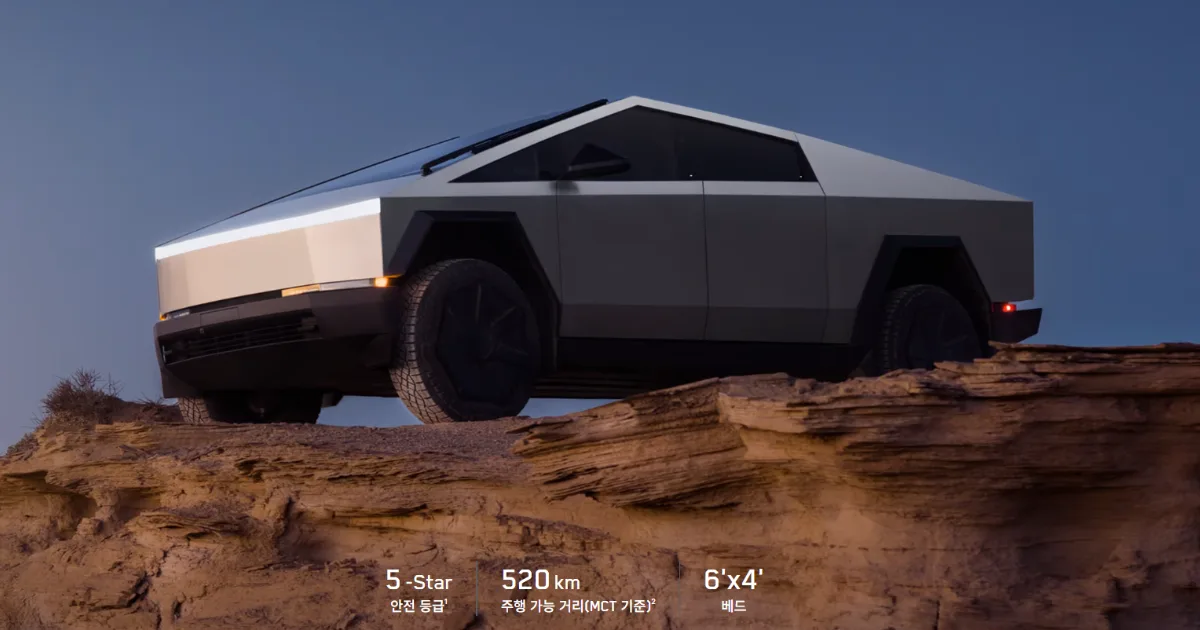
Tesla's Cybertruck, once presented as a symbol of the future of automobiles, is approaching the end of production at the company's Texas factory.
On November 6, 2026, Tesla CEO Elon Musk announced on his social media platform X that the company plans to phase out Cybertruck production at Gigafactory Texas by mid-2027.
The objective is to increase production of the Cybercab.
Cybercab is Tesla's two-seat robotaxi, designed for autonomous operation without a steering wheel or pedals.
In other words, Tesla intends to reduce manufacturing capacity dedicated to an electric pickup truck driven by humans and expand production of vehicles designed to provide transportation without human drivers.
A day later, Musk provided further details.
He explained that Tesla would operate an additional Cybertruck production shift to fulfill remaining orders before dismantling the production line around June or July 2027 and redirecting capacity toward Cybercab.
The decision represents more than an ordinary production adjustment.
Cybertruck was a product Tesla had pursued for years as part of its effort to open a new segment of the electric vehicle market.
Since its unveiling in 2019, its distinctive stainless-steel body and futuristic design have attracted worldwide attention.
Actual sales, however, failed to meet expectations.
While Musk had previously discussed annual Cybertruck sales reaching approximately 250,000 vehicles, estimated U.S. sales in 2025 amounted to only about 20,000 units.
That represented a decline of approximately 48% from the previous year.
Meanwhile, Tesla has been expanding its robotaxi business around Cybercab.
These developments suggest something more significant than the discontinuation of an underperforming vehicle at one manufacturing site.
They reveal where Tesla increasingly sees its future.
Tesla appears to see greater long-term potential not simply in selling vehicles to people who drive them, but in operating vehicles that drive themselves and generate recurring transportation revenue.
Why Was Cybertruck Such an Important Symbol for Tesla?
When Cybertruck was unveiled in 2019, it looked unlike almost any conventional pickup truck.
Instead of the curved body panels commonly found on automobiles, it featured an angular exterior dominated by sharp lines and flat surfaces.
Tesla also emphasized its unconventional stainless-steel body construction.
Musk presented the vehicle as an attempt to transform both automobile design and manufacturing.
At the time, the American pickup truck market was dominated by established automakers, including Ford, General Motors, and brands associated with Stellantis.
Pickup trucks occupy an important position in the U.S. automotive industry.
They serve commercial, recreational, and family transportation needs.
Some models command relatively high prices and generate attractive margins for manufacturers.
Tesla sought to enter this market with an electric alternative and create new demand.
Cybertruck was therefore more than another addition to Tesla's product lineup.
It became a symbolic project representing the company's technological ambition and distinctive brand identity.
However, the same design and engineering choices that made Cybertruck unusual may also have created obstacles to mainstream adoption.
Attracting consumer attention and converting that attention into vehicle purchases are fundamentally different challenges.
Why Did Strong Reservations Fail to Translate into Sales?
Cybertruck attracted enormous interest following its unveiling.
Some reports suggested that prelaunch reservations exceeded one million.
But reservation figures have limitations as indicators of confirmed purchase demand.
A reservation is not equivalent to a completed vehicle sale.
When consumers can reserve a vehicle with a relatively small, refundable deposit, expressions of interest may not translate into actual purchases.
Customers can also abandon their reservations if prices rise beyond expectations or the specifications of the production vehicle differ from those originally anticipated.
Cybertruck experienced multiple delays during development.
Although the vehicle was unveiled in 2019, customer deliveries did not begin until late 2023.
Its eventual pricing and product configurations also differed from early expectations.
The striking exterior created a powerful brand image, but it did not necessarily align with the preferences or practical requirements of every conventional pickup truck buyer.
The electric pickup market itself also developed more slowly than some had anticipated.
Large electric pickups present challenges involving vehicle weight, price, charging, and driving range while towing.
Traditional pickup customers often place considerable importance on practical utility, durability, payload capacity, and affordability.
That makes it difficult to explain Cybertruck's disappointing sales through its design alone.
Quality concerns and repeated recalls also created additional challenges.
Ultimately, Cybertruck succeeded in attracting global attention but struggled to convert that interest into sustained mass-market demand.
The Gap Between 250,000 Annual Sales and Reality
The difference between expected and actual demand is central to understanding Tesla's production decision.
Musk had previously suggested that Cybertruck could reach annual sales of approximately 250,000 vehicles.
However, according to estimates from Kelley Blue Book, U.S. sales declined from approximately 39,000 units in 2024 to around 20,000 in 2025.
The 2025 estimate represented only about 8% of the earlier 250,000-vehicle annual ambition.
Of course, the 250,000 figure was a target or expectation, not a confirmed order volume.
U.S. retail sales estimates also cannot be compared directly with Tesla's global production capacity as though they were identical measures.
Nevertheless, the gap in scale is striking.
According to Tesla's third-quarter 2026 disclosures, Gigafactory Texas had installed annual Cybertruck production capacity exceeding 125,000 vehicles.
Actual demand, however, did not sufficiently support that capacity.
Manufacturing efficiency depends partly on how effectively production facilities are utilized.
When demand falls below expectations, the capital invested in equipment, labor, and factory space may generate weaker returns.
Dedicated equipment developed for a particular model may also be difficult to reuse for another vehicle without modification.
If demand for one product is insufficient while demand for another is expected to grow, reallocating production resources can be a rational business decision.
However, Tesla has not yet disclosed the specific cost of converting Cybertruck manufacturing facilities to Cybercab production or the efficiency gains that the conversion might produce.
How Is Cybercab Different from Cybertruck?
Cybertruck and Cybercab are both electric vehicles developed by Tesla.
But they target fundamentally different markets.
Cybertruck is a vehicle purchased and driven by an individual customer.
When Tesla sells the vehicle, it recognizes revenue associated with the sale.
Cybercab, by contrast, is designed for autonomous mobility services.
Although vehicle sales may also be possible, Tesla has placed particular emphasis on developing a robotaxi network.
Under that model, the primary commercial offering is not necessarily the vehicle itself.
It is the transportation service provided by the vehicle.
Consider the difference.
When an individual purchases a car, the manufacturer primarily generates revenue from the vehicle transaction.
But when a robotaxi transports multiple passengers throughout the day, each trip can generate additional revenue for the service operator.
The economic structure changes.
An automaker pursuing this model must consider more than production volume and vehicle selling prices.
It must also manage trip frequency, passenger occupancy, vehicle utilization, operating hours, and service costs.
Software becomes increasingly important.
To provide an actual transportation service, Cybercab must use AI to perceive its surroundings, make driving decisions, and transport passengers safely to their destinations.
Automotive manufacturing, autonomous-driving software, and service operations become parts of one integrated business.
Tesla aims to build that structure through Cybercab.
From Selling More Cars to Keeping Vehicles in Service Longer
The central idea behind the Cybercab strategy is changing how the economic value of a vehicle is realized.
Traditional automakers have largely depended on manufacturing volumes, selling prices, and production costs to determine profitability.
Once a vehicle is sold, ownership and primary operating responsibility generally transfer to the customer.
Robotaxi economics are different.
The financial structure depends partly on who owns and operates the vehicle.
If a service provider retains ownership, it must bear costs including vehicle acquisition, depreciation, charging, maintenance, insurance, cleaning, and remote support.
In return, it can earn recurring revenue from passenger fares.
Robotaxi profitability therefore cannot be determined solely by how cheaply each vehicle can be manufactured.
Utilization is equally important.
If a vehicle spends substantial time traveling without passengers or waiting for ride requests, profitability can decline.
Maintenance and cleaning also reduce the time available for paid trips.
Accident rates and insurance expenses represent additional variables.
Even if Tesla succeeds in manufacturing Cybercabs at scale, it may struggle to achieve profitability unless these operational challenges are addressed.
Increasing Cybercab production could therefore be a necessary condition for expanding Tesla's robotaxi business.
It is not, by itself, sufficient to guarantee success.
Tesla's Third-Quarter Results Already Signaled the Strategic Shift
The plan to end Cybertruck production in Texas did not emerge without broader strategic context.
Tesla's third-quarter 2026 results had already indicated an increasing emphasis on autonomous driving and AI.
Quarterly revenue was approximately $28 billion, broadly similar to the previous year.
Operating income, however, fell 56% year over year to approximately $720 million.
Vehicle deliveries declined 2% to around 487,000 units.
At the same time, research and development spending and capital investment increased.
Tesla has been directing additional resources toward AI computing infrastructure, autonomous-driving technology, and robotic manufacturing facilities.
The production shift from Cybertruck to Cybercab is consistent with that investment direction.
Cybertruck symbolized Tesla's capabilities as an automobile manufacturer.
Cybercab represents the type of business Tesla increasingly wants to become.
One product is designed primarily around selling vehicles.
The other is intended to support a business that provides transportation services through autonomous vehicles.
Musk's decision to allocate more manufacturing capacity at the Texas factory to Cybercab indicates a higher strategic priority for the latter.
Cybercab Is Already Operating on Public Roads
Tesla said it began introducing Cybercab vehicles into its robotaxi service in Austin, Texas, in September 2026.
According to the company's third-quarter materials, cumulative driverless robotaxi mileage was approaching two million miles.
However, this is a cumulative metric for Tesla's robotaxi operations.
It should not be interpreted as mileage generated exclusively by the Cybercab model.
Tesla has been expanding service hours and operating areas while accumulating real-world driving experience.
This process is important for commercialization.
Developing an autonomous-driving model and operating a transportation service carrying actual passengers are different challenges.
Road conditions change constantly.
Autonomous systems must respond to weather, traffic, construction zones, pedestrians, and unexpected hazards.
Expanding a service also requires reliable vehicle maintenance and operating procedures.
Tesla is currently testing and expanding these capabilities.
However, detailed standalone revenue, profitability, and per-vehicle operating costs for Cybercab have not yet been sufficiently disclosed.
The beginning of vehicle operations should therefore not be equated with the completion of stable, large-scale commercialization.
In the United States, vehicles without steering wheels or pedals also face questions involving compliance with applicable motor vehicle safety standards.
The pace at which these regulatory matters are resolved could influence the economics of future production expansion.
Installed Capacity of More Than 125,000 Vehicles Is Not the Same as Actual Production
Tesla's third-quarter 2026 production-capacity disclosures listed both Cybertruck and Cybercab at Gigafactory Texas with installed annual capacity exceeding 125,000 vehicles.
But installed capacity is not actual production.
Installed production capacity represents the theoretical manufacturing volume supported by a factory and its equipment.
Actual output depends on equipment utilization, component supply, quality issues, production adjustments, and regulatory requirements.
Consequently, Cybercab's installed capacity exceeding 125,000 vehicles does not mean Tesla is already manufacturing or selling that many Cybercabs.
The proposed conversion of Cybertruck production facilities should be understood within this distinction.
Establishing manufacturing capacity for a new vehicle and converting that capacity into sustained mass production are separate tasks.
Even if Tesla reallocates factory space and resources from Cybertruck to Cybercab, the transition may require additional time.
Future assessments will therefore need to examine Cybercab's actual production volumes and delivery rates.
Was Cybertruck a Technological Failure?
Weak sales do not necessarily mean Cybertruck was a complete failure in technological development.
The vehicle also served as a platform through which Tesla explored new materials, manufacturing processes, and vehicle architectures.
Its unconventional body construction and changes in electrical and electronic systems provided experience in applying new engineering approaches to a production vehicle.
Following reports of the production phaseout, Cybertruck chief engineer Wes Morrill described the vehicle as an important technological development platform.
He suggested that lessons learned through Cybertruck could carry over to Cybercab.
This offers another way to interpret Cybertruck's legacy.
Even if its commercial performance failed to meet expectations, technologies developed during the project could potentially be useful in other vehicles.
However, the possibility of technology transfer does not automatically justify the economic performance of the Cybertruck business.
Technical achievements and commercial profitability must be evaluated separately.
The actual value of any technology transferred to Cybercab will become clearer when information about its manufacturing costs, quality, and production efficiency becomes available.
Why Is Tesla Choosing to Concentrate Its Resources Now?
Every company must allocate limited resources among competing business opportunities.
Factories, employees, and research and development funding are not unlimited.
Tesla is currently pursuing several capital-intensive businesses simultaneously.
These include conventional electric vehicles, autonomous-driving software, robotaxi operations, the Optimus humanoid robot, energy storage, and AI computing infrastructure.
All require considerable investment and technological development.
In that environment, continuing to maintain production capacity for a vehicle whose demand has fallen short of expectations can create opportunity costs.
Resources assigned to Cybertruck might potentially generate greater future returns if redirected toward another business.
Musk has chosen Cybercab as the beneficiary of that reallocation.
The decision suggests Tesla is increasingly concentrating resources on businesses it considers strategically important to its future rather than attempting to expand every segment of its existing automobile lineup.
However, actual demand for Cybercab still needs to be established.
It would therefore be premature to conclude that shifting production from Cybertruck to Cybercab will necessarily produce higher profits.
What can be observed is that Tesla is changing the priorities behind its future growth strategy.
Will Producing More Cybercabs Make Tesla More Profitable?
Cybercab's economic potential depends heavily on vehicle utilization.
Traditional automakers generate revenue when vehicles are sold.
Robotaxi operators can potentially generate recurring revenue while vehicles are in service.
In theory, a vehicle that maintains high utilization over an extended period could produce substantial cumulative revenue.
But recurring revenue does not automatically mean high profitability.
Robotaxi operations incur expenses involving depreciation, maintenance, insurance, charging, cleaning, customer support, and remote operations.
If customer demand is insufficient, vehicles may spend long periods waiting for passengers.
Longer idle times reduce the productivity of the invested capital.
Price competition may also intensify as robotaxi services expand.
Whether Tesla can generate greater profit through Cybercab than through conventional automobile sales must therefore be demonstrated through actual operating data.
The most important indicators may ultimately include the number of paid trips per vehicle, revenue per vehicle, and operating cost per vehicle rather than production volume alone.
Mass production addresses the challenge of supplying vehicles to the market.
Operating those vehicles profitably is a separate challenge.
Tesla's Autonomous-Driving Competitors Are Not Just Automakers
Cybertruck primarily competed with pickup trucks produced by established vehicle manufacturers.
Electric pickups from Ford, GM, and Rivian were among its major comparisons.
Cybercab faces a different competitive environment.
In the robotaxi market, Tesla must compete with companies developing autonomous-driving technology and operating transportation services.
One prominent competitor is Waymo.
Waymo already provides paid autonomous transportation services to customers and has been expanding its operations.
Tesla must therefore demonstrate more than manufacturing expertise.
It must develop autonomous-driving technology capable of operating reliably on public roads, supported by customer-facing services and robust fleet management.
This competition differs from traditional automotive rivalry.
Vehicle design, driving range, and selling price remain relevant, but service coverage, safety, utilization, and passenger fares also become critical competitive factors.
As Tesla increasingly focuses on Cybercab, it may be evaluated not only as an automobile manufacturer but also as a mobility service operator.
Has Cybertruck Been Officially Discontinued Worldwide?
One important qualification concerns the word "discontinued."
Musk's initial announcement specifically described a plan to phase out Cybertruck production at Gigafactory Texas.
It did not explicitly establish whether production would move to another factory or whether the model would be permanently discontinued worldwide.
Subsequent information about dismantling the Texas production line makes continued production at that location in its current form increasingly unlikely.
No specific official plan to manufacture Cybertruck at another factory has been identified in the information provided.
The most accurate characterization at this stage is therefore Tesla's plan to end Cybertruck production at its Texas factory.
Describing the announcement as a definitive, worldwide discontinuation requires caution.
Existing Cybertruck vehicles will also not suddenly become unusable because production is ending.
Musk indicated that Cybertrucks already on the road would continue operating for a long time.
However, the specific arrangements for parts supply, servicing, warranties, and maintenance after production ends still need to be clarified.
From Selling Cars to Providing AI-Powered Mobility Services
Tesla's decision invites a broader reconsideration of growth strategies in the electric vehicle industry.
The traditional business model of an automobile manufacturer is to produce and sell vehicles.
When customers buy more cars, manufacturers can increase revenue.
Advances in autonomous driving, however, create the possibility of a different model.
Vehicles can transport passengers independently and generate revenue through transportation fees.
In such a business, competitive advantage may shift from vehicle sales volume toward operating efficiency and software performance.
Tesla intends to lead that transformation through Cybercab.
But moving from automobile sales to mobility services is not simply a matter of replacing one product with another.
It represents a change in business structure involving manufacturing, operations, insurance, regulation, software, and customer service.
Experience accumulated as a vehicle manufacturer may provide useful advantages.
It does not automatically guarantee success in robotaxi operations.
In the future, Tesla may be judged not only by how many vehicles it can manufacture, but also by how safely and economically it can operate them.
What Cybertruck's Planned Exit Reveals About Tesla's Future
Cybertruck has been one of the most symbolic vehicles in Tesla's history.
It challenged established automotive design and manufacturing conventions and attracted worldwide attention long before customer deliveries began.
But public interest did not translate into sustained mass-market demand.
Sales fell substantially short of early ambitions, while pricing and quality concerns added pressure.
Tesla has now decided to phase out Cybertruck production in Texas and concentrate additional manufacturing capacity on Cybercab.
The important issue is not simply that a particular vehicle may disappear from production.
It is what the decision reveals about where Tesla believes the next major source of automotive revenue will emerge.
Cybertruck represented a futuristic vehicle driven by a human customer.
Cybercab represents a future in which the vehicle drives itself.
Both symbolize technological innovation, but their commercial economics differ.
With Cybertruck, Tesla attempted to transform the conventional pickup truck market.
With Cybercab, it is attempting to transform the way automobiles are owned, operated, and used.
The success of that transition remains uncertain.
Cybercab's actual production volumes, autonomous-driving safety, regulatory approvals, service demand, and per-vehicle profitability all require further validation.
Changing production lines alone will not resolve every challenge facing Tesla's existing automotive business.
Nevertheless, the strategic direction is clear.
Tesla is increasingly betting its future not simply on becoming a manufacturer that sells more cars, but on becoming an AI-powered mobility company whose vehicles operate autonomously and generate recurring revenue.
The planned phaseout of Cybertruck production in Texas is a symbolic expression of that shift.
A vehicle celebrated for its futuristic design is making way for a vehicle designed to operate without a driver.
The decision reflects Tesla's broader ambition to evolve from an electric vehicle manufacturer into a business increasingly centered on autonomous driving, robotics, and artificial intelligence.
Ultimately, Cybertruck's planned departure is not simply a story about one model falling short of commercial expectations.
It is a story about where Tesla believes the next economic structure of the automotive industry will emerge.