Users had done nothing unusual. They had not downloaded software from an unknown source or installed an unofficial mod. They had simply launched the official PC launcher for GODDESS OF VICTORY: NIKKE as they normally would. Yet a script file loaded externally by the launcher became part of the attack path.
According to operator Level Infinite, the insightjs.com domain, which had been used by some of its game services, was hijacked by a third party on the morning of September 27, 2026. Later that afternoon, abnormal code was inserted into four script files hosted on the official content delivery network (CDN) accessed by the PC launcher. Level Infinite said these scripts began distributing malicious software to users’ PCs on October 30. However, the independent security researcher who first analyzed the incident reported signs that the malware may have been active from late October, leaving some uncertainty over the exact starting point.
The incident became public on November 3, when an independent security researcher published a technical analysis on GitHub. Level Infinite responded the following day by replacing the affected files. Based on the timeline disclosed by the operator, roughly 38 days passed between the initial file tampering and the detection of the abnormal activity. During that period, PCs and account information belonging to users who launched the game may have been exposed to significant risk. The actual scale of the damage and the precise intrusion path remain under investigation, while Level Infinite has said that no confirmed cases of information leakage have been identified so far.
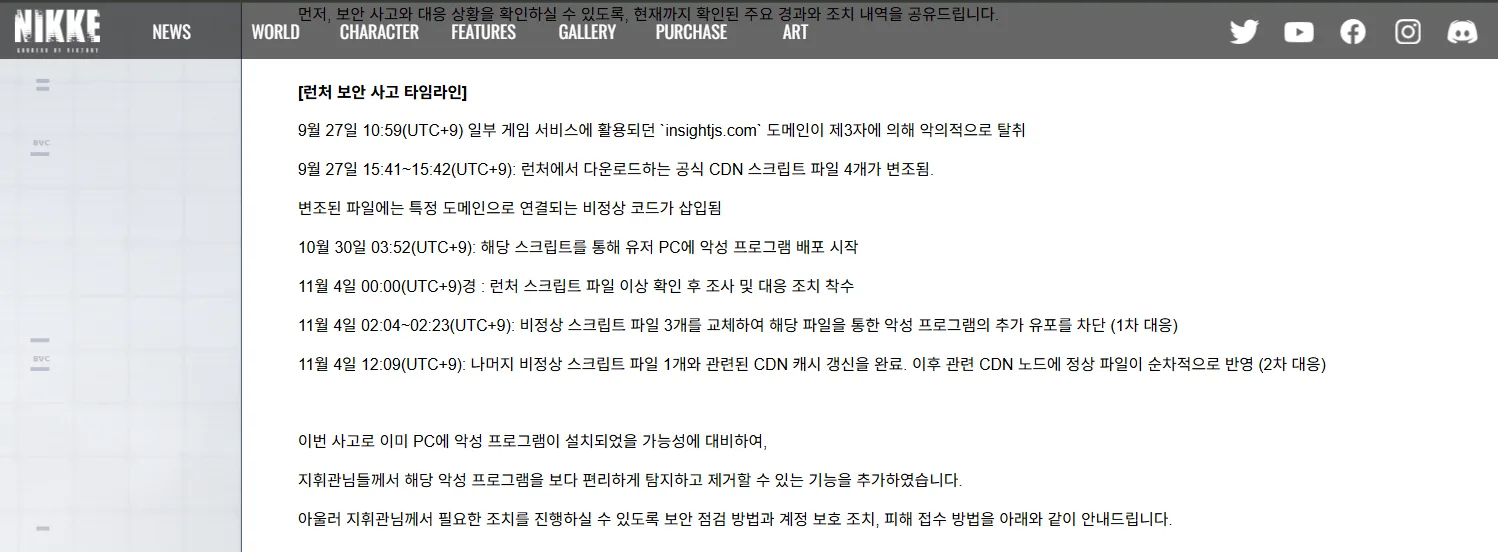
What makes this incident especially notable is that the attack took advantage of the execution process of an “official program” that users had trusted. It has the characteristics of a software supply-chain incident—one that is difficult to prevent simply by avoiding suspicious programs and relying only on official distribution channels.
The incident also reveals another issue. To users, NIKKE is a single game. But the development and distribution of the game, as well as the operation of its PC launcher and servers, are not all handled by a single company. Understanding this incident therefore requires looking not only at how the malicious code entered the system, but also at how responsibilities are divided among the multiple companies behind a single game service.
Behind One Game Are Multiple Operators
GODDESS OF VICTORY: NIKKE is developed by South Korean game company SHIFT UP and serviced by Level Infinite, Tencent’s global game publishing brand. SHIFT UP is responsible for creating the game’s characters, systems, and content, while Level Infinite handles global publishing and service operations. The PC version has also been distributed through a launcher developed and serviced by Tencent. To users, it is one game, but delivering that game to a user’s PC involves multiple interconnected layers, including development, publishing, the launcher and servers, CDNs, and external resources.
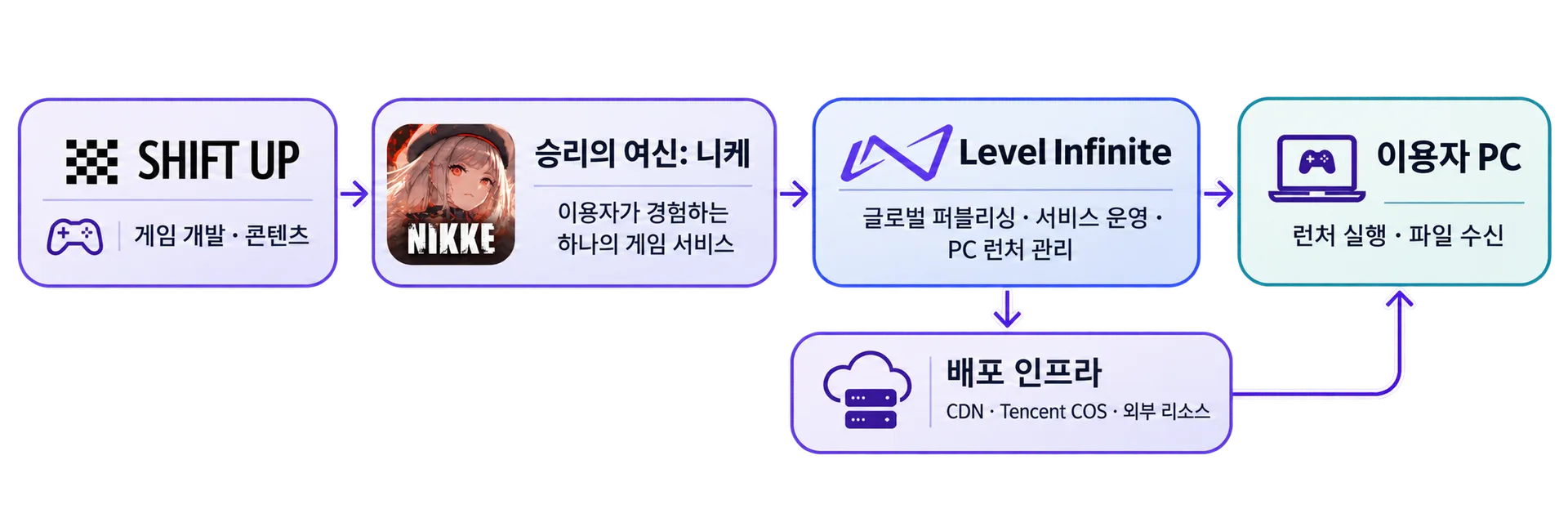
The incident made these divided roles more visible. SHIFT UP is responsible for developing the game content, while the PC launcher and service operations involved in the incident fall within the publisher’s operational domain. After the incident, Level Infinite replaced the launcher files and inspected the CDN. It later added a function to the PC client that automatically detects and removes malicious software, while advising users to change passwords and reissue API keys and access tokens. It also said that users who suspected damage involving external accounts or financial assets could submit reports through customer support.
That does not mean the incident can immediately be attributed to a particular system or company. Level Infinite explained that the insightjs.com domain used by some of its game services had been hijacked by a third party, after which script files loaded by the PC launcher were altered. The company is still investigating the network environment, including the CDN, to determine how the files were modified. As part of its follow-up measures, it also announced plans to introduce integrity verification for external resources and to ensure that each launcher function operates with only the minimum permissions required.
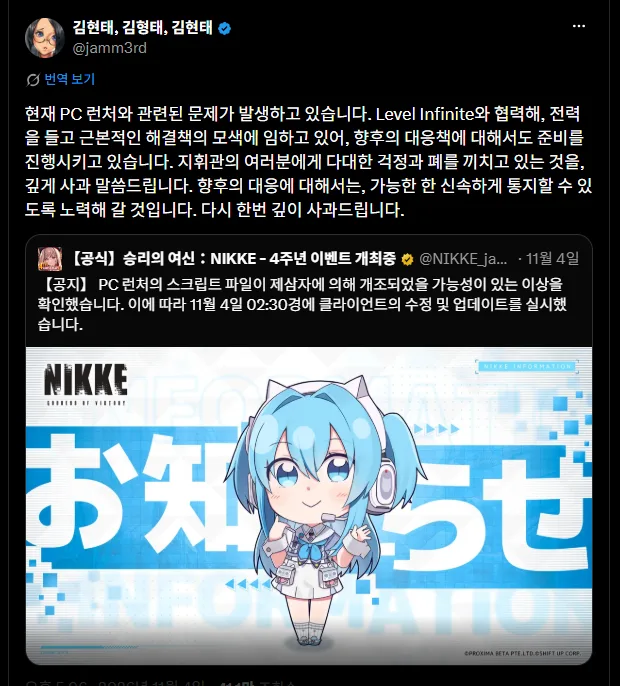
Although Level Infinite, as the operator, remained at the center of the response, developer SHIFT UP was not entirely separate from the incident. On November 4, SHIFT UP CEO Kim Hyung-tae personally apologized to users and announced that a security inspection function capable of automatically checking and addressing the launcher’s security status had been applied. He also said the company would continue reviewing the service to ensure its safety. Technical recovery and service operations may have been handled by the publisher, but users do not build trust in a game by separating the roles of the developer and publisher.
Ultimately, the key issue is not the role of any one company. When the company developing the game, the company operating the service, and the technical systems delivering files to users’ PCs are separated, the entire chain must still remain connected: where the problem occurred, who detected it, who explained it to users, and who took responsibility for recovery. Roles may be divided, but the boundaries between them should not become gaps in user protection.
Separate Roles, Responsibilities That Are Harder to Separate
So who is responsible for this incident? Rather than pointing to a single company, it is more accurate to distinguish the different areas in which responsibility arises.
First, there is the technical and operational question of who managed the launcher and distribution system and maintained their security. How operation, security, and incident-response duties were divided between the developer and publisher belongs to the business and contractual domain. Then there is another layer of responsibility: when an incident occurs, who informs users, resolves the problem, receives reports of actual damage, and protects those affected. These three forms of responsibility do not always belong to the same company.
Legal liability is a separate matter again. It may vary depending on the contracts between the companies, the actual cause of the breach, and the laws that apply. Based on the information currently available to the public, it is difficult to conclusively assign legal responsibility to any one company. From the user’s perspective, however, the issue becomes somewhat simpler.
When users launch a game, they do not distinguish which company manages which system behind the launcher. They cannot—and do not need to—know where the developer’s code, the publisher’s operational systems, the CDN, and external resources connect. What users chose was not a collection of technical components, but a single game service.
That is why the more roles are divided, the more important the connections between them become. Determining where a technical incident occurred is important, but there should be no gap in the process of explaining the situation to users, providing necessary instructions, and receiving damage reports. Level Infinite’s acknowledgement of its responsibility as the operator and its establishment of a reporting channel for potential damages can be understood in this context.
Development, publishing, and technical operations can be separated. User protection cannot be divided into isolated compartments in the same way. To users, the service remains one continuous experience from beginning to end.
Does Responsibility End When Recovery Is Complete?
Replacing the affected files and introducing malware detection may restore the service to normal operation. But in a security incident, restoring the service does not necessarily mean that all consequences for users have been resolved.
PCs that may already have been exposed can require separate inspection, while users may need to change passwords or reissue API keys and access tokens themselves. If they used other service accounts or managed personal assets on the same PC, they may also need to investigate the possibility of additional damage. Even after the operator restores the system, users may still bear the time, anxiety, and effort required to check their own devices and accounts.
This raises a broader question about the scope of user protection in game services. In the case of a typical server outage or login failure, in-game compensation may go some way toward addressing the problem. But when an incident potentially affects users’ PCs and external accounts, the problem no longer ends within the game itself. What matters, therefore, is not simply how quickly the service is restored. Users need a way to determine whether they were affected, clear guidance on the security measures they should take, and a process for reporting and addressing actual damages if they occur.
The incident therefore leaves one question: if a problem arising not inside the game itself but during the process of using it can expose users’ devices and other services to risk, how far should a game company’s concept of “user protection” extend?
Restoring the service may not be the end of incident response. It may instead be the beginning of the next stage: identifying user harm and rebuilding trust.
The Official Launcher Is Part of the Supply Chain Too
The impact of the incident did not stop with NIKKE. Because the problem involved the official PC launcher and distribution process, other games serviced through the same publisher also had to verify and clarify whether they had been affected. Krafton said that PUBG Mobile was unrelated to the incident, while Arena Breakout also announced that it had not been affected. An incident that began with one game therefore prompted checks across other games connected to the same service ecosystem.
This broader impact reflects the structure of PC games themselves. Many PC games use proprietary launchers to deliver executable files, updates, and various external resources directly to users’ computers. In this case, the incident did not begin with the game content itself, but with a script that the launcher loaded from an external source. Users had done nothing more than run the official program, yet they could still be exposed to an attack when a file trusted by that program was altered. The safety of the game executable alone does not guarantee the safety of the entire service. The official launcher itself is part of the supply chain that delivers the game to users.
That is why Level Infinite’s prevention measures include stronger security monitoring, integrity verification for external resources, and minimizing launcher permissions. Replacing the affected files is only the beginning. The more important questions are how quickly the system can detect changes to externally loaded files and whether the launcher can be restricted to operating only within the permissions it genuinely needs.
The fact that more than a month passed between the initial file tampering and the discovery of the abnormal activity illustrates the weight of this challenge. Security is not only about removing a problem after an incident occurs. It is also about how quickly small deviations can be detected within the normal flow of a live service.
When the Boundaries of Roles Must Not Become Gaps in Protection
Today, a single game service is built from many interconnected companies and technologies. A developer creates the content, a publisher operates the service, and behind them sit launchers, servers, CDNs, and external services. In global games, this is an entirely normal structure.
The problem is not that these roles are divided. The problem arises when, after an incident, those same boundaries are passed on to users. Knowing which company was responsible for which system and where the problem occurred is essential for identifying the cause and determining responsibility. But if users must first understand that structure in order to protect themselves or recover from harm, that burden should not fall on them.
In this incident, operator Level Infinite acknowledged the launcher security incident in an official notice on November 4 and announced malware inspection and removal tools, a damage-reporting process, and measures to prevent recurrence. On the same day, SHIFT UP CEO Kim Hyung-tae also apologized directly to users through his X account, saying that the company was working with Level Infinite to “mobilize all available resources to find a fundamental solution” and was preparing follow-up measures. Technical remediation was centered on the operator, but the developer also became part of the effort to restore user trust.
Of course, it is still too early to determine whether those measures were sufficient. The full scale of the damage and the exact intrusion path remain under investigation, and the actions required may change depending on what further harm is confirmed. What is clear, however, is that the scope of user protection cannot be defined solely by determining which company’s domain the incident originated from.
The company that makes the game may be different from the company that operates it, and responsibility for the launcher and distribution infrastructure may be divided again. Responsibility itself may also be allocated differently depending on the cause and contractual arrangements. But users launched one game that they trusted. When that trust is shaken and responsibility branches out across multiple parties, user protection must become correspondingly more seamless and robust.