Anthropic has introduced Claude Opus 5.
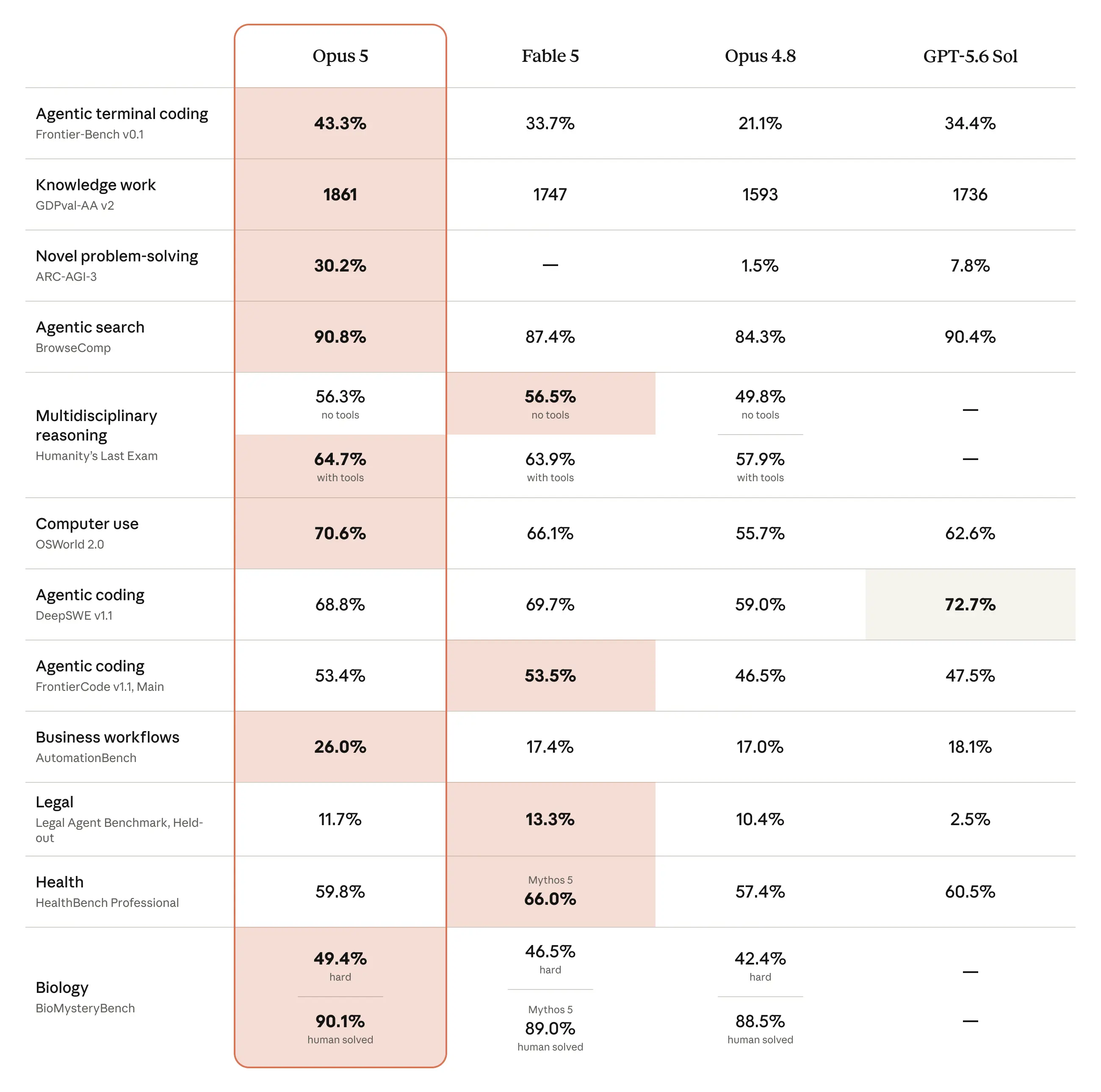
The company describes it as a thoughtful and proactive model that comes close to the frontier intelligence of Claude Fable 5 at half the price. It says Opus 5 reaches state-of-the-art performance on coding and knowledge-work evaluations such as Frontier-Bench and GDPval-AA, while remaining behind Claude Mythos 5 on cybersecurity tasks.
At first glance, this looks like another frontier model release.
But the real point of the launch is not simply that Anthropic has produced a stronger model.
The more important word in the Opus 5 announcement is not intelligence.
It is efficiency.
Anthropic says Opus 5 is designed to be used every day. It is more efficient than other models, becomes the new default model on Claude Max, and is the strongest model on Claude Pro.
That positioning matters.
Opus 5 is not being framed as a laboratory trophy model. It is being framed as a model for repeated use in real work: coding, analysis, document creation, automation, finance, legal review, research and agentic workflows.
The question in AI competition is changing.
Who built the smartest model?
That still matters.
But companies and developers increasingly ask different questions.
Can this model finish real work?
Is it cost-effective?
Does it burn too many tokens?
Can it handle coding, automation and knowledge tasks repeatedly?
Can it be powerful while still remaining controllable?
Claude Opus 5 is Anthropic’s answer to those questions.
The Default Model Matters More Than the Most Spectacular Model
In AI, the most glamorous position is the top-performing model.
Benchmark leadership, long-horizon reasoning, difficult math, complex coding and autonomous agent performance all attract attention.
But the commercially more important position may be the default model.
The model users open every day.
The model developers call by default.
The model enterprises place inside recurring workflows.
The model with the right balance of performance, reliability and cost for large-scale use.
That is why Opus 5 matters.
Anthropic is making Opus 5 the default model on Claude Max and the strongest model available on Claude Pro.
In AI products, the default is powerful.
Most users do not change settings unless they have a reason. Developers do not move to more expensive models if the default is good enough. Enterprises prefer stable, predictable and cost-efficient models for operational deployment.
The strategic meaning of Opus 5 is therefore not that it sits below Fable 5.
It is that Anthropic is trying to make near-Fable-level intelligence practical for everyday use.
The top model builds the brand.
The default model creates usage.
With Opus 5, Anthropic is targeting the second.
AI Is Moving Toward Token Discipline
One of the most important elements in the Opus 5 announcement is the effort setting.
Anthropic says customers can adjust the model’s effort level to optimize for intelligence or conserve tokens for faster and cheaper results.
That is a strong signal that AI has moved from experimentation into operations.
In the early generative AI market, performance came first. Companies often assumed that the strongest model was the best choice.
But once AI is embedded into real workflows, cost appears immediately.
Coding agents, knowledge-work automation, data analysis, document generation, customer support and agentic assistants can all consume large numbers of tokens. When a model plans, calls tools, checks its work, retries and revises, usage grows quickly.
Not every task should run at maximum effort.
A simple summary may need a lower effort setting.
A difficult code migration may justify higher effort.
A legal or financial analysis may require more reasoning.
A high-volume repetitive workflow may prioritize speed and cost.
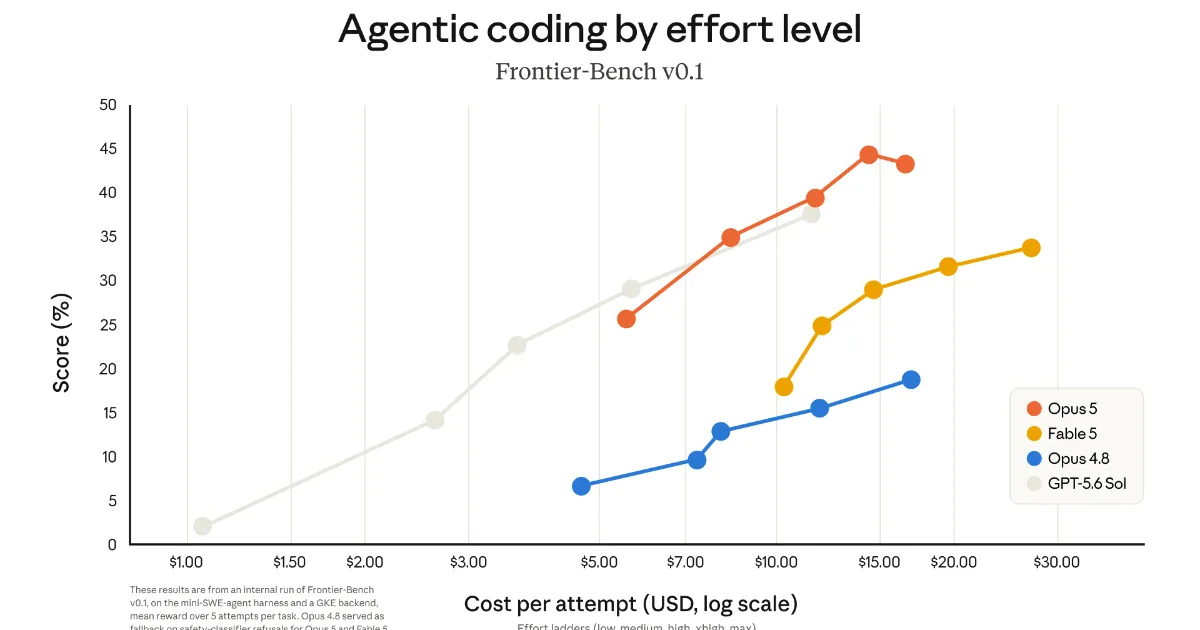
By emphasizing performance and cost across effort settings, Anthropic is showing that the AI model is no longer a single block of intelligence.
It is becoming an adjustable work engine.
Enterprises will not only choose a model.
They will decide how much reasoning cost each workflow deserves.
That is a new form of AI FinOps.
Coding Competition Is Moving From Solving Problems to Finishing Work
Opus 5 is positioned strongly for software engineering.
Anthropic says it excels on valuable software engineering tasks. On Frontier-Bench v0.1, Opus 5 surpasses other models and more than doubles Opus 4.8’s performance at a lower cost per task. It also shows strong performance on CursorBench and other coding evaluations.
But the more important point is not the benchmark score alone.
It is the type of work Anthropic highlights.
Opus 5 is presented as a model that can handle complex, agentic and ambiguous software tasks. External users quoted by Anthropic describe improvements in long-running development work, code review, production workloads, frontend implementation, large-scale code changes and financial-research workflows.
This shows where coding AI is heading.
The competition is no longer only about generating code snippets.
The real test is whether the model can understand the issue, inspect the system, use tools, verify results, identify root causes, handle edge cases and revise its own work.
A coding agent is no longer just autocomplete.
It is becoming a worker that reads issues, diagnoses failures, writes tests, changes code and validates output.
Opus 5 is positioned for that world.
It is not only an answer model.
It is an agentic work-completion model.
In Knowledge Work, Completion Rate Matters More Than Answer Quality Alone
Opus 5 also targets knowledge work.
Anthropic highlights its performance in office, research, finance, legal, enterprise-content and analysis workflows. Partner feedback cited in the launch points to improvements in due diligence, financial modeling, legal redlining, slide creation, specialized enterprise content and long-horizon analytical work.
The key issue in knowledge work is not simply whether a model can produce a good paragraph.
It is whether the model can finish the job.
A business user may ask for a report, a deck, a financial model, a legal comparison or an analytical memo. The model must gather context, reason through ambiguity, maintain format, revise based on feedback and produce a usable artifact.
In enterprise work, the value of AI comes from completion.
A beautiful first response is not enough.
The AI must stay with the task.
It must use tools.
It must create and edit files.
It must handle constraints.
It must recover from mistakes.
It must produce output that can actually be used.
That is why Opus 5’s positioning is significant.
Anthropic is not selling only “better answers.”
It is selling higher work-completion reliability at a more practical cost.
The next enterprise AI market is not the chatbot market.
It is the work-completion market.
Anthropic Wants to Sell a Strong Model That Feels Safer to Deploy
Safety and alignment are also central to the Opus 5 announcement.
Anthropic says Opus 5 performs better than prior Opus models in its safety evaluations and is less prone to cyber misuse than more specialized high-risk models. Reuters also described Opus 5 as safer than earlier versions, less prone to cyber misuse and less vulnerable to exploitation, while noting that Fable 5 remains preferable for some larger autonomous projects.
This is strategic.
Anthropic is positioning Opus 5 as a model that is powerful enough for demanding everyday work, but not as risky as the most capable models in sensitive domains.
That balance is attractive to enterprise customers.
Companies want strong AI.
But they do not want uncontrolled AI.
They want coding, research, analysis and automation capabilities.
But they also want guardrails around cybersecurity, biology, misuse and dangerous autonomy.
Opus 5 is designed to occupy that middle ground.
It is not being sold only as intelligence.
It is being sold as controllable intelligence.
Cybersecurity Limits Are Part of the Product Strategy
Anthropic’s broader model portfolio makes the cybersecurity positioning clearer.
Claude Fable 5 and Claude Mythos 5 were released earlier in 2026, with Mythos 5 described as a more restricted model for approved cybersecurity partners and certain high-trust use cases. Anthropic has said Fable 5 is the same underlying model as Mythos 5 but with robust safeguards for cybersecurity and biology.
That context matters for Opus 5.
Anthropic is not treating model capability as a single product dimension. It is dividing the market by use case, risk level and access permissions.
General users get safer models.
Trusted cybersecurity partners may receive access to more capable or less restricted configurations.
Requests that trigger safety systems may be routed or handled differently depending on risk.
This shows a larger shift in AI product strategy.
The question is not only what a model can do.
It is who is allowed to use which capability, under what conditions and with what safeguards.
AI companies are not just selling models.
They are selling access regimes.
Fallback and Routing Reflect the Reality of AI Operations
Anthropic’s recent Fable 5 deployment also introduced a pattern that matters for Opus 5: when certain safeguards are triggered, a request may fall back to another Opus model rather than simply proceeding through the highest-risk path.
This reflects the reality of enterprise AI operations.
If an AI system is embedded in a workflow and a request is suddenly blocked, the user experience breaks. But allowing every request is not acceptable either.
Fallback is a practical compromise.
If one model or configuration cannot handle a request safely, another model may provide the best available response within safer boundaries.
This means AI operations are evolving from single-model calls into routing systems.
Enterprises will increasingly combine high-performance models, lower-cost models, safer models, domain models and fallback logic. Requests may be routed based on risk, cost, latency, task type and required quality.
The competitive advantage will come not only from the model itself.
It will come from model orchestration.
The Pricing Is Aggressive
Opus 5 is priced at $5 per million input tokens and $25 per million output tokens, the same price as Opus 4.8. Anthropic says this gives customers substantially better performance at the same cost as the previous Opus generation. Fable 5, by comparison, is priced at $10 per million input tokens and $50 per million output tokens.
This pricing strategy is clear.
Anthropic wants customers to see Opus 5 as a direct upgrade.
More capability.
Same Opus-class price.
Near-Fable performance.
Half the Fable token price.
That matters because price determines deployability.
A model can be excellent, but if it is too expensive, companies cannot use it broadly. This is especially true for agentic workflows, where planning, tool use, retries and verification can increase token consumption.
Cost-performance is therefore not a secondary metric.
It is the enterprise adoption metric.
Opus 5 is positioned as the model that is not necessarily the absolute top of the portfolio, but is good enough and efficient enough to become the daily high-performance workhorse.
That is a powerful market position.
The Model Names Matter Less Than the Portfolio
Anthropic now has a more segmented model portfolio.
Fable 5 represents frontier intelligence made broadly usable through safeguards.
Mythos 5 represents a more restricted high-risk capability tier for approved users.
Opus 5 represents high performance for everyday coding, knowledge work and agentic workflows.
Sonnet and other models occupy other balances of speed, cost and capability.
This segmentation is important.
Anthropic is not trying to make one model serve every market.
It is separating models by performance, safety, access, price and daily usability.
That is what enterprise customers increasingly need.
Not every workflow needs the same model.
Some workflows need maximum reasoning.
Some need lower latency.
Some need strong safety limits.
Some need cheaper repeated execution.
Some require trusted access to more sensitive capabilities.
Opus 5 sits in a strategically valuable position inside this portfolio.
It is strong, but not priced like the most expensive model.
It is agentic, but designed for broad use.
It is capable, but framed as safer and more deployable.
That is the kind of model enterprises can standardize on.
What Korean Companies Should Learn: Classify Work Before Choosing Models
The Opus 5 announcement has a clear lesson for Korean companies.
Many organizations begin AI adoption by asking which model to use.
That is the wrong first question.
Before choosing a model, companies should classify the work.
Not every task needs the same intelligence level, cost tolerance, security requirement or human review.
A short document summary.
Meeting minutes.
A report draft.
Data analysis.
Code review.
Vulnerability analysis.
Customer support.
Financial review.
Legal analysis.
Workflow automation.
Each task requires a different balance of accuracy, cost, risk and oversight.
A model like Opus 5 points toward a more mature approach.
Do not use the most expensive model for everything.
Do not use the cheapest model for everything.
Define which work deserves which model, which effort setting and which review process.
This is especially important for Korean enterprises adopting AI across the company. They must manage token costs, API costs, agent execution costs, tool-use costs and human review costs together.
AI is not a free employee.
It is a usage-based digital workforce.
AI governance is therefore not only about security.
It is about cost and performance.
High-Risk Work Needs Operating Policy, Not Just a Model
Opus 5’s safety positioning also matters for Korean companies.
Enterprises want powerful models, but they should not expose every capability to every employee. High-risk areas such as cybersecurity, biotechnology, manufacturing design, financial decision-making and legal review require access controls and review procedures.
A model that can find vulnerabilities should not automatically be available for all forms of penetration-testing-like work.
A model that can analyze biological research should not be given unlimited autonomy for experimental design.
A model that can support legal review should not replace accountable legal judgment.
Anthropic’s portfolio suggests one useful approach.
Allow beneficial defensive use.
Restrict dangerous exploit-oriented use.
Provide special access programs for trusted users.
Use fallback and routing to preserve workflow continuity when a request is blocked.
Korean companies need similar AI operating policies.
Who can use which model?
Which tasks should be blocked?
Which tasks require approval?
What happens when a request is denied?
Who reviews AI-generated outputs?
Model adoption is not enough.
Model operations matter more.
Opus 5 Is a More Realistic Model Than the Smartest Model
The core of Claude Opus 5 is not just performance improvement.
It is a practical statement about where AI model competition is heading.
Companies and developers do not only want the strongest model. They want a model they can use every day, at scale, with good cost-performance, strong coding and knowledge-work completion, adjustable effort and meaningful safeguards.
Opus 5 is aimed at that position.
Near-Fable performance.
Half the Fable token price.
The same price as Opus 4.8.
Strong coding and knowledge-work performance.
Everyday deployment through Claude Max and Pro.
Safety positioning below the most sensitive high-risk models.
Effort settings for cost and intelligence control.
This combination is commercially powerful.
AI model competition can no longer be explained only by the highest benchmark score.
The symbolic value may come from the frontier model.
But usage and revenue may come from the model that customers choose every day.
That is the essence of Opus 5.
It is not simply trying to be the smartest model.
It is trying to be the high-performance model that people actually use.
In the AI era, the winner may not be the company with the model that wins the most headlines.
It may be the company whose model becomes the default choice for daily work.