The world model responds to natural-language edits and generates sound and dialogue in real time, but it remains a limited research preview
Google DeepMind has introduced Genie 4, a world model designed to generate visual environments and sound in real time while a user—or another AI system—interacts with them. Announced on October 27, 2026, the model marks a shift from producing a finished video clip to simulating a scene that continues to change in response to new instructions and actions.
Access remains limited. Google is initially offering Genie 4 as a research preview to a small group of trusted testers. The company also plans to make it available through Project Genie for Google AI Ultra subscribers and through early-access programs for selected partners using the Gemini API and Google AI Studio. It has not announced a general release date, detailed API pricing, regional availability, or a timetable for broader access.
Most of what is currently known comes from Google’s own demonstrations and descriptions, along with early accounts from invited testers. Those materials show a more responsive form of generative media, but they do not yet provide enough independent evidence to judge how reliably the system performs across different users, prompts, and longer sessions.
From Generated Clips to Responsive Environments
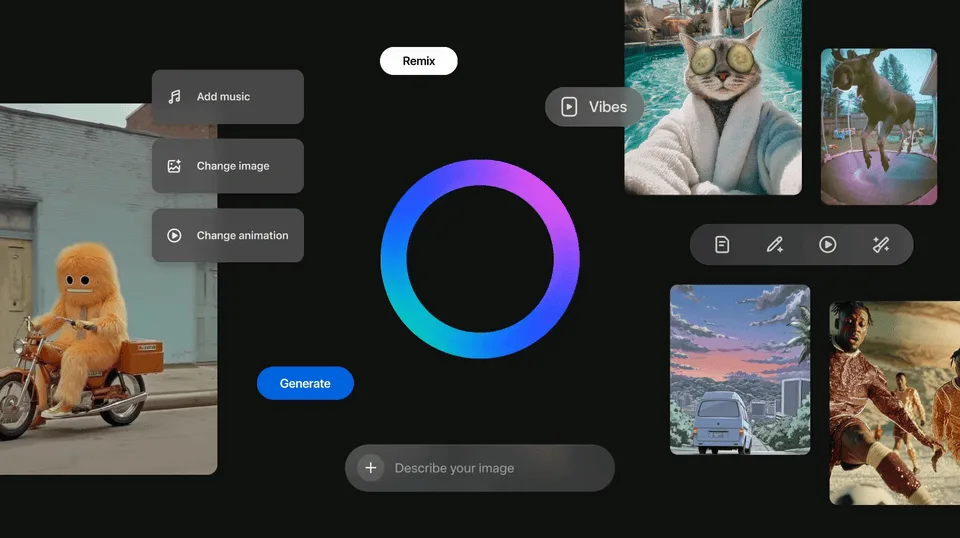
A world model aims to represent how an environment changes and how actions affect what happens next. In Genie 4, that means the user does not simply describe a scene and wait for a completed video. The user can keep intervening as the simulation runs—changing the weather, moving the camera, or adding people and objects through natural-language instructions.
Google says the model can depict phenomena such as aerodynamics, collisions, flowing water, and characters that react to events around them. The important distinction is continuity. A conventional video generator usually turns a prompt into a fixed sequence. If the user wants a different result, the model often has to generate a new clip. Genie 4 is intended to preserve the current state of a scene and calculate what should happen after the user changes a condition.
The model builds on Genie 3, which Google introduced in 2025. Genie 3 could generate interactive environments at 24 frames per second and 720p resolution, maintaining broad visual consistency for several minutes. It also supported “promptable world events,” allowing users to alter an environment while exploring it. Google nevertheless identified several limitations, including difficulty handling multiple independent agents, reproducing exact real-world locations, rendering legible text, and maintaining consistency over longer periods.
Google brought that earlier technology to a wider audience in January 2026 through Project Genie, an experimental web application for adult Google AI Ultra subscribers in the United States. Users could start with text or an image, define an environment and a character, then explore or remix the resulting world. At launch, individual experiences were limited to 60 seconds, and some capabilities shown in the Genie 3 research demonstrations were not included.
Genie 4 extends that line of work rather than replacing it with a finished consumer product. Its main advance is the tighter connection between a user’s intervention and the scene’s next state. Whether that connection remains coherent during more complicated or sustained interactions is still an open question.
Audio Becomes Part of the Simulation
Genie 4 also adds native audio generation. Google’s demonstrations include ambient sound such as wind and waves, music, effects tied to events, and dialogue that changes in response to what characters see or do. One demonstration shows a crowned crane playing a piano in a snowy landscape, with the image, music, and environmental sound generated together.
Google presents this as more than a soundtrack added after the visuals are produced. The system is meant to generate audio and imagery as parts of the same evolving situation. If an event changes, the sound should change with it; if a character is addressed, the reply should reflect the interaction taking place in the scene.
That capability could make simulated environments feel more usable for storytelling, prototyping, and AI training. It also introduces another layer that must remain synchronized. Google lists real-time audio accuracy among the areas that still need improvement, and it has not published a reproducible public benchmark or a detailed evaluation showing how often sound, dialogue, and visual events remain aligned. Carefully selected demonstrations can illustrate what the model is capable of, but they cannot establish how consistently it reaches that level.
Gemini Plans While Genie Renders
The system shown by Google does not rely on Genie 4 alone. It combines the world model with members of the Gemini family, assigning different parts of the task to different models.
Google says Gemini Omni helps ground the appearance and behavior of real-world objects, while a Gemini 3.8 Flash-based guiding agent observes the environment and decides what to do next. For more complicated objectives, the agent can divide a goal into smaller steps, inspect newly generated frames, and adjust its plan as the simulated situation changes.
In one demonstration, a model identified as Gemini 4 Argon breaks down the steps needed for a humanoid robot to complete a checkers task, while Genie 4 simulates the sequence. The demonstration is evidence of a planning model working with a world simulator. It does not show that a physical robot completed the same task in the real world or that a policy developed in the simulation would transfer without further training and testing.
Even with that qualification, the setup points to a significant direction in AI development. Language models can formulate plans, but they need an environment in which actions produce observable consequences. A world model can provide such an environment, allowing an AI agent to act, inspect the result, and revise its next move without immediately operating a physical machine or affecting a live system.
A Platform for Prototyping and Training
Google says early testers are exploring Genie 4 for film previsualization, game prototypes, historical settings, disaster scenarios, education, manufacturing, and robot training. These uses share a common need: they benefit from environments that can be changed quickly and explored from inside, rather than viewed only as finished footage.
For a creative team, that could mean comparing lighting, camera placement, dialogue, and action before committing to production. A game developer could test the feel of an interaction before building the underlying systems in code. Educators might use a simulated setting to explain a process or event from different perspectives.
The broader technical opportunity lies in training and evaluating AI agents. Real-world testing can be expensive, slow, dangerous, or difficult to repeat under controlled conditions. A generated environment could let a robot or software agent rehearse many variations of a task before deployment.
For now, that remains a proposed direction supported by limited experiments, not a demonstrated solution to real-world training. An agent that performs well in a simulation may fail when it encounters physical details the model did not capture. Errors in friction, object weight, spatial relationships, or cause and effect can lead an agent to learn behavior that works only inside the generated world. The usefulness of Genie 4 for robotics will therefore depend on more than visual realism; it will require evidence that the simulation is accurate enough for the intended task and that learned behavior transfers safely.
Consistency Is Still the Hard Problem
Google describes Genie 4 as an early-stage research model, and its official materials acknowledge several constraints. Continuous interaction is currently limited to a few minutes. During longer sessions or after repeated complex edits, objects and details can drift. The model also continues to struggle with multiple independent agents, exact locations, legible text, and precise spatial relationships.
These weaknesses matter because a convincing image is not necessarily an accurate representation of reality. A historical environment may look plausible while containing factual errors. A disaster simulation may depict dramatic effects without reproducing the underlying event correctly. In robot training, an error in physics or causality can teach the wrong response even when the scene appears realistic.
Google says all video and audio generated by Genie 4 will carry SynthID, its watermarking technology for AI-generated media. That can help identify content as synthetic. It does not certify that a simulation is factually correct, physically accurate, or safe to use for training and decision-making.
Several practical questions remain unanswered. Google has not disclosed when or how access will expand, what the service will cost through an API, how much latency users should expect, or whether resolution and interaction time will increase. Independent evaluation will also require reproducible tests of state consistency, physical behavior, audio synchronization, and the transfer of simulated training to real environments.
Genie 4 is therefore more than an incremental improvement in AI video quality, but it is not yet a finished platform for building persistent virtual worlds. Its significance lies in the attempt to turn generative media into an environment where people and AI systems can act, observe consequences, and continue from the resulting state. The decisive test will be whether that world remains coherent when the interaction becomes longer, less predictable, and more demanding than the demonstrations released so far.