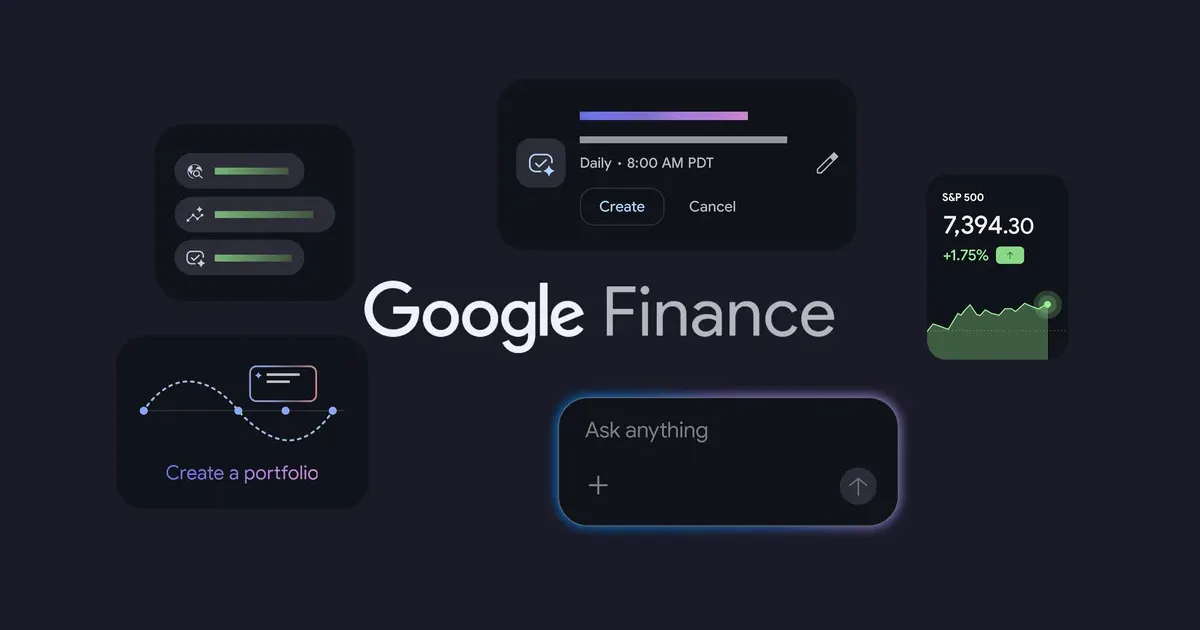
Google has significantly expanded its financial information service, Google Finance, signaling a shift from a simple stock-price and market-news destination into an AI-powered platform designed to help users understand their investment portfolios.
In an announcement on June 25, Google said the new Google Finance was exiting beta and expanding its core capabilities. The update includes personal portfolio management, AI-powered research tools, customizable market briefings and a new Android app.
The most important change is the introduction of a more advanced personal portfolio function.
Users can now view stocks, bonds, funds and other investments through a unified dashboard. Existing Google Finance portfolios can be imported automatically, while new portfolios can be created from scratch.
The way users add investment information has also changed.
Instead of requiring people to manually enter ticker symbols, share counts and purchase prices into a spreadsheet-style interface, Google Finance now supports multiple forms of input. Users can upload CSV files or PDFs containing their holdings. They can upload screenshots of investment-account screens. They can even begin by describing their holdings in natural language.
A user could write something as simple as: “I own U.S. technology stocks and Treasury bonds,” and use that description as a starting point for building a portfolio.
The change reflects a broader transformation in financial technology. Investment services are moving away from interfaces built entirely around numbers, tickers and tables. They are beginning to rely on natural language, image recognition and document understanding to organize financial information.
For investors, the appeal is obvious. Instead of manually converting information from brokerage statements, screenshots and personal records into a structured portfolio, AI can potentially read, interpret and organize the information automatically.
From Price Tracking to Portfolio Understanding
Google Finance has traditionally been associated with market data, company profiles and financial news. The expanded service is trying to go further.
Once a portfolio is registered, users can ask the platform’s AI research tool more detailed questions about their investments.
Examples include questions such as:
“What sectors are currently underrepresented in my portfolio?”
“How does my fixed-income allocation affect my long-term growth potential?”
“What percentage of my portfolio is exposed to semiconductor companies?”
“How concentrated is my portfolio in U.S. technology stocks?”
The purpose is not simply to display prices. It is to help users understand the structure of their assets.
Checking the price of a stock is easy. Understanding asset allocation is harder.
Many individual investors struggle to see whether they are too heavily concentrated in one sector, whether their portfolio is overly dependent on one country or currency, whether they own too many growth stocks, or whether their bond allocation is sufficient for their investment horizon.
Professional asset managers and wealth advisers often provide this kind of portfolio diagnosis. Google is attempting to lower that analytical barrier by allowing ordinary users to ask similar questions in plain language.
In this sense, the new Google Finance is not trying to become a brokerage or an asset-management company. It is trying to occupy the information and analysis layer that sits before an investment decision is made.
Market Intelligence Moves From Search to Scheduled Briefings
Another major update is the introduction of what Google calls market intelligence.
Users can now set up recurring AI-generated market briefings based on their interests and preferred schedule. Instead of searching manually every morning, investors can ask Google Finance to monitor specific topics and deliver summaries at regular intervals.
For example, a user could request:
“Send me a daily pre-market briefing analyzing significant overnight moves across major cryptocurrencies.”
The user can then customize the schedule, instructions and source of personalization. The briefing can be linked to a watchlist or to the user’s own portfolio.
This moves beyond basic stock alerts.
Traditional alerts simply tell users that a stock moved up or down by a certain percentage. Google Finance is attempting to provide context: what changed, why it may have changed and how that information connects to the user’s own investments.
For an investor heavily exposed to semiconductor stocks, a scheduled briefing could focus on global chip supply chains, earnings results, interest-rate expectations, geopolitical risk, memory prices and AI infrastructure spending.
For an investor with a large bond allocation, the briefing could emphasize inflation data, Treasury yields, central-bank guidance and interest-rate expectations.
The broader significance is that financial information services are moving from a search model to an agentic model.
In the search model, the investor repeatedly looks for information.
In the agentic model, the service learns what the investor cares about, monitors relevant developments and delivers tailored information before the investor asks.
Google Finance is not only helping users find answers. It is trying to become a system that anticipates which questions users may need answered.
The Android App Brings Financial Intelligence to the Mobile Screen
Google has also launched a dedicated Google Finance app for Android.
Until now, the service was largely web-based. The new app is designed for investors who check market information multiple times throughout the day — during the morning commute, at lunch, before market close or on the way home.
The Android app includes watchlists, real-time market data, financial news, the AI research tool and an AI-powered “key moments” feature designed to explain why a stock moved.
That last feature could become especially important for retail investors.
When a stock suddenly rises or falls, users often want to know one thing first: why?
A price chart can show movement, but it cannot always explain the cause. Google is using AI to connect market moves with possible drivers such as earnings reports, industry news, regulatory developments, macroeconomic indicators, company filings and other relevant events.
The goal is to turn raw market data into a more understandable narrative.
Google has said it plans to expand the app further with functions such as earnings-call live coverage, portfolio tools and task-management features. An iOS version is also expected later this year.
A Financial Assistant, Not a Broker
Google’s latest move should not be interpreted as an attempt to compete directly with brokerages, wealth managers or asset-management firms.
Google Finance does not execute trades or sell investment products. It is not positioning itself as a brokerage account or a robo-adviser that directly manages money.
Instead, Google appears to be building a financial intelligence layer.
The company wants to help users understand market conditions, organize personal holdings, identify portfolio concentration and receive more relevant information at the right time.
That strategy makes sense for Google.
The company already operates one of the world’s largest information-discovery systems. Financial markets are highly dependent on information: company earnings, economic data, regulation, interest rates, commodity prices, geopolitics, supply-chain developments and investor sentiment.
Google Finance is trying to apply AI to that information flow.
The goal is to make financial research more conversational, more personalized and less dependent on users manually opening multiple websites, research reports, news apps and market-data screens.
The Risk of Confusing Analysis With Advice
The expansion of AI into investment analysis also creates important risks.
An AI system can summarize market news, identify portfolio exposure and explain possible drivers behind price movements. But none of those functions guarantees investment performance.
Markets remain unpredictable. AI-generated analysis depends on available data, the sources selected, the assumptions built into the system and the way the information is interpreted.
The risk becomes greater when analysis is personalized.
If an AI tool tells an investor that a sector is “underrepresented” or that a certain asset class may affect long-term growth, users may interpret that statement as a recommendation to buy or sell.
The line between analytical support and investment advice can become blurry.
Financial AI services will need to make that boundary clear. A useful system should help investors ask better questions, understand risk and gather more relevant information. It should not create the illusion that market uncertainty has disappeared.
The best investment tool is not one that makes decisions for the user. It is one that helps the user make more informed decisions.
Portfolio Data Becomes a New Privacy Challenge
The new Google Finance features also raise important questions about financial-data privacy.
A portfolio can reveal a great deal about a person: their wealth level, risk appetite, investment strategy, favored industries, geographic exposure, currency preferences and possible trading history.
As Google Finance begins accepting CSV files, PDFs, screenshots and natural-language investment descriptions, the amount of sensitive financial information handled by the platform may grow significantly.
That makes transparency essential.
Users will want to know how long portfolio data is retained, whether uploaded documents are used to improve AI systems, whether data is shared across Google services, how users can delete or export their information and what controls exist around third-party access.
The easier it becomes to upload personal financial information, the more important it becomes to explain what happens to that information afterward.
Convenience should not come at the cost of unclear data ownership.
The Next Competition in Finance Apps Is About Understanding, Not Charts
Google Finance’s overhaul points to a broader shift in the financial-information market.
The next competition among finance apps may not be about who can display the most charts, stock prices or news headlines. It may be about who can understand a user’s portfolio more accurately, identify the information that matters most and explain it in language that users can actually use.
Investors do not only need more information. They need better context.
They need to know how a rate decision might affect their bond holdings, how a chip shortage might affect their technology exposure or how a change in currency markets might affect global investments.
That is the role Google Finance is trying to play.
The service is evolving from a place where users type a ticker symbol and check a price into a personalized financial-information assistant that can read portfolios, monitor markets and deliver regular briefings.
But the ultimate test will be whether users gain understanding without becoming overly dependent on automated analysis.
AI may become better at explaining the market.
It cannot take responsibility for an investor’s decisions.