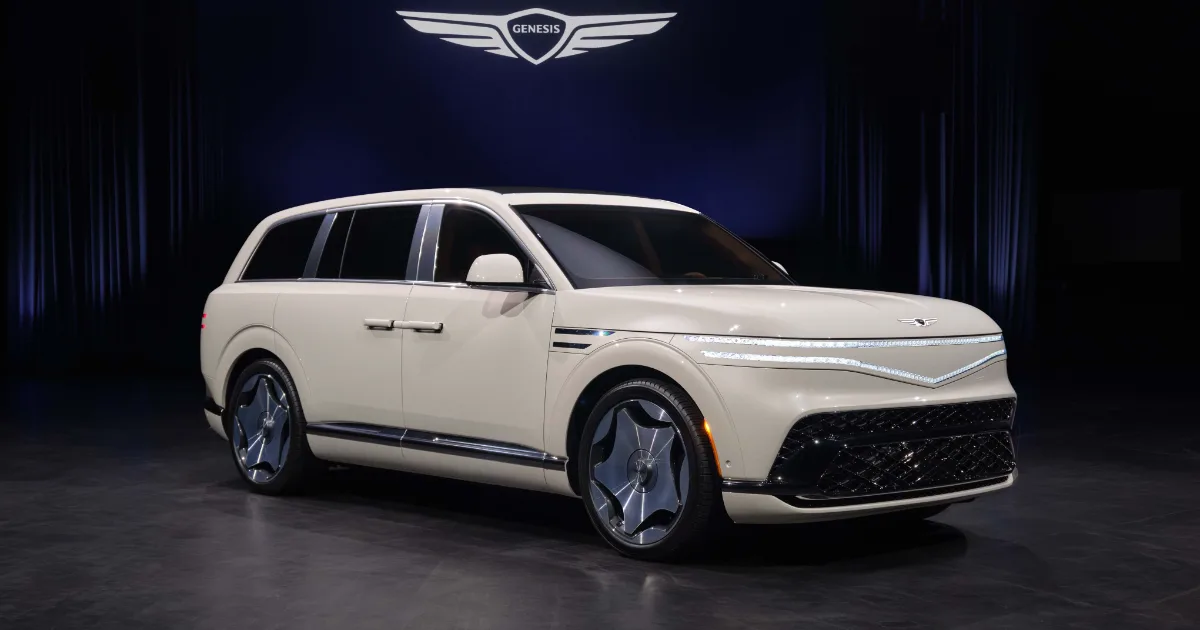
Genesis has unveiled the GV90, its first full-size flagship electric SUV.
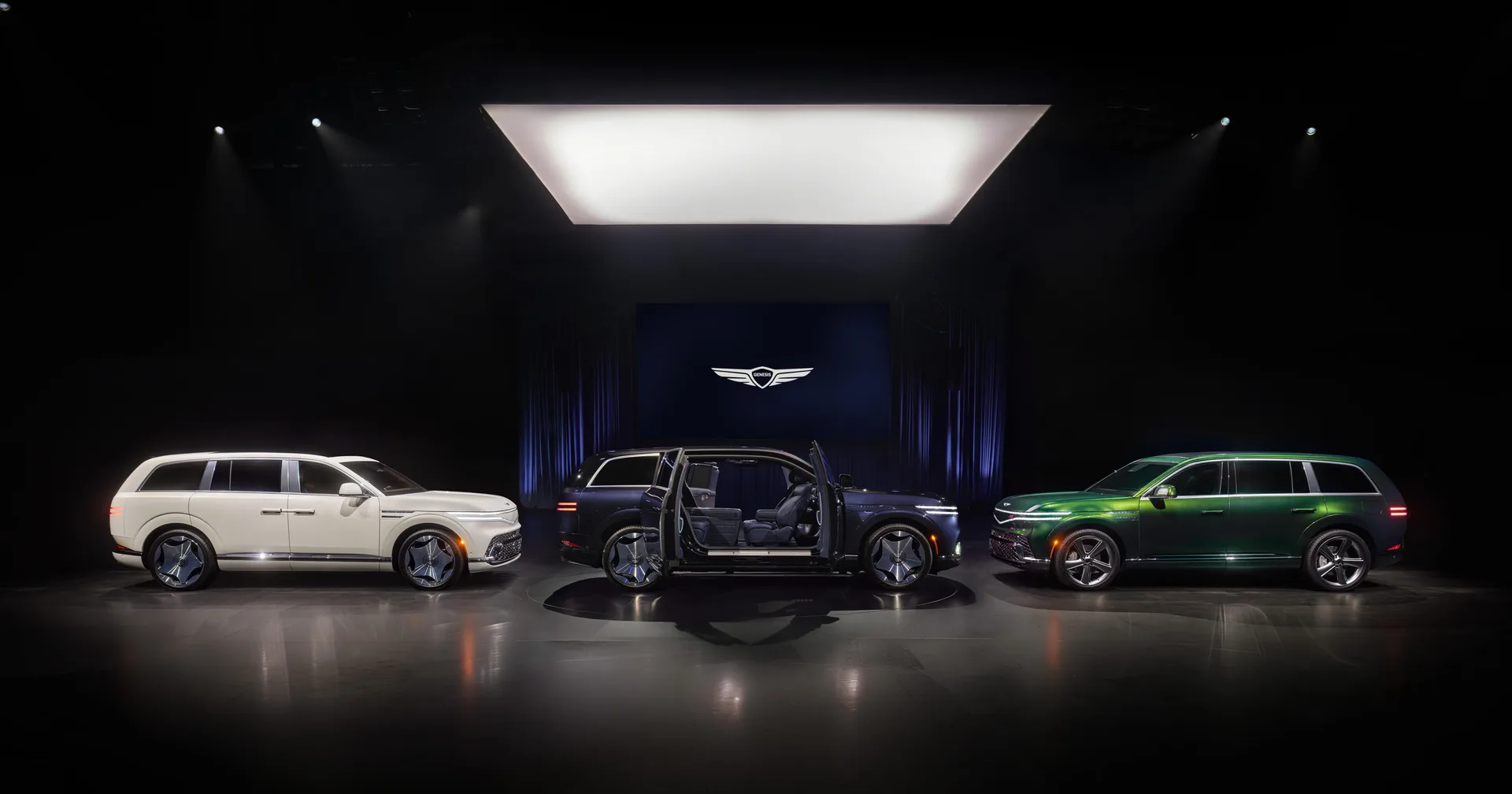
On August 19, 2026 local time, Genesis held the GV90 World Premiere at the Palace of Fine Arts in San Francisco and introduced the GV90 Neolun and GV90 for the first time. The model is designed to show how Genesis intends to define luxury in the electrification era.
What matters here is not simply that Genesis has introduced a large electric SUV.
The GV90 shows where Genesis wants to locate luxury in the future. In the past, luxury cars were defined by engine character, ride comfort, materials and brand history. The GV90 tries to reconstruct that formula around an electric platform, interior space, safety architecture, software, AI and emotional experience.
Hyundai Motor Group Executive Chair Chung Euisun described the GV90 as a model that shows the direction of future luxury. Hyundai Motor Company President and CEO José Muñoz also called it a new milestone for Genesis and future luxury mobility.
The keyword Genesis attaches to the GV90 is hospitality.
The idea is to make the car not simply a means of transportation, but a premium space that welcomes passengers and allows them to stay. That is why the GV90 is not defined only by performance figures. Its meaning lies in the whole experience of approaching the car, opening the doors, sitting down, resting, talking, watching content and moving through the world.
The GV90 is closer to a declaration of how Genesis wants to open the next decade as a luxury brand.
Why the GV90 Matters
The GV90 sits at the top of the Genesis lineup.
Genesis has operated the G90 as its flagship sedan and strengthened its presence in the luxury SUV market through the GV80. But the center of gravity in the global luxury market has already shifted toward large SUVs and electrification. In major premium markets such as the United States, China and the Middle East, a full-size SUV is not merely another segment. It is a symbol of brand status.
The GV90 targets that position.
The electric vehicle market has recently entered a period of adjustment, but for luxury brands, an electrified flagship remains an essential task. EVs lose the symbolic value that combustion-engine flagships once had through engine sound and displacement. In their place, new values emerge: silence, spaciousness, software, displays, charging, battery safety and personalized experience.
The GV90 represents that transition.
Genesis is using the GV90 to say that a flagship is still possible in the EV era. But this flagship is not completed by a larger engine. It is completed by a quieter space, a more relaxed passenger experience, a more sophisticated safety structure and a richer digital environment.
That makes the GV90 highly important for Genesis.
In a premium brand, a flagship is not always the highest-volume vehicle. It is the vehicle that raises the standard for the whole brand. If the GV90 succeeds, it can elevate the image of the GV80, GV70, G80 and G90. If it falls short, Genesis’ electrified luxury strategy could be weakened.
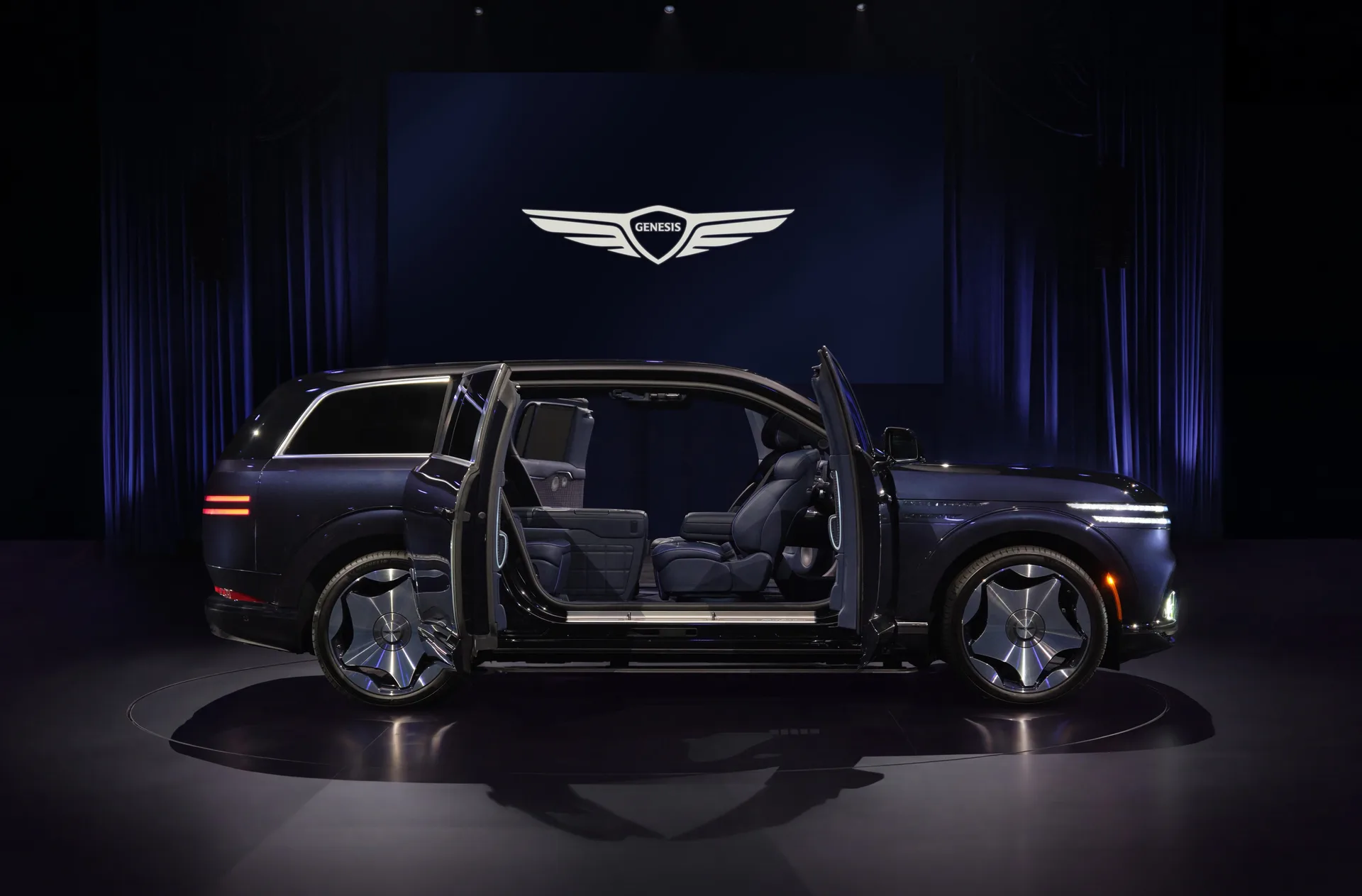
The Symbol of the GV90 Neolun: The Neolun Arch Gate
The most visually striking feature of the GV90 Neolun is the Neolun Arch Gate.
Genesis describes it as the world’s first independently opening and closing hidden B-pillar coach door system. The front and rear doors open toward each other, creating a wider sense of entry and exit. Because it appears to remove the conventional B-pillar, the moment of entering the vehicle changes dramatically.
In a luxury brand, a door is not merely a component.
As Rolls-Royce coach doors have long shown, the way a door opens communicates how a brand treats its passengers. Genesis’ decision to apply coach doors to the GV90 Neolun is not only a design experiment. It is an attempt to translate Korean hospitality into automotive structure.
The independent opening mechanism is particularly interesting.
Traditional coach doors can be constrained by opening order or structural interference. Genesis says it uses a dual-motion hinge on the rear door, allowing the rear door to slide outward and then rotate. This enables front and rear doors to open and close independently without interfering with each other.
If successfully implemented, the GV90 Neolun could feel less like an ordinary SUV and more like a chauffeured lounge, VIP mobility space or the entrance to a premium hotel.
But the essential challenge of coach doors is safety.
The B-pillar plays a crucial role in side-impact strength and crash protection. Genesis says it addressed this through ultra-high-strength dual steel beams inside the doors, a hidden roll-cage structure, a passenger-cell frame 1.5 times thicker than conventional structures, ultra-high-strength steel tubes and high-rigidity structural foam.
The GV90 Neolun’s real test is here.
It is not enough for the doors to open beautifully.
The openness must be achieved safely.
Luxury hospitality is complete only when it rests on structural trust.
The Roof Airbag Sends a New Safety Message
Genesis says the GV90 features the world’s first roof airbag.
The roof airbag deploys across the roof glass in rollover situations. It is designed to help prevent occupants from being ejected through the glass roof and reduce injury from impact with the roof area. The GV90’s 12-airbag system also includes the roof airbag.
This technology matches the nature of the vehicle.
A full-size electric SUV is large and heavy. It carries a large battery, which adds weight. Consumers naturally pay attention to rollover safety in SUVs. If a vehicle also emphasizes a large glass roof and a premium interior, roof-impact protection and occupant retention become even more important.
Genesis also highlights other safety technologies, including passenger dual-depth airbags, seat-cushion airbags, third-row curtain airbags, first- and second-row side airbags and enhanced driver knee-airbag protection. The cabin monitoring system detects occupant type and seating status so that airbags and seatbelts can be controlled more appropriately in a crash.
The reason Genesis emphasizes safety is clear.
In the luxury electric SUV market, safety is not an optional feature. It is a foundation of trust. For buyers considering family travel, VIP passengers, rear-seat comfort and long-distance mobility, safety can matter as much as design or displays.
The GV90’s safety message goes beyond “a strong car.”
It points toward a car that understands its occupants and protects them according to posture, position and circumstance.
A 123.5kWh Battery and 500km Range
The GV90 uses a 123.5kWh high-voltage battery, the largest capacity battery in a Hyundai Motor Group EV.
Genesis says the seven-seat GV90 can travel 500km on a single charge based on its own internal testing. With 350kW-class fast charging, the battery can charge from 10% to 80% in 22 minutes.
In a full-size electric SUV, battery capacity is crucial.
The vehicle is large and heavy. Premium features, large wheels, three-row seating and high-output motors all increase energy consumption. Luxury SUV customers want not only city driving but also relaxed long-distance travel. A 500km-class range and fast charging in the 20-minute range are close to essential competitive conditions.
Another important feature is the wireless battery management system.
Genesis says wireless BMS reduces complex wiring and helps secure enough battery capacity within the limited space of a large vehicle. In an EV, battery-pack design is not only a matter of capacity. Space, weight, thermal management, safety, serviceability and production all matter.
Battery safety is also emphasized.
The GV90 uses battery thermal-runaway prevention technology designed to suppress heat transfer between cells. It also applies cloud-based battery management diagnostics to enable real-time monitoring and early detection of potential anomalies.
Battery safety is becoming increasingly sensitive in the EV market.
It matters even more in a large luxury SUV. The larger the battery, the more important consumer trust becomes around crash safety, heat management, fire prevention and anomaly detection.
The GV90 treats the battery not simply as an energy-storage device, but as a software-managed safety and diagnostic system.
The eMP Platform as the Foundation of the Genesis Electric Flagship
The GV90 is built on Genesis’ flagship-dedicated Electric Mobility Prime platform, or eMP.
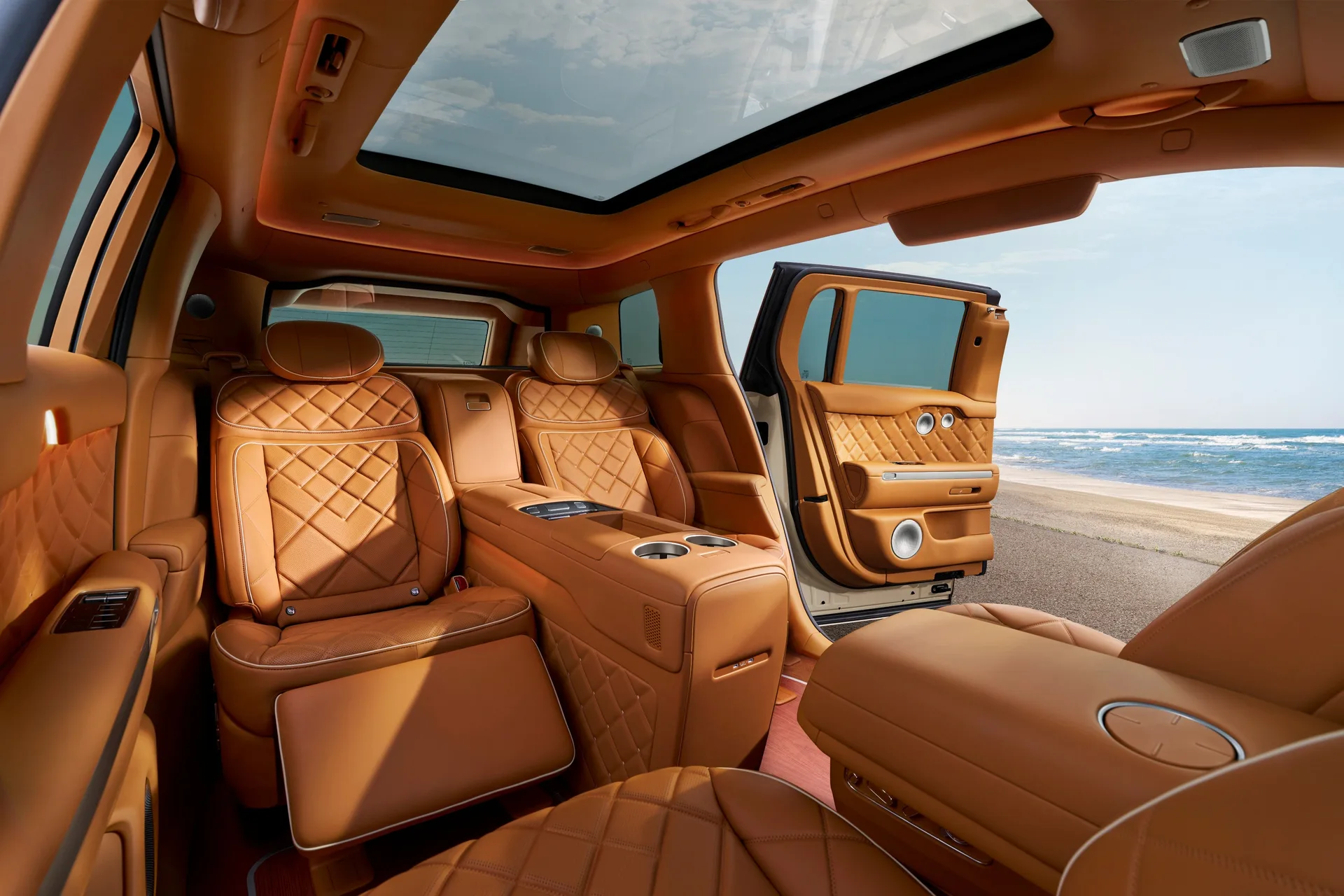
The platform is designed to deliver the space, driving performance and ride comfort required for a full-size flagship electric SUV. The GV90’s wheelbase is 3,245mm. A flat floor and slim cockpit help create a spacious cabin.
The advantage of a dedicated EV platform is clearest inside the vehicle.
Combustion-engine vehicles are constrained by engine compartments, transmission tunnels and drivetrain layouts. EVs allow flatter floors and more flexible cabin layouts through battery and motor placement. The GV90 Neolun’s swiveling seats and lounge-like interior are possible because of this platform structure.
Genesis applies power-operated swiveling front seats to the GV90 Neolun. When parked, the front seats can rotate 180 degrees so passengers can face one another, rest or work in a lounge-like arrangement.
This partially reflects the imagination of the autonomous-driving era.
Even if full autonomy does not become universal immediately, EV interiors are gradually shifting from driver-centered to passenger-centered. As charging, waiting, working, resting and content consumption time increase inside cars, the cabin becomes something between a vehicle and a living space.
The GV90 tries to realize that moving lounge in the form of a flagship SUV.
More Important Than Performance Is Graceful Movement
The GV90 delivers a combined output of 490kW and maximum torque of 800Nm from its front and rear motors. Genesis says it uses the most powerful motor yet applied to a Hyundai Motor Group EV.
But the GV90’s message is not simply that it is a high-performance electric SUV.
It is closer to a promise of graceful, quiet movement.
Genesis applies dual electronic limited slip differentials for the first time in a Hyundai Motor Group vehicle. E-LSD units on both front and rear motors enable more precise control of the four wheels during high-speed cornering and help support stability on snow and rain.
Multi-chamber air suspension is another core feature. Adjustable air springs absorb road impact and change ride height according to conditions. Monotube dual-valve electronically controlled shock absorbers adjust damping depending on the driving situation.
Rear-wheel steering is also applied. The rear wheels can steer by up to five degrees, reducing the turning radius to a level comparable with midsize vehicles and improving stability in medium- and high-speed turns.
The GV90’s performance seems designed more for perception than numbers.
Its goal is not merely to make a large SUV fast, but to make the large body feel smaller and the heavy EV move smoothly and confidently. In a luxury flagship, what matters is not raw acceleration but composure. Luxury is making passengers feel the power without being forced to notice it.
Quietness Is Central to EV Luxury
An electric vehicle has no engine noise.
That makes other noises more noticeable: road noise, wind noise, tire noise, body vibration and high-frequency motor sounds. Quietness in a luxury EV may therefore be harder to achieve than in a combustion luxury car.
Genesis says the GV90 uses advanced sound-insulating glass thicker than 5mm from the windshield to the vision roof and tailgate. It also uses high-expansion sound-insulating material inside major body structures, extensive sound-absorbing materials and improved sealing around the hood and tailgate.
This shows that the GV90 treats silence as a core luxury value.
Genesis’ idea of hospitality is connected to quietness. A premium hotel lobby or private lounge feels separated from outside noise. The GV90 tries to create that sensation while moving.
In electric luxury, the battle is not the motor.
It is noise.
The question is not only how fast the car is.
It is how quietly it moves.
Removing the Start Button
The GV90 introduces a new power control system that removes the traditional start button.
When the user pulls the door handle, the vehicle powers on and the door opens automatically. After the passenger enters and closes the door, the rotary gear selector moves from the 12 o’clock position to the 2 o’clock position, indicating that shifting is available. The crystal sphere integrated controller rotates, and the tweeter cover on the dashboard opens to signal that the vehicle is ready to drive. The driver can then press the brake and select a gear without pressing a separate start button.
This is a small but symbolic change.
For more than a century, cars began with the act of starting an engine. In combustion vehicles, ignition was a ritual of awakening the engine. EVs have no engine. Yet many EVs still retain the start button as a habit inherited from the past.
The GV90 tries to reduce that legacy.
The car recognizes the user, opens the door, powers itself, and signals readiness. The experience becomes more like using a smartphone. The user does not operate a machine. The user enters a space, and the space responds.
Luxury can come not from adding another button, but from removing unnecessary actions.
The GV90’s new power system shows how automotive user interfaces may change with electrification.
Pleos Connect and Gleo AI
The GV90 is equipped with Hyundai Motor Group’s next-generation infotainment platform, Pleos Connect.
Pleos Connect is an interface for software-defined vehicles. The GV90 also introduces the vehicle AI agent Gleo AI, which can support conversational vehicle control and information search. Based on Android Automotive OS, it also allows vehicle-specific third-party apps through the Pleos App Market.
This matters.
The GV90 is a hardware flagship, but Genesis is also positioning it as a software platform. The competitive center of the automobile is moving from engine and chassis to operating system, AI agent and app ecosystem.
In the future, luxury cars may differ in areas such as these:
How naturally can vehicle functions be controlled by voice?
What content and services can be used inside the car?
How well does the vehicle understand user context?
How rich is the third-party app ecosystem?
How much does the experience improve through updates?
The GV90’s AI agent is an attempt to change the relationship between driver and vehicle beyond simple voice commands. But the real test will come in everyday usability. How natural is the conversation? How fast and accurate are vehicle control and information search? How open and useful is the app ecosystem?
The winner in automotive AI will not be the assistant that talks most impressively.
It will be the one that is actually useful inside the car.
Displays Move From the Driver’s Seat to the Lounge
The GV90 features a pop-up center OLED cinematic display.
During driving, a 23.6-inch wide screen displays driving information, navigation and media data. When the vehicle is stationary, pressing the display expansion button raises the screen by 90mm, creating a 24.6-inch screen that is about 1.7 times larger than before.
The vehicle also includes a 25-inch head-up display, allowing the driver to check speed, navigation and driver-assistance status without looking away from the road.
This structure separates driving information from stationary content experience.
In the EV era, people spend more time inside cars while not driving: waiting during charging, being chauffeured, taking work trips, traveling with family or consuming media. As a result, displays are no longer merely instrument panels. They become furniture at the center of the cabin.
That is why Genesis calls it a cinematic display.
The car is being presented as a space for content consumption. Combined with a Bang & Olufsen 25-speaker 3D sound system, Dolby Atmos and a virtual venue function, the GV90 becomes closer to a mobile listening and viewing room.
The car interior is no longer only a place for driving information.
It is a mixed space for watching, listening, resting and working.
Emotional Luxury: Ondol and Wood Flooring
The GV90 Neolun Executive Suite four-seat version includes exclusive features for VIP customers.
One of the most notable is the use of wood flooring and a radiant heating system in the second row. Genesis says the system is inspired by ondol, Korea’s traditional floor-heating method. A comfort partition separates the second row from the cargo area, reducing noise and creating a more private environment.
This point reveals Genesis’ brand strategy.
To become a global luxury brand, it is not enough simply to imitate German premium brands. Genesis must translate Korean aesthetics and hospitality into the language of luxury. That is why references to the moon jar, ondol, negative space, restraint and craftsmanship appear in its design and experience language.
The question is whether these ideas are implemented convincingly.
If Korean elements are attached only as explanations, they may become decorative storytelling. But if wood flooring, radiant heating, lounge space and a quiet cabin combine into real sensory value, they can become a distinctive experience.
The GV90 is a test of how deeply Genesis can embed Korean luxury into a product.
Design Language From the Moon Jar
Genesis says the GV90’s design was inspired by the Korean moon jar.
A moon jar is defined not by perfect symmetry but by natural proportion, emptiness and restrained beauty. Genesis says the GV90’s exterior removes unnecessary elements and emphasizes proportion and the harmony of curves.
The front features the first wing-face MLA headlamps applied to the GV90. They run across the front under a large clamshell hood, while a cutless process minimizes the boundary between lamp and body. The lower bumper uses a three-dimensional chrome grille with two stacked layers of the G-Matrix pattern.
The side profile uses the long 5,285mm body and 24-inch forged wheels to create flagship presence. The rear removes the rear spoiler and emphasizes a smooth unified surface through surface-emitting rear lamps and Genesis lettering.
What matters in the GV90 design is reduction rather than decoration.
Luxury is often expressed through more chrome, larger grilles and stronger character lines. Genesis is trying to move in the opposite direction. It reduces lines, enlarges surfaces, emphasizes curves and interprets empty space as premium.
That is also a risky choice.
Restraint can be elegant when executed well. If not, it can look plain. For the GV90 to succeed in the global luxury SUV market, its restrained design must still feel sufficiently present on the road.
Marilyn Monroe and the Genesis Brand Story
In its communications around the GV90, Genesis also connects the brand vision with Marilyn Monroe.
Genesis presents Marilyn Monroe as a cultural icon who built a new life beyond existing boundaries, linking that story to Genesis’ own effort to become Korea’s global luxury automotive brand. It also references the Marilyn Monroe centennial exhibition at Genesis House New York and support for a commemorative film.
This is unusual for a vehicle announcement.
It shows that Genesis wants to become not only a car brand, but a cultural brand. Global luxury brands do not only sell products. They connect with art, music, film, architecture, fashion and lifestyle to create cultural symbolism. Genesis is trying to move into that layer through the GV90.
But this strategy is double-edged.
If the cultural narrative aligns with the product experience, it raises brand prestige. If the connection feels weak, it can look like excessive storytelling. If the GV90’s technology, design and Korean hospitality are compelling enough, the Marilyn Monroe narrative may function as brand expansion. If the product does not persuade, it may feel like decoration.
Luxury needs stories.
But stories gain strength only when the product supports them.
Where the GV90 Sits in the Global Competition
The GV90 enters a difficult market.
The global luxury electric SUV segment already includes strong competitors from Mercedes-Benz, BMW, Audi, Cadillac, Lucid, Rivian, Rolls-Royce, Bentley and others. In the full-size SUV segment, brand history and symbolic capital matter deeply.
Genesis’ strengths are its rapidly built design identity, strong value proposition, Hyundai Motor Group’s EV technology and fast product development capability. Its weakness is its shorter history and smaller symbolic heritage compared with traditional luxury brands.
The GV90 tries to compensate with technology and experience.
Coach doors.
A roof airbag.
A 123.5kWh battery.
A 500km driving range.
22-minute fast charging.
Dual E-LSD.
Multi-chamber air suspension.
Swiveling seats.
An AI agent.
Ondol-inspired radiant heating.
Moon jar design.
This combination shows that Genesis is not merely trying to build a Korean version of a luxury SUV. It is trying to establish its own grammar.
The deciding factors will be price, quality and actual use.
A flagship can attract attention through specifications, but reputation is built through experience. How smoothly do the doors open? How quiet is the cabin? How useful is the AI? How comfortable is the third row? How stable are charging and battery management? How premium is after-sales service?
Those details will decide whether the GV90 becomes a statement or a standard.
What the GV90 Means for the Korean Auto Industry
The GV90 is also symbolic for the Korean automotive industry.
For decades, Korean cars were associated with value, quality and fast followership. Hyundai Motor Group has been changing that image through dedicated EV platforms, design, software, high-performance sub-brands and Genesis. The GV90 sits at the peak of that transformation.
The fact that a Korean brand is launching a global luxury flagship electric SUV has industrial significance.
This is no longer only a follower strategy.
Genesis is using the GV90 to speak about the future standard of luxury. It is combining world-first technologies, Korean aesthetics, an electric platform, AI infotainment and advanced safety to build an independent position.
The market, however, will be unforgiving.
Luxury is not created by technology alone. Brand trust, residual value, service experience, scarcity, cultural symbolism and customer community all matter. For the GV90 to succeed, it must provide not only a good car, but a good luxury experience.
For Genesis, the GV90 is not merely a product launch.
It is a brand examination.
It asks whether a Korean automaker can move beyond premium and be recognized as luxury.
GV90 Is Genesis’ Second Founding Statement
The GV90 is Genesis’ first full-size flagship electric SUV.
But its meaning is larger than its segment.
The GV90 shows how Genesis wants to redefine luxury in the electrification era. If combustion-era flagships proved themselves through displacement, engines and rear-seat comfort, the GV90 tries to prove itself through a silent electric platform, safety architecture, lounge-like interior, AI interface, displays, emotional features and Korean aesthetics.
The GV90 Neolun’s Neolun Arch Gate is a structural expression of hospitality. The roof airbag and reinforced body structure target safety trust in a full-size electric SUV. The 123.5kWh battery, 500km range and 22-minute fast charging define practical expectations for an electric flagship. Pleos Connect and Gleo AI show that the automobile is moving toward software platform status. Ondol-inspired radiant heating and moon jar design translate Korean luxury into a global product language.
The GV90 is not simply the largest SUV in the Genesis lineup.
It is a model that reveals what Genesis wants to become.
Now Genesis has a clear task. It must turn the technology and philosophy shown on stage into real customer experience. The coach doors must be easy to use every day. The interior must truly be quiet. The AI must be useful in real life. Safety must be confirmed through testing and market trust. Charging and battery performance must be convincing in daily use.
Luxury is not completed by declaration.
It is proven through repeated experience.
The GV90 is Genesis’ biggest test yet in moving from a Korean car brand to a global luxury brand.
If it succeeds, the GV90 may become more than a new vehicle.
It may become the symbol of Genesis’ second founding.
The core sentence can be stated this way:
The GV90 is Genesis’ declaration that luxury in the electric-vehicle era will no longer be defined by engines and displacement, but by space, hospitality, safety, software, AI and Korean aesthetics. The key question is whether Genesis can turn technological symbols such as the Neolun Arch Gate, roof airbag, 123.5kWh battery and Gleo AI into a premium experience customers can feel every day.