Game music often brings to mind background tracks heard while playing or theme songs associated with particular characters. It is music created for the game, designed to better convey its scenes and emotions. It may later move beyond the game through OST albums or concerts, but its point of origin still lies within the game itself.
One of the major programs at the game culture festival ‘GXG 2026,’ which will take place around Pangyo Station from September 11 to 12, approaches that relationship from a slightly different direction: the game music competition ‘The 3rd GXG SOUND TRACK.’
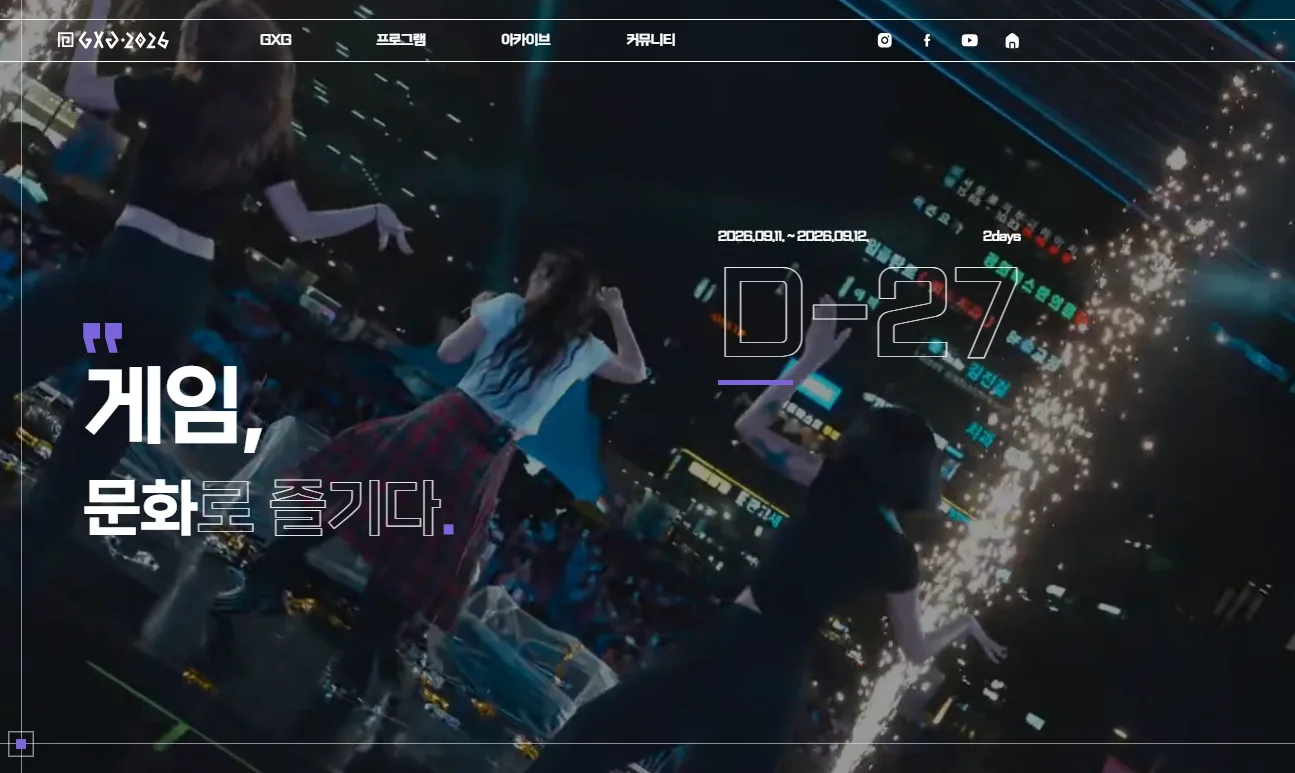
Hosted by Seongnam City and organized by the Seongnam Industry Promotion Agency and the Game Culture Foundation, the competition does not ask participants to perform or rearrange existing OSTs. Instead, they create entirely new music inspired by selected games. This year, 15 game companies provided 16 titles as creative source material, and six teams advanced to the finals.
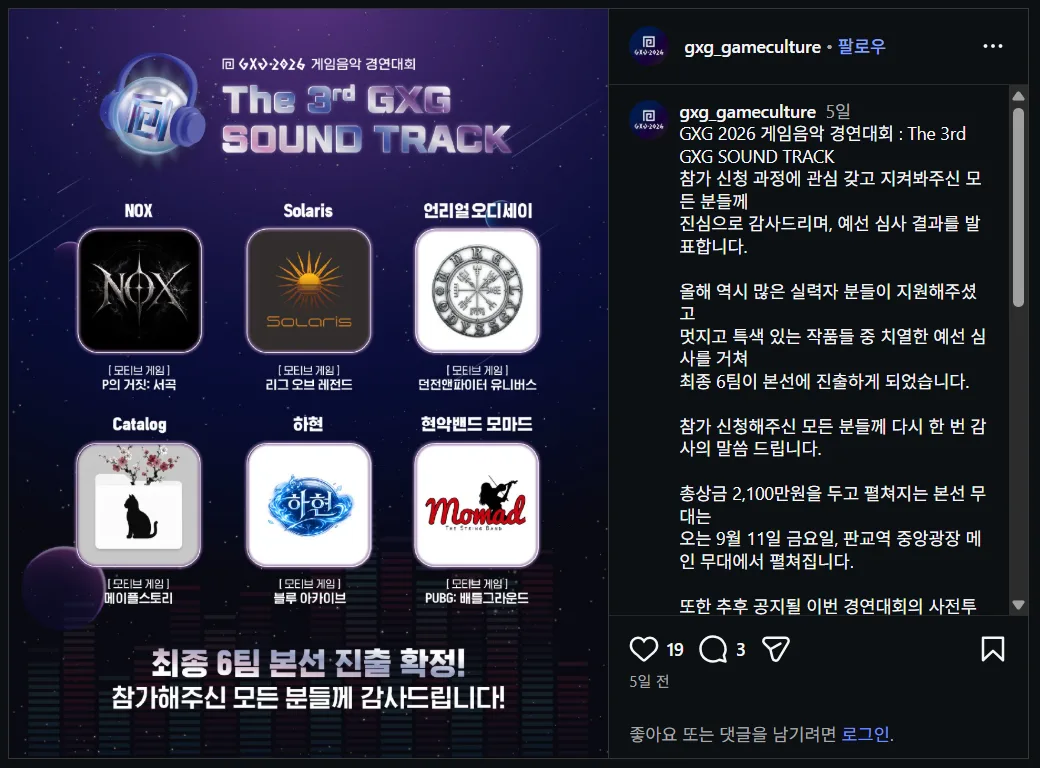
The finalists also begin from very different games. NOX created 'Bite the lie' inspired by 'Lies of P: Overture,' while Solaris drew on 'League of Legends' for 'Arise!'. Unreal Odyssey’s 'Gloria' takes inspiration from the 'Dungeon & Fighter Universe,' Catalog’s 'Maehwa' from 'MapleStory,' Hahyun’s 'LoveRace' from 'Blue Archive,' and string band MOMAD’s 'Nova X' from 'PUBG: Battlegrounds.' All of them were born from games, yet none of them actually exists within the games themselves.
Music for Games, and Music That Begins with Games
Conventional game OSTs are designed as part of the game itself. They reinforce the emotions of particular scenes and help players quickly understand a space, situation, or atmosphere. The music may later be enjoyed independently, but it is originally created to function together with the gameplay experience.
GXG SOUND TRACK reverses that order. The completed game comes first, and an outside creator then translates the impressions left by that game into music. There is no need to follow the original melody or musical style. What the creator takes from the game may be its world or characters, but it may also be an emotion associated with a particular scene or a memory left by the act of playing. The competition itself describes its purpose as transforming inspiration drawn not only from game worlds and characters but also from gameplay experiences into original music.
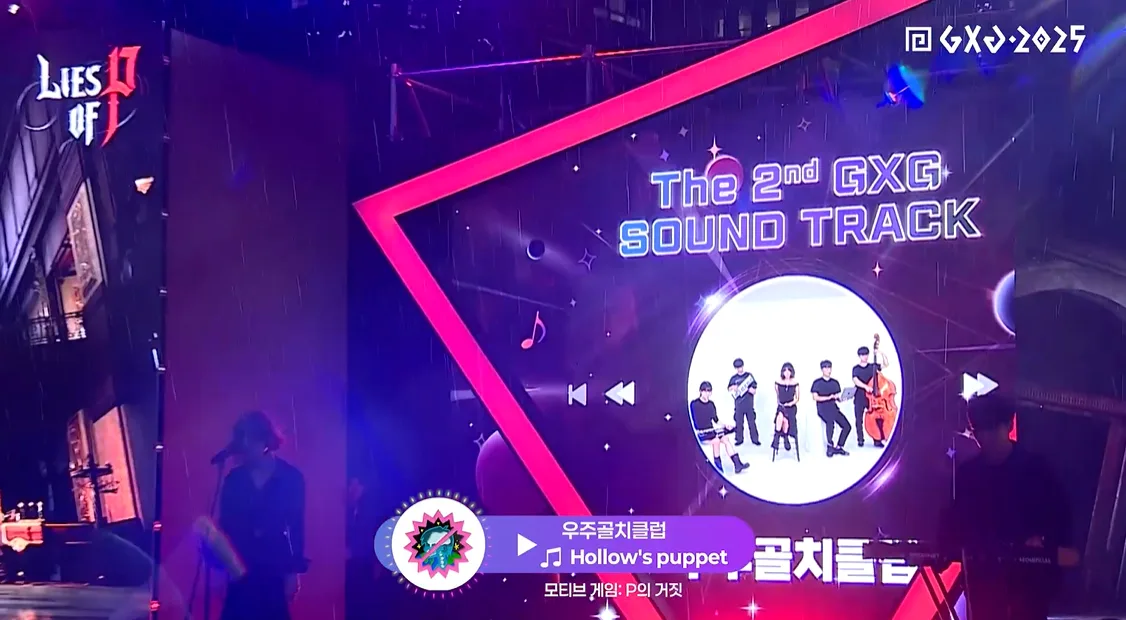
The distinction became especially clear in last year’s grand-prize winner. Space Trouble Club’s 'Hollow's Puppet' is not an official track from 'Lies of P.' The team began with the sorrow and emptiness they felt in Sophia’s sacrifice and memories, then translated those emotions into a new piece combining orchestral and electronic music. They also explained that, in preparing the live performance, they adjusted the emotional arc of the vocals and instrumentation as well as the overall sound balance so that even audiences unfamiliar with the game could feel something of Sophia’s emotions and world.
https://www.youtube.com/watch?v=MOQP7ZkNzbY
What matters here is not replaying the original music, but translating an experience received through the game into a different musical language. This year, NOX’s 'Bite the lie,' inspired by 'Lies of P: Overture,' has again brought the same broader IP into the finals. It is not based on exactly the same work as last year’s 'Lies of P,' but it is still notable that one IP can lead to another musical interpretation when it meets a new work and a new creator.
Nor does the source material have to be narrative. The 2025 finalists included Band 203’s 'UP!,' inspired by 'Mobile Hangame Poker.' Even a game without a prominently foregrounded world or cast of characters can provide musical material through the tension of play, recurring rhythms, the satisfaction of particular moments, or memories accumulated over years of playing.
Unlike film or literature, games are media in which users act and make choices directly. When game experiences move into other forms of creation, the source material can therefore include not only story and imagery but also remembered sensations and actions from play. Even the same game can lead to entirely different music depending on what each creator experienced and remembers.
Music Moves Beyond the Game
The character of the competition is also reflected in its judging criteria. Finalists are selected on the basis of musical quality, completeness, relevance to the game, creativity, and ‘stage expandability.’ In other words, the judges consider not only how effectively inspiration from the game has been transformed into a song, but also how that music can be realized on a live stage.
The six finalist tracks will meet audiences online before they are performed live. Advance voting will run from August 28 to September 10, allowing users to view each team’s profile and interview, listen to an approximately 30-second audio teaser, and cast a vote. The finals will then take place at Pangyo Station Plaza on September 11, with the winners determined through a combination of expert judging and public voting. The finalists will return to the stage the following day for a gala concert.
An experience that began in a game becomes music, and that music moves through online content before arriving on a live stage. Part of the emotion and atmosphere that once required the game itself to be launched can thus move beyond the original medium.
Music is especially well suited to this kind of movement. Games require hardware, installation, familiarity with controls, and a certain investment of time. Music, by contrast, can be encountered in a matter of minutes and can move easily between live performance, video, and streaming services. That makes it possible for the music to reach people who have never played the original game.
For that reason, the relationship between games and music does not have to move in only one direction. Existing players may seek out music inspired by a game they already love, while someone unfamiliar with the game may encounter the music first and become interested in the original work afterward. Once a game becomes material for music, the IP gains the possibility of being encountered beyond the time and space of gameplay.
This is also somewhat different from a conventional game OST concert. An official OST performance usually allows audiences to hear familiar music from the game in a new setting. GXG SOUND TRACK, by contrast, begins with music that never existed in the original game and introduces it to audiences through performance. Rather than simply moving a game’s music outside the game, it creates new music from the game and then allows that music to travel outward.
IP Expansion Beyond Content Created Directly by the IP Holder
When people think of expanding a game IP, they often imagine sequels, animation, merchandise, or official concerts planned and managed by the original rights holder. GXG SOUND TRACK follows a somewhat different model. With permission from the original IP holder, outside creators reinterpret the game through their own musical language and present the result on stage. The cultural reach of a game can therefore expand through the participation of other creators even when the IP holder is not directly producing every new piece of content.
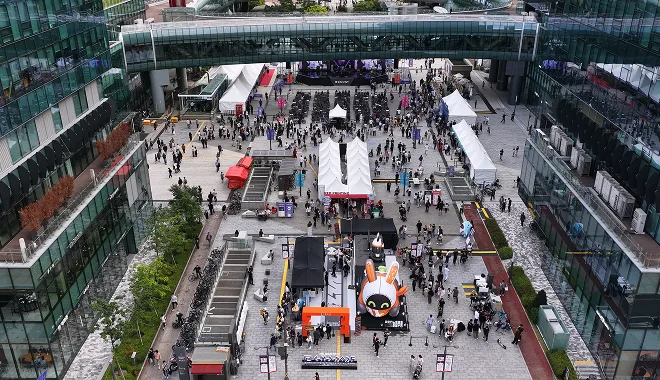
The location of the festival is also significant. Pangyo is one of South Korea’s major game-industry hubs, home to many leading game companies. There is a certain resonance in seeing music and performances inspired by games meet the public in the same industrial space where many games are made. Because GXG is not an event devoted to a single IP but a broader festival combining games with various forms of cultural content, these works can also connect with audiences beyond an existing fan base.
https://gxg.world/archive/history
This structure also suggests a slightly different way of thinking about game IP. IP is certainly a business asset that can generate sequels and products, but it can also become cultural material that other creators reinterpret in their own way. GXG SOUND TRACK offers a relatively direct example of that second possibility.
Of course, GXG SOUND TRACK is not an entirely unrestricted space for derivative creation. The participating games and IP are provided with the cooperation of their rights holders, and participants create their work within defined competition rules. The difference is that, rather than having the original company create the music itself, the program opens a space in which outside creators can interpret the game in their own way.
Creation That Continues After the Game Ends
The fact that a game inspires new music and that the music reaches a live stage does not automatically mean the resulting work will establish itself as independent content outside the game. Last year’s grand-prize winner, 'Hollow's Puppet,' did lead to further activity, but not every work will follow the same path. A competition can provide the occasion for a new work to emerge, but it cannot guarantee its life afterward.
Even so, the change represented by GXG SOUND TRACK is clear. Games are no longer consumed only as finished products. They can also become material that other creators reinterpret and transform. A game leaves behind not only stories, characters, and images, but also emotions and memories accumulated through play, repeated actions, tension, achievement, and personal experience. These elements can be expressed again through music, performance, video, illustration, writing, and other forms without simply reproducing the original narrative.
GXG SOUND TRACK tests that possibility through music. Rather than having the original developer create another piece of official content, outside creators select what they found in the game, transform it into new songs, and present those songs to an audience. What matters here is not only the musical outcome but also the fact that the range of people who can create from the game is expanding. The people who made the game are no longer the only ones able to generate new forms of expression from it; those who experienced it can become creators as well.
If such processes continue, the lifespan of a game IP becomes harder to measure solely through sequels or the duration of live service. Even after play ends, the game can be recalled in other works and transmitted to new audiences in different forms. The expansion of game culture therefore means more than increasing the number of people who play the same game. It can also mean allowing a single game experience to continue through music, performance, video, illustration, writing, and other forms of creation.
This is what makes GXG SOUND TRACK interesting. Not because it has already established a new market for game music, but because it demonstrates, through actual creation and performance, the possibility that games themselves can become a source from which other creative works emerge.
Even after a game ends, its world does not necessarily close with it. When someone takes an experience from that world and reworks it in their own language, the game moves beyond play and becomes material for another act of creation.