On July 21, 2026, Meta announced that Xbox Game Pass Starter Edition would be included with Meta Horizon+. Eligible Horizon+ subscribers in supported regions can access more than 50 games, receive 10 hours of cloud gaming each month, and earn Xbox Rewards through play. Combined with the more than 100 VR games already available through Horizon+, Meta says the total number of accessible titles now exceeds 150.
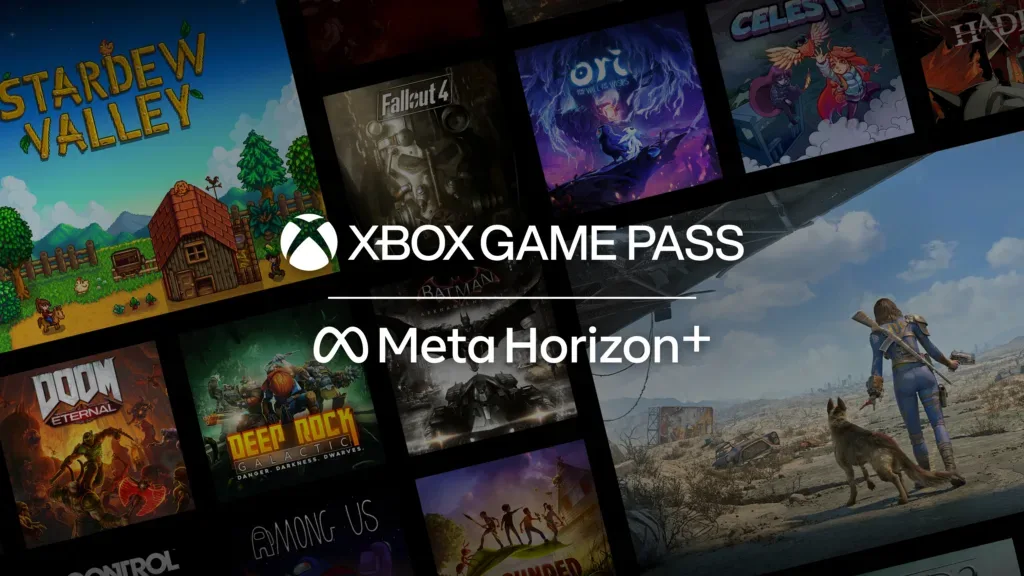
These Xbox titles are not being converted into VR games for Quest. Through the Xbox app on Quest, users stream console and PC games such as ‘Fallout 4’, ‘Fallout 76’, ‘Grounded’, ‘DayZ’, and ‘Overcooked 2’, then play them on a virtual screen inside the headset. Meta offers virtual displays measuring up to 26 feet, and plans to gradually introduce an emulation feature that will allow Quest Touch controllers to function like an Xbox gamepad.
The announcement, therefore, does not mean that roughly 50 new VR games have been added to Horizon+. Rather, existing Xbox games are becoming accessible through Quest, with that access now included as a Horizon+ subscription benefit. The games themselves remain conventional console and PC titles, but the route through which users discover and launch them has moved inside Horizon+.
This is where the difference between the current partnership and its earlier form becomes clear. Meta and Xbox had already built an environment in which Xbox cloud games could be played on Quest, and in 2025 they introduced the ‘Meta Quest 3S Xbox Edition’, which bundled special-edition hardware with short-term subscriptions. At the time, however, the connection was limited to users who purchased a specific device and received access for a defined trial period.
This time, the Horizon+ subscription itself becomes the route into Xbox games. The significance of the change lies not only in the larger number of available titles. The partnership has shifted from a bundle tied to the moment of hardware purchase toward an ongoing service relationship that lasts for as long as the subscription remains active.
From Hardware Bundle to Subscription Integration
The ability to play Xbox games on Quest is not new. Meta and Microsoft had already released an Xbox app for Quest, allowing Xbox Game Pass Ultimate subscribers to use Xbox Cloud Gaming and play supported titles on a large virtual screen inside the headset.
In June 2025, the two companies turned that cooperation into a physical product with the release of the ‘Meta Quest 3S Xbox Edition’. Priced at $399.99, the limited-edition package included a 128GB Quest 3S designed in Xbox colors, Touch Plus controllers, a pre-paired Xbox Wireless Controller, and an Elite Strap. It also came with three months of Xbox Game Pass Ultimate and three months of Meta Horizon+.
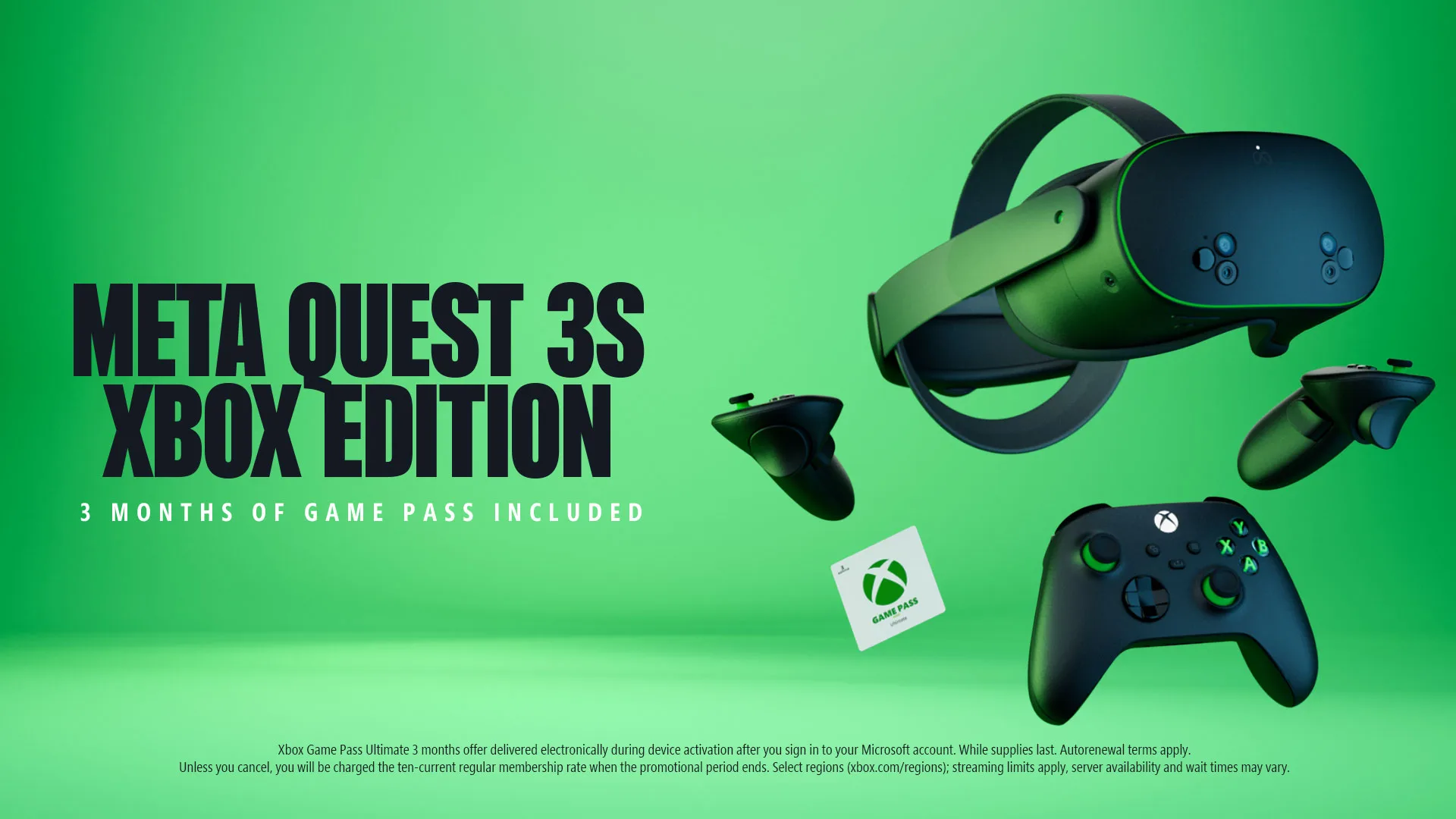
At the time, the partnership was centered on hardware. The package was designed so that buyers of a new Quest could immediately experience both Xbox cloud gaming and VR content without having to prepare separate peripherals. The two services were brought together in a single product, but Game Pass and Horizon+ were each provided as three-month trials. Once those periods ended, users had to subscribe to the services separately.
The new arrangement is structured differently. Horizon+ subscribers do not receive the full premium version of Xbox Game Pass, but Starter Edition. They can access more than 50 selected games, while cloud gaming on Quest is limited to 10 hours per month. The list of games may change, and availability also depends on region and account eligibility.
It would therefore be inaccurate to describe the arrangement as a complete integration of Horizon+ and Xbox Game Pass. It is closer to an additional benefit that gives Horizon+ subscribers access to a limited Xbox catalog and a restricted amount of cloud gaming. Users still need the Xbox app, a Microsoft account, and a stable internet connection, while Quest VR games and conventional Xbox games continue to operate in separate environments.
Even so, the form of the partnership has clearly changed. In 2025, users had to purchase a specific Xbox Edition headset to receive trial access to both services. Under the new arrangement, existing Quest users can access Xbox games as long as they meet the Horizon+ subscription requirements. What is new is not Xbox support on Quest itself, but the transfer of that access from a hardware purchase benefit to an ongoing Horizon+ subscription benefit.
The point of connection between Meta and Xbox has also moved from the moment of product purchase to the duration of the subscription. The hardware bundle introduced both services to buyers of a specific device, while the new arrangement continuously connects Horizon+ subscribers with Xbox games as part of an ongoing service partnership.
Meta Gains Content, While Xbox Gains a New Point of Access
Meta and Xbox gain different things from this arrangement. Meta expands the range of uses available through Horizon+ and Quest, while Xbox gains a new point of contact through which users outside the console ecosystem can encounter its games and subscription service.
For Meta, the benefit is not simply an increase in the number of games. The more important change is that Horizon+ can now cover forms of use beyond VR-exclusive content. Horizon+ is a subscription service that offers a catalog of Quest VR games, monthly titles, and discounts, but VR games differ from conventional console and PC games in both control schemes and play habits. Users do not necessarily spend every moment inside Quest playing fully immersive VR content.
Once Xbox games can be played on a virtual screen, Horizon+ can also serve users who want to wear the headset while playing games in a more traditional way. Meta’s official announcement treats the more than 100 VR games and more than 50 Xbox games as distinct categories of content. Xbox titles do not replace the existing VR catalog. Instead, they fill use cases that a VR-only subscription could not easily address.
The identity of Quest as a device also becomes broader. Quest can function not only as an immersive VR gaming system, but also as a personal display that places a large virtual screen inside the user’s physical environment. Xbox games strengthen this second use case. If users can enjoy conventional games on a large virtual screen even on days when they do not want to play VR titles, Meta can present Quest as an entertainment device that does not depend on a single content format.
The perceived value of Horizon+ may also increase. In the United States, Meta has added the Xbox benefit without changing the existing price of $7.99 per month or $59.99 per year. Including recognizable third-party games at no additional cost can create more reasons to subscribe and may give current users a stronger reason to remain subscribed. Since Meta has not disclosed subscriber growth or changes in churn, however, it would be premature to claim that the arrangement has already improved retention. It is more accurate to say that Meta is expanding the benefits of Horizon+ in a way intended to raise its perceived value.
For Xbox, the most immediate benefit is the addition of Quest users as a new point of access to Game Pass. Horizon+ subscribers who do not own an Xbox console or already subscribe to Game Pass can still experience Xbox games through Starter Edition. This allows Xbox to expose its games, accounts, and services to the Quest ecosystem without developing its own XR hardware.
The move also fits Xbox’s broader strategy of expanding access beyond the console. Quest does not replace an Xbox console. Instead, it becomes another screen through which users can connect to Xbox services via the cloud. In this model, the important question is not which hardware a user owns, but how many environments allow that user to reach an Xbox account and its games.
It also matters that Xbox does not have to create separate Quest ports for these titles. By streaming existing games through Xbox Cloud Gaming, the company can reach XR users without bearing the cost of developing native Quest versions. In supported games, users may also carry their accounts and progress across Xbox consoles, PCs, and Quest. Quest does not become an independent Xbox platform, but it can function as an additional screen leading users into the existing Xbox ecosystem.
The limited structure of Starter Edition further clarifies this role. More than 50 games and 10 hours of monthly cloud play are less suited to highly engaged players seeking a complete subscription product than to Horizon+ users encountering Xbox for the first time. Meta and Xbox have not disclosed how users may later move to higher Game Pass tiers, nor have they revealed their revenue-sharing terms. It is therefore more reasonable to describe Quest as a new distribution channel for discovering and trying Xbox games than as an explicit upselling mechanism.
In the end, Meta uses Xbox games to expand both the kinds of content consumed inside Quest and the amount of time users may spend there. Xbox uses Quest to reach more users and more screens outside the console. Meta needs more reasons for people to keep using the headset, while Xbox needs more points of access through which Game Pass can reach new audiences. This arrangement brings those two needs together.
From the Same Box to the Same Subscription Path
The 2025 ‘Meta Quest 3S Xbox Edition’ placed the two brands inside a single product. Buyers received a limited-edition Quest, an Xbox controller, and three-month subscriptions to both services. The partnership was most visible at the moment of purchase, and once the trial period ended, users had to decide separately whether to continue each service.
The 2026 arrangement is organized around subscribers rather than products. As long as users remain eligible Horizon+ subscribers, they can access the benefits of Xbox Game Pass Starter. If the hardware bundle functioned as cross-selling at the point of purchase, the new arrangement is closer to cross-distribution, continuously directing existing subscribers toward another service throughout the subscription period.
The two ecosystems have not become one. Their accounts and execution environments remain separate, and Xbox cloud gaming is still limited to 10 hours per month. The change is not a full platform integration, but the creation of a route through which subscribers and content can move across boundaries that remain intact.
This is where the significance of the announcement becomes clear. In the past, users had to deliberately choose an Xbox-branded Quest product before the relationship between the two services began. Now, simply subscribing to Horizon+ brings users into contact with Xbox games.
The shift means more than adding another group of games to Quest. Meta can expand the use of Horizon+ without building a large console game catalog of its own, while Xbox can reach Quest users without developing separate XR hardware. The companies have not merged their products into a single platform. Instead, they have begun using each other’s subscriptions and platforms as tools for their own expansion. The significance of the partnership lies not in the addition of roughly 50 games, but in the creation of a shared subscription path linking Meta’s user base with the Xbox gaming ecosystem.


