Does running a massive artificial intelligence model necessarily require an enormous data center?
For years, the most powerful models in the AI industry have largely resided in the cloud. Rather than owning and operating models themselves, businesses and developers accessed them through APIs. Only a handful of companies could afford the GPUs, servers, memory, networking, electricity, and cooling infrastructure required to operate frontier-scale models.
Meta is now presenting another possibility.
An AI model with 816 billion parameters can be run directly in a desktop environment.
On October 15, 2026, Meta released the model weights for Muse Spark Open. The company described it as the most capable open-weight model developed in the United States. Muse Spark Open contains 816 billion total parameters, but activates approximately 42 billion during inference. It also supports a context window of up to one million tokens.
What makes the announcement particularly notable is Apple's role.
Muse Spark Open has been optimized to run on two Mac Studio computers equipped with Apple's M5 Ultra chips, using the latest MLX framework. This presents an environment in which developers can operate a massive AI model on their own desks rather than relying exclusively on cloud APIs.
The significance goes beyond the release of another AI model.
It suggests that AI competition is expanding from a contest over who can develop the most capable models into a contest over who can run, operate, and control them.
816 Billion Parameters, but Only 42 Billion Active at a Time
Muse Spark Open's most distinctive characteristics are its scale and execution architecture.
Generally, the more parameters an AI model has, the more memory and computational resources it requires. Larger models may offer greater performance potential, but deploying them in real services often involves considerable infrastructure costs.
Meta addresses this challenge through a Mixture-of-Experts, or MoE, architecture.
Although Muse Spark Open contains 816 billion parameters in total, only approximately 42 billion are activated when processing each token. Instead of computing all parameters every time, the model selectively uses the expert components needed for a particular operation.
This is a design intended to make massive models more computationally efficient.
However, activating fewer parameters does not mean the entire model no longer needs to be stored in memory. The model weights must still be available so that the appropriate experts can be selected dynamically.
Muse Spark Open's ability to run in a desktop environment is therefore not the result of its MoE architecture alone. It reflects the combination of computational efficiency, large-capacity hardware memory, and inference-framework optimization.
Its one-million-token context window is also important.
AI agents differ from chatbots that answer individual questions. To perform complex tasks, they must read extensive documents, maintain information from earlier steps, call multiple tools, and decide what to do next based on intermediate results.
A longer context window enables these systems to retain more of the information required for such tasks.
Meta describes Muse Spark Open as optimized for long-running tasks, complex software engineering, multi-step reasoning, and coding agents. Its model card also identifies code generation, debugging, sequential tool calls, recovery from failures, and sustained task execution as important use cases.
This reveals the market Meta is targeting.
Muse Spark Open is not designed merely to improve conversational performance. It targets agentic environments in which AI performs work directly.
Two Apple Mac Studios Become a Massive AI Computing System
One of the most symbolic aspects of the announcement is the collaboration with Apple.
Meta and Apple have long been competitors, particularly over privacy policies and digital advertising. Yet this time, they have worked together to enable Meta's massive AI model to run efficiently on Apple hardware.
Meta optimized Muse Spark Open for the M5 Ultra Mac Studio, while Apple demonstrated how multiple Macs could be connected through MLX to execute large models.
The key lies in memory architecture.
Each M5 Ultra Mac Studio can support up to 512GB of unified memory. Combining two machines creates a configuration with an aggregate of approximately 1TB of unified memory resources.
In conventional PCs, CPU memory and GPU memory are often separate. This means GPU memory capacity can become a major bottleneck when running large AI models.
Apple Silicon, by contrast, uses a unified memory architecture in which the CPU and GPU share memory resources. Meta states that the M5 Ultra provides memory bandwidth of up to 1.2TB per second.
This allows two Mac Studios to function together as a large inference system.
Apple also published a technical report on multi-Mac Studio inference performance using RDMA and MLX. In Apple's tests, connecting four M5 Ultra Mac Studios produced generation speeds exceeding 36 tokens per second with Muse Spark Open.
That result, however, was measured under specific experimental conditions, including a context length of 8,192 tokens. It should not be interpreted as a performance guarantee across all workloads.
The distinction matters.
Being able to load a massive model into memory is not the same as being able to use it at a practical speed. If a model fits into memory but generates responses too slowly, it may be unsuitable for actual development or business tasks.
By demonstrating performance gains and parallel execution across multiple Macs, Apple sought to show that local AI can evolve beyond a technical demonstration into a practical inference environment.
Still, this should not be mistaken for the ability to run such a model cheaply on an ordinary personal computer.
Two M5 Ultra Mac Studios represent expensive professional hardware. The Wall Street Journal reported that the configuration costs more than $40,000. It is not an environment that most consumers could readily afford.
Nevertheless, the significance remains considerable.
A model that would previously have been associated with large-scale server infrastructure can now be executed on a relatively small number of desktop-class machines.
This suggests that the minimum practical infrastructure required to operate powerful AI models may be changing.
What Could the AI Actually Do?
Meta emphasized real agentic tasks rather than relying exclusively on benchmark scores.
According to its announcement, Muse Code, powered by Muse Spark Open, modified the actual iOS source code of Ice Cubes, an open-source Mastodon client.
The tasks included fixing bugs, adding features, and performing a complete build.
In another demonstration, the model operated DaVinci Resolve, a video-editing application.
It reviewed video frames, identified important scenes, and cropped the footage into a format suitable for vertical video.
These two examples illustrate where AI agents are heading.
The first represents software-development automation. AI moves beyond suggesting individual lines of code to modifying an actual project and completing a build.
The second represents creative-tool automation. AI interprets video content, operates editing software, and produces an edited result.
What makes these demonstrations especially noteworthy is that they were conducted in a locally operated computing environment.
Instead of sending task contents to an external model API, developers can operate an AI model directly and allow it to process local files and applications.
This creates another option for businesses and developers.
Local inference may be attractive when working with sensitive information such as source code, unreleased videos, internal corporate documents, and customer records.
However, running a model locally does not automatically guarantee data protection.
If an agent calls external services or accesses a network, independent permission management and security controls remain necessary.
Why Did Meta and Apple Join Forces?
The collaboration reflects overlapping interests.
Meta needs to expand the environments in which Muse Spark Open can be used.
Even a highly capable model has limited influence if developers cannot actually run it. Publishing model weights is less meaningful when the required GPU infrastructure remains beyond the reach of most potential users.
Meta therefore has an incentive to expand the hardware and software ecosystem capable of executing its models.
Apple sees an opportunity from the other side.
As AI models grow larger, hardware capable of providing high-performance computation and large memory capacity becomes more valuable.
If demand for local AI increases, devices capable of running advanced models without relying exclusively on cloud servers could create a new market.
Meta supplies the model.
Apple supplies the hardware and MLX environment in which it can run.
They are expanding the same market from different positions.
This collaboration does not mean Muse Spark Open will necessarily be integrated into Siri or Apple Intelligence.
The confirmed scope of the announcement concerns executing and optimizing a massive open-weight model on Apple Silicon.
Nevertheless, the partnership illustrates how fluid competitive relationships have become in the AI industry.
Companies that compete over advertising and privacy can cooperate on AI execution environments.
The reason is straightforward.
AI models, hardware, developer tools, cloud platforms, data, and applications are deeply interdependent.
Connecting complementary strengths may be more effective than having one company attempt to build every layer independently.
Open Weights Do Not Mean Complete Freedom
Another defining feature of Muse Spark Open is the release of its model weights.
Developers can download the model, execute it directly, and potentially modify or further train it for specific purposes.
Meta announced that the weights would be available not only through Hugging Face but also through platforms including Amazon SageMaker AI, Google Cloud Model Garden, and Microsoft Foundry Models.
Hosted API access is also available through providers such as Baseten, Fireworks AI, Groq, Modal, Nebius, OpenRouter, and Together AI.
The execution environment is not limited to a single hardware platform.
Supported inference engines include SGLang, vLLM, TensorRT-LLM, Hugging Face Transformers, Apple MLX, llama.cpp, and Unsloth. Optimizations are available for hardware from AMD, Apple, Intel, and NVIDIA.
The central issue here is choice.
Developers can purchase hardware and run the model themselves.
They can deploy it in the cloud.
They can access it through an external inference API.
They can also adapt or fine-tune it for particular applications.
But open-weight models should not automatically be equated with fully open-source models.
Muse Spark Open is governed by a separate Muse Model License.
The license permits a broad range of activities, including use, modification, fine-tuning, development of derivative models, and distribution, subject to specified conditions.
One condition is particularly important.
If a company and its affiliates have combined gross revenue exceeding $20 million over a consecutive 12-month period and intend to operate a Model-as-a-Service business providing third parties with access to the AI model through APIs or similar mechanisms, they must notify Meta and enter into a separate written agreement.
The license provides exceptions for internal use, research, ordinary commercial activities that do not constitute model services, and using the model to implement features in a company's own products.
This reveals the boundaries of Meta's openness strategy.
Meta encourages developers and businesses to use and improve its models while imposing additional conditions on companies that seek to build competing model-service businesses around them.
Muse Spark Open therefore increases freedom in AI model deployment, but it does not permit every commercial use without restriction.
Competition Among American Open-Weight Models Is Changing
One phrase Meta repeatedly emphasized in its announcement was its claim that Muse Spark Open is the most capable open-weight model developed in the United States.
That wording reflects the wider context of global AI competition.
Chinese companies have become increasingly prominent in the open-weight AI market.
Alibaba's Qwen, Moonshot AI's Kimi, and Z.ai's GLM have released model weights and expanded their developer ecosystems.
Meta introduced Muse Spark Open against this backdrop.
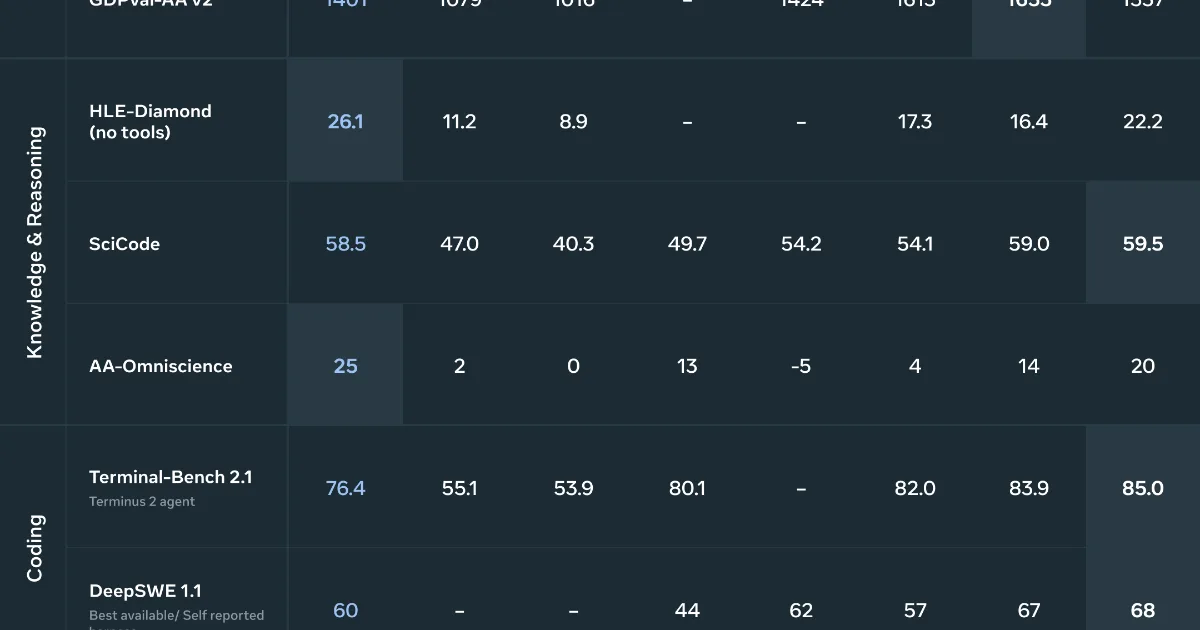
However, Meta's claim should not automatically be interpreted as proof that Muse Spark Open outperforms every other open-weight model in every category.
Its published comparisons include Nemotron 3 Ultra, Mistral 4 Large, Qwen3.8, GLM 5.3, and Kimi K3.
The evaluations cover agentic tasks, knowledge and reasoning, coding, and multimodal tasks involving tool use.
Model performance varies by workload and evaluation methodology.
A strong result in coding or agentic tasks does not necessarily mean every competing model performs worse in all areas.
The significance of Meta's announcement should therefore be understood more broadly than a performance ranking.
Meta is seeking to expand a powerful American open-weight model into an ecosystem where developers can execute and use it directly.
What matters is not merely releasing model weights, but also supporting multiple inference engines, hardware architectures, and cloud platforms.
Who Is Responsible for AI Safety?
Releasing model weights gives developers greater freedom.
But it also makes control more difficult.
With a closed API model, the service provider can centrally enforce usage policies, restrict access, and operate certain safeguards.
With an open-weight model, developers and businesses can download, modify, and operate the model independently.
That makes comprehensive centralized control more difficult.
Meta states that it has applied additional safety-focused post-training to Muse Spark Open.
The company also says it evaluated the model against severe-risk categories under the Meta Superintelligence Scaling Framework and determined that the model satisfied its internal requirements for release.
However, Meta said the full evaluation report would be published later.
This introduces an important limitation.
Meta's safety assessment is the company's judgment regarding the model's release. It is not a guarantee that the model will be safe in every possible deployment environment.
This is particularly important because Muse Spark Open emphasizes coding and agentic tasks.
When an agent modifies actual files, runs programs, accesses external services, and executes complex tasks over long periods, safety requires far more than filtering harmful text outputs.
The spread of open-weight models therefore creates new responsibilities for enterprises.
Where should the model run?
What data should it be allowed to access?
Should external network connectivity be restricted?
Which actions should require human approval?
If something goes wrong, who can stop the system and audit its behavior?
These questions matter whether the model runs in the cloud or locally.
Operating a model directly gives organizations greater control.
But it also transfers more responsibility for exercising that control to the operator.
The Basis of AI Infrastructure Competition Is Changing
The most important change illustrated by Muse Spark Open concerns how AI models are owned and operated.
Until recently, enterprise AI adoption largely meant connecting to an external model service.
Organizations used AI according to the model provider's pricing, policies, service availability, and data-processing conditions.
Open-weight models offer another option.
Organizations can run models on internal servers when necessary.
They can fine-tune models for specific tasks.
They can change cloud providers or adjust their operating environments to match their own infrastructure.
These choices are especially important for companies handling sensitive data and internal workflows.
But operational autonomy is not free.
Powerful hardware is required, along with the technical expertise needed to optimize models.
Electricity, maintenance, updates, security, monitoring, and evaluation all impose costs on the operator.
Not every company will abandon cloud AI services and begin running its own models.
Instead, organizations are likely to combine cloud APIs, private servers, and local AI according to the characteristics of different models and tasks.
They may use external AI services for general work while operating sensitive-data applications or highly specialized agents on their own infrastructure.
Muse Spark Open attempts to extend that choice to a more powerful class of model.
Apple, meanwhile, gains an opportunity as the hardware provider enabling such execution environments.
This means that AI infrastructure competition, once centered primarily on data centers, is expanding toward desktops and independently operated systems.
Meta Is Offering Not Just a Larger Model, but Broader Access
If this announcement is viewed merely as the release of an 816-billion-parameter model, its most important implications may be missed.
Meta emphasized not only model size, but also executability and developer accessibility.
The underlying argument is that calling the latest model through an API should not be the only option.
Developers should be able to download and run models directly, modify their weights, optimize them for specific tasks, and operate them on infrastructure they control when necessary.
This also connects to Meta's broader ambition of making personal superintelligence more widely available.
If personal superintelligence remains nothing more than access to a large cloud service, users can only employ AI within the boundaries set by the service provider.
But if sufficiently capable models can be operated directly, developers and businesses can design AI systems more freely around their own needs.
Of course, running Muse Spark Open on two Mac Studios does not mean personal superintelligence has suddenly become affordable for everyone.
Hardware costs, performance, maintenance, security, and licensing remain significant challenges.
Nevertheless, this announcement raises an important question for the AI industry.
Who builds the most powerful AI?
And an even more important question follows.
Who can actually run that AI?
The initial stage of AI competition focused on improving model capabilities.
The next stage intensified the race to secure GPUs and data centers needed to deliver those models as services.
Now the competition is expanding into questions of where models can run, who controls them, and how freely they can be used.
Meta has released the weights of Muse Spark Open.
Apple has demonstrated the possibility of running a massive model locally through M5 Ultra hardware and MLX.
Multiple cloud and inference platforms are making the same model available in their respective environments.
Models, hardware, and execution environments are combining to create an ecosystem.
In this competition, the number of parameters may not be the most valuable asset.
Developer ecosystems that can actually use models, compatibility across different hardware platforms, and governance systems that enable safe operation may become equally important.
Muse Spark Open is one illustration of that shift.
Massive AI has not suddenly become affordable for everyone.
Nor does this development eliminate the need for cloud infrastructure.
But it makes the path more concrete for bringing intelligence once assumed to require enormous data centers onto a developer's desk.
AI competition no longer ends with creating the most capable intelligence.
The next question is who can own it, where it can run, and how it can be controlled.
Meta and Apple's collaboration has brought that question to the forefront of the AI industry's next competitive frontier.