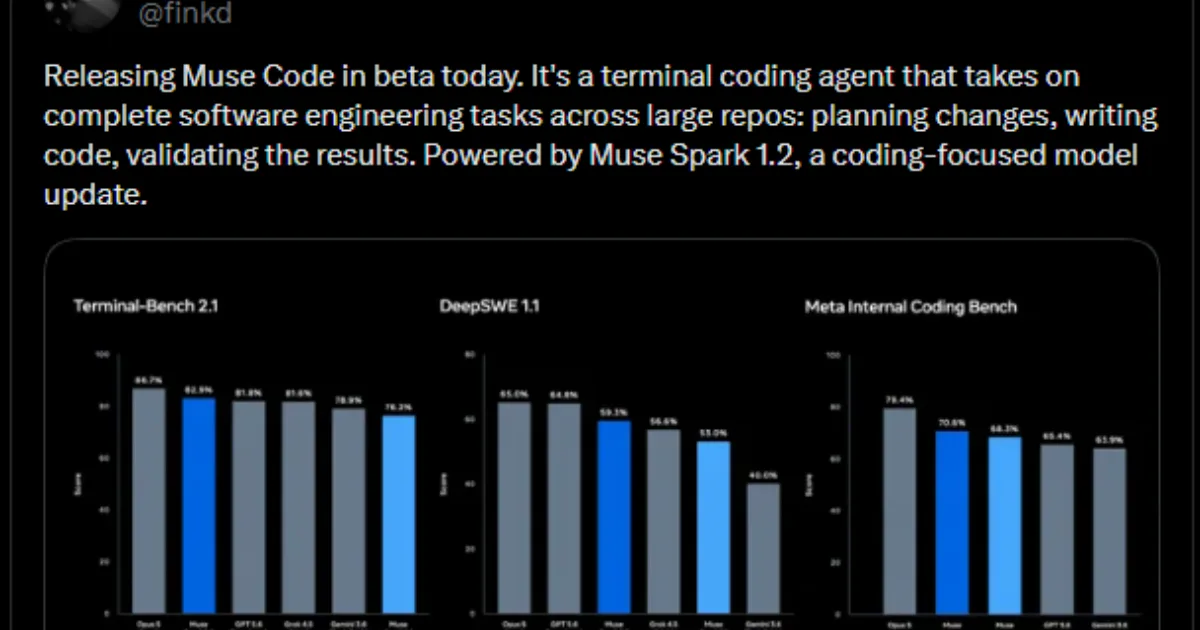
Meta has introduced Muse Code.
Mark Zuckerberg announced the beta release of Muse Code on X. He described it as a terminal coding agent that can take on complete software engineering tasks in large repositories, plan changes, write code and verify results. The tool is powered by Muse Spark 1.2, a coding-focused model update.
The announcement was short.
But its meaning is significant.
Meta has entered the AI coding tool competition in earnest. More importantly, its direction is not simple code suggestion or autocomplete. Muse Code is an agent that works in the terminal. It is not a tool that merely proposes a few lines of code after a user instruction. It is aimed at long-running software engineering tasks: planning, tool use, file editing and validation.
The AI coding tool market is changing quickly.
The first phase of competition was about who could suggest better code. Then the focus moved to how naturally AI could help with coding and refactoring inside the IDE. Now the competition has moved again. A developer explains a problem, and the AI reads the repository, plans the change, edits multiple files, runs tests, fixes failures and returns a pull-request-ready result.
Muse Code sits directly on that trend.
Coding AI is no longer just an assistant that gives advice from the side.
It is trying to work like a junior developer.
Three Things Muse Code Emphasizes
Zuckerberg’s posts suggest three core features of Muse Code.
The first is long-term context retention.
Muse Code runs specialized background agents that stay active across the entire session. These agents do not restart from scratch for every task. They accumulate context over time.
That matters in large repositories.
Software development does not happen through one question and one answer. The agent must understand repository structure, dependencies, code style, testing conventions and previous failures. An AI that starts fresh each time forces the developer to repeat context and can lose direction during long tasks.
Muse Code tries to address this through background agents.
The second feature is parallel sub-agents.
When a task is large enough, Muse Code can fan it out into separate sub-agents. These sub-agents work in isolated worktrees. This is more scalable than asking a single AI to modify every file sequentially.
Large feature work or optimization tasks may require testing multiple hypotheses at once. If one approach fails, another may work. Different modules may need to be analyzed in parallel. Isolated worktrees reduce conflicts while allowing multiple attempts to proceed at the same time.
The third feature is auditability.
Zuckerberg described Muse Code as auditable by design. Every model call, tool run and edit is written to a local event log before execution. If the process crashes, it can resume from the exact point of interruption using that log. No work is lost and the user does not need to re-prompt.
These three features point in the same direction.
If an AI coding agent is going to work for a long time, it must remember.
If it is going to work at scale, it must parallelize.
If developers are going to trust it, it must be auditable.
The Axis of Coding AI Competition Is Changing
The Muse Code announcement shows how the AI coding market is shifting.
Until recently, many coding AI tools focused on helping developers at the moment of writing code. Autocomplete, function generation, error explanation, simple refactoring and test generation were common use cases. The developer still controlled the workflow, while AI made suggestions along the way.
The new competition is different.
Claude Code, OpenAI’s Codex-related tools, Cursor’s agentic coding features and now Meta’s Muse Code all target longer tasks. The goal is not “AI that suggests code.” The goal is “AI that performs work.”
That difference is large.
Code-suggestion AI leaves context and decisions with the developer.
Work-execution AI receives a goal and finds a path.
Code-suggestion AI is strong at one file or one function.
Work-execution AI must understand the repository, tests and runtime environment.
That requires different capabilities:
long-context understanding;
tool use;
terminal work;
file editing and validation;
test execution;
retry after failure;
work logs;
permission control;
and orchestration of parallel agents.
This is why Muse Code emphasizes background agents, isolated worktrees and local event logs.
In the future, coding AI may be judged less by benchmark scores and more by whether it can complete real development tasks end to end.
The Meaning of 24 Hours and More Than 1,000 Tool Calls
Zuckerberg said Muse Spark 1.2 was applied to a kernel optimization task on NVIDIA Hopper and performed more than 1,000 tool calls over 24 hours. He added that the model continued finding real improvements beyond the initial exploration phase.
That detail is symbolic.
It suggests that AI agents are moving beyond making code changes for a few minutes. They are beginning to experiment and optimize over the course of an entire day.
Kernel optimization is different from simple CRUD development. It requires performance measurement, hypothesis generation, code changes, repeated benchmarking and hardware-specific understanding.
Of course, Zuckerberg’s X posts alone do not allow full verification of the specific results. Public information does not reveal the exact kernel task, the baseline, the improvement size or the degree of human involvement.
Still, the direction shown by “24 hours” and “1,000 tool calls” is clear.
Meta is positioning Muse Code as a long-running autonomous engineering agent, not a short coding assistant.
If such tools work reliably, development workflows could change.
A person assigns a large task before leaving work.
The AI tests several hypotheses overnight.
In the morning, the developer reviews the results, logs, changes and validation output.
The human makes the final judgment.
This resembles the broader trend seen in overnight research agents at companies like Nuro and in Anthropic’s emphasis on long-running autonomous work through Claude Code auto mode.
The next productivity gain in AI development may not come from faster drafts.
It may come from long-running asynchronous work.
Why Auditable Agents Matter
Muse Code’s local event log is not only a crash-recovery feature.
It is a trust mechanism for the AI-agent era.
In software development, developers need to know what the AI did. Which model calls occurred? Which tools were run? Which files were edited? Which commands executed? Where did the task fail?
This becomes essential when an agent works autonomously for a long time.
If AI changes code and no one knows why, it is risky.
If AI says it ran tests but no one knows what was actually executed, trust is weak.
If a crash erases work context, the task must start over.
If multiple sub-agents work in parallel, developers need to know which agent changed what.
A local event log appears to be designed to solve these problems.
It is also important for security. The risks of AI coding agents are no longer limited to bad code. They include file deletion, secret exfiltration, incorrect permission changes, excessive shell commands and unintended behavior caused by prompt injection.
Execution records are necessary for audit and recovery.
The more autonomous an AI agent becomes, the more logging it needs.
Meta Is Targeting the Developer Ecosystem
Meta has built a strong presence in AI infrastructure, models and open-source ecosystems.
Muse Code extends that strategy into developer tools. Its position as a terminal coding agent suggests that Meta wants to enter the real working environment of developers. Rather than sitting only inside an IDE plugin, it works closer to the repository, shell and toolchain.
Developer tools are strategically important.
Even if an AI model is powerful, its influence is limited if it does not enter the daily workflow. If a model becomes part of the coding toolchain, it is used every day on real tasks: repository understanding, testing, deployment, refactoring and optimization.
This is why OpenAI, Anthropic, Google, Microsoft and Meta are all focused on coding agents.
Developers are among the most active AI users.
Coding is a good domain for testing agent capabilities.
Software development has high economic value.
Tool use and long-running tasks are natural parts of the workflow.
Enterprise adoption is also plausible.
Muse Code is Meta’s signal that it does not intend to fall behind in this market.
The Position of Muse Spark 1.2
Muse Code is powered by Muse Spark 1.2.
Zuckerberg described Muse Spark 1.2 as the next step toward frontier. He also said larger and more powerful models are coming.
That statement reveals Meta’s strategic position.
Muse Spark 1.2 is not necessarily the final target. Meta appears to be releasing a coding-focused model update inside a developer tool first, with the intention of improving performance through stronger models later.
Model capability matters in AI coding agents.
But models are not enough.
As Claude Code auto mode shows, permission control and risky-command blocking are necessary. As Muse Code emphasizes, background agents, worktree parallelization and event logs are also necessary. Product architecture and model capability must advance together.
Muse Spark 1.2 is the engine inside that product architecture.
If stronger models are later connected to Muse Code, the tool’s long-running capability may grow. But the stronger the model, the greater the risk of incorrect commands and unintended behavior. That makes audit logs and isolated worktrees more important.
If Meta is moving toward frontier models, Muse Code may become a testbed for connecting those models to real software engineering work.
Competing With Claude Code and Codex
Muse Code will inevitably be compared with Claude Code and OpenAI’s Codex-related tools.
Claude Code is a terminal-based development agent that emphasizes long-running work, tool calls, permission management and auto mode. OpenAI is also pushing development work and workplace automation through Codex and ChatGPT-related workflows. Cursor has strengthened agentic coding experiences from an IDE-centered position.
Muse Code appears to be Meta’s answer to this competition.
Persistent background agents across a session.
Fan-out into sub-agents when a task is large.
Parallel work in isolated worktrees.
Auditing and resumption through local event logs.
A coding-focused Muse Spark 1.2 model.
The competitive questions are clear.
Who understands large repositories best?
Who can work longer and more reliably?
Who can complete validation with less human intervention?
Who can execute commands more safely?
Who offers the best developer experience and pricing?
Zuckerberg also emphasized easy installation and a low-cost contributor tier. That is a market-entry strategy. Developer tools need low friction. If installation and pricing are simple, developers can experiment quickly.
The coding agent market is still early.
But the competition is already intense.
Parallel Agents Are a Miniature Development Organization
Muse Code’s sub-agent architecture is especially interesting.
When a task is large, separate sub-agents work simultaneously in isolated worktrees. This resembles a miniature software development organization. Multiple developers work toward a shared goal on separate branches, compare results and select the best approach.
As AI agents improve, software development may not be organized around one AI doing everything. It may become a structure in which multiple agents divide roles.
One agent analyzes the codebase.
Another writes tests.
Another tries performance optimization.
Another reviews security risk.
A critic agent compares results.
A main agent integrates the final change.
Muse Code’s fan-out design hints at this future.
But parallelization also introduces risks. Multiple agents may create conflicts. They may work from different assumptions. Validation costs may increase. Orchestration becomes important: the system must decide which result is best and how to merge it safely.
The next technical challenge for coding agents is not only individual model intelligence.
It is multi-agent coordination.
Security Risks of AI Coding Agents
It is positive that Muse Code emphasizes audit logs and isolated worktrees.
But AI coding agents carry inherent security risks. They have terminal access. They modify files. They run tools. They may use networks. Long-running autonomous work can increase those risks.
The risks appear in many forms:
unintended file deletion;
external transmission of files containing secrets;
incorrect git push operations;
use of production credentials;
confusion between test and production environments;
prompt injection that hijacks behavior;
supply-chain attacks during package installation;
overbroad permission requests;
and generation of vulnerable code.
Recent AI cyber evaluation incidents and discussions around Claude Code auto mode all point in the same direction. As agents become more powerful, their behavior must be controlled. Asking humans to approve every command creates fatigue. Allowing full automation creates danger. Therefore, model calls, tool runs and edits must be logged; risky commands must be blocked; and work must be isolated.
Muse Code’s event log is a starting point.
Users will increasingly ask:
Which commands were executed?
Which files changed?
What external network access occurred?
Were secrets exposed?
Was work performed in an isolated environment?
Can failed work be rolled back?
What validation was completed before a PR review?
The trustworthiness of AI coding agents will come not only from code quality.
It will come from controllability.
Lessons for Korean Development Organizations
Muse Code also matters for Korean companies and development teams.
Many organizations are already adopting AI coding tools, but often still treat them as personal productivity tools. Developers use Copilot, ChatGPT or Claude Code individually to generate code snippets or debug issues.
Tools like Muse Code change the picture.
AI can analyze an entire repository.
It can perform long-running work.
It can modify multiple files.
It can run tests and validation.
It can produce PR-ready results.
It can work overnight and return results in the morning.
Development organizations will need new operating principles.
First, they should restrict which repositories and branches AI agents can access.
Second, they should block access to production credentials and sensitive files.
Third, AI-generated changes must always go through code review and testing.
Fourth, execution logs and change histories must be retained.
Fifth, teams need criteria for integrating results from parallel agents.
Sixth, security, licensing and privacy checks should be automated.
Seventh, organizations should distinguish between tasks AI can perform autonomously and tasks requiring human approval.
AI coding agents can increase development productivity.
But if they do not enter the organization’s software development lifecycle properly, they become uncontrolled automation.
Developers Will Not Disappear
Tools such as Muse Code may make it seem as though developers’ roles will shrink.
The real change is closer to role movement.
Developers move from writing every line of code to defining goals, providing context, reviewing AI-generated changes and making architectural judgments. In large repositories, AI may modify many files, but humans must decide whether those changes fit the product direction, architecture principles, security requirements and operational reality.
The more AI writes code, the more human design responsibility matters.
What should be built?
What constraints apply?
What quality standards matter?
Which changes are allowed and which are not?
Does the performance improvement matter for the actual product?
Are the tests sufficient?
What are the risks?
AI coding agents can reduce manual coding labor.
They cannot remove judgment.
In fact, development organizations that fail to exercise judgment may become more vulnerable to plausible-looking AI-generated changes.
The Next Standard for Coding Agents: Work Longer, Log Everything, Verify Results
Meta’s Muse Code beta shows the next phase of the AI coding tool market.
Muse Code is a terminal-based coding agent. It aims to perform complete software engineering tasks in large repositories: planning, coding and verifying results. Powered by Muse Spark 1.2, it emphasizes persistent background agents, fan-out into parallel sub-agents, isolated worktrees and local event logs for audit and resumption.
The meaning is straightforward.
AI coding competition is moving from code snippet generation to long-running autonomous work.
The key question will no longer be how good a function the model writes in a single prompt. It will be whether the agent can understand a large repository, plan a task, test multiple approaches in parallel, run tests, recover from failure, log every step and produce a result that humans can review.
Muse Code is Meta’s entry into that war.
With OpenAI, Anthropic, Cursor, Microsoft, Google and now Meta all competing in coding agents, the developer tool market may be reshaped quickly.
But as the direction becomes clearer, the questions also become sharper.
How much work should AI be allowed to perform?
How should AI-generated code be verified?
How should command execution be controlled?
How should logs and accountability be managed for long-running autonomous work?
Who makes the final decision when parallel agents produce competing results?
In the AI coding agent era, developers may write less code by hand.
But they will need to design, review and control more.
Muse Code is therefore not just another tool announcement.
It is another signal that software development is being reorganized around collaboration between humans and AI agents.