The lawsuit over Elon Musk’s delayed disclosure of his Twitter stake is effectively over.
But the ending is anything but simple.
The U.S. Securities and Exchange Commission originally alleged that Musk failed to timely disclose his growing ownership stake in Twitter, now X, while continuing to buy shares. According to the SEC, the delay deprived investors of information they should have had and allowed Musk to save about $150 million by buying stock before the market fully reacted.
Yet the final settlement does not impose judgment on Musk personally.
It falls on the Elon Musk Revocable Trust dated July 22, 2003.
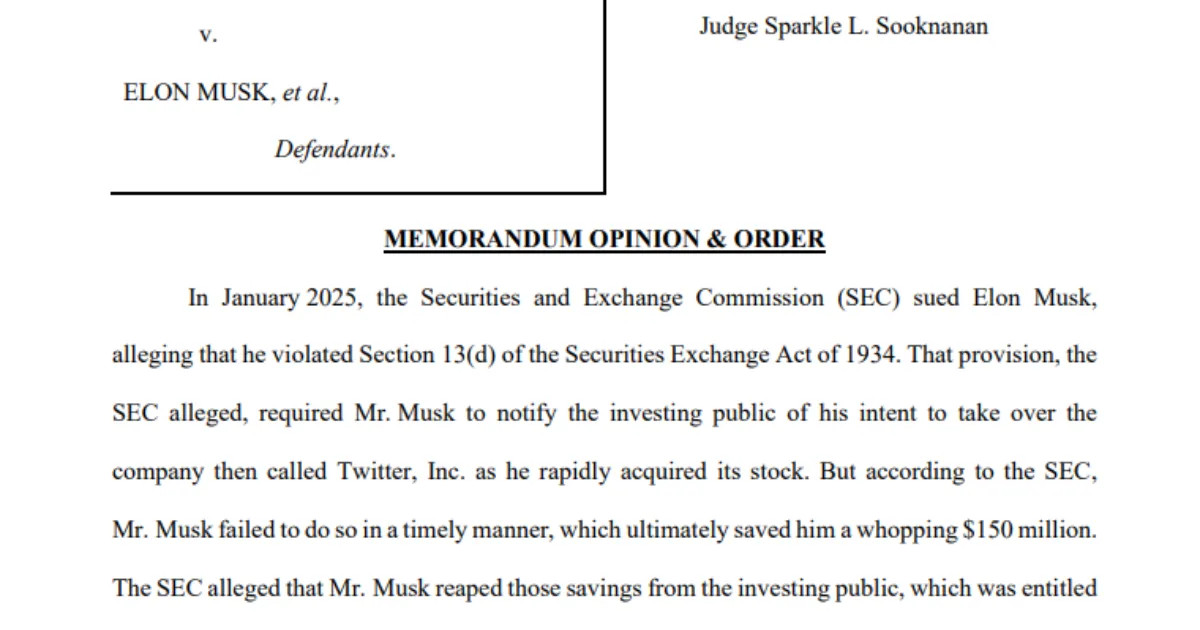
On July 8, 2026, U.S. District Judge Sparkle Sooknanan approved the consent judgment between the SEC and Musk’s side. Under the deal, the trust must pay a $1.5 million civil penalty and is permanently enjoined from future violations of Section 13(d) of the Securities Exchange Act and related rules.
The court approved the settlement.
But it did not do so comfortably.
Judge Sooknanan said she had serious misgivings about the agreement and noted “red flags” in the SEC’s decision-making process. Still, she concluded that the court’s role in reviewing an agency settlement was limited. The agreement, she found, was not so deficient that it mocked the court’s authority or fell outside the bounds of public interest.
The case is therefore more than a disclosure dispute.
It is a window into how one of the world’s richest people handled U.S. securities reporting rules, how strongly the SEC enforces the law against a figure of extraordinary power and wealth, and how far a court can go when reviewing an enforcement agency’s settlement discretion.
It Began With the 5% Disclosure Rule
Under U.S. securities law, an investor who acquires beneficial ownership of more than 5% of a public company’s shares must disclose that position within a required period.
This is not a mere administrative formality.
The rule exists because markets need to know when a person or entity is accumulating a large stake in a public company. Such information can significantly affect price, investor expectations and corporate-control dynamics.
That is especially true when the buyer may seek influence or control.
The SEC alleged that Musk crossed the 5% threshold in Twitter but waited too long to file the required beneficial-ownership disclosure. During that delay, he continued to buy shares.
The agency’s original theory was straightforward.
Had the market known earlier that Musk had taken a significant stake in Twitter, the stock price may have risen sooner. Because disclosure was delayed, Musk allegedly bought additional shares at lower prices and saved roughly $150 million.
That is why the SEC initially sought disgorgement, the return of alleged ill-gotten gains.
But by the final settlement, that demand had disappeared.
Is $1.5 Million Large or Small?
Under the settlement, the trust must pay a $1.5 million civil penalty.
The SEC and Musk’s side argued that this amount was historically significant for a standalone Section 13(d) violation. Reuters reported that the judge acknowledged the penalty was unusually large for this type of case.
But the court also looked at the larger number.
The SEC had alleged that Musk saved about $150 million because of the delayed disclosure. Compared with that figure, the $1.5 million penalty is about 1%.
That gap is the heart of the discomfort.
Civil penalties and disgorgement are legally different. A penalty punishes a violation. Disgorgement seeks to strip away gains obtained through unlawful conduct.
The SEC explained that disgorgement in a standalone Section 13(d) case would have been difficult and that such relief was not commonly obtained in similar cases.
But that explanation leaves a question.
If disgorgement was historically difficult, why did the SEC seek it in the first place?
And if the case really involved a $150 million economic advantage, why did the final settlement end with a $1.5 million penalty?
Those questions are not erased by the approval order.
They remain the shadow over the case.
The Strange Defendant: A Revocable Trust
The most unusual feature of the settlement is the defendant that remains.
The SEC initially sued Musk personally. Later, the agency amended its complaint to add the Elon Musk Revocable Trust dated July 22, 2003. The SEC’s litigation release says the amended complaint alleged that the defendants failed to timely file a beneficial-ownership report after the trust acquired more than 5% of Twitter’s outstanding shares.
The timing drew judicial concern.
According to reports on the court’s review, the amended complaint was filed only minutes before the proposed consent judgment. The court questioned whether the complaint had been reshaped to fit the settlement rather than the other way around.
The trust itself is not a normal corporate defendant.
SEC filings related to Musk’s Twitter stake described the shares as held by the Elon Musk Revocable Trust, with Musk as the sole trustee.
In substance, that makes the distinction between Musk and the trust difficult for the public to understand.
The trust may be the legal holder of the shares.
But the economic and reputational consequences are closely tied to Musk.
That naturally raises the question:
Why was the judgment imposed on the trust rather than Musk personally?
The SEC reportedly acknowledged that this was a concession sought by Musk’s side.
A Structure That Lets Musk Say He Was Not Personally Judged
The trust-only settlement is not merely a technical matter.
It changes the public meaning of the case.
Because the judgment applies to the trust, Musk personally avoids being the direct subject of the final consent judgment. The SEC agreed that once the court approved the trust settlement, it would dismiss its claims against Musk personally.
That gives Musk room to say that no direct judgment was entered against him.
For a public figure whose companies include Tesla, SpaceX and X, legal form matters. A personal judgment and a trust-level penalty send different messages to investors, employees, counterparties and the public.
Judge Sooknanan appeared to understand that point.
She questioned why the final resolution was structured this way and why a trust, rather than Musk himself, became the settling party.
The SEC also acknowledged that it had not identified a prior standalone Section 13(d) case resolved only against a trust without the trustee or beneficiary as a settling party.
That made the settlement unusual.
Yet the court still approved it.
Why the Court Approved the Deal
A court reviewing a consent judgment does not retry the case.
It does not decide what settlement it would have negotiated. It does not replace the agency’s enforcement judgment with its own.
The court asks whether the settlement is fair, reasonable and consistent with the public interest under the limited standard applicable to agency settlements.
Judge Sooknanan emphasized that limitation.
The court could not sit in the SEC’s chair and decide whether the agency should have demanded more. It could not force the SEC to pursue disgorgement if the agency chose not to do so. It could not rewrite the settlement simply because the court had doubts.
The judge saw warning signs.
She questioned the settlement’s structure, the late addition of the trust, the disappearance of disgorgement and the possibility that Musk had received unusually favorable treatment.
But the final question was narrower:
Was the settlement so inadequate that the court had to reject it?
The judge concluded it was not.
The permanent injunction against the trust had some public value, and the $1.5 million penalty was large by the standards of standalone Section 13(d) cases. On that basis, the settlement could be approved even if it remained troubling.
That makes the decision unusual.
The court approved the settlement while leaving its doubts on the public record.
The Question of Equal Enforcement
The biggest question left by the case is fairness.
The SEC exists to protect investors and market transparency. Beneficial ownership disclosures allow the market to know when someone is accumulating a major position in a public company. If disclosure is delayed, other investors may trade without information they should have had.
When one of the world’s most influential business figures resolves such a case through a $1.5 million trust-level penalty, the market is bound to ask questions.
Would an ordinary investor receive the same treatment?
Could another executive use a trust to seek a similar structure?
Did the SEC enforce more strongly because Musk is powerful, or more softly because he is powerful?
What happened to the original concern about investor harm or improper savings?
The judge ultimately placed some of those questions in the realm of political accountability. Reports on the decision noted that she said whether the SEC held Musk sufficiently accountable is a question citizens can evaluate through democratic processes.
That is a statement about separation of powers.
It is also a statement about judicial limits.
The court had doubts but did not stop the deal.
The SEC made allegations but did not press them to the end.
Musk resolved the case through a trust rather than a personal judgment.
Lessons for Other Capital Markets
The case is not only an American celebrity-CEO dispute.
It also carries lessons for other capital markets, including Korea.
Large-shareholding disclosures are central to market transparency. Investors need to know who owns significant stakes, who may influence control and whether a major corporate transaction may be coming.
This is especially important when ownership is held through complex structures: trusts, foundations, affiliates, family offices, overseas vehicles, investment partnerships or related parties.
Formal ownership is not always enough.
Markets also need to know who exercises real control and who receives the economic benefit.
The Musk settlement shows how legal form can complicate accountability.
A trust may be the formal holder. But if one person is effectively the decision-maker and economic beneficiary, regulators and investors must understand that reality.
Korean markets face similar issues.
Major-shareholder reporting, related-party disclosure, friendly stakes, convertible instruments, warrants, overseas entities and family-controlled structures are constant sources of market sensitivity.
Regulators must be able to look beyond formal holders and identify substantive controllers and beneficiaries.
The second lesson concerns deterrence.
If the benefit from a violation is large, a small penalty can become merely a cost of doing business.
Market discipline works only when the cost of violating the rules exceeds the benefit of doing so.
Otherwise, delayed disclosure can become a strategic option.
Is a Fine a Punishment or a Fee?
In legal terms, $1.5 million may be a meaningful penalty.
In economic terms, the question changes.
The SEC initially alleged that the disclosure delay saved Musk about $150 million. Reuters reported that the judge noted Musk’s extraordinary wealth in evaluating the proportionality of the settlement.
Against those numbers, a $1.5 million penalty raises an obvious question.
Is it a deterrent?
Or is it a transaction cost?
The purpose of securities-law penalties is not only to punish past conduct.
It is to prevent future violations.
It is to send a signal to other market participants.
It is to establish that trading on an information gap created by delayed disclosure should not be profitable.
If the penalty is only a tiny fraction of the alleged benefit, that signal weakens.
The settlement does include a permanent injunction. The trust must comply with future beneficial-ownership reporting obligations. That matters.
But markets remember numbers.
$150 million in alleged savings.
$1.5 million in penalty.
A judgment against the trust rather than Musk personally.
Those numbers and that structure may leave a more complicated message than the SEC intended.
The Settlement Is Over, but the Questions Remain
The legal case is nearing its end.
The court approved the consent judgment. The SEC’s claims against Musk personally are set to be dismissed as part of the settlement structure.
But the meaning of the case does not end with the order.
The larger questions remain.
How strictly should large-stake disclosure rules be enforced?
Do the same standards apply to the wealthiest and most powerful market participants?
Can legal structures such as trusts soften personal accountability?
Did the SEC fight hard enough for investor protection?
How far should courts go when reviewing enforcement settlements by agencies?
Judge Sooknanan’s decision does not fully answer those questions.
It leaves a different message.
The court approved the settlement, but it did not hide its doubts.
The SEC ended the case, but it did not end the market’s suspicion.
Musk avoided a direct personal judgment, but the structure of the settlement may invite more scrutiny rather than less.
The Twitter takeover is already history.
But the question of what the market should have known, and when it should have known it, is not finished.
This settlement may be remembered less as the final line of a disclosure case than as a footnote in the continuing debate over trust in U.S. capital-market enforcement.