NASA is beginning to reshape how it operates Mars exploration.
Instead of developing and managing every major element of a planetary mission itself, the agency is testing a new public-private model: NASA will build the scientific instruments, while a commercial company will provide the spacecraft, launch vehicle and cruise operations needed to deliver the payload to Mars.
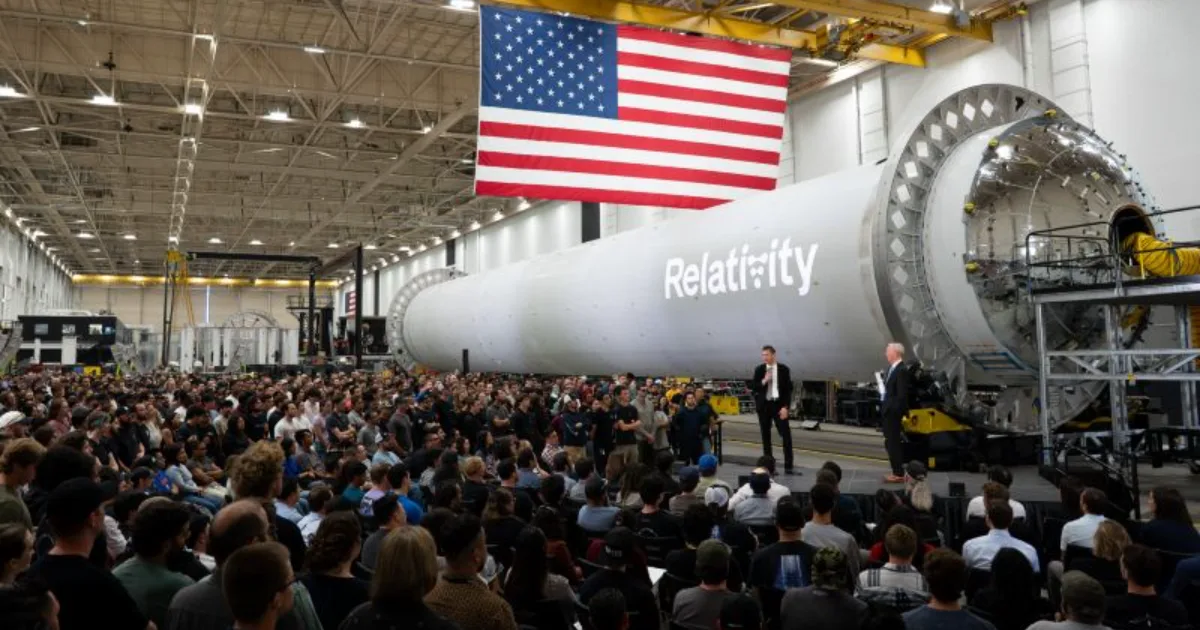
On June 17, NASA announced a partnership with Relativity Space to advance a Mars atmospheric science mission called Aeolus. Under the agreement, NASA will provide the Aeolus atmospheric-science instrument suite, while Relativity Space will develop the spacecraft, supply the rocket and manage cruise operations during the journey to Mars.
If the mission proceeds as planned, Aeolus will launch in 2028 and provide daily global observations of Martian winds, temperatures, dust and clouds.
The significance of the announcement is not simply that another Mars mission has been added to NASA’s schedule. The more important shift is operational. NASA is outsourcing much of the spacecraft development, launch and interplanetary transit process while concentrating its own resources on scientific instruments, data products and mission goals.
The model reflects a broader effort by NASA to extend commercial partnerships beyond low Earth orbit, lunar cargo deliveries and International Space Station resupply missions. The agency is now testing whether similar arrangements can accelerate Mars science, increase mission frequency and reduce risks for future human exploration.
The Biggest Challenge of Landing on Mars Is the Weather
Mars has a far thinner atmosphere than Earth. But that does not make landing easier.
A spacecraft arriving at Mars must enter the atmosphere at extremely high speed, then slow down using heat shields, parachutes and propulsion systems. During this entry, descent and landing sequence, even small changes in wind direction, atmospheric density, temperature, dust concentration or seasonal conditions can affect the landing trajectory and available safety margin.
Mars is also home to major dust storms. Some are local, while others can grow large enough to cover much of the planet. Dust can interfere with solar power generation, reduce sensor visibility, alter atmospheric density and change the thermal environment around a landing vehicle.
For robotic landers and rovers, these risks are already significant. For future crewed Mars missions, which will involve larger spacecraft, heavier cargo and human lives, the need for accurate atmospheric prediction will become even more critical.
Aeolus is designed to address that gap.
NASA’s four-instrument payload suite will measure winds and temperatures from the surface to roughly 60 kilometers above Mars. It will also observe the vertical structure of dust and water-ice clouds, surface energy balance and global atmospheric activity.
Mars missions have studied the atmosphere before. NASA’s MAVEN mission, Mars Reconnaissance Orbiter and Mars Odyssey have all contributed major insights into Martian climate, upper-atmospheric conditions and surface environments.
Aeolus, however, is intended to provide a more integrated and operational view. Rather than simply improving scientific understanding of Mars, it is designed to generate environmental data that can directly support safer entry, descent and landing planning.
NASA is not merely trying to understand Martian weather more clearly. It is trying to build the kind of environmental knowledge that could help determine when, where and how future astronauts should land.
NASA Builds the Science, Relativity Space Handles the Transport
The partnership divides responsibilities clearly.
NASA’s Ames Research Center in California’s Silicon Valley will lead the design, construction and integration of the Aeolus payload. NASA will also support science instrument operations for at least one Martian year, equivalent to about 687 Earth days.
Relativity Space, meanwhile, will manage spacecraft development and mission operations, including the launch vehicle and cruise phase required to deliver the payload to Mars.
The division of labor is straightforward: NASA will focus on what should be measured and how the data should be used scientifically. Relativity Space will focus on how the mission gets to Mars and how the spacecraft operates along the way.
This represents a meaningful departure from the traditional structure of NASA planetary missions.
Historically, major Mars exploration programs have involved complex arrangements among NASA research centers, the Jet Propulsion Laboratory, universities and aerospace contractors. NASA typically defined detailed mission requirements, maintained strong control over system integration and verification, and relied on private companies to build specific hardware to agency specifications.
Aeolus moves closer to the opposite direction.
NASA is supplying the science instruments and setting the scientific mission. The commercial partner is responsible for the spacecraft, launch and interplanetary mission infrastructure.
The model is designed to use private capital and development capacity to make Mars exploration more frequent, while allowing NASA to concentrate limited public funds on high-value science.
It also suggests that NASA is gradually moving from being an agency that directly builds every spacecraft into an institution that designs scientific missions, develops instruments and generates data through a broader exploration ecosystem.
The Goal Is Repeatable Mars Exploration
One of the most important ideas in the Aeolus partnership is mission cadence.
Mars exploration has traditionally been built around large, expensive and highly customized missions with development timelines measured in years. A single rover or orbiter could require a decade of planning, engineering, testing and launch preparation.
That approach has delivered extraordinary scientific results. But it also limits how often NASA can send new instruments to Mars.
Commercial launch vehicles and spacecraft platforms could make it possible to send targeted science payloads more frequently without rebuilding every system from scratch.
The same model could eventually be applied beyond atmospheric science. Future commercial Mars delivery systems could support communications relay payloads, terrain mapping, resource surveys, radiation monitoring, landing-site analysis and other specialized missions.
The long-term implication is significant.
Mars exploration could gradually shift away from a model dominated by a few massive missions spanning decades. It could become a more continuous operational system in which focused scientific missions are delivered repeatedly as new data needs emerge.
Mars may never become commercialized in the same way as Earth observation satellites. But NASA’s partnership with Relativity Space suggests that the agency is trying to create a more repeatable supply chain for Mars science.
Human Mars Exploration Will Depend on Data as Much as Rockets
Human missions to Mars are often discussed in terms of giant rockets, life-support systems, long-duration habitats and spacecraft capable of carrying astronauts across interplanetary space.
All of those capabilities are essential.
But reducing the risk of landing humans on Mars will also depend on how accurately the environment can be predicted.
A crewed mission will require landing much larger masses than today’s robotic missions. Cargo, habitats, power systems, food, water, return vehicles and equipment for astronauts will all need to be delivered safely.
As landing mass increases, so does uncertainty during atmospheric entry and descent.
Aeolus data on wind, temperature, dust and clouds could help reduce those uncertainties. Scientists may be able to model when dust activity intensifies, how regional winds affect landing risk and how atmospheric temperature changes influence parachutes, heat shields and vehicle guidance systems.
Aeolus is therefore not a high-profile human exploration mission in the usual sense. It is closer to a risk-management mission.
Before people can land on Mars, mission planners need to understand which conditions are dangerous, how often they occur and how those risks can be quantified.
A Major Test for Relativity Space
For Relativity Space, the partnership is more than a contract.
The company has built its identity around advanced manufacturing, including large-scale 3D printing and reusable rocket development. Delivering NASA science instruments to Mars and operating the cruise phase would push the company beyond being a launch provider.
It would test whether Relativity Space can become a deep-space transportation and mission-operations partner.
If Aeolus succeeds, Relativity Space could be viewed as a company capable of supporting missions not only in low Earth orbit, but also to the Moon and Mars.
But the project also carries risk.
Relativity Space must demonstrate launch reliability, spacecraft integration capability, operational maturity and long-term mission execution. Mars missions are not like low Earth orbit launches. A successful launch is only the beginning.
The mission must survive months of cruise, maintain communication and navigation, approach Mars correctly and keep the science payload functioning throughout the journey.
Any delays in rocket development, spacecraft integration difficulties or launch reliability problems would not only affect Relativity Space. They could also create questions about NASA’s expanding commercial-space strategy.
Commercial Partnerships Do Not Remove Risk — They Redistribute It
Public-private partnerships are often described in terms of cost reduction and faster execution. But in planetary exploration, commercial participation does not eliminate risk. It redistributes it.
When government agencies directly control every major system, they can apply extensive verification, testing and oversight. But that approach often takes longer and costs more.
When commercial companies take on more responsibility, development may become faster and more flexible. But the mission also becomes more dependent on a company’s financing, technical maturity, launch readiness and business continuity.
Mars missions make this especially complex.
A spacecraft must operate for months after launch. It must manage communications, navigation, power systems, thermal conditions and science operations far from Earth. The interfaces between the spacecraft and scientific instruments, the data transmission system, contingency planning and division of responsibility must all be carefully designed.
NASA’s use of its first six-year reimbursable Space Act Agreement for Aeolus reflects that long-term complexity. The arrangement is not just a one-time launch contract. It creates a framework spanning development, launch, cruise operations, observations and data processing.
Mars Weather Data Could Become Future Landing Infrastructure
The value of Aeolus cannot be measured only by the number of scientific papers it produces.
The mission’s atmospheric data could become part of the infrastructure needed for future Mars exploration.
On Earth, roads, ports, weather stations and navigation systems make transportation and logistics possible. On Mars, data about orbital conditions, winds, dust, temperature and atmospheric behavior may serve a similar role.
A future Mars mission will need more than a large rocket. It will need to know when to land, where to land and what environmental conditions to expect.
In that sense, Aeolus can be understood as an early infrastructure project for human Mars exploration.
It is an effort to map the Martian sky and atmosphere before humans attempt to build a more permanent presence on the surface.
NASA’s decision to pursue this mission with a private company reflects the scale of the challenge. Human Mars exploration cannot be completed by one government agency or one company alone. It will require the combination of public science capability, private manufacturing and launch capacity, long-term investment and a durable industrial ecosystem.
The Aeolus partnership is therefore not simply a contract designed to shorten the route to Mars.
It is an experiment in creating a repeatable industrial and data system for Mars exploration.
NASA’s goal is not only to learn more about Martian winds. It is to develop a new way of exploring Mars more often, obtaining data more quickly and eventually sending people more safely.
The success of human exploration may be decided long before a flag is planted on the Martian surface. It may be decided first by the quiet accumulation of environmental data, operational experience and risk-reduction systems.
Aeolus is designed to build that invisible foundation.