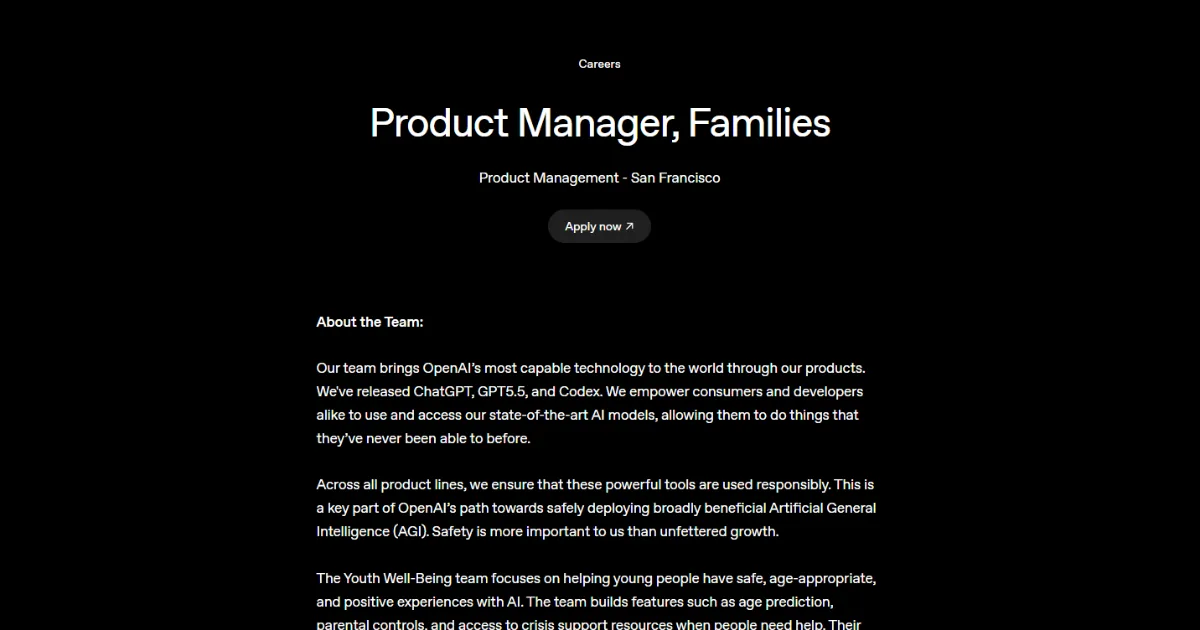
OpenAI is looking for a product manager to lead its family product efforts.
On the surface, it is a job posting.
But inside it is an important signal about where ChatGPT may be heading next.
OpenAI says the role will shape how families, caregivers and older adults benefit from AI across its products. The position is connected to the company’s Youth Well-Being team, which focuses on helping young people have safe, age-appropriate and positive experiences with AI.
The team’s work includes age prediction, parental controls and access to crisis-support resources when users need help.
That description matters.
It suggests that OpenAI no longer sees ChatGPT only as a personal productivity tool. The product is already used by students for homework, professionals for work, developers for coding and creators for brainstorming. But once AI enters the home, the meaning of the product changes.
The questions become more sensitive.
What can a child ask?
How much should a parent know?
How should a system respond to signs of emotional distress?
How can older adults use AI safely without being misled, confused or exploited?
How should trust be designed between a person, a family and an AI system?
AI is moving from being an individual tool to becoming part of household infrastructure.
Family AI Is Not Just Parental Control
Until now, family features in digital services have usually meant parental controls.
A parent can limit screen time, block certain content, approve purchases or manage app downloads. These features are familiar from smartphones, games, streaming platforms and social media.
But generative AI is more complicated.
AI is not merely a platform that displays content. It responds to questions, continues conversations, provides emotional support and offers advice about school, relationships, careers, health and personal struggles.
A teenager may tell an AI something they are not ready to tell a parent.
A child may ask questions that feel too embarrassing to ask a teacher.
An older adult may use AI to understand government services, medical information, financial tasks or simply to cope with loneliness.
That means family AI cannot be reduced to a block button.
The product must decide what kind of answer is appropriate for different ages. It must determine what parents should be able to see, what privacy a teenager should retain, how the system should respond during a crisis and how authority should be shared among family members.
This is likely why OpenAI is treating family products as a dedicated product-management domain.
Family AI is not a feature.
It is a new set of rules for how humans and AI relate to one another inside the most intimate part of daily life.
Age Prediction Becomes a Foundation of AI Safety
One of the most notable items in the job description is age prediction.
Knowing a user’s age online is difficult.
Many services rely on a birth date entered during sign-up. But young people can enter false information. Family members may share devices or accounts. A platform may not know who is actually using the service at a given moment.
For generative AI, this problem is especially important.
The same question may require different answers depending on whether the user is an adult, a teenager or a child.
Topics involving self-harm, eating disorders, sexual content, violence, drugs, money, relationships, health and personal identity all require age-sensitive handling.
If an AI system does not know the user’s age, or guesses incorrectly, it may provide advice that is inappropriate or unsafe.
Age prediction therefore becomes more than an account setting.
It becomes a safety infrastructure.
It helps the system infer who it is speaking with and apply the right standards for tone, content, escalation and risk.
But age prediction also raises privacy concerns.
If a system estimates age based on language, behavior, account signals, device usage or conversation patterns, users and families need to know how that data is collected, stored and used.
Protecting children cannot become an excuse for excessive surveillance.
That is the central difficulty of AI safety design.
Children need protection.
But they should not be treated only as subjects of monitoring.
Parents need meaningful oversight.
But teenagers also need space for private exploration, learning and growth.
Parental Controls Should Design Trust, Not Surveillance
For parents, generative AI produces both hope and anxiety.
AI can help children learn. It can explain difficult concepts, support writing practice, encourage foreign-language conversation, help with reading and provide creative prompts.
It can also create risks.
A child may become overly dependent on AI. A student may use it to complete assignments dishonestly. A teenager may accept inaccurate information as fact. A young person in emotional distress may speak only with an AI and fail to reach a human who can help.
If parents have no visibility into how AI is being used, anxiety grows.
Parental controls can help.
But poorly designed controls can damage trust between parents and children.
If parents can read every conversation, teenagers may stop treating AI as a safe place to ask difficult questions. If parents see nothing at all, they may miss serious warning signs.
The right design is therefore subtle.
A family AI product may need controls for usage time, age-appropriate feature access, sensitive-topic alerts, crisis escalation, educational boundaries, privacy protections and distinctions between learning support and academic cheating.
Good parental control is not surveillance.
It is a framework for trust.
It allows parents and children to set expectations together, understand the limits of the technology and decide when human involvement is necessary.
Crisis Support Reflects How People Already Use AI
OpenAI’s reference to crisis-support resources is also important.
Many people already use AI systems to discuss emotional struggles.
Loneliness, anxiety, depression, family conflict, school pressure, relationship problems and career uncertainty often appear in AI conversations. For teens and older adults, an AI may sometimes feel like the easiest available conversation partner.
But AI is not a therapist, doctor or emergency responder.
It can generate empathetic language, but it cannot fully diagnose a person’s condition. In cases involving self-harm risk, abuse, mental-health emergencies or immediate danger, human intervention and professional support may be necessary.
That is why crisis-resource connection is becoming a core safety feature for family AI.
When a system detects risk, it should do more than offer comforting words. It should help the user find appropriate support, whether through local crisis services, trusted adults, caregivers, medical professionals or emergency resources.
This changes how AI quality should be evaluated.
The question is not only how intelligently a model answers difficult questions.
It is also whether the system knows when not to act like an all-purpose answer machine.
The best AI in a crisis may not be the one that gives the longest response.
It may be the one that recognizes when a person needs another human being.
Why Older Adults Matter in Family AI
One striking part of OpenAI’s job posting is that it explicitly includes older adults.
This suggests that OpenAI is not thinking about family products only as child-safety features.
AI may become an important everyday tool for older users as well.
Older adults could use AI to understand digital services, schedule appointments, draft forms, navigate public services, ask everyday questions, manage reminders or communicate with family members.
AI may also help reduce isolation for people who live alone.
But safety risks are real.
Older users may place too much trust in AI-generated information. They may be more vulnerable to scams, phishing, impersonation, financial manipulation, health misinformation or privacy mistakes. Small screens, complex settings and technical language can create additional barriers.
A family AI product must therefore serve different generations in different ways.
For teens, the challenge may be age-appropriate autonomy.
For parents, it may be visibility without overreach.
For older adults, it may be accessibility, clarity, fraud protection and safe guidance around health and financial information.
That means family AI is not only a child-protection product.
It is an intergenerational product.
It must understand how risks and needs differ across the household.
AI Competition Is Moving Toward Family Trust
OpenAI’s job posting points to a broader shift in the AI market.
At first, model performance dominated the competition. Companies raced to build systems that could solve harder problems, speak more naturally, handle longer contexts and write better code.
Then tool use and agentic capabilities became central. AI systems began opening browsers, editing documents, executing code and completing multi-step tasks.
Now another competitive dimension is emerging.
Can families trust the AI?
This question will be crucial in consumer AI.
Parents may not allow children to use AI for learning unless they believe it is safe. Schools may not adopt AI unless they trust its safeguards. Families may not rely on AI for older relatives unless they believe it can reduce harm rather than create new vulnerability.
As AI moves deeper into daily life, trust becomes more than a brand value.
It becomes a market-entry requirement.
OpenAI’s search for a family product leader is therefore not merely an organizational expansion.
It signals a possible evolution of ChatGPT from a tool used alone into a product that families may configure, govern and use together.
Korea Also Needs Family-Centered AI Safety Standards
This trend has direct implications for Korea.
Korean students are already using AI for assignments, study, search and informal counseling. Parents hope AI can support learning, but they also worry that children may become dependent on it, encounter inappropriate information or lose the habit of thinking for themselves.
Schools are still deciding whether AI should be prohibited, permitted or integrated into assessment and learning design.
Yet Korea’s AI policy has not fully addressed family-level use.
The country will need standards for teen AI use, parental controls, school-home responsibility, crisis response, AI assignment transparency, age-based data protection and AI accessibility for older adults.
This is especially important in Korea because education is deeply tied to family life.
Parents are heavily involved in children’s academic development. Digital-device adoption is high. The pressure surrounding school, career and social comparison is intense.
If AI enters education and daily life, it will inevitably affect parent-child relationships.
Korea’s AI strategy must therefore move beyond models, data centers and industrial deployment.
It must ask how families can use AI safely.
AI literacy should not be limited to individual users.
Parents need to understand what AI can and cannot do.
Children need rules that protect them without eliminating their autonomy.
Schools need clear standards for learning and assessment.
Companies need age-appropriate safety systems.
And public institutions need crisis-response frameworks that connect AI use with real human support.
AI Inside the Family Requires a Higher Standard
When AI is a work tool, productivity is the main measure.
When AI is a creative tool, expression and copyright become central.
But when AI enters the family, the standard becomes higher.
Child safety, teen privacy, parental trust, older-adult accessibility, crisis response and family relationships all become part of product quality.
OpenAI’s Product Manager, Families job posting symbolizes this shift.
AI companies can no longer compete only by making smarter models.
They must design safer relationships.
An AI used inside the family enters one of the most sensitive spaces in human life.
In that space, careful judgment matters more than speed.
Trust matters more than novelty.
Safety matters more than unlimited growth.
ChatGPT’s next challenge may not be answering more questions.
It may be becoming the kind of AI that families feel safe asking.