The NextSlide team has joined OpenAI.
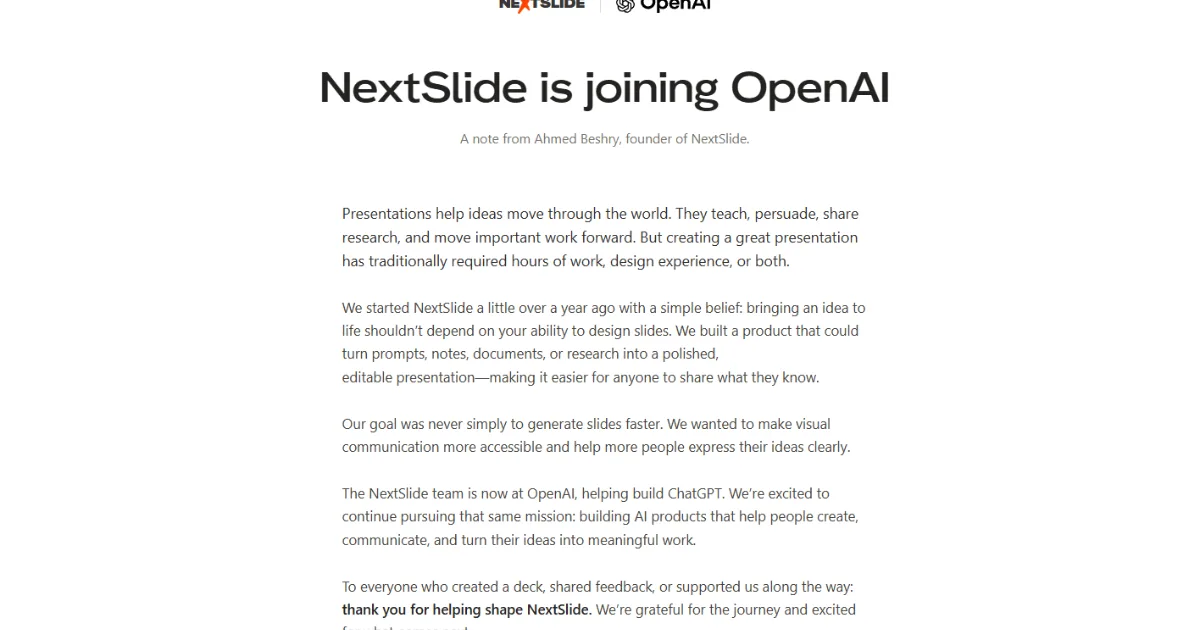
NextSlide founder Ahmed Beshry announced the move in a short post. He described presentations as tools that move ideas into the world. Presentations teach, persuade, share research and help important work move forward. But creating a good presentation has long required significant time, design experience or both.
NextSlide started from that problem.
The team believed that communicating ideas vividly should not depend on slide design skills. It built a product that could turn prompts, notes, documents and research into polished, editable presentations. Its goal was to help more people share what they know more easily.
The most important part is how NextSlide described its mission.
The goal was not simply to generate slides faster. The team wanted to make visual communication more accessible and help more people express their ideas clearly.
That sentence explains why this move matters.
OpenAI is unlikely to be interested only in automated slide generation. What it likely wants is the ability for ChatGPT to understand a user’s ideas, documents, research, meeting notes, data and plans, then turn them directly into presentation-ready outputs.
The center of AI competition is changing.
A good answer is no longer enough.
The answer must become a report.
It must become meeting material.
It must become a slide deck.
It must become something a decision-maker can understand immediately.
NextSlide’s move to OpenAI shows that transition.
Presentations Are Not Merely a Design Problem
Creating presentations is painful work for many professionals.
The material may already exist. The idea may be clear. The message may be important. But once it has to become slides, the work becomes complicated. The creator must decide the title, divide the message, arrange the flow, place charts and text, and decide how much information belongs on each slide.
A presentation is both a design task and a thinking task.
The issue is not simply making pretty slides. The creator must understand the audience, the decision that needs to be influenced, the evidence that matters and the persuasive flow that will make the argument work.
A good presentation starts with structure before design.
That is why presentations are both difficult and attractive for AI.
AI can read documents.
It can summarize notes.
It can structure research.
It can create a logical flow.
It can divide messages by slide.
It can place text and visuals.
But doing this well requires more than image generation or template filling. It requires content understanding, information selection, audience analysis, storyline design, editability and brand-style awareness.
That is why NextSlide emphasized polished, editable presentations.
What professionals need is not a beautiful static image.
They need material that can be revised, adapted to the flow of a presentation and used in a real meeting.
ChatGPT Is Moving From Conversation to Output
ChatGPT’s early strength was conversation.
Users asked questions. ChatGPT answered, summarized writing, translated text and suggested ideas. But in the workplace, the value of AI does not end with conversation. Users need outputs: reports, emails, tables, code, presentations, proposals, plans, training materials, meeting notes and execution roadmaps.
The NextSlide team’s move can be understood as part of ChatGPT’s expansion into this output layer.
Slides are especially important.
In companies and organizations, ideas do not move through sentences alone. In meeting rooms, slides are often the language of decision-making. Strategies are shared through decks. Business plans are defended through presentations. Research results spread through slides. Fundraising, sales proposals, internal reporting, education and conference talks all rely on presentations.
If ChatGPT becomes good at creating slides, that is not a minor feature.
It means ChatGPT is entering the center of work.
If a user can ask ChatGPT to research, draft, analyze data and turn the result into a presentation, ChatGPT stays longer and deeper inside the workflow. It becomes not only a tool that answers questions, but a tool that completes work.
For OpenAI, presentations are a core work output that can increase ChatGPT’s professional value.
What NextSlide Brings Is Not Only a Product, but a Product Sense
NextSlide was a young startup, founded just over a year before joining OpenAI.
Its short history does not reduce the importance of the problem it was solving. Turning prompts, notes, documents and research into slides is much harder than placing text into a template.
A good AI presentation tool needs several kinds of judgment.
First, it must extract the core message. Even if a document is long, each slide should carry one main point.
Second, it must understand information hierarchy. Titles, subtitles, evidence, numbers, examples and conclusions play different roles.
Third, it must build a presentation flow. Problem, background, analysis, solution, expected impact and execution plan must connect naturally.
Fourth, editability matters more than pure design. Work materials are never final on the first try. They go through feedback from managers, executives, clients and teams.
Fifth, the tool must understand the purpose of visual communication. A slide is not a shortened document. It is a way to make thinking visible.
The NextSlide team’s move to OpenAI suggests that this kind of product sense may enter ChatGPT’s development.
When users ask AI to make slides, they do not simply want automated decorative pages. They want the AI to clarify their thinking, reshape it into a persuasive structure and produce material that can be edited immediately.
A team that understands that distinction can be valuable.
The AI Presentation Market Is Already Competitive
The AI presentation market is already crowded.
Gamma, Tome, Canva, Microsoft PowerPoint Copilot, Google Slides with Gemini, Adobe Express and other generative media tools are all trying to turn ideas and documents into visual materials. Users can type text and receive slide drafts, generated images and automatic layouts.
But the core competition is not simply generation speed.
It is workflow understanding.
Business users do not only want an empty deck filled beautifully. They want a persuasive presentation based on their own documents, data, meeting notes, emails, research, policy materials, RFPs and customer requirements.
For that, an AI presentation tool must connect to the user’s work context.
This is where OpenAI has an advantage.
ChatGPT is already part of user workflows involving conversation, documents, research, coding, data analysis, image generation and task automation. If NextSlide-style presentation capabilities are integrated into ChatGPT, users may not need to move to a separate slide-generation tool.
This creates pressure on standalone AI presentation startups.
They can no longer compete only on generation quality. If slide generation becomes a default feature inside ChatGPT, Microsoft 365, Google Workspace or Canva, standalone tools must find stronger differentiation.
The AI presentation market is moving from feature competition to workflow competition.
OpenAI’s Goal Is Bigger Than Slide Generation
NextSlide’s post was short, but it offers a clue to OpenAI’s direction.
The NextSlide team said it is joining OpenAI to build ChatGPT. It also said it will continue pursuing the same mission: building AI products that help people create, communicate and turn ideas into meaningful work.
That statement is broader than presentation generation.
Turning ideas into meaningful work means creating outputs across the workplace. Slides are one of those outputs, but they are especially important because they structure thinking, visualize information, communicate with others and move decisions.
The ChatGPT OpenAI may want in the long term is not simply an AI that answers questions.
It may be a tool that takes a user’s ideas and turns them into documents, turns documents into slides, adjusts slides for a specific audience, visualizes data as charts, matches a design tone and even prepares a presentation script.
A user may ask:
“Turn this report into a 10-slide executive briefing.”
“Make this more persuasive for a client proposal.”
“Explain this technical concept for non-experts.”
“Turn this research into an investor pitch deck.”
“Create a presentation draft from these meeting notes.”
These tasks are not simple summaries.
They require understanding the work context, decision structure and visual form.
NextSlide’s move is one piece of that direction.
The Democratization of Slide Creation
One of NextSlide’s key themes was accessibility.
The team argued that making a good presentation should not depend on design ability. This connects to a familiar promise of AI tools: democratization. In the past, people with design experience, PowerPoint skill or visual sense could produce better materials.
Content matters most.
But in reality, form matters too.
The same idea can be more persuasive when presented in a clear and well-structured slide deck. A strong idea can lose impact if the slides are messy. In organizations, slide quality is often treated as a sign of professional competence.
AI presentation tools can reduce this gap.
People who are not designers can create structured slides.
Long writing can be divided into message-centered pages.
Research materials can be reorganized into a presentation flow.
Non-specialists can create visually persuasive materials.
For individuals, this is an opportunity.
For organizations, it creates another change. As the baseline quality of materials rises, the scarcity of simple slide design skill may decline. The more important capability will be asking better questions, identifying the right message and understanding the audience and decision context.
As AI helps with slide design, humans must bring better judgment and clearer messages.
Consulting, Proposal Work and Education Will Be Affected
Stronger AI presentation capabilities will affect consulting, proposal work, education, sales and marketing first.
In consulting and proposal work, slides are the default language. Problems, analysis, strategy, execution plans, schedules, organizations, costs and expected impact are all structured into decks. A large amount of time is spent organizing materials and refining design.
Education and lectures are similar. Instructors turn content into slides and arrange it in a sequence learners can understand. Sales and marketing teams need to present product value and customer benefits visually.
If NextSlide-style capabilities are integrated deeply into ChatGPT, draft creation in these fields could become much faster.
From documents to slides.
From meeting notes to training material.
From research to executive briefing.
From RFPs to proposal structure.
From data analysis to chart-centered presentations.
This flow could become natural.
But quality review will become more important.
AI-generated slides can look convincing. But the evidence may be wrong, the logic may be exaggerated, the context may be misread or the audience may be misunderstood. In proposals, executive reports, investor materials and policy documents, a wrong slide can lead to a wrong decision.
AI can generate drafts quickly.
Final responsibility still belongs to humans.
PowerPoint Is Not Ending. It Is Being Redefined.
AI-generated presentations do not mean the end of PowerPoint-style work.
In fact, presentations may become even more common. When the cost of creation falls, more people create more decks more often. Instead of writing a long report, they may produce a slide summary. Every meeting may come with visual materials. Client-specific proposal decks may be generated more quickly.
The method of production will change.
In the past, a person opened a blank slide and filled it page by page. In the future, users may work with AI through conversation, defining purpose, audience, length, tone and key message. AI produces a draft, and the human edits it.
Presentation creation moves from manual slide design to AI-assisted editing.
Editability becomes critical.
Slides generated like finished images have limited usefulness in real work. Organizations constantly change one phrase, one order, one chart or one color after feedback. That is why NextSlide emphasized editable presentations.
For work, an AI-generated slide deck must be more than visually impressive.
It must be structurally editable.
If OpenAI strengthens this capability, ChatGPT can become not merely a presentation generator, but an iterative presentation partner.
The Impact Could Be Larger in Korean Work Culture
Presentations are a central work language in Korean companies and public institutions.
Reports, proposals, business plans, policy briefings, investment reviews, performance updates, training, seminars, academic presentations, competitions and procurement proposals are often built around slides. In many settings, the structure and polish of slides affect evaluation, not only the content itself.
If ChatGPT strengthens slide creation and editing, the impact on Korean workplaces could be significant.
Drafting time will shrink.
The conversion from plan to presentation will become faster.
People without strong design skills will produce better baseline materials.
Recurring reports and training materials may become easier to automate.
Proposal managers and consultants may shift from slide makers to message designers.
But there are risks.
If AI-generated slides look too polished, reviewers may become less critical. Unsourced numbers, exaggerated impact claims, inaccurate market analysis or wrong citations may enter the deck. A clean design may give weak content excessive credibility.
Korean organizations sometimes give strong persuasive power to well-designed slides. If AI amplifies this effect, evidence management and logic review become even more important.
Slide capability in the AI era is not the ability to make pretty slides.
It is the ability to verify the logic and evidence in AI-generated slides and take responsibility for the final message.
The Next Competitive Edge in AI Presentation Tools
The next competitive edge in AI presentation tools can be summarized in several areas.
First, document understanding. The tool must extract key messages from long research and reports.
Second, storyline design. It must not simply summarize, but build a persuasive order for a specific audience.
Third, editability. Work slides must be revised continuously.
Fourth, data visualization. Tables and numbers must become charts with meaningful interpretation.
Fifth, brand and tone adaptation. Corporate templates, colors, language and reporting conventions must be reflected.
Sixth, source and evidence management. Users must be able to verify where slide claims and numbers came from.
Seventh, collaboration flow. Comments, feedback, versioning, exporting and integration with PowerPoint or Google Slides matter.
The NextSlide team’s move to OpenAI matters because this competition may now move deeper into ChatGPT.
ChatGPT is already a place where users organize ideas, write, analyze, generate images and produce code. If presentation creation becomes part of that same flow, users can move from idea to output in one workspace.
AI no longer only explains ideas.
It turns them into something people can see.
Turning Ideas Into Slides Is Becoming a Core AI Work Capability
NextSlide’s move to OpenAI may look like a small talent acquisition.
But its meaning is larger.
Presentations are one of the central outputs of modern work. They explain ideas, support decisions, share research and persuade people. Making good slides is not merely a design skill. It is the ability to structure thinking and communicate it visually.
NextSlide tried to solve that problem.
It built tools to turn prompts, notes, documents and research into polished, editable presentations so that more people could share knowledge more easily. Now the team is joining OpenAI to help build ChatGPT.
This shows where AI product competition is going.
AI can no longer stop at generating answers. It must turn user thinking into documents, documents into slides and slides into materials that can be used for presentation and decision-making. In work, information itself is not enough. What matters is how that information is communicated and used to persuade.
If OpenAI absorbs NextSlide’s capabilities into ChatGPT, ChatGPT can move further beyond conversational AI and deeper into workplace visual communication.
The next competition will not end with who gives the best answer.
It will be about who can turn that answer into an output people can use immediately.
NextSlide’s move is a signal of that change.
A person with an idea should not have to be a slide expert.
But one thing remains important in the AI era:
what to say;
whom to persuade;
and what evidence should move them.
AI can make the slides.
But the responsibility for persuasion still belongs to humans.