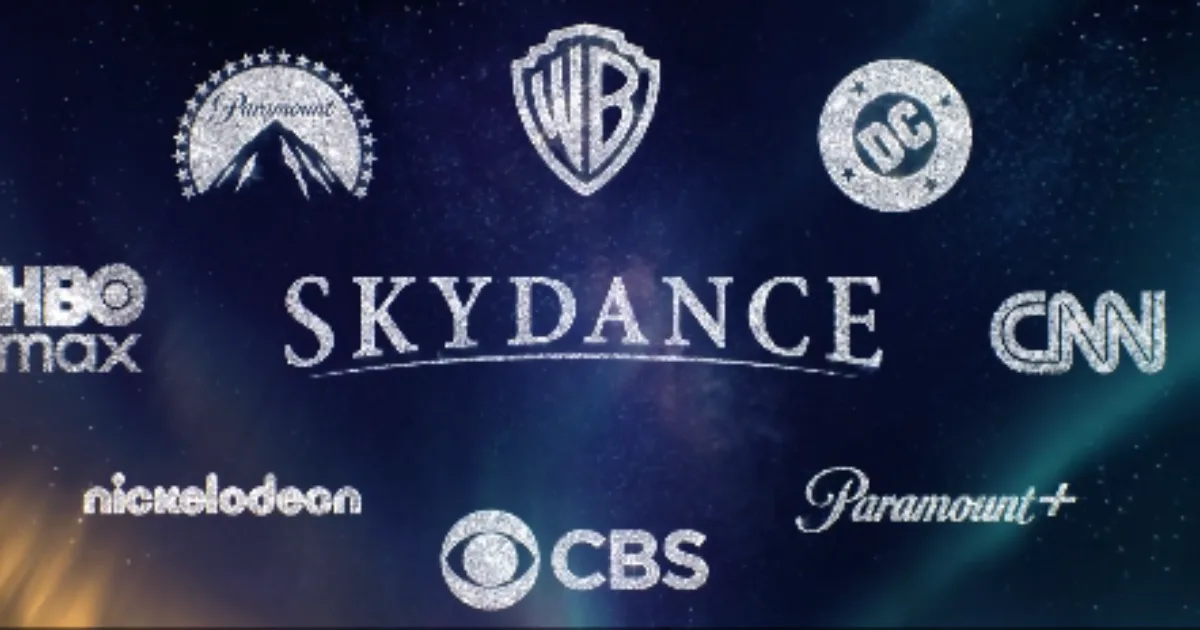
The company combining Paramount and Warner Bros. will not be called Paramount.
It will not be called Warner Bros. either.
The name David Ellison chose is Skydance.
Ellison said through X that Paramount and Warner Bros. had shaped culture for more than a century. Bringing them together, he argued, was not about rewriting history. It was about placing a more powerful engine behind these iconic studios. He described the combined company as a home for bold, high-quality storytelling with creativity at the center. Reuters reported that, after the merger closes, the combined company will be called Skydance and that the company plans to change its legal name to Skydance Corporation.
This is not simply a name change.
In the media business, a name is strategy. When brands as historically significant as Paramount and Warner Bros. are brought together, the question of which name sits at the top becomes a question of power, legacy and market signaling.
Ellison seems to understand that directly.
He said he wanted to bring Paramount and Warner Bros. together while preserving the identity, legacy and audience recognition of each studio. According to Axios, Ellison said the Skydance name gives the combined company an identity of its own while allowing Paramount and Warner Bros., along with the company’s other brands, to remain in the spotlight.
The core message is this:
Skydance is not replacing Paramount and Warner Bros.
Rather, Skydance becomes the parent identity placed above them. Paramount and Warner Bros. remain the brands that meet audiences. Skydance becomes the new corporate identity that explains the combined company.
That is a way to avoid brand conflict.
Paramount and Warner Bros. are both powerful names. If one were chosen as the representative name of the combined company, the other might appear diminished. A combined name such as “Paramount-Warner” or “Warner-Paramount” could preserve historical weight, but it would be long, complicated and less effective as a future-facing corporate identity.
Skydance, by contrast, is Ellison’s origin point.
It also signals the future orientation of the new leadership.
The choice is an attempt to balance legacy and control. Paramount and Warner Bros. remain as historic creative brands. Skydance becomes the upper-level name associated with management, capital, technology, expansion and the next phase of strategy.
One of the hardest problems in corporate integration is managing the impression of who absorbed whom.
In creative industries, that problem is especially sensitive. A studio name is not just a logo. It carries directors, actors, writers, producers, fandoms, theaters, distribution networks, archives and franchise memories.
The name Warner Bros. evokes DC, HBO, Harry Potter, classic films, television history and the cable era.
The name Paramount evokes Hollywood’s golden age, CBS, Nickelodeon, MTV, Showtime and Paramount+.
If names like these are handled poorly during integration, the cultural backlash can outweigh any cost-saving benefit.
That is why Ellison’s message is careful. He does not deny the history of Paramount and Warner Bros. He emphasizes that they have shaped culture for more than a century. He describes the purpose of the combination not as brand replacement, but as giving these studios a stronger engine.
That word, “engine,” matters.
It reflects the current crisis of the media industry.
Hollywood studios can no longer grow as easily from theatrical distribution and cable profits alone. Streaming competition increased costs. Slower subscriber growth created pressure on profitability. The theatrical business became more concentrated around blockbusters. Linear television and cable networks entered structural decline. Technology companies and platform companies took greater control over distribution.
In that environment, combining Paramount and Warner Bros. is about scale.
The pressure is to combine more intellectual property, larger production capacity, broader distribution, stronger streaming bundles, greater international reach and more advertising, data and technology capability. Paramount said in September 2026 that it had satisfied all regulatory conditions required to close its proposed acquisition of Warner Bros. Discovery, securing clearances in nearly 70 countries worldwide.
The post-merger leadership structure is also becoming clear.
Paramount announced that David Ellison will serve as chairman and CEO, while Ynon Kreiz, the CEO of Mattel, will join as co-CEO of the anticipated merged company at closing. Paramount described the move as part of building a next-generation global media company.
This makes the meaning of the Skydance name clearer.
Skydance is no longer only the name of the production company Ellison founded. It is being expanded into the name of a combined media empire. If Paramount and Warner Bros. symbolize creative legacy, Skydance symbolizes how that legacy will be modernized, managed and industrially repositioned.
Of course, the choice can be controversial.
Paramount and Warner Bros. are much older and more widely recognized than Skydance. For many viewers, Skydance may be a less familiar name. Some may ask why a company combining two giant historic studios would take the name of a smaller production company.
But that may be exactly Ellison’s point.
If he chooses Paramount, Warner Bros. looks subordinated.
If he chooses Warner Bros., Paramount looks subordinated.
If he chooses Skydance, both studios can continue to shine under their own names.
This is a brand portfolio strategy.
The parent company is Skydance.
The studio brands are Paramount and Warner Bros.
The content brands include HBO, DC, Nickelodeon, CBS, CNN, MTV, Showtime, Cartoon Network and others.
The platform brands may include Paramount+, HBO Max or future services that could be integrated or reorganized.
In this structure, the most important question is not only the name at the top. It is the role each brand plays.
The logo audiences see in theaters may still be Warner Bros.
Children’s content may still be led by Nickelodeon.
Premium drama and documentary may still center on HBO.
Sports and news may rely on CBS, CNN, TNT Sports and other brands, each with its own trust and usage context.
Skydance becomes the command system that coordinates them.
In Ellison’s framing, Skydance is not the name that covers up the two studios. It is the engine that allows them to tell more stories and reach broader audiences. That is the strategic claim behind the new name.
The keyword is engine.
Today’s media companies cannot be explained by creativity alone. Strong stories and valuable IP remain central, but the ability to distribute that content globally, monetize it across platforms, manage fandoms and connect stories to games, commerce, licensing, theme parks, advertising and data has become just as important.
A studio is now expected to be a story factory, a technology company, a platform company, a data company and an IP management company.
The Skydance name appears to place this integrated operating capability at the center.
Ellison says the combined company will be creativity-first. But the creativity he describes is supported by greater scale and capability. That matches the direction of the modern media business, where creative ambition increasingly depends on capital, technology and distribution power.
Still, a name alone cannot make integration succeed.
The combination of Paramount and Warner Bros. will come with enormous organizational challenges. Overlapping operations must be addressed. Production slates must be reviewed. Streaming strategy must be reorganized. Theatrical release strategy, the future of cable networks, the balance between news and entertainment, franchise management and relationships with creators will all be tested.
The phrase “creative-first” will have to be proven.
In Hollywood mergers, promises of creator focus, quality and long-term investment are common. But the integration process can also bring cost cuts, layoffs, project cancellations, library rationalization and brand consolidation. Whether creators trust the Skydance structure will depend less on the name and more on investment decisions and creative governance.
Ellison’s emphasis on taking smart risks is also important.
The media business has moved toward reducing risk. Established IP, sequels, reboots, franchises and globally proven genres have become safer bets. But audiences also feel fatigue. To claim bold storytelling, a company must use legacy IP while still allowing new creators, new formats and new distribution experiments.
That is Skydance’s challenge.
It must use the vast legacy of Paramount and Warner Bros. without becoming trapped by it. Major assets such as DC, Harry Potter, Mission: Impossible, Transformers and Star Trek are powerful. But to capture future audiences, the company will also need new IP and new ways of telling stories.
Streaming is another core issue.
The future of the merged media company will not be determined only by theaters and television. Streaming integration or repositioning, bundling, advertising-supported tiers, the role of sports, news and children’s programming, and global rights strategy will all matter. Warner Bros. and Paramount each have strong content libraries, but in the streaming war, technology, user experience, cost structure and content-investment efficiency are decisive.
The Skydance name does not yet answer these questions.
But Ellison’s message is clear. He does not view Paramount and Warner Bros. only as studios of the past. He sees them as cultural assets that can grow again if connected to a larger engine. Choosing the name Skydance is also a declaration of who owns that engine and where it is headed.
That is why this announcement is not simply about corporate branding.
It is about redesigning the power structure.
Paramount and Warner Bros. remain luminous brands.
But the future narrative of the combined company will be written under Skydance.
The old studio names remain.
But the operating system will be reorganized around Ellison’s leadership and the Skydance philosophy.
This sends different messages to fans, creators and investors.
To fans, it says the familiar brands are not disappearing.
To creators, it suggests the studios may gain greater capital and distribution power.
To investors, it signals that the combined company is not merely the sum of legacy assets, but a new organization under a new management system.
The market, however, will be cold.
Even the best name cannot compensate for weak content performance, streaming losses, debt pressure or strategic confusion. Recent reporting has described the transaction as an enormous merger, and Paramount’s own disclosures warn of risks related to integration, streaming, advertising markets, debt, litigation, regulatory uncertainty and the challenge of realizing expected benefits.
Ultimately, the success of the Skydance name depends on two questions.
First, can it truly respect the legacies of Paramount and Warner Bros.?
Second, can it make those legacies grow again within today’s media industry?
Ellison said the goal was not to rewrite history, but to put a more powerful engine behind these iconic studios. That sentence explains the name choice.
Skydance is not a name that says history will be erased.
It is a name that says history will be operated.
But history has weight.
Paramount and Warner Bros. are not just lists of assets. They are accumulations of films, series, characters, logos, creators and audience memories. To place Skydance above them is both a major opportunity and a major responsibility.
In the media industry, one of the hardest tasks is turning past prestige into a current business.
Skydance now stands at that test.
The century of culture built by Paramount and Warner Bros. is not the end. In Ellison’s framing, it is only the beginning.
But for that beginning to work, Skydance must do something harder than introducing a new name.
It must protect the soul of old studios while proving the engine of a new media company.