How much of the internet is now written by AI?
Pew Research Center has offered one of the clearest answers so far.
In a report published on August 20, 2026, titled “How Much of the Internet Is Written With AI?”, Pew researchers analyzed roughly 490,000 English-language webpages from the Common Crawl web archive, covering snapshots collected between January 2021 and July 2026. They used an AI detection model from Open Pangram to identify signs of AI authorship or substantial AI editing.
The result is simple, but significant.
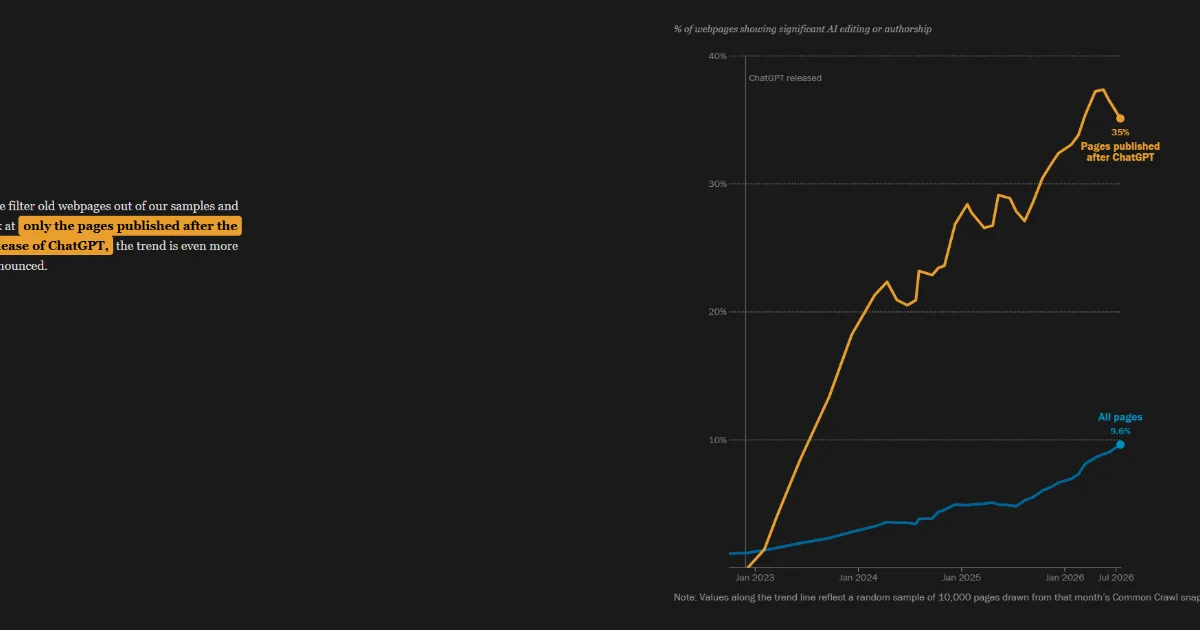
In a random sample of 10,000 English webpages from July 2026, about 10% showed signs of being written or substantially edited by AI. At first glance, that may sound like only one-tenth of the web.
But that number includes old pages.
The internet contains a vast amount of material that existed long before ChatGPT was released in November 2022: archived blogs, institutional documents, government pages, university sites, old company pages, wiki-style entries and news archives.
The more important number is different.
Among webpages published after ChatGPT’s release, more than one-third of the pages in Pew’s July 2026 sample showed signs of AI authorship or substantial AI editing.
That does not mean the entire internet has suddenly been taken over by AI.
It means something more specific and perhaps more important: a large share of the newly created web is already being shaped by AI’s writing style and production logic.
This is a major signal for the content industry.
AI is not merely a tool that writes on behalf of humans. It is changing the texture of average sentences, marketing copy, blog posts, informational pages, product descriptions and SEO content.
A growing share of the web we search and read may no longer be written in purely human language.
After ChatGPT, the Web’s Production Model Changed
OpenAI released ChatGPT in November 2022.
Pew uses that moment as a dividing line. Before ChatGPT, generative AI text tools were not part of mainstream content production. After ChatGPT, the cost and speed of producing web content changed.
The old web was labor-intensive.
Company blogs, product pages, explainers, newsletters, FAQs, customer-support documents, educational content and SEO articles required people, time and editorial effort. Generative AI changed that cost structure. With a few lines of instruction, a writer or marketer can draft an article, summarize an existing document, create search-optimized copy or generate multiple versions of a marketing message.
The marginal cost of content production dropped sharply.
As a result, more pages can be published more quickly.
The problem is that many of those pages begin to resemble one another.
AI-generated writing is often fluent, grammatically stable and readable. But it also tends to repeat certain words, structures and rhythms. Pew’s analysis gives statistical form to what many readers have already sensed: the web increasingly carries the linguistic fingerprints of AI.
This is no longer only an impression.
It is visible in large-scale web data.
The Difference Between 10% of the Web and One-Third of New Pages
The 10% figure for all English webpages in July 2026 may seem modest.
But it should be interpreted carefully.
The internet is cumulative. Pages created in the 1990s, 2000s and early 2010s remain online. Old blogs, past news stories, university pages, government documents, institutional archives and corporate materials all remain part of the web. These pages could not have been written by modern generative AI.
That means 10% across the entire English-language web sample is not a small number.
Less than four years after ChatGPT’s release, one in ten pages in Pew’s July 2026 sample showed meaningful signs of AI authorship or editing. When the analysis is limited to pages published after ChatGPT, the share rises above one-third.
This difference is the heart of the story.
The entire internet is the accumulation of the past.
The newly created internet reflects the current mode of production.
The overall ratio shows how much change has accumulated.
The ratio among new pages shows where the web is going.
If more than one-third of newly published webpages show signs of AI involvement, the overall language of the internet will inevitably change over the next several years.
The web does not change all at once.
It changes first through the pages being added today.
AI Traces Are Especially High on .com
Another striking finding in Pew’s analysis is the difference by top-level domain.
When ChatGPT first appeared, AI-like language patterns were relatively similar across major domains such as .com, .org, .edu and .gov. By 2026, however, the differences had become clearer.
In July 2026, around one in ten .com pages showed signs of AI authorship. The share was about 4.6% for .org pages and around 1% for .edu and .gov pages.
This tells us something about how different parts of the internet produce text.
The .com domain is the center of the commercial web. It includes corporate websites, product pages, marketing blogs, affiliate content, e-commerce descriptions, SaaS landing pages, advertising materials and search-optimized articles. These are exactly the areas where generative AI has a strong business incentive.
Companies can lower costs.
They can produce more copy.
They can improve search coverage.
They can fill product descriptions and blogs faster.
By contrast, .edu and .gov pages are more institutionally controlled. Universities and government agencies often have review processes, formal writing standards and higher reputational burdens. Even if they use AI, the adoption may be more cautious and slower to appear in public-facing documents.
AI content is not spreading evenly across the internet.
It is spreading first through the commercial web.
That matters because ordinary users often encounter the internet through commercial information pages, product comparisons, reviews, service explainers and marketing blogs.
AI is changing the language of commercial persuasion before it changes the language of public record.
The Fingerprints of AI Style
Pew also examined linguistic features that have become more common in AI-influenced text.
Among them are the em dash, the Oxford comma, AI-preferred vocabulary and negative parallelism.
The em dash is a long dash used to mark a break in thought or set off a phrase inside a sentence. It is common in journalism and literary nonfiction, but AI models tend to use it frequently. The Oxford comma, which appears before the final item in a list, also appears more often in AI writing.
Pew also identified vocabulary that appears frequently in AI-like text. Words and phrases such as “additionally,” “align with,” “boasts,” “bolstered,” “enhance,” “showcase,” “significant,” “valuable” and “vibrant” appeared in the study’s AI-typical vocabulary set. Other words often associated with AI style include “delve,” “interplay,” “testament,” “pivotal,” “crucial,” “landscape,” “underscore,” “highlight,” “fostering” and “intricate.”
Negative parallelism is another revealing pattern.
It is the familiar “not just X, but Y” structure.
This is not just information. It is influence.
This is not merely a tool. It is infrastructure.
This is not only a writing problem. It is a trust problem.
The form is effective. It is clear, dramatic and easy to follow. But because AI models use it so often, it has become one of the recognizable signals of AI-like prose.
Pew found that these features have increased significantly compared with the pre-ChatGPT web. Em dash use roughly doubled. Oxford comma use rose substantially. AI-preferred vocabulary increased sharply. Negative parallelism nearly tripled.
None of these features proves that a specific page was written by AI.
Humans use em dashes.
Humans use Oxford commas.
Humans write “not just X, but Y.”
But across hundreds of thousands of documents, the average pattern changes.
The internet’s style is beginning to resemble AI’s habits.
AI Detection Is Not Perfect
Pew is careful to acknowledge the limits of AI detection.
AI detection models are not perfect. They can misclassify human writing as AI-generated. They can miss AI writing that has been edited or rewritten by people. It is risky to take a single document and declare with certainty that AI wrote it.
But Pew’s analysis is not primarily about individual accusation.
It is about large-scale trends.
Judging one person’s writing is different from examining nearly 490,000 webpages for statistical language shifts. Even if individual classifications contain errors, large samples can reveal the direction of change. Pew’s use of Open Pangram is meant to detect broader patterns, not to issue final judgments on individual authors.
This distinction is important in the AI detection debate.
AI detectors are dangerous when used as the sole basis for punishment, grading or discipline.
But they can be useful as ecological instruments: tools for observing changes across platforms, content ecosystems and large corpora.
Pew’s study shows that use case.
AI detection may be less reliable as a personal verdict machine and more useful as a telescope for the internet’s changing language.
The Average Sentence on the Internet Is Changing
The most important issue is not only how much of the web AI has written.
It is how the average sentence on the internet is changing.
AI-generated writing is often smooth. It is grammatically stable, neutral and highly structured. But it also tends to repeat certain expressions: “a rapidly changing landscape,” “a pivotal moment,” “not merely X but Y,” “the key is,” “this underscores,” “a complex ecosystem.”
When such sentences accumulate across the web, readers begin to encounter the same texture again and again.
There is more information, but less distinctiveness.
The prose is polished, but experience becomes thinner.
The content appears abundant, but the substance may repeat.
Search results are full, but reliable original sources become harder to find.
This is not just a stylistic issue.
The internet is the foundation for search, learning and AI training. People use the web to find information. AI models are trained on the web. If AI-generated writing increasingly fills the web, future models may learn more and more from AI-written text.
That creates the possibility of stylistic self-replication.
AI learns from human writing.
AI generates writing.
That writing is posted online.
The next AI model trains on that web.
The cycle repeats.
If this loop grows stronger, linguistic diversity on the internet may decline while the average AI style becomes more dominant.
Mass-Produced SEO Content and Search Trust
The growth of AI-written webpages also affects search.
Much of the .com web is produced for search visibility. Companies anticipate what potential customers will search for and produce blogs, landing pages and explainers to answer those queries. Generative AI makes this process easier to scale.
The problem is quality.
AI-generated SEO content can look credible while lacking original reporting, real experience, expert validation or firsthand knowledge. If many sites generate similar articles on the same topic, search results may appear rich while offering little genuinely new information.
Users think they are searching for answers.
They may actually be reading AI-recombined text.
The source may be unclear.
The original material may be difficult to verify.
The article may lack human experience or accountable review.
Pew’s finding that AI traces are much higher in .com than in .edu or .gov supports this concern.
Commercial content can be AI-ified very quickly.
Search trust must keep pace.
Human Writing Becomes More Valuable
As AI writing becomes more common, human writing may become more valuable.
In the past, the ability to write itself was a competitive advantage. Now, almost anyone can use AI to produce a decent average text. The point of differentiation is no longer whether there is writing.
The question becomes whether the writing contains real experience, original judgment, reporting, data and responsibility.
AI can organize information.
But it cannot personally experience a workplace, conduct an interview with human nuance, understand the internal context of a company, feel the emotional weight of failure or notice what is hidden between policy statements.
As the web fills with AI-like text, readers may become more sensitive.
Did a real person experience this?
Did the writer read the source material and make a judgment?
Where did the information come from?
Can the author take responsibility for the claim?
Is there a perspective here that AI would have difficulty inventing?
Pew’s study does not show that AI will destroy writing.
It shows that the cost of average writing is approaching zero, while the value of distinctive writing may rise.
What It Means for Journalism and Publishing
The findings also matter for journalism and publishing.
As AI-generated web content increases, readers are exposed to more informational prose. But more information does not necessarily mean deeper public understanding. Journalism must move beyond summary and explanation toward verification, context, analysis of interests and accountable interpretation.
AI is good at quick organization.
It can summarize events, extract keywords, compare surface-level differences and organize documents.
But good journalism does not end there.
It explains why an event matters, who is affected, what is hidden, how it connects to past patterns and what readers should watch next.
As AI content grows, journalism’s differentiation becomes clearer:
verification over speed;
interpretation over summary;
perspective over prose;
trust over volume.
Pew’s data poses an uncomfortable question for newsrooms and content creators.
Are they producing work that is meaningfully different from the average AI-generated sentence?
The Effect on Education
The growth of AI-style writing on the internet also affects education.
Students rely on the web for research. Reports, presentations and assignments often draw from online sources. If a substantial share of search results already contains AI-written or AI-edited text, students may end up inserting AI-reconstructed information into their own work.
The problem is that source and responsibility become blurred.
An AI-written webpage becomes a student’s reference.
The student summarizes it again using AI.
The result is submitted as an assignment.
The teacher struggles to know what original knowledge the work is based on.
In this environment, banning AI use is not enough.
Source evaluation becomes more important.
Students need to judge not merely whether a text was written by AI, but whether it has evidence. Does it cite primary sources? Does it present data? Is the author or institution accountable? Are claims separated from facts? Are links to original materials available?
AI-era literacy does not end with the question “Did you use AI?”
It requires the ability to find trustworthy information in a web where AI is already mixed into the source layer.
The Social Risk of AI Detection
Pew used an AI detection model for large-scale analysis.
But the study does not justify using AI detectors as final judges in individual cases.
This point is crucial.
AI detectors produce false positives and false negatives. Human writing can look AI-like. AI writing can look human after revision. Non-native English writing, formal institutional language, academic prose and marketing copy may be misclassified.
Therefore, schools or employers should not use Pew’s findings to rush into individual accusations.
The study shows a trend across the internet. It does not determine whether a particular student, employee or writer cheated.
AI traces may be part of an inquiry.
They should not be the verdict.
As AI content grows, the desire to detect it will also grow. But if the limits of detection are ignored, honest writers may be unfairly suspected. As recent debates over AI watermarks and AI detection have shown, the problem is not only technology. It is interpretation.
Saying that a text shows AI traces does not necessarily mean AI wrote all of it.
It may mean AI substantially edited it.
It may mean the writer has adopted a style that AI also favors.
What About the Korean Web?
Pew’s study focused on English webpages.
But the Korean web is likely to face a similar transformation.
AI use is already increasing in blogs, shopping-mall product descriptions, corporate press releases, card-news copy, YouTube scripts, newsletters, personal statements, assignments and review-style content.
Several Korean-specific features may emerge.
First, Naver blogs and search-optimized content may become AI-written very quickly. Restaurant posts, travel guides, product reviews, life tips and policy explainers are easy to mass-produce with AI.
Second, Korean AI writing may develop its own recognizable habits. Repeated phrases such as “the key point is,” “this is not merely X,” “this carries significant meaning,” “it offers implications,” “in a rapidly changing environment” and “an important turning point” may become common.
Third, repackaged content without original sources may increase. If foreign reports or technical documents are translated and summarized by AI without proper verification, factual errors and missing context may spread.
Fourth, monetized blogs and advertising-style content may expand through mass AI writing, putting pressure on search quality and user trust.
Fifth, Korean AI detection tools may be less reliable than English ones because of data limitations, model differences, stylistic variation and translation effects.
For Korea, the central question should not be how to catch every AI-written sentence.
It should be how to distinguish trustworthy sources and original interpretation in an AI-saturated web.
The Responsibility of Platforms
As AI-written webpages increase, platform responsibility also grows.
Search engines decide what content appears at the top. Social networks decide what spreads. Advertising platforms personalize AI-generated copy. Content platforms must decide whether to label AI-written material and how to set monetization rules.
AI-written content itself is not the problem.
The problem is when low-quality AI content occupies search results and feeds at scale.
The problem is AI-generated reviews pretending to be personal experience.
The problem is AI-written news without reporting.
The problem is uncited AI health advice, investment advice or legal guidance spreading through search and social platforms.
Platforms will need to manage several issues more aggressively:
AI-content labeling;
stronger emphasis on sources and original links;
ranking penalties for duplicate or low-quality AI content;
stronger verification signals in expert domains;
preference for firsthand experience and source-based work;
and restrictions on monetizing mass automated content.
Search should not aim to show more sentences.
It should help users reach better answers.
As AI makes webpages easier to produce, search and recommendation systems must become more demanding.
AI Is Changing the Style of the Internet Before It Replaces the Internet
Pew Research Center’s analysis shows how the internet is changing after the rise of generative AI.
As of July 2026, about 10% of the English webpages in Pew’s random sample showed signs of AI authorship or substantial AI editing. But among pages published after ChatGPT’s release, the share rose to more than one-third. The signal was especially strong in .com domains, where AI traces were far more common than in .edu or .gov pages.
This does not mean AI has replaced the entire web overnight.
But it does mean that a significant portion of newly produced web content is already influenced by AI.
The deeper change is linguistic.
Em dashes, Oxford commas, AI-preferred vocabulary and “not just X, but Y” structures are spreading. The average sentence on the internet is changing.
AI has lowered the cost of producing content. At the same time, it is spreading similar styles and structures at scale. This affects search, education, journalism, marketing, publishing and platform trust.
The answer is not to reject all AI-written text.
The task is to learn how to read an internet where AI is already mixed into the language layer.
Who wrote this?
What evidence supports it?
Is there firsthand experience?
Was the original source checked?
Is there accountability?
AI-era content abundance creates a new problem.
The problem is not scarcity.
It is excess.
And similarity.
Pew’s analysis is therefore an important warning.
The internet has not disappeared.
But the sentences we read on it are already changing.