Coca-Cola has disclosed a ransomware incident.
The affected business is not Coca-Cola’s core soda operation, but fairlife, the dairy company owned by Coca-Cola. According to the company, fairlife identified unauthorized access by a third party to a portion of its systems, including production-related systems, in connection with a ransomware event. Coca-Cola said it activated incident response and business continuity protocols, brought in external advisers and cybersecurity experts, and notified law enforcement.
The company made one point clear.
Product quality and safety have not been impacted.
But the more important sentence came immediately after that.
As a result of the incident, fairlife’s production operations in the United States were temporarily suspended. Its Canadian production operations were not currently affected. Coca-Cola said it was working to restore affected systems and operations, while the full scope, nature and impact of the incident remained under investigation.
The disclosure is brief.
But its meaning is not small.
Ransomware is no longer just an IT incident in which files are encrypted and criminals demand payment. Once it touches production systems, ransomware becomes an operational risk that can stop physical manufacturing.
In food and beverage, the impact is especially sensitive.
A production disruption can lead to supply shortages. Supply shortages can affect retailers, distributors, consumer experience, brand trust and revenue flow.
The core of this incident is not simply that a Coca-Cola subsidiary suffered a cyberattack.
It is that a cyberattack can stop the real-world production of food and beverages.
Product Safety Was Protected, but Production Stopped
Coca-Cola clearly stated that product quality and safety were not affected.
For a food and beverage company, that sentence matters enormously. Consumers first want to know whether the product is safe, whether there is any risk of contamination and whether products already in circulation are affected.
Coca-Cola moved quickly to address that concern.
But product safety being unaffected does not mean operations were unaffected.
The company also said fairlife’s U.S. production operations were temporarily suspended. That means the cyber incident affected physical manufacturing activity. The fact that production-related systems were involved makes the issue more serious than a routine corporate IT disruption.
Modern manufacturing cannot function without digital systems.
Raw-material planning, production scheduling, batch management, quality records, equipment controls, logistics, inventory management, order processing and supplier coordination are all connected to software systems.
If ransomware reaches production-related systems, a company may need to stop operations until it can confirm that systems are safe, records are intact and manufacturing can resume without risk.
Food and beverage companies must be especially conservative.
Even if products themselves are not contaminated, production cannot continue normally if quality records, batch data or process controls cannot be trusted. A company must know what was produced, when it was produced, which materials were used, which equipment was involved and whether quality checks were properly completed.
That is why the fairlife incident is so revealing.
Product safety was not affected.
But production still stopped.
That distinction shows that cybersecurity and quality control can no longer be separated in food manufacturing.
fairlife Is Not a Peripheral Coca-Cola Business
fairlife is not just a minor subsidiary in Coca-Cola’s portfolio.
It is a strategically important brand.
Coca-Cola has long been identified with carbonated soft drinks, but the company has expanded across categories as consumer preferences have shifted toward protein, nutrition, hydration and functional beverages. fairlife is one of the company’s major plays in high-protein and value-added dairy.
AP reported that fairlife now has more than $3 billion in annual retail sales and produces lactose-free dairy products, including milk and protein shakes.
That makes the incident more significant.
fairlife is not merely a side business.
It represents part of Coca-Cola’s effort to participate in health, nutrition, protein and premium dairy trends.
A ransomware incident that pauses production at a growth brand shows how cyber risk has moved beyond headquarters, data centers and customer-information systems.
Growth brands, manufacturing subsidiaries, production plants and operational technology systems are all part of the attack surface.
The issue becomes even more complex when large companies expand through acquisitions or operate subsidiaries with separate technology environments. Different business units may have different systems, different security maturity and different levels of integration with the parent company.
As corporate portfolios expand, cyberattack surfaces expand with them.
Even a company with Coca-Cola’s global brand power can face a public disclosure because a subsidiary’s production systems were affected.
The fairlife incident is therefore also a case study in portfolio cybersecurity.
Ransomware Has Moved From Data to Operations
Early ransomware was mainly about encrypting data.
Attackers locked files and demanded payment for decryption keys. Later, ransomware evolved into double extortion. Criminals not only encrypted systems but also stole data and threatened to publish it. Personal information, trade secrets, contracts and emails became leverage.
Now a more powerful form of leverage is emerging.
Operational disruption.
If attackers gain access to production-related systems, the victim may need to stop operations even if the attackers do not physically destroy equipment. In sectors such as food, pharmaceuticals, energy and manufacturing, companies cannot continue operating if they cannot trust system integrity.
That makes ransomware more dangerous.
A data leak can be handled over time.
A production halt affects revenue and supply immediately.
Delivery schedules can be disrupted.
Retail partners can be affected.
Inventory planning becomes harder.
If recovery takes longer than expected, market share and brand trust may also be damaged.
Attackers understand this.
In ransomware negotiations, the strongest pressure may no longer be “we will publish your data.”
It may be “you cannot keep running your business.”
For consumer-products and manufacturing companies, production disruption creates both economic and reputational pressure.
The fairlife incident shows this shift clearly.
Food and Beverage Cyber Risk Is Especially Sensitive
Food and beverage companies are different from many software businesses.
A temporary outage in a digital service is serious. But a disruption at a factory that makes products people eat and drink carries a different kind of risk.
Product safety, quality assurance, expiration dates, cold-chain logistics, raw-material management, regulatory compliance and potential recalls are all involved.
When ransomware affects food manufacturing systems, a company must answer several questions at once.
Which systems did the attacker access?
Were production records altered or damaged?
Are quality-control records intact?
Are products already manufactured safe?
Are products in distribution affected?
Are inventory and shelf-life systems reliable?
What must be verified before the plant can restart?
Coca-Cola’s statement that product quality and safety were not affected was necessary to reduce consumer concern. But production restart is a separate question. Restoring systems is not the same as deciding that production can safely resume.
In food and beverage, cyber incident response cannot end with IT recovery.
Quality assurance, manufacturing, supply chain, legal, communications and regulatory teams must all move together.
Ransomware has become an operational risk that can intersect with food-safety governance.
What the 8-K Tells Us
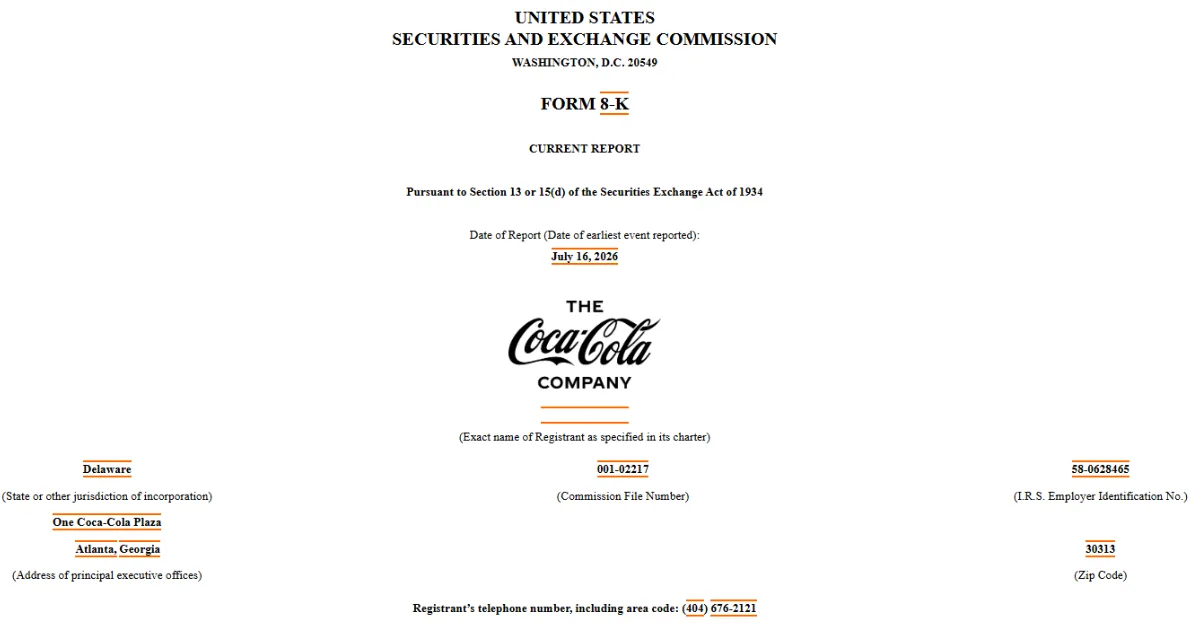
Coca-Cola’s decision to disclose the event in a Form 8-K is also significant.
A Form 8-K is a current report used by U.S.-listed companies to notify investors of important events. Coca-Cola said it had not yet determined the full nature, scope or impact of the incident and could not determine whether the incident was reasonably likely to materially impact the company.
That language is careful.
The company did not state that the incident would have a material financial impact. But because U.S. production operations at fairlife were temporarily suspended, the company judged the event important enough to disclose.
This shows the difficulty of cyber incident disclosure.
In the early stage of an incident, companies rarely know everything. The scope of access, possible data theft, production downtime, financial impact, recovery costs, insurance treatment and legal exposure may all remain uncertain.
But investors need timely information about important risks.
That forces companies to disclose under uncertainty.
Say too little, and the company may be accused of hiding risk.
Say too much, and it may overstate facts before the investigation is complete.
Product safety, production disruption and financial materiality must be separated carefully.
Coca-Cola’s disclosure reflects that balancing act.
It stated that product quality and safety were not affected, but also acknowledged U.S. production suspension and ongoing assessment.
That is the new reality of cyber disclosure.
Brand Trust Recovers More Slowly Than Systems
In ransomware incidents, companies often focus first on technical recovery.
They isolate affected systems, restore from backups, bring in forensic specialists and close security gaps.
But for consumer brands, the harder problem can be trust.
fairlife is a dairy brand. Consumers drink and eat its products. Even when a company says product safety is unaffected, words such as cyberattack, ransomware and production-related systems can create anxiety.
Food and beverage brands depend on trust.
Consumers do not see the production process. They trust the company to make safe products and maintain reliable systems. When ransomware affects production-related systems, some consumers may begin to connect cybersecurity with product confidence.
That means Coca-Cola and fairlife must manage more than technology.
They must explain product safety clearly to consumers.
They must manage supply disruption with retailers and distributors.
They must update investors on possible operational and financial effects.
They must communicate with employees and production sites.
They must demonstrate that quality checks and restart procedures are trustworthy.
Brand trust can be harder to restore than servers.
How Prepared Is the Supply Chain?
The incident also matters from a supply-chain perspective.
If fairlife’s U.S. production is paused, the impact does not stop inside the company. It can affect distributors, logistics providers, raw-material suppliers, retailers and consumers.
If disruption lasts, inventory allocation, delivery schedules, promotions and shelf availability may all be affected.
Food and beverage supply chains are time-sensitive.
Dairy products depend on shelf life and cold-chain logistics. If production stops, the company cannot simply make up all volume later without consequence. Raw materials, plant capacity, packaging, transport slots and retail supply plans must all align.
Ransomware disrupts that rhythm.
Supply-chain risk management has traditionally focused on natural disasters, pandemics, port delays, raw-material prices and geopolitical risk.
Cyberattacks must now be treated as a major cause of supply-chain disruption.
Large companies must assess cyber resilience across subsidiaries, suppliers, production sites and logistics systems. Strengthening headquarters IT is not enough. The operational network where products are made and moved must also be secure.
Korean Companies Should Pay Attention
The fairlife incident carries a warning for Korean companies.
Korean food and beverage, manufacturing, biotech, chemical, automotive and battery companies face the same risk.
Smart factories, automation equipment, manufacturing execution systems, warehouse systems, quality data and supplier portals are increasingly connected. Efficiency has improved, but the attack surface has expanded.
If ransomware enters a production network, the result may not be limited to encrypted office documents.
It can become a factory stoppage.
Korean companies are especially sensitive to production disruption.
Delivery commitments, product quality, customer response, export schedules and channel trust all matter. For large companies, a cyber incident at a single plant or subsidiary can affect the broader group brand and even share price.
That means cybersecurity cannot remain only the responsibility of the information-security department.
Plant managers must be involved.
Quality-assurance teams must be involved.
Supply-chain teams must be involved.
Finance must be involved.
Legal and communications teams must be part of the response structure.
Ransomware exercises must also change.
Companies should not only practice restoring encrypted PCs from backup. They must practice what happens when production-related systems are affected.
When should a line be stopped?
What must be verified before restart?
Which production records must be checked?
What should be disclosed to customers, regulators and investors?
Who approves restart?
These are no longer theoretical questions.
Cybersecurity Is Now an Operating-Continuity Problem
The Coca-Cola disclosure changes the language of cybersecurity.
Cybersecurity has often been described in technical terms: confidentiality, integrity and availability.
From a management perspective, the key term is now operating continuity.
Can the business keep running?
Can the factory operate?
Can products be made safely?
Can customers be supplied?
Can brand trust be protected?
Can investors be informed?
Ransomware touches all of these questions.
Coca-Cola said product safety was not affected, but fairlife’s U.S. production operations were temporarily suspended. That difference matters.
In a cyber incident, the question should no longer be only whether data was stolen.
The question is whether the business stopped.
As AI, cloud systems and automation spread, corporate operations become more digital. Manufacturing sites are no exception. That means cyber incidents increasingly have physical and direct consequences.
Ransomware is not only a screen problem.
It can close the factory door.
The Standard for Ransomware Response Is Production Continuity
Coca-Cola’s fairlife disclosure is short, but it sends a powerful signal.
A ransomware attack is no longer only an IT systems event. It can affect production-related systems at a food and beverage subsidiary and force U.S. production operations to pause.
The company says product quality and safety were not affected. But the production disruption itself makes the incident an important operational risk.
Companies must change how they measure ransomware response.
The question is not only how quickly files were restored.
The question is whether production can continue safely.
The question is what criteria determine when a production line stops and when it can restart.
The question is how the integrity of quality data and manufacturing records is verified.
The question is what must be disclosed to investors, customers and regulators, and when.
Cybersecurity is no longer only a server-room issue.
It is a factory-floor issue.
A supply-chain issue.
A brand-trust issue.
A boardroom issue.
Coca-Cola’s disclosure shows that change clearly.
Ransomware does not stop at locking data.
It now stops production.