Roblox has introduced a new AI creation platform called Build.
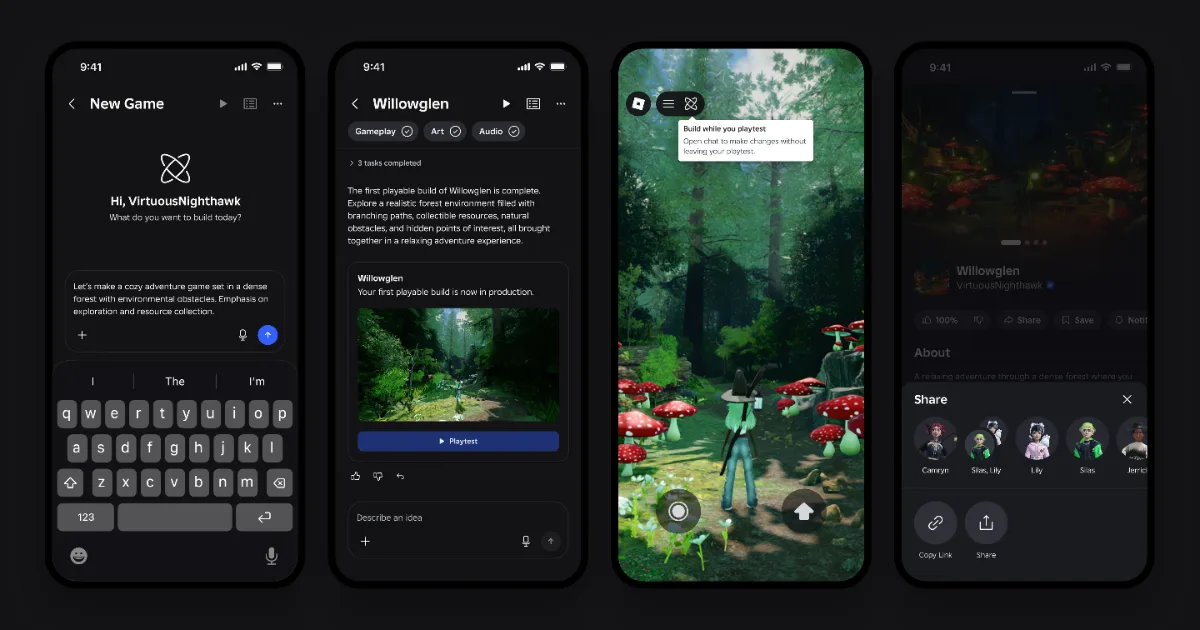
Build is a mobile-first creation feature inside the Roblox app. It can turn a text prompt into the starting point of a basic playable game. A user may describe an idea — for example, an adventure game set in a dense forest with environmental obstacles — and Build generates a playable foundation. The user can then revise it, test it, share it with friends or publish it to Roblox.
On the surface, this looks like an AI game-making tool.
But that is not the real meaning of the announcement.
Roblox is not merely adding another creation feature. It is trying to revive an old promise — the democratization of game development — in the age of AI and mobile computing. More precisely, Roblox wants to convert its massive user base from players into potential creators.
That is the core of Build.
For Roblox, the most important asset is not any single game. It is the cycle in which creators constantly make new experiences, players discover and play them, and some of those players become creators themselves.
Build expands the front end of that cycle.
Until now, a user who wanted to create on Roblox generally had to learn Roblox Studio. That meant a PC environment, creation tools, scripts, 3D objects and some understanding of game mechanics. Build lowers that barrier. It begins on mobile, accepts natural-language prompts and lets AI generate the basic structure.
Build is therefore not just a game-making tool.
It is strategic infrastructure for expanding Roblox’s creator supply chain.
Roblox’s Real Bottleneck Is Not Users. It Is Creators.
Roblox already has a massive user base.
The problem is not a shortage of players. The long-term challenge is giving those players reasons to stay. Those reasons come from new games, new experiences, new social interactions and new ways to play.
Roblox does not create all of that content itself.
Its creators do.
That is Roblox’s strength.
It is also its bottleneck.
More people must be able to create more easily.
They should not need to be professional developers. They should not need to know how to code. They should not need to understand 3D modeling before they can test an idea. Anyone with an idea should be able to try it quickly.
Build targets that bottleneck.
Roblox’s slogan has long been that anyone can create. But historically, that meant anyone could learn to create.
After Build, the meaning changes.
Now it means anyone can begin by describing.
That is a major shift.
Game creation is complex. It requires worlds, rules, maps, characters, objects, sound, interactions, reward systems, testing and balancing. Build does not eliminate all of that work. But it automates or drafts enough of it to help the user move past the blank page.
For platforms, the hardest moment is the first creation experience.
If that first experience feels too difficult, users quit. If AI produces a starting point, users can begin by editing, testing and improving. The psychological barrier falls.
Build’s real value is not that it creates finished games.
It is that it keeps first-time creators from giving up.
Mobile-First Is the Strategic Point
The mobile-first nature of Build is not just a user-interface decision.
Roblox’s audience already experiences the platform heavily through mobile devices. If the device for playing and the device for creating are separate, the conversion from player to creator becomes harder.
Build closes that gap.
A player has an idea while playing.
A friend suggests a new scene.
The user opens the Roblox app.
They type a prompt.
AI creates a basic game.
They share it with friends.
They receive feedback.
They revise it.
If needed, they continue in Studio.
That flow matters deeply to Roblox.
A PC-based professional creation tool can raise quality, but it does not maximize participation. Mobile maximizes access. For younger users and first-time creators, the phone is the most familiar environment.
Roblox says Build and Studio are connected through shared backend systems, models and chat history, so a project started in Build can continue in Studio. AI agents running in Studio can also be monitored from mobile.
This creates a stepped creator pathway.
Mobile Build is the entry point.
Studio is the advanced environment.
AI agents provide automation.
The recommendation system validates quality.
The platform provides distribution and monetization.
Roblox is redesigning the creator journey.
The Fear: AI Will Flood Roblox With Low-Quality Games
The first concern about a tool like Build is obvious.
Will AI-generated low-quality games flood Roblox?
Roblox appears to understand that concern. In its announcement, the company emphasized that quality standards for experiences surfaced on the home page will not change. Its discovery system is designed to highlight experiences with long-term retention, and games that no one plays will not be easily discovered.
That distinction is important.
Build lowers the barrier to creation.
It does not necessarily lower the barrier to distribution.
Roblox is effectively saying: anyone can build, but not everything will be discovered.
This is the core logic of platform economics.
Creation is opened.
Visibility is algorithmically controlled.
That becomes even more important in the age of AI creation. As generation tools improve, content supply explodes. But user attention remains finite. The real power of the platform shifts from creation tools to discovery systems.
Roblox’s strategy is to expand the creative supply with Build while using recommendation and retention signals to filter quality.
But this strategy also carries risk.
If AI-made games multiply, beginners may find it easier to start, but harder to stand out. The platform may say that anyone can build, while actual success concentrates among the few experiences that pass through the recommendation system.
Creation democratization does not automatically mean revenue democratization.
Build’s success will depend on two questions.
How many people will it help create?
And how many meaningful creators will survive inside the ecosystem?
Roblox Wants to Own the First Draft of Game Development
The core of AI creation is not the finished product.
It is the first draft.
Creating a complete game from a prompt is still difficult. Games are more complex than images or text. They require player input, physics, rules, rewards, multiplayer behavior, stability and safety.
But creating a draft is different.
AI can help generate a basic map, place characters, add obstacles, define simple goals, attach visual styles and provide a starting structure. The creator then edits, tests and adds the real fun.
Build is trying to own this first-draft layer.
The blank screen is one of the biggest barriers in game development. When a beginner starts from nothing, the task feels overwhelming. If AI produces a skeleton, the creator becomes a director and critic. They do not need to build everything manually from the beginning. They can judge, refine and redirect.
That changes the creator’s role.
From maker to director.
From modeler to editor.
From coder to experience designer.
Professional developers do not disappear in this model. In fact, advanced creators may benefit even more. They can test ideas faster, validate mechanics sooner, design deeper systems and optimize monetization and live operations more effectively.
Build is both a beginner tool and a productivity tool for serious creators.
Studio AI Agents Target Professional Creators
Roblox is not only introducing Build.
It is also expanding AI tools across Studio for more experienced creators. The company has described AI agents for playtesting, analytics and experimentation.
This may be even more important commercially than Build itself.
A playtesting agent can find bugs before a game reaches players. That reduces quality-control costs. User-generated games often face issues with bugs and polish. If AI can assist pre-release testing, creators can ship faster while improving reliability.
An analytics agent can let creators ask natural-language questions about their games. Instead of digging through dashboards, a creator may ask why retention dropped, where players are leaving or which items are contributing to revenue.
An experimentation agent can identify tests that may improve engagement, retention and monetization. That moves Roblox creators closer to live-service operators.
These agents have one thing in common.
They automate the work after creation.
Successful Roblox games are not built once and left alone. They are updated, measured, debugged, tuned, monetized and operated continuously.
If Build lowers the barrier to creation, Studio’s AI agents lower the barrier to operation.
Roblox is trying to wrap the entire creation lifecycle in AI.
Idea generation.
First draft creation.
3D asset generation.
Scene generation.
Playtesting.
Analytics.
Experimentation.
Publishing.
Discovery.
Monetization.
That is the bigger picture behind Build.
The Meaning of Cube, Roblox’s 3D Foundation Model
Roblox has also been building its own 3D foundation model, Cube.
Cube is designed to turn prompts into 3D objects that can be used inside games. Roblox has described its 4D generation work as going beyond static shapes to produce functional objects that behave as players expect. For example, a prompted car should be drivable, not merely a decorative model.
This is one of Roblox’s strongest differentiators.
General image generation and game-ready 3D generation are not the same.
A game object cannot only look good. It must move, collide, respond to input and work inside the engine. A car must drive. A weapon must fire. An obstacle must interact with the player.
That is why Roblox’s approach matters.
AI-generated 3D assets must be easy to integrate into working games using Roblox’s existing creation tools. They are not just outputs. They are functional assets connected to a game engine.
In AI game creation, visual quality is not enough.
The object must work.
Roblox can use its huge base of 3D models, game experiences, creator behavior and play patterns to build this capability. That is difficult for general-purpose AI model companies to replicate.
Roblox’s AI advantage therefore does not come only from model size.
It comes from platform-specific game creation data.
Roblox Is Using AI to Address the Developer Shortage
Game creation has always faced a talent bottleneck.
Many people have ideas. Far fewer can build a game. Programming, art, sound, level design, user interface, quality assurance and live operations all require skill. Small creators rarely have all of those capabilities.
AI reduces that bottleneck.
Build helps beginners create a basic game. Cube and procedural models help with 3D asset generation. Scene generation can accelerate map creation. Playtesting and analytics agents can reduce operational burden.
That can raise the productivity of the Roblox ecosystem.
In the past, one creator needed a lot of time to produce one experience. If AI reduces repetitive work, the same creator can test more ideas in the same amount of time. The cost of failure also falls. A creator can quickly learn whether an idea is fun and then invest more if it works.
Game development is experimentation.
Creators must test which mechanics are fun, which map structures retain players and which rewards drive engagement.
AI lowers the cost of experimentation.
Roblox wants to become the environment where that experimentation happens at scale.
Creation Democratization Also Deepens Platform Dependence
Build makes creation easier.
But the easier creation becomes, the deeper creators may become tied to Roblox.
A user creates ideas inside the Roblox app. Roblox AI models generate assets and scenes. Roblox Studio improves the experience. Roblox’s recommendation system determines discovery. Roblox’s economy handles monetization.
The entire process happens inside Roblox.
That is convenient for creators.
It also increases platform dependence.
Creation tools, asset formats, distribution channels, recommendation algorithms, monetization rules, safety reviews and age policies all remain under Roblox’s control.
For Roblox’s business model, this is powerful.
More creators produce more content. More content keeps more users engaged. More engagement expands economic activity. AI tools accelerate the loop.
But from the creator’s perspective, questions remain.
Who owns AI-generated assets?
What is free, and what may eventually become paid?
How will the recommendation system evaluate AI-generated games?
Who is responsible for quality and safety issues in AI-generated assets?
How will revenue be split when Build-made games monetize?
Will creators using AI tools gain an advantage over those who do not?
Creation democratization is always double-sided.
More people can create.
But they may succeed only inside the platform’s rules.
Children and Safety Are the Central Variables
Roblox says Build’s alpha test will begin in New Zealand on July 28. During the alpha period, Build will be available only to age-verified users 9 and older. Experiences created with Build must pass strict safety checks, and published Build experiences will be available globally only to age-verified users 16 and older. Experiences must undergo additional review before being added to Roblox Kids or the Select catalog.
This is crucial.
Roblox has many young users. If AI makes it easy for anyone to create games, safety becomes more complex.
The platform must manage inappropriate content, violent elements, scam-like experiences, low-quality games, personal-information risks and harmful interactions.
AI increases the speed of creation.
That increases the burden of review.
Roblox emphasizes safety systems, but if Build scales, moderation systems will face more pressure. If mobile-made games can be created and shared quickly, both pre-publication and post-publication review must be fast and accurate.
The success of an AI creation platform is not determined only by generation capability.
It is also determined by filtering capability.
For Roblox, this is especially sensitive. An AI creation tool on a platform used by children is both a growth engine and a regulatory risk.
The Game Market May See an Explosion of Micro-Experiments
If Build succeeds, the game market may see a new phenomenon.
Micro-game experiments may explode.
Traditional game development takes time. Even inside Roblox, a polished experience requires planning and production. But if Build supports basic game generation and fast iteration, creators can test many more ideas.
A small concept.
A short play loop.
A test with friends.
A retention signal.
An improved version in Studio.
That cycle can accelerate.
This could change how hit games emerge inside Roblox. A small idea started on mobile could be tested quickly, refined by data and expanded into a larger experience.
But it can also create a content flood.
If many draft-level games appear, users may encounter more low-quality experiences. Roblox says retention-based discovery can filter the best games, but early discovery may become noisier.
The next competitive advantage for game platforms will come from the combination of creation tools and recommendation systems.
Let many things be made.
Surface the good ones quickly.
Game Development Education Will Change
Build may also affect education.
Roblox is already used by many children and teenagers as an entry point into game creation. It can teach coding, 3D modeling, game design, virtual economies and collaborative production.
AI Build changes how that learning begins.
Instead of starting with code, students may begin by expressing an idea in a prompt, evaluating what AI creates, revising it and improving the result. They may focus first on the experience they want to create rather than the technical steps required to build it.
That can strengthen creativity.
But it can also weaken foundational skills.
If AI produces the draft, users may modify results without understanding how the structure works. They may not learn why a game functions, how scripts connect, how physics works or how interactions are implemented.
Education must therefore balance AI-assisted creation with structural learning.
AI is useful for lowering the entry barrier.
But deeper creators still need to understand the system.
Roblox’s connection between Build and Studio matters here. Mobile Build can help beginners start, while Studio can provide a deeper creation environment for those who want to grow.
Roblox’s AI Strategy Redefines the Metaverse
Roblox has long been described as a metaverse company.
But the word “metaverse” has gone through cycles of hype and disappointment. The vision of virtual worlds, avatars, 3D spaces and digital economies was large, but mainstream use cases were harder to build.
Build shows a different version of the metaverse strategy.
The core of the metaverse is not one giant 3D world.
It is a network of user-created worlds where people play, socialize and transact.
In that model, the most important variable is the cost of making worlds.
Build lowers that cost.
The more people can create, the larger Roblox’s metaverse becomes. If AI accelerates world creation, Roblox becomes a platform containing more experiences, not merely a destination for a few blockbuster games.
This is a more practical version of the metaverse.
It is not hardware-first or virtual-reality-first.
It is a network of AI-assisted user-generated 3D experiences.
From that perspective, Build is not a minor product update.
It may be one of Roblox’s most important moves to remain a metaverse company in a post-metaverse-hype era.
Lessons for the Korean Game Industry
The Korean game industry has long been strong in polished commercial games.
MMORPGs, mobile RPGs, collection-based games, esports and live-service operations have been core strengths. But Roblox-style user-generated ecosystems and AI-assisted creation platforms point to a different competitive direction.
Part of the game industry may move from finished games made entirely by studios to platform-based games that users create, modify and share.
AI accelerates that shift.
Korean game companies should ask several questions.
What can users create inside our game?
How can AI help players create?
Can creation tools work on mobile?
How should user-created content be reviewed and recommended?
How can creators earn revenue?
How should child safety and creative freedom be balanced?
For companies working on metaverse, UGC, sandbox or educational games, Build is an important reference case.
The future of games may not be only studios making all content for players.
Platforms may increasingly provide creation tools, AI models, recommendation systems, safety review and monetization infrastructure.
Roblox is pushing that model aggressively.
Build Moves the Starting Point of Game Creation to Mobile
Roblox’s Build announcement marks an important shift in AI game creation.
Build turns prompts inside the mobile app into basic games. Cube and procedural models generate functional 3D assets. Future scene-generation models may create entire editable and playable 3D environments. Studio AI agents will help with playtesting, analytics and experimentation.
Together, the direction is clear.
Roblox is trying to accelerate the entire game-creation lifecycle with AI.
Beginners start on mobile.
Advanced creators move into Studio.
AI generates assets and scenes.
Agents support testing and analytics.
The recommendation system surfaces experiences with retention.
The platform handles distribution and monetization.
If this structure succeeds, Roblox becomes more than a game platform.
It becomes an AI-powered game creation operating system.
The risks are real.
AI may generate low-quality content at scale. Dependence on recommendation algorithms may deepen. Child safety and moderation may become harder. Creation democratization may strengthen platform lock-in.
Still, the meaning of Build is clear.
The starting point of game creation is changing.
It is moving from a professional tool on a PC to a prompt inside a mobile app.
Creators no longer need to begin from a blank screen.
They begin with an AI-generated draft, then revise, share and test.
Roblox is returning to its original promise:
You make the game.
But in 2026, that sentence means something different.
You describe the idea.
AI builds the first scene.