SK Hynix is raising roughly 40 trillion won through the U.S. capital market.
This is not merely an overseas listing event.
It is a strategic declaration by one of the world’s most important AI memory suppliers. At a time when demand for high-bandwidth memory and advanced AI infrastructure is surging, SK Hynix is turning to global capital markets to secure the financial firepower needed for the next phase of semiconductor competition.
The company priced its American depositary receipts, or ADRs, at $149 each. The offering consists of 177.9 million ADRs, with 10 ADRs representing one SK Hynix common share. On that basis, the offering corresponds to 17.79 million new common shares. The deal is expected to raise about $26.5 billion, or approximately 40 trillion won.
The scale is extraordinary.
But the more important question is not how much money SK Hynix is raising.
It is what the company plans to do with it.
The proceeds are intended for facility investment, including the first fab at the Yongin semiconductor cluster, the Cheongju P&T7 advanced packaging facility and the acquisition of extreme ultraviolet, or EUV, lithography equipment.
That makes the offering more than a financing exercise.
It shows that the AI semiconductor battle is expanding beyond the memory chip itself. The new competition is about production capacity, advanced packaging, equipment access and the ability to mobilize capital at global scale.
Why a U.S. ADR Offering Now?
SK Hynix’s capital raise is not a conventional domestic rights offering.
The company is not directly selling new shares to Korean retail investors. Instead, new common shares are being issued as the underlying securities for ADRs. Those shares are deposited with a custodian and used as the basis for depositary receipts sold to global investors in the United States.
In practical terms, SK Hynix is using the U.S. market to broaden its investor base, deepen liquidity and connect itself more directly with the global AI investment cycle.
That timing is important.
HBM, high-performance DRAM, advanced packaging and next-generation process equipment all require enormous upfront investment. In semiconductors, waiting until demand is fully visible can mean arriving too late.
A company must commit capital years before the revenue arrives.
Fabs must be built.
Equipment must be ordered.
Packaging lines must be expanded.
Engineers must be hired.
Customers must be assured that future supply will be available when their AI servers, accelerators and data centers need it.
Semiconductors are a timing business.
If a memory supplier fails to secure enough capacity during an AI infrastructure buildout, customers may turn to competitors. But if a company overinvests and demand weakens, fixed costs can become a financial burden.
By going to the U.S. capital market at this moment, SK Hynix is signaling that it does not view AI memory demand as a short-term boom.
It sees it as a structural shift.
What the 40 Trillion Won Will Fund
SK Hynix has identified three major uses for the proceeds.
The first is the Yongin semiconductor cluster.
Yongin is not just another factory site. It is intended to become a next-generation memory production base for Korea’s semiconductor industry. As demand moves from PCs and smartphones toward data centers, AI accelerators and high-performance computing, the scale and stability of production sites become more important.
AI memory demand is different from traditional consumer-device memory demand.
Customers want long-term supply commitments, tighter integration with AI accelerators and faster transitions to more advanced products. A memory company that cannot scale production at the right time risks losing influence in the AI value chain.
The second major investment is the Cheongju P&T7 advanced packaging facility.
This may be the most strategically important part of the plan.
In AI semiconductors, packaging is no longer a secondary back-end process. HBM requires multiple DRAM dies to be stacked vertically and connected at high speed to GPUs and AI accelerators. Bandwidth, power efficiency, thermal management and yield are all tied closely to packaging capability.
Winning in HBM requires more than strong memory-cell technology.
It requires the ability to supply high-performance memory in forms that match the needs of AI customers. Packaging is now part of the core product.
Cheongju P&T7 therefore represents SK Hynix’s bet that the next stage of AI memory competition will be won through integrated production and packaging capacity.
The third investment area is EUV lithography equipment.
EUV scanners are among the most important and constrained pieces of equipment in advanced semiconductor manufacturing. As memory processes become more complex, equipment access becomes a strategic asset, not merely a procurement decision.
The ability to obtain and deploy EUV tools on schedule can influence process migration, yield improvement and long-term technology leadership.
Together, these investments point in one direction.
SK Hynix is preparing for a world in which AI memory demand requires simultaneous strength in wafer capacity, packaging and next-generation process equipment.
The Offering Was Priced at a Premium
One notable feature of the ADR offering is its pricing.
Large equity offerings are often priced at a discount to the most recent market price. Investors typically demand compensation for dilution and execution risk, while issuers offer a discount to attract sufficient demand.
SK Hynix’s offering moved in the opposite direction.
The $149 ADR price represented a premium of roughly 2.7% to recent share averages, according to Reuters. Other reports also described the pricing as above the company’s Seoul-listed share price at the time of the offering.
That is significant.
It suggests that global institutional demand was strong enough to absorb a very large new share issuance without the usual discount.
Reuters reported that the U.S. listing was more than seven times oversubscribed, underscoring investor appetite for exposure to one of the leading beneficiaries of the AI memory cycle.
A premium price does not guarantee future stock performance.
But it does show that investors were willing to pay for SK Hynix’s position in the AI semiconductor supply chain. They appear to have accepted the company’s argument that massive capital investment is necessary to capture the next stage of growth.
Dilution Versus Growth
The offering is not free of cost for existing shareholders.
The 17.79 million new common shares represented roughly 2.5% of SK Hynix’s pre-offering share count. That means existing shareholders face dilution.
In the short term, a large new issuance can also weigh on the stock because the market must absorb additional supply.
But dilution must be judged against the use of proceeds.
If a company raises capital to cover operating losses or repay debt, the market may view the move defensively. If it raises capital to fund capacity, technology and future growth, the calculation is different.
The investor question is therefore straightforward.
Is the potential return from AI memory investment large enough to justify roughly 2.5% dilution?
The answer will depend on HBM demand, AI data-center growth, supply agreements with major customers, competitors’ capacity plans, the memory cycle and the efficiency of SK Hynix’s capital spending.
Semiconductor investment always carries this dual risk.
If demand remains strong, the company that invested early can capture outsized returns. If supply exceeds demand, the same investment can become a burden.
SK Hynix is effectively telling the market that the AI memory cycle is not a temporary surge.
It is a long-term infrastructure buildout.
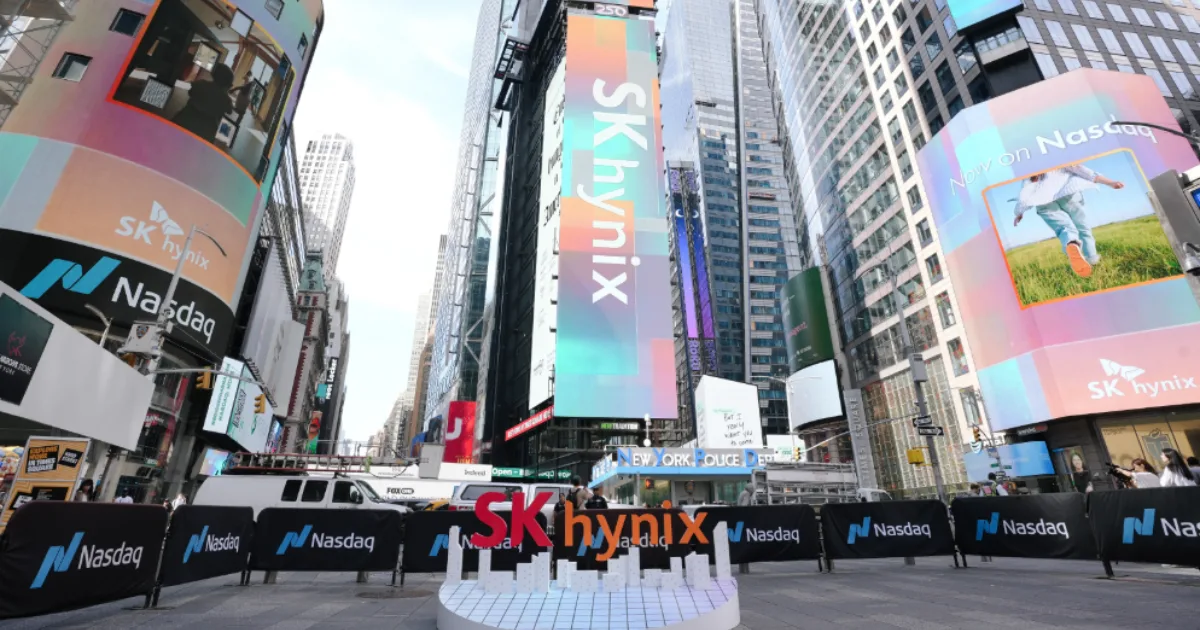
The Symbolism of Nasdaq
The Nasdaq listing also carries symbolic weight.
Nasdaq is the home market for many of the companies defining the AI economy: Nvidia, Microsoft, Apple, Amazon, Alphabet and Meta. By listing ADRs there, SK Hynix is positioning itself directly inside the global AI equity story.
SK Hynix is not merely a memory supplier in this ecosystem.
HBM has become a critical component for high-performance GPUs and AI accelerators. As AI models grow larger, memory bandwidth and power efficiency become central constraints. HBM helps relieve one of the most important bottlenecks in AI infrastructure.
The U.S. listing gives global investors a more direct way to buy into that role.
American investors are familiar with Nvidia, cloud providers and AI software companies. But many have had less direct access to the memory and packaging companies that make AI infrastructure physically possible.
SK Hynix’s ADRs create a clearer investment channel into the memory side of the AI supply chain.
The first day of trading reinforced that message. Reports showed the ADRs opening above their $149 offer price and closing at $168.01, up 12.8% on debut.
The market was not merely buying a Korean memory stock.
It was buying a core supplier to the AI infrastructure boom.
A Message for Korean Industrial Policy
The offering also raises a broader question for Korean industrial strategy.
Can Korea’s domestic capital market alone support the scale of investment required in the AI semiconductor era?
The answer is becoming less obvious.
Fabs, advanced packaging lines and EUV equipment now require tens of trillions of won in capital. As the scale of investment rises, access to global capital markets becomes part of corporate competitiveness.
SK Hynix’s Nasdaq ADR offering shows that Korean manufacturers may increasingly need to connect directly with global investors to finance the next phase of industrial expansion.
But there is also a policy challenge.
Even if the money is raised abroad, the investment must translate into domestic production capacity, high-skilled jobs, advanced-equipment ecosystems and infrastructure expansion.
The Yongin and Cheongju projects cannot be completed by corporate capital alone.
They require electricity, water, roads, permits, talent pipelines, supplier coordination and local acceptance.
The AI semiconductor race is not a fight that companies can win alone.
The state must support power infrastructure, industrial sites, talent development, tax policy, regulatory speed, supply-chain security and international technology diplomacy.
SK Hynix has secured financial ammunition.
Now Korea’s broader industrial system must move fast enough to turn that capital into capacity.
The Race After HBM Has Already Begun
Today’s market is centered on HBM.
But semiconductor competition is already moving beyond the current generation of high-bandwidth memory.
The next phase will require higher bandwidth, lower power consumption, more sophisticated packaging, better yield, faster customization and closer collaboration with AI accelerator customers.
AI models are growing.
Inference demand is expanding.
Data centers require more memory, not less.
Customers do not want only a strong chip. They want a reliable roadmap, stable supply, advanced packaging capability, energy efficiency and deep ecosystem collaboration.
SK Hynix’s 40 trillion won capital raise is a preemptive move for that future.
Yongin is the foundation for production capacity.
Cheongju P&T7 is the foundation for advanced packaging.
EUV equipment is the foundation for next-generation process competitiveness.
These are not separate investments.
Together, they form a three-part strategy for the AI semiconductor era.
The meaning of the offering is therefore not simply that SK Hynix raised a record amount of money.
It is that the company is defining where it wants to stand in the AI chip war.
The Nasdaq ADR listing sends a message to global investors.
The 40 trillion won facility investment sends a message to customers and competitors.
The Yongin, Cheongju and EUV commitments send a message to Korea’s semiconductor ecosystem.
AI memory competition will no longer be decided only by the performance of a single product.
It will be decided by how quickly a company can raise capital, secure capacity, integrate packaging and acquire the equipment needed for the next generation of chips.
SK Hynix has secured the ammunition.
Now the market will watch one thing:
How quickly that 40 trillion won can be converted into real AI semiconductor capacity and profit.