The venture market is setting records again in 2026.
Investment in the first half of the year has already surpassed the total for all of 2025. A blockbuster IPO has changed the market’s mood. AI companies are absorbing unprecedented amounts of capital. On the surface, venture capital appears to have ended its long downturn and entered another explosive growth cycle.
But the numbers tell a more complicated story.
According to the Q2 2026 PitchBook-NVCA Venture Monitor, $412.7 billion was deployed into U.S. venture-backed companies in the first half of 2026. Of that total, deals of $100 million or more captured 87.5% of the capital. AI companies alone accounted for 86% of venture dollars invested. On the fundraising side, Andreessen Horowitz, Thrive Capital and Founders Fund captured nearly half of all capital raised by venture funds.
The venture market looks alive again.
But more precisely, only the top of the market is overheated.
Capital, attention and exit opportunities are concentrating in giant AI companies, a small number of space and infrastructure firms, and the most powerful venture-capital franchises. Meanwhile, early-stage startups, non-AI companies, emerging managers, corporate venture investors and nontraditional investors are being forced through a narrower and colder market.
The defining feature of venture capital in 2026 is not recovery.
It is polarization.
SpaceX Created a Giant Number
The symbolic event of the quarter was SpaceX’s IPO.
PitchBook described SpaceX’s $1.7 trillion listing as having generated more exit value in a single quarter than the prior decade combined. That is not merely a dramatic statistic. It shows how one extreme event can reshape the appearance of an entire venture market.
In venture capital, exits are the bloodstream of the ecosystem.
When startup investments are converted into cash through IPOs or acquisitions, the proceeds return to limited partners. Those limited partners can then commit capital to new funds, and venture managers can invest in the next generation of startups.
When exits stall, the market freezes.
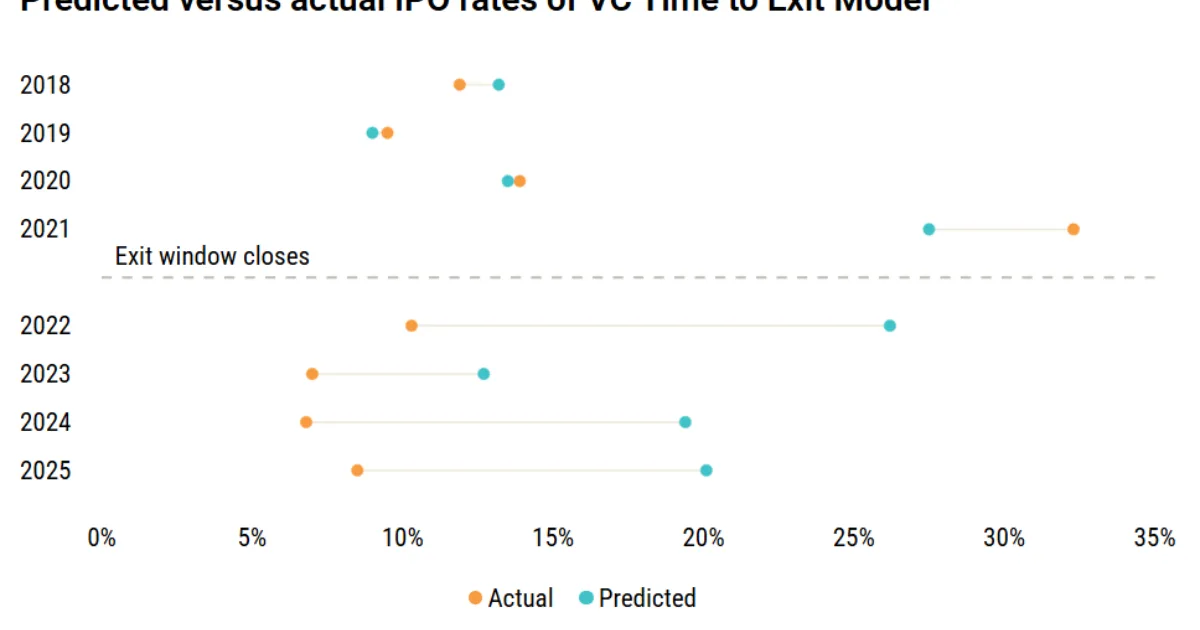
That has been one of the central problems of the past several years. Unicorns multiplied, but IPOs and acquisitions slowed. Paper valuations accumulated, but cash did not flow back at the same pace. Limited partners became more cautious. Emerging managers struggled to raise new funds. Early-stage startups faced a tighter financing environment.
SpaceX’s IPO created a massive opening in this blocked exit market.
But it also created an illusion.
The exit value produced by SpaceX alone is so large that it makes the entire market look healthier than it may be. The success of one extraordinary company does not necessarily mean the venture market has normalized.
It may instead show how dependent the exit market has become on a small number of exceptional companies.
The real test comes next.
OpenAI and Anthropic are widely anticipated as future public-market candidates, and their listings could further reshape the venture exit environment. But beyond a small number of AI and infrastructure giants, the broader IPO pipeline remains less certain.
A durable recovery requires many companies across many sectors and stages to go public or be acquired.
Without that, the venture market risks becoming a warehouse of unrealized value once again.
AI Has Become the Venture Market
In the first half of 2026, AI was not simply one venture sector.
It was the market.
AI companies captured 86% of all venture dollars, according to PitchBook-NVCA data. That figure means more than investor enthusiasm. It means companies outside AI are increasingly being pushed to the margins of capital access.
AI is no longer a narrow software category.
It now touches data centers, semiconductors, cloud infrastructure, agents, robotics, cybersecurity, healthcare, finance, enterprise automation and content creation. For investors, missing AI can feel like missing the next industrial cycle.
But this concentration carries risk.
First, valuations can rise too quickly.
If expectations about future market dominance overwhelm current revenue, margins, retention and infrastructure costs, the market begins to speak the language of a bubble again.
Second, innovation outside AI can suffer from capital scarcity.
Climate technology, biotech, education, local services, industrial software and non-AI consumer startups may receive less attention, even when their long-term social and economic value is significant.
Third, even within AI, capital may concentrate in a handful of winners.
Foundation-model companies, major AI infrastructure providers and agentic AI firms with global enterprise customers can raise enormous rounds. But many application-layer AI startups face platform dependence, weak differentiation and rising customer-acquisition costs.
AI is reviving venture capital.
But it is also narrowing it.
Megadeals Now Dominate the Market
The fact that 87.5% of first-half venture dollars went to deals of $100 million or more is critical.
It means the market is not recovering broadly.
Capital is not flowing evenly across thousands of startups. Instead, a small group of very large companies is absorbing most of the money.
The traditional ideal of venture capital was a wide field of experimentation.
A small team with a new idea could raise seed capital. Early investors would take risks. Many companies would fail. Some would become large. The system worked because capital was spread across uncertain futures.
The 2026 market looks increasingly different.
Capital is flowing toward companies with proven growth, famous founders, technical moats, large infrastructure requirements and global customer bases. AI infrastructure and model companies naturally require larger financing rounds because they must pay for compute, data centers, chips and talent at extraordinary scale.
That creates a self-reinforcing cycle.
The companies that raise the most money can grow faster. They can hire the best people. They can buy more compute. They can secure more data. They can form stronger partnerships. Then they can raise even more money.
The venture market begins to tilt toward winner-take-most dynamics.
For early-stage founders, this is a difficult environment.
Even if total venture investment rises, the amount available to ordinary startups may shrink. Investors say they are searching for the next OpenAI, but they may prefer to invest in companies already adjacent to OpenAI, Nvidia, SpaceX or Anthropic.
Record investment totals are not automatically good news for the next generation of founders.
Fundraising Is Polarizing Too
Capital concentration is not limited to startups.
It is also visible among venture-capital firms.
According to the Venture Monitor, Andreessen Horowitz, Thrive Capital and Founders Fund accounted for 48.1% of all venture capital raised in the first half of 2026.
That means limited partners are concentrating commitments in large, established firms.
The decision is understandable.
In an uncertain market, institutional investors prefer managers with track records, access to mega-deals and proximity to companies such as OpenAI, SpaceX and Anthropic. Large funds can participate in the biggest AI rounds. Smaller and emerging managers often cannot.
But the ecosystem cost is real.
Emerging managers often invest in new sectors, overlooked regions and more diverse founder groups. They may back early companies that large firms ignore: non-consensus industries, women founders, minority founders and regional innovation ecosystems.
If first-time fund formation is heading toward its lowest level since 2016, that matters.
Fewer new managers means fewer new investment perspectives.
Capital flows toward safer names.
The market moves inside a narrower network.
Venture diversity is not only an ethical slogan. It is a mechanism for funding a wider range of innovation.
If the number of capital providers shrinks, the range of funded ideas shrinks with it.
Corporate Venture Capital Is Pulling Back
The report also points to weakness in corporate venture capital and nontraditional investor participation outside AI.
Corporate venture capital has played an important role in the startup ecosystem. It does not only provide money. It can provide strategic partnerships, customer access, technical validation and potential acquisition pathways.
For large companies, corporate venture is a window into external innovation. For startups, it can be a bridge to market adoption.
But when uncertainty rises, corporate investors often become more cautious.
Core businesses face pressure. Shareholders demand cost discipline. Investment horizons lengthen. Strategic experiments are cut. Areas not directly tied to AI may be pushed down the priority list.
That creates another burden for startups.
Traditional venture capital focuses primarily on financial returns. Corporate venture capital often evaluates strategic fit and industrial application.
If corporate participation weakens, some startups lose not only funding but also pilot customers, validation partners and routes to commercialization.
For non-AI startups, the 2026 market may be colder than the headline numbers suggest.
Venture Debt Is Splitting Too
The venture debt market is also dividing.
PitchBook describes a split between large infrastructure-style financings and a long tail of companies with more limited access to capital.
That reflects the cost structure of AI.
AI companies need enormous computing resources, data-center capacity, GPUs and cloud spending. Equity alone may not be enough to finance that scale. Some companies increasingly require debt-like structures tied to infrastructure and long-term capacity.
Large AI infrastructure companies may be able to secure major financing packages.
Ordinary startups may face the opposite environment.
Higher interest rates, credit risk and weaker revenue visibility make lenders more selective. They prefer companies with strong backers, clearer revenue, hard assets or dominant market positions.
The pattern is the same across the market.
Many companies need capital.
Capital goes first to the strongest.
The Mountain of Unrealized Value Is Growing Again
A healthy venture market requires balance between investment and exits.
The problem in 2026 is that investment and valuation are growing quickly again, while cash returns are still not broad enough.
SpaceX’s IPO is a historic event. But even such a massive listing does not automatically solve liquidity across the entire venture ecosystem. It may take time for value to flow back to limited partners. And if other companies do not follow, unrealized value will accumulate again.
The scene recalls 2021.
That year, venture capital expanded rapidly on the back of abundant liquidity and high growth expectations. Unicorns multiplied. Valuations soared. But when interest rates rose, growth stocks corrected and the IPO market cooled, much of that paper value became a burden.
The 2026 market faces a similar question.
This time, the narrative is stronger because AI is real and infrastructure demand is enormous. SpaceX has produced a spectacular exit. OpenAI and Anthropic may follow. But it remains uncertain whether the layer beneath those giants can produce sustained IPO and acquisition activity.
The future of venture capital will not be decided only by how high AI valuations climb.
It will be decided by how much of that value can be converted into cash.
A Warning for Korean Startups and Investors
The trend has direct implications for Korea.
Korea’s startup ecosystem is also being reorganized around AI. Government support, corporate partnerships, venture investment, cloud credits and talent mobility are flowing toward AI companies. On the surface, the opportunity looks large.
But the U.S. venture market offers a warning.
A company may not be able to raise capital for long simply by attaching the AI label.
Capital will eventually concentrate around companies with defensible technology, proprietary data, large customers, global scalability, infrastructure leverage and clear workflow ownership.
Startups that simply add AI features to existing SaaS products may face pressure from platforms, foundation-model providers and larger incumbents.
Korean startups therefore need a more precise strategy.
Rather than competing head-on with global Big Tech in general-purpose AI models, they should build specialized AI products around Korea’s industrial strengths: manufacturing, finance, healthcare, public services, telecommunications, content and logistics.
The point is not to add AI as a feature.
It is to change the workflow of an industry.
Investors face a similar question.
If capital chases only a few large AI companies, it may follow the short-term market cycle. But over time, the ecosystem may lose diversity. Early-stage companies, non-AI innovation, regional industrial technologies, deep tech and manufacturing innovation may be deprived of capital.
A venture ecosystem cannot survive on mega-winners alone.
Venture Capital Is Bigger and Narrower
The first half of 2026 is undeniably impressive.
SpaceX created an unprecedented exit. OpenAI and Anthropic are expected to deepen public-market interest. AI has captured the center of venture capital. Total investment has surged.
But this does not mean the market is healthy for everyone.
The market is larger, but narrower.
There is more capital, but it is more concentrated.
Exit value is higher, but more dependent on fewer companies.
AI is creating opportunities, but it is shrinking the space for non-AI startups.
The original logic of venture capital was diversified investment in the future.
The current market is becoming concentrated investment in a small number of futures.
The biggest companies, the strongest funds and the hottest technology are absorbing more of the money. That can produce extraordinary returns in the short term. But it can also narrow the range of innovation over the long run.
The 2026 PitchBook-NVCA Venture Monitor tells less of a recovery story than a warning story.
The venture market is hot again.
But the heat is not reaching everyone.
This is the world of SpaceX, AI and a handful of mega-winners.
Below them, for many founders and fund managers, the winter has not ended.