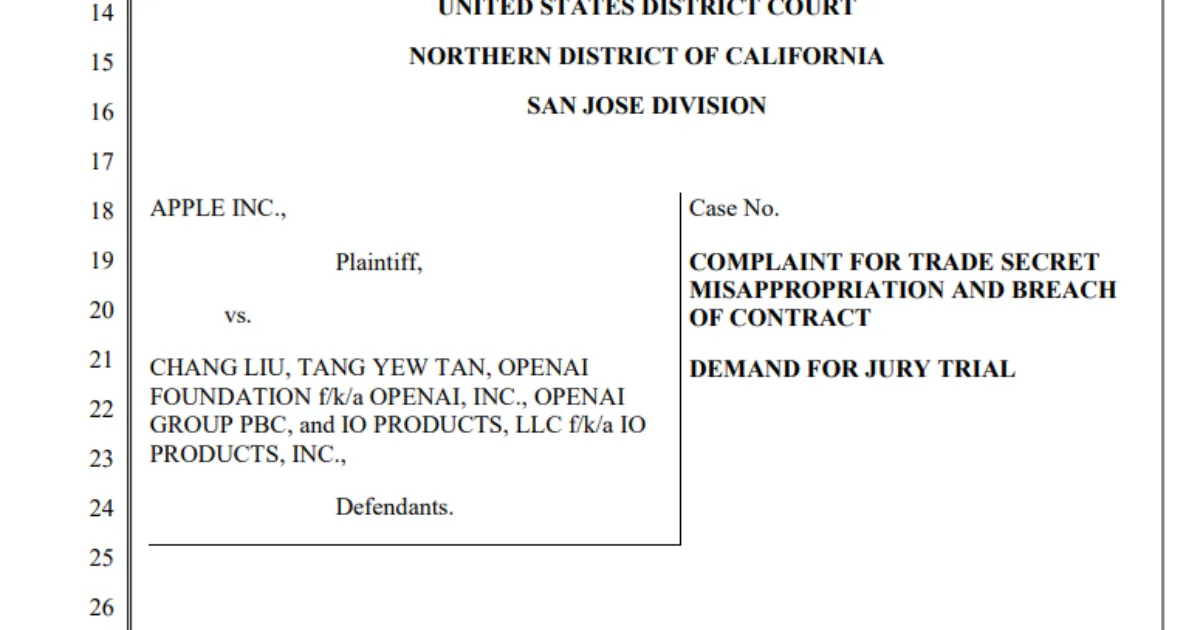
Apple has sued OpenAI.
Formally, the case is about trade-secret misappropriation and breach of contract. But its significance goes far beyond whether a handful of former employees took company files.
The lawsuit shows where the next battlefield in artificial intelligence may be moving.
Until now, OpenAI has competed largely through language models, chatbots, APIs and enterprise AI platforms. Apple has dominated consumer hardware through the iPhone, Apple Watch, MacBook, operating systems and its tightly integrated services ecosystem. The two companies have also been commercial partners through the integration of ChatGPT into Apple Intelligence.
But once AI moves beyond software on a screen and into physical devices that people carry, wear and interact with throughout the day, the relationship changes.
In its complaint, Apple alleges that OpenAI used former Apple employees, supply-chain relationships, interview processes and internal materials to systematically obtain Apple’s trade secrets as OpenAI moved into consumer hardware. Apple’s central claim is that OpenAI and io Products sought to shortcut decades of Apple’s accumulated hardware-development, manufacturing and supply-chain expertise in order to accelerate OpenAI’s first consumer-device efforts.
These are still Apple’s allegations. OpenAI and the individual defendants will have the opportunity to respond in court, and any legal finding will depend on discovery and trial.
But the case already raises a larger question.
Will competitiveness in the AI era be decided only by model performance?
Or will the next market be controlled by companies that can combine AI models with hardware, manufacturing processes, supply chains, interfaces, data protection and user experience?
The Core Issue Is Not Talent Mobility, but the Movement of Trade Secrets
Talent mobility is routine in Silicon Valley.
An Apple engineer may move to OpenAI. A Google researcher may join Anthropic. A Meta employee may leave for xAI or Mistral. The technology industry has long grown through the movement of people, knowledge and experience across companies.
California, in particular, has historically protected employee mobility and the freedom to change jobs.
That means Apple cannot prevail simply by saying that OpenAI hired too many of its employees. The key distinction is whether former employees used their general experience and skills, or whether they took specific documents, data, components, processes and project information that Apple had protected as confidential.
Apple’s complaint is designed to draw that line sharply.
According to Apple, Chang Liu worked at the company for eight years as a senior system electrical engineer before leaving for OpenAI in January 2026. Apple alleges that after his departure, he failed to return an Apple-issued laptop and exploited an authentication vulnerability that allowed him to continue accessing Apple’s network storage.
Apple claims Liu accessed and downloaded dozens of confidential hardware-related files after leaving the company, including materials related to unreleased products, engineering presentations, technical specifications and proprietary project data. The complaint says some of the files concerned the manufacture and testing of main logic boards, including workflows, equipment, captured data and analytical methods.
Another central figure in the complaint is Tang Yew Tan.
Tan worked at Apple for 24 years and served as vice president of product design for iPhone and Apple Watch. He is now OpenAI’s Chief Hardware Officer. Apple alleges that Tan had access to sensitive projects, supplier relationships, manufacturing techniques and unreleased products, and that he used Apple’s confidential information to benefit OpenAI’s hardware development.
Apple’s argument is not merely that people moved from Apple to OpenAI.
It is that confidential information moved with them.
The complaint alleges that OpenAI’s hiring process encouraged Apple employees to discuss internal project names, components, CAD and design artifacts, prototypes, supplier-selection methods, manufacturing workflows and integration tools.
In that framing, the case is not about whether people changed jobs.
It is about whether secrets changed companies.
OpenAI’s Hardware Ambitions Form the Backdrop
The lawsuit cannot be separated from OpenAI’s move into hardware.
OpenAI no longer wants to remain only a chatbot company. It is trying to design a new consumer AI experience, and it has moved into hardware through io Products, the company associated with former Apple design chief Jony Ive. Apple alleges that io functioned as a dedicated vehicle for OpenAI’s hardware development and was already operating in coordination with OpenAI.
For OpenAI, hardware is strategically important.
Today, ChatGPT is mostly accessed through smartphones, PCs, browsers and apps. Those user interfaces are controlled by Apple, Google and Microsoft. A user opens ChatGPT on an iPhone, uses AI coding tools on a MacBook or accesses AI services through an Android device.
If OpenAI wants to become a true consumer AI platform, software alone may not be enough.
When, where and how users call AI; which sensors the AI can access; how voice, screen, camera and contextual information are combined — these are hardware and operating-system questions.
If AI becomes an assistant, an agent and a companion embedded in daily life, the device is not merely a container.
It is the gateway to the AI experience.
That is why OpenAI may want its own hardware. Just as Apple redefined the mobile internet through the iPhone, OpenAI may want to define the interface of the AI era.
But consumer hardware is vastly more difficult than software.
Building a prototype is one thing. Manufacturing millions of reliable devices and distributing them globally is another. A company must select components, manage suppliers, design production processes, validate quality, solve thermal and battery constraints, handle electromagnetic interference, perfect exterior finishes and manage packaging and logistics.
Apple is one of the strongest companies in the world in that domain.
Its true competitive advantage is not only the design of the iPhone. It is the ability to manufacture hundreds of millions of refined devices every year while controlling quality, supply chains and margins.
That invisible system is what Apple is trying to protect.
Apple’s Alleged Trade Secrets Are Not One Technology, but a Hardware Operating System
Apple’s complaint divides its alleged trade secrets into several broad categories.
They include hardware engineering and product design; manufacturing design and process engineering; component technologies; testing, validation and development methodologies; and global supply-chain operations and supplier relationships.
The important point is that Apple is not focusing on a single patent or one design file.
It is describing a system.
Hardware engineering information may include circuit designs, system specifications, power-management innovations, unreleased product roadmaps, AI and machine-learning integration data, and testing methods for managing electromagnetic interference.
Manufacturing information may include custom machinery, production processes, metal alloys, metal-finishing techniques, material specifications and design-for-manufacturability expertise.
Supply-chain information may include supplier contracts, specialized sub-suppliers, component-allocation strategies, global logistics coordination and the way internal Apple teams interact with outside partners.
This kind of information is not public like a patent.
Its value comes from remaining secret.
The core is often negative know-how: what failed, what was refined, which equipment detects which defects, which supplier can meet which tolerances and which manufacturing process collapses at scale.
For a company trying to build AI hardware, that knowledge could be extremely valuable.
Model performance can be tracked through papers, benchmarks and product releases. But hardware manufacturing and supply-chain know-how are much harder to observe from the outside.
That is why Apple argues that OpenAI sought to bypass decades of investment.
Is an Interview a Hiring Process or an Information-Gathering Tool?
One of the most sensitive parts of the complaint concerns OpenAI’s alleged interview practices.
Apple claims OpenAI asked Apple employees to prepare technical deep-dive presentations, including slides about their recent Apple work, CAD and design artifacts, prototypes and actual physical parts. The complaint also alleges that candidates were asked to discuss component selection, system-integration tools, simulation methods, vendor selection and collaboration with suppliers.
Apple further alleges that OpenAI interviewers used Apple internal project code names and proprietary terminology to ask candidates about unreleased Apple projects. In one example described by Apple, Tan allegedly used an Apple internal project codename during an interview to ask about the plan for an unannounced Apple product.
If proven, this would go beyond ordinary recruiting.
A job candidate may describe their skills and experience. But they should not disclose confidential project names, components, drawings, testing data, supplier information or unreleased product plans from a former employer. An interviewer should not ask for them.
The case therefore asks where the legal boundary lies in AI-era recruiting.
Companies may hire talent from competitors. The general experience and capability of those employees can be used lawfully. But if the hiring process is structured to extract a competitor’s confidential information, the situation changes.
This issue is especially important in AI hardware.
Employees from established hardware companies know what is difficult, which suppliers matter and which approaches have already failed.
The question is whether that knowledge belongs to the individual as general professional experience or to the former employer as protected trade-secret information.
This lawsuit may test how courts draw that boundary.
The Battle Extends Into the Supply Chain
Apple’s allegations do not stop with former employees.
The complaint claims that OpenAI and io Products also approached Apple’s trusted partners and supply chain. Apple alleges that OpenAI used Apple’s proprietary industrial-design techniques related to metal finishing by having an Apple partner perform those processes for OpenAI’s benefit.
According to Apple, the partner was bound by confidentiality obligations and use restrictions that limited the work it could perform using Apple’s confidential processes and facilities. Apple claims OpenAI misled the partner into believing that Apple had authorized the work.
This part of the case is significant.
AI hardware is not built by hiring a few engineers alone. It requires relationships with component suppliers, assemblers, materials companies, testing labs, tooling vendors, finishing specialists and logistics partners.
Apple’s supply chain was not built overnight.
For decades, Apple has cultivated suppliers, designed equipment, optimized processes, enforced quality standards and, in some cases, developed Apple-specific machinery and procedures inside supplier facilities.
If an AI hardware startup can access that network, it can dramatically shorten its time to market.
That is why Apple is especially sensitive to supply-chain information.
The iPhone’s power does not reside only inside the device. It also resides in the network of factories, suppliers and process knowledge that makes the device possible.
That supply chain is one of Apple’s strongest defenses.
It is also one of the most tempting targets for any company trying to enter consumer hardware.
OpenAI Has Shifted From Partner to Potential Competitor
One of the most interesting aspects of the case is that Apple and OpenAI are not purely adversaries.
Apple acknowledges in the complaint that the companies have a commercial relationship involving the integration of ChatGPT into Apple Intelligence. But Apple says the alleged trade-secret misconduct has no connection to that agreement.
This captures the complexity of modern Big Tech relationships.
Companies can cooperate in one area, compete in another and sue each other in a third.
Apple has been strengthening its own AI capabilities, but it has also needed OpenAI’s generative AI models to support its consumer AI strategy. OpenAI, in turn, gained access to Apple’s ecosystem and potentially hundreds of millions of user touchpoints.
Both sides had reasons to cooperate.
But if OpenAI moves seriously into consumer hardware, the relationship becomes more tense.
For Apple, an OpenAI device may not be just another accessory. It could become a new interface that competes with parts of the iPhone’s role or shifts the user’s AI interaction away from Apple’s ecosystem.
For OpenAI, Apple is not merely a partner. It is one of the most powerful platform companies in the world, controlling hardware, operating systems, app distribution, payments, privacy architecture, chips and user experience.
If AI becomes the next major computing interface after mobile, OpenAI may not want to remain inside Apple’s platform forever.
The lawsuit erupted at precisely that point of tension.
Why AI Companies Want Hardware
AI companies want hardware for several reasons.
First, hardware allows deeper understanding of user context.
A smartphone app can provide useful signals, but it is different from controlling device-level sensors, operating-system integration, wearables, cameras, microphones, location data, biometric signals and environmental context. An AI agent that operates meaningfully in daily life needs access to context.
Second, hardware can change how AI is invoked.
Today, users usually open an app and type or speak a prompt. A dedicated AI device could create more natural interactions: screenless devices, voice-first devices, wearables, camera-based assistants or context-aware ambient devices.
Third, hardware reduces platform dependence.
If OpenAI depends entirely on Apple and Google app stores, operating-system policies, device permissions and privacy frameworks, it cannot fully control the consumer AI experience. A proprietary device could give OpenAI a more direct relationship with users.
Fourth, hardware expands the business model.
AI subscriptions alone may not be enough to support long-term growth expectations. Hardware can create new revenue streams, service bundles, premium subscriptions, enterprise devices and agent ecosystems.
But hardware is hard.
When software companies enter hardware, the biggest obstacles are often manufacturing and supply chains. A promising idea and a prototype do not automatically become a reliable product shipped at global scale.
Apple’s complaint is built around that point.
Apple alleges that OpenAI did not build those capabilities through ordinary time and investment, but instead sought a shortcut through Apple’s people, materials and partners.
The Legal Questions
The main legal basis of the lawsuit is the U.S. Defend Trade Secrets Act.
Apple alleges that the defendants improperly acquired, used and disclosed Apple’s trade secrets. It also alleges that Liu and Tan breached the intellectual-property agreements they signed while employed at Apple.
In a trade-secret case, several questions are central.
First, is the information actually a trade secret?
It must generally not be publicly known. It must have economic value because of its secrecy. And the company must have taken reasonable steps to protect it.
Second, did the defendant acquire or use the information through improper means?
The distinction between general professional experience and specific confidential files, parts, processes or supplier information will be critical.
Third, was the information used in the defendant’s business, or is there a serious risk that it will be used?
Apple alleges that the defendants downloaded files, extracted confidential information during interviews, used Apple processes through suppliers and deployed Apple’s hardware know-how in OpenAI’s development work.
OpenAI and the individual defendants may respond in several ways.
They may argue that the information Apple identifies is not a trade secret, but general industry knowledge. They may argue that former employees used only their general experience. They may deny that OpenAI requested or used Apple materials. They may argue that individual conduct should not be attributed to the company. They may also challenge whether Apple can show actual use or damages.
The central legal question will be simple but difficult:
Did OpenAI improperly use Apple’s hardware know-how?
There is no answer yet.
Trade Secrets Are Expanding in the AI Era
The case also shows how the meaning of trade secrets is expanding in the AI era.
In earlier software disputes, trade secrets often centered on source code, algorithms, customer lists, pricing strategies or business plans. But once AI becomes tied to hardware, the scope broadens dramatically.
Training data, inference optimization, chip design, data-center operations, cooling systems, hardware design, supply-chain relationships, manufacturing equipment, component placement, testing protocols, user interfaces and safety-evaluation methods can all become trade-secret assets.
If AI companies begin making consumer devices, trade-secret disputes will no longer be only about software code.
They will be about physical manufacturing systems.
As OpenAI moves from a language-model company toward a hardware company, the rules of competition change.
The fight expands from talent and data needed to train models to suppliers and manufacturing know-how needed to build devices.
Apple’s lawsuit may be one of the first major collisions in that transition.
Why Korean Companies Should Pay Attention
The case has important implications for Korean companies as well.
Korea has global strengths in semiconductors, displays, batteries, camera modules, telecommunications equipment, electronic components and advanced manufacturing. As AI hardware grows, Korean firms and suppliers are likely to become important partners for global AI companies.
That also increases trade-secret risk.
As AI companies enter hardware, demand will grow for talent from Apple, Samsung, LG, SK, Hyundai Motor, battery companies, semiconductor manufacturers and component suppliers. Job changes are natural. But taking drawings, test data, supplier information, manufacturing processes, customer information, source code or internal AI model materials from a previous employer creates serious legal risk.
Korean companies should not view the case merely as a fight between Apple and OpenAI.
They should treat it as a warning about talent mobility and trade-secret protection in the AI era.
Exit procedures, access-rights termination, log monitoring, confidential-document classification, supplier security, interview guidelines, clean-room onboarding for hires from competitors and project-assignment rules for former competitors’ employees will all become more important.
This is especially true where AI hardware and manufacturing converge.
Companies must define clearly what belongs to an employee’s general expertise and what belongs to the company as protected confidential information.
A company can lawfully use the experience of a new hire.
It must not import a competitor’s trade secrets.
That distinction is both a legal safeguard and a foundation of long-term trust.
OpenAI’s Hardware Business Now Faces Tougher Scrutiny
The lawsuit may create pressure on OpenAI’s hardware ambitions.
Apple is not seeking only damages. It asks for preliminary and permanent injunctions preventing the defendants from possessing, using or disclosing Apple trade secrets; preservation of evidence; return of Apple materials; declarations that the defendants have no rights to use Apple’s confidential information; damages; unjust-enrichment recovery; reasonable royalties; exemplary damages; and attorneys’ fees.
If a court grants even part of Apple’s requested injunctive relief, it could affect OpenAI’s hardware-development timeline, supplier negotiations and launch strategy.
Hardware development is deeply interconnected. Early design choices, manufacturing processes, component supply, exterior finishing and testing procedures all influence each other.
If any part of a project is alleged to be contaminated by trade-secret misuse, the entire effort may require clean-room validation.
OpenAI may need to show that its hardware development does not depend on Apple materials or processes, and that any disputed information was not used in product development.
That is not only a reputational issue.
To become a hardware company, an AI firm needs trust from consumers, investors, suppliers and regulators. Allegations of trade-secret misuse before the first product reaches market could complicate hardware partnerships.
The Real Question Behind the Case
The Apple-OpenAI lawsuit is still at an early stage.
The complaint contains strong language and detailed allegations, but it is only Apple’s side of the story. The court will have to evaluate evidence. OpenAI and the individual defendants will have the chance to respond.
But the industry questions are already clear.
When an AI company enters hardware, what counts as legitimate talent use and what counts as trade-secret misappropriation?
How far can a former employee’s experience travel to a new employer?
How should supply-chain and manufacturing know-how be protected in the AI era?
Can a software-first company shortcut the time and trial-and-error required to build consumer hardware?
And will the next phase of platform competition depend on who controls the physical interface through which users meet AI?
This is not only a lawsuit in which Apple accuses OpenAI of misconduct.
It is a sign that generative AI companies are moving down from the cloud and into the world of consumer hardware, where they will collide with the existing hardware empires.
OpenAI may not be trying to build just another device.
Apple may not be trying to protect only a set of documents.
One company wants to create the interface of the AI era.
The other wants to defend the hardware ecosystem and manufacturing operating system it has built over decades.
That is why this case is both a trade-secret lawsuit and an opening battle in the AI hardware era.
The AI race has moved beyond the model answer box.
The next battlefield is the device in the user’s hand, the factory that builds it and the invisible know-how that makes it possible.