Who is willing to invest the most money in a company developing artificial intelligence models?
Venture capital firms?
Institutional investors?
Or technology giants seeking to secure a dominant position in the future AI market?
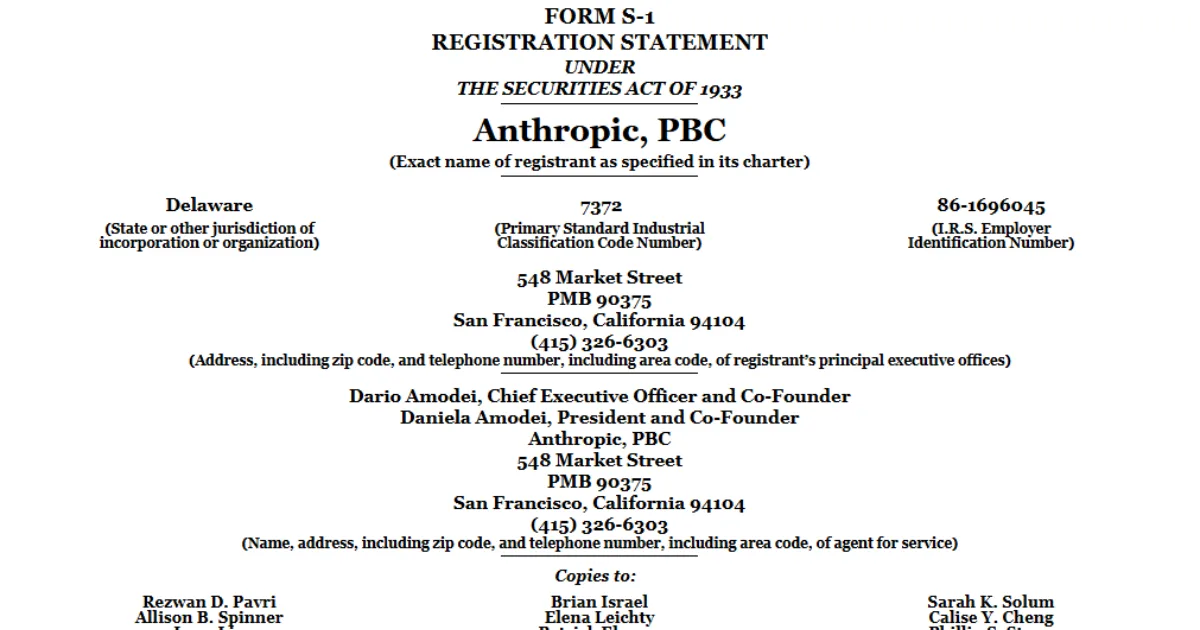
Anthropic's second amended registration statement for its initial public offering, filed with the U.S. Securities and Exchange Commission on November 10, 2026, offers an intriguing answer.
Companies supplying AI semiconductors and operating cloud infrastructure are emerging as major investors in Anthropic.
Google is investing $10 billion.
Nvidia is also investing $10 billion.
AMD is committing $2.5 billion.
Broadcom, Micron, and Microsoft are each investing $1 billion.
An investment entity affiliated with TSMC is contributing another $500 million.
Together, the seven companies are committing $26 billion.
These investments are structured as private placements separate from the IPO offered to public investors.
But there is something more significant about the investor list.
These companies are not merely financial investors.
They supply semiconductors, cloud services, and computing infrastructure needed to run AI models, or maintain business relationships with Anthropic in related areas.
As Anthropic grows, demand for AI infrastructure may increase.
The companies supplying that infrastructure are now investing capital back into Anthropic.
The transaction illustrates how the boundaries between customers, suppliers, and investors are becoming increasingly blurred in the AI industry.
Anthropic must spend enormous amounts of money on computing infrastructure to develop its AI models. Yet the companies supplying that infrastructure are also seeking to purchase Anthropic shares, providing some of the capital needed to sustain its growth.
This arrangement could create new opportunities.
But it also raises an important question.
To what extent are AI industry revenue and investment ultimately supported by independent demand from paying end customers?
1. Anthropic Reveals a $70–$78 IPO Price Range
In its amended Form S-1/A filed on November 10, Anthropic proposed an IPO price range of $70 to $78 per share.
The offering consists of 825 million Class A common shares.
Of those shares, approximately 801.35 million will be newly issued by Anthropic.
Existing shareholders will sell approximately 23.65 million shares.
Applying the proposed price range produces the following figures.
Item | Amount |
|---|---|
Proposed IPO price | $70–$78 per share |
Total offering shares | 825 million |
Gross offering size | $57.75 billion–$64.35 billion |
Newly issued company shares | Approximately 801.35 million |
Shares sold by existing shareholders | Approximately 23.65 million |
Separate private investments | $26 billion |
Midpoint of proposed price range | $74 per share |
At the midpoint of $74 per share, the IPO would have a gross offering value of approximately $61.05 billion.
Of that total, the proceeds attributable to newly issued shares would amount to approximately $59.3 billion.
The remaining portion represents proceeds from shares sold by existing shareholders.
Consequently, the entire IPO offering amount will not flow into Anthropic's accounts.
Including the separate $26 billion private placement, the company expects approximately $84.6 billion in net proceeds after underwriting discounts and related expenses.
That estimate assumes the underwriters do not exercise their option to purchase additional shares.
Anthropic intends to use the proceeds for operating expenses, research and development, computing infrastructure investments, and talent acquisition.
At this stage, however, the figures represent a proposed offering price and estimated fundraising amounts.
The final IPO price and actual proceeds have not yet been determined.
2. Anthropic's Valuation Is Approaching $1 Trillion
The amended registration statement also provides information about the number of shares expected to be outstanding after the IPO, including different classes of stock.
After accounting for the public offering and separate private placement, approximately 13.08667 billion Class A and Class N shares with economic rights are expected to be outstanding.
Multiplying that figure by the proposed midpoint price of $74 produces an implied equity value of approximately $968.4 billion.
At the lower end of the proposed price range, $70 per share, the implied value would be approximately $916.1 billion.
At the upper end of $78, it would reach approximately $1.0208 trillion.
These figures are illustrative calculations based on the anticipated number of outstanding Class A and Class N shares and the proposed offering prices.
They may differ from a fully diluted valuation that includes the potential effects of stock options, restricted stock units, and other dilutive securities.
It is therefore important not to confuse a simple share-count-based equity valuation with a fully diluted valuation reported elsewhere.
Nor do these calculations represent a final market valuation.
After listing, Anthropic's share price will depend on actual investor demand.
Nevertheless, the company's pursuit of a valuation near $1 trillion is significant.
An AI company founded only a few years earlier is preparing to enter public markets with an implied valuation comparable to some of the world's largest technology businesses.
The central question is whether future operating performance can justify that valuation.
3. Why Are Google and Nvidia Investing $10 Billion Each?
Google and Nvidia are the most prominent participants in the separate investment round.
Each has committed $10 billion.
Combined, their investments total $20 billion.
That represents approximately 77% of the $26 billion private placement.
Although Google and Nvidia operate different businesses, they share an important economic interest in the AI industry.
As companies developing and deploying AI models consume more computing resources, suppliers of those resources may benefit.
Google operates its own Tensor Processing Units, or TPUs, alongside Google Cloud.
Nvidia supplies GPUs, networking technologies, and computing systems used in AI workloads.
Anthropic requires enormous computing capacity to train Claude models and deliver them to customers.
If Anthropic continues growing rapidly, demand for related infrastructure could increase.
The investments may therefore have strategic significance extending beyond the potential appreciation of Anthropic's shares.
However, an important distinction is necessary.
There is no confirmed evidence in the information disclosed that the entire $20 billion investment will flow directly back to Google and Nvidia through specific semiconductor purchase agreements.
Nor can it be assumed that every investment and infrastructure supply contract is connected under identical terms.
What the filing establishes is that these companies are participating as investors in Anthropic.
Determining how their commercial interests influence particular transactions will require examination of contract terms and subsequent disclosures.
4. Nvidia's Rival AMD Is Investing Too
Another striking feature of the investor list is that Nvidia and AMD appear together.
AMD is investing $2.5 billion.
Broadcom and Micron are also participating.
An investment entity affiliated with TSMC is contributing $500 million.
These companies occupy different positions within the AI semiconductor industry.
Nvidia and AMD compete in the market for AI accelerators.
Broadcom operates businesses involving custom semiconductors and networking technologies.
Micron specializes in memory semiconductors.
TSMC manufactures advanced semiconductors for other companies.
The result is an investment structure in which several major semiconductor companies participate in financing the same AI model developer.
This arrangement also reflects the reality that AI model companies may need to use diverse technologies and infrastructure rather than depend entirely on a single semiconductor supplier.
However, the investor list does not reveal exactly which chips Anthropic will purchase in the future or in what quantities.
Supply volumes, contract periods, pricing arrangements, and other commercial terms require separate verification.
What the investment structure does show is that Anthropic is establishing extensive relationships across the AI industry's critical supply chain.
5. Computing Commitments Rise to $900.9 Billion
Another major figure in the amended registration statement deserves attention.
Anthropic's long-term spending commitments related to computing infrastructure have increased.
In its first amended filing on November 2, the company reported approximately $895.4 billion in relevant commitments.
The second amendment, filed on November 10, increased that total to approximately $900.9 billion.
That represents an increase of roughly $5.5 billion.
Of the total, approximately $451.6 billion is expected to be spent by the end of 2030.
Substantial additional expenditures are scheduled between 2031 and 2045.
The $900.9 billion figure does not mean Anthropic currently owes that amount in outstanding debt.
It represents aggregate commitments for future computing services, infrastructure, leases, and related arrangements.
It includes resources that have not yet been delivered and expenditures that will occur in future years.
Nevertheless, the economic significance is substantial.
Anthropic operates a business that requires enormous computing resources over an extended period.
To meet those obligations sustainably, revenue must continue growing.
The company must also maintain access to external capital when necessary.
Its IPO and separate $26 billion private placement are closely connected to this growth strategy.
6. A New Capital Cycle Is Emerging in the AI Industry
Viewed across the industry, the transaction reveals an interesting structure.
AI model developers need semiconductors and data centers to build increasingly capable models.
Infrastructure suppliers gain opportunities to generate revenue as AI model developers expand.
Some of those suppliers then invest in the model developers themselves.
The model developers can use the additional capital to expand research, development, and infrastructure procurement.
The relationship can be simplified as follows.
AI infrastructure suppliers → Investment in AI model developers → Expansion of computing demand → Additional business opportunities for infrastructure suppliers
This does not mean that invested capital automatically returns to the same supplier through procurement contracts.
Nor does every agreement necessarily follow this pattern.
However, when suppliers and investors overlap, their economic interests become interconnected.
Such relationships could accelerate growth in the AI industry.
Infrastructure suppliers may gain greater exposure to future demand, while model developers obtain capital to support technological development.
But the structure also creates risks.
It may become more difficult to distinguish investment circulating within the AI ecosystem from revenue ultimately supported by independent end customers.
Even if investments between companies continue increasing, long-term business sustainability could become difficult if end customers are not willing to pay enough for AI services.
Evaluating AI industry growth therefore requires more than examining headline revenue figures.
Analysts must also consider revenue sources, customer composition, and relationships among investors and suppliers.
Anthropic's latest filing demonstrates why that distinction is becoming increasingly important.
7. How Fast Is Anthropic's Revenue Actually Growing?
Anthropic generated approximately $16.956 billion in revenue during the third quarter of 2026.
Revenue for the first nine months of the year reached approximately $33.242 billion.
That substantially exceeded its full-year 2025 revenue of approximately $4.585 billion.
The figures indicate rapidly expanding enterprise demand for Claude models.
Usage-based API and platform services account for a substantial proportion of the company's revenue.
During the first nine months of 2026, usage-based revenue totaled approximately $26.3 billion.
That represented around 79% of total revenue.
However, rapid revenue growth does not necessarily produce profit growth at the same pace.
Anthropic recorded an operating loss of approximately $567 million in the third quarter.
The company identified high short-term computing expenses among the principal causes.
Its net loss for the quarter was approximately $23.291 billion.
That figure included substantial accounting losses associated with changes in the fair value of convertible financial instruments.
It should therefore not be interpreted as an equivalent amount of operating cash outflow.
The central financial challenge is that Anthropic must manage rapid business growth and enormous infrastructure costs simultaneously.
Capital raised through the IPO could play an important role in supporting that business model.
8. Can All the IPO Proceeds Be Used for New Investment?
Anthropic plans to use the capital raised through its IPO and private placement primarily for working capital, infrastructure investment, and other business requirements.
However, the entire amount will not necessarily be spent on new data centers and semiconductors.
The company also needs funding for employee recruitment and retention, research and development, and general operating expenses.
It additionally expects to use some proceeds to satisfy tax withholding obligations associated with the settlement of certain restricted stock units, or RSUs.
This is an important consideration for investors.
The amended registration statement provides additional information about stock-based compensation expenses and potential dilution associated with the IPO.
The public offering may trigger the satisfaction of certain conditions attached to existing equity awards.
Such expenses can affect reported earnings, the number of shares outstanding, and existing shareholders' ownership percentages.
Consequently, it would be inaccurate to assume that every dollar raised in the IPO will be available exclusively for additional growth investments.
9. What Dilution Will New Investors Face?
Anthropic also disclosed the expected dilution in net tangible book value per share for new investors.
Using the proposed offering price midpoint of $74, the adjusted net tangible book value after the IPO and separate private placement is estimated at approximately $8.21 per share.
That produces estimated dilution of approximately $65.79 per share for new investors.
The calculation represents the difference between the offering price and the adjusted net tangible book value per share.
It does not mean the stock price is expected to fall by $65.79 immediately after the offering.
The market value of a technology company reflects more than the tangible assets recorded on its balance sheet.
Future revenue, earnings potential, technological competitiveness, and other factors can significantly influence equity valuations.
Nevertheless, the figure illustrates that new investors would be paying substantially more than the company's current net tangible assets per share.
They would therefore be assigning considerable value to Anthropic's future growth prospects.
The critical question is how much of that expected growth can ultimately be realized.
10. Anthropic's AI Safety-Oriented Governance Structure Will Remain
Anthropic has adopted a governance structure that differs from that of many conventional publicly traded corporations.
The company intends to retain its status as a public benefit corporation.
Its Long-Term Benefit Trust is designed to hold a special class of shares giving it authority to appoint or remove a majority of the board of directors.
Anthropic's founders are also expected to maintain voting influence equivalent to 50.1% of the general shareholder voting power through a separate Class F share.
The company describes these arrangements as mechanisms intended to preserve its commitment to AI safety and long-term public-benefit objectives.
For outside investors, however, the structure introduces additional considerations.
Even after purchasing publicly traded shares, ordinary shareholders may have limited influence over major corporate decisions.
Disagreements could arise among public shareholders, founders, and the public-benefit trust over large infrastructure investments, capital financing, or the direction of AI model development.
Anthropic's IPO therefore requires investors to evaluate more than growth rates and valuation.
Its unusual governance structure is also an important part of the investment proposition.
11. What Are the Questions Investors Should Really Be Asking?
Anthropic's second amended registration statement provides a much more detailed picture of its proposed fundraising.
The company has disclosed its anticipated IPO price range.
It has specified the proposed number of offering shares.
It has identified strategic investors, including Google and Nvidia, and the amounts they intend to contribute.
But important uncertainties remain.
First, the final offering price has not yet been determined.
Second, it remains uncertain whether the company's implied valuation can be sustained after listing.
Third, Anthropic must demonstrate that approximately $900.9 billion in long-term infrastructure commitments can be supported by sufficient future revenue and profits.
Fourth, investors will need to evaluate how stock-based compensation, potential dilution, and future financing requirements affect shareholder value.
Fifth, the relationships between Anthropic and its infrastructure suppliers must be assessed for both their contribution to growth and the dependencies they may create.
An important point is that participation by strategic investors such as Google and Nvidia does not eliminate the risks facing ordinary shareholders.
These companies may benefit economically from Anthropic's growth in several different ways.
Ordinary equity investors, by contrast, are primarily exposed to changes in Anthropic's equity value and the possibility of future shareholder returns.
Different investors therefore have different economic interests.
Who Is Financing AI's Growth, and Who Will Ultimately Profit?
The most important feature of Anthropic's proposed IPO is not simply its enormous scale.
It is the simultaneous participation of major AI industry companies as investors and infrastructure suppliers.
Anthropic develops AI models.
Google, Nvidia, AMD, and other participating companies provide technologies and infrastructure essential to developing and operating those models.
Together, the seven companies have committed $26 billion in separate investments.
Anthropic intends to raise substantial additional capital through its public offering and use those resources to expand its business.
At the same time, its aggregate commitments for future computing and infrastructure expenditures have reached approximately $900.9 billion.
A new structure within the AI industry is becoming visible.
Model development, semiconductor supply, data center construction, and capital financing are becoming increasingly interconnected.
Growth at one company can create infrastructure revenue opportunities for another.
That infrastructure company may then invest in the model developer's future.
Such relationships could accelerate the industry's development.
But if actual AI usage and willingness to pay among end customers fail to expand as expected, recovering the invested capital may become difficult.
The IPO therefore reveals more than an optimistic valuation of an AI company.
It also illustrates how the enormous amounts of capital required for the industry's future growth are being raised and connected within the AI supply chain itself.
The important question is no longer simply where Anthropic's IPO price will be finalized.
It is what economic returns will emerge from Google's and Nvidia's combined $20 billion investment, the $26 billion committed by seven strategic investors, and Anthropic's approximately $900.9 billion in future infrastructure spending commitments.
An AI company can generate extraordinary revenue growth without necessarily producing sustainable profits.
Anthropic has demonstrated that substantial demand exists for its AI models through rapid revenue expansion.
The next challenge it must address in public markets is even greater.
Can that demand develop into a durable business capable of supporting hundreds of billions of dollars in long-term infrastructure commitments?
Anthropic's IPO is becoming more than the public listing of a single AI company. It is a test of the economics of an emerging AI ecosystem in which semiconductor suppliers, cloud providers, and model developers invest in and supply one another.