The front line of generative AI copyright litigation is shifting.
Until now, the central question has been relatively clear: did AI companies infringe copyright by using images and creative works collected from the internet as training data?
The lawsuits brought by major Hollywood studios against Midjourney began from that question. Disney, Warner Bros. Discovery and other entertainment companies have argued that Midjourney’s image- and video-generation systems can reproduce protected characters and works without authorization.
But Midjourney’s latest court filing seeks to turn the focus back toward the plaintiffs.
The AI company argues that Disney and Warner should disclose whether they have developed generative AI systems internally, trained models using third-party copyrighted material or used AI-based image and video tools in their own creative and production workflows.
If the studios have done so, Midjourney argues, that information could matter to its fair-use defense and its “unclean hands” defense.
The argument is direct.
If copyright owners accuse Midjourney of unlawfully training AI on publicly available works, but have themselves used similar materials to develop or operate AI systems, the court should be allowed to examine that conduct.
In a June 29 filing in the U.S. District Court for the Central District of California, Midjourney asked the court to reconsider an earlier discovery ruling that limited the scope of information the studios would have to produce.
The dispute involves litigation brought by Disney-affiliated and Warner Bros.-affiliated companies, which accuse Midjourney’s image- and video-generation tools of infringing copyrighted characters and works.
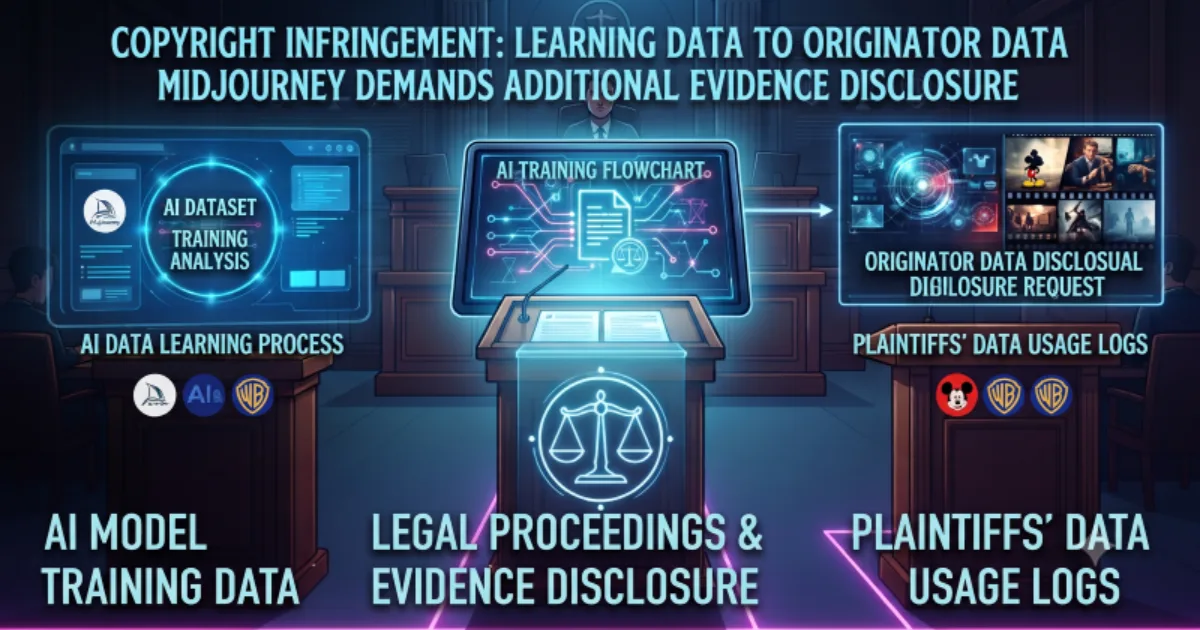
Midjourney is seeking four broad categories of material: documents concerning the plaintiffs’ own AI-model development and training; records of their use of image- and video-generation tools; internal AI-policy documents; and prompts entered into Midjourney by the plaintiffs or their investigators, together with the resulting outputs.
The filing signals that generative AI copyright litigation is no longer focused only on what AI companies trained on.
It is increasingly becoming a fight over who uses AI, how they use it and whether the same legal standard applies to everyone.
The Dispute Over Consumer AI and Internal AI
The earlier discovery ruling gave Midjourney a partial victory, but only within limits.
The magistrate judge allowed some discovery related to AI systems developed or used by the plaintiffs when those systems involved image or video outputs offered to consumers. But the ruling generally excluded materials concerning nonpublic uses of AI, including internal research, storyboarding, ideation, character development and other private creative or production functions.
Midjourney argues that this limitation misses the central issue.
The company contends that internal AI use may be relevant even when a tool was never released to consumers. If a studio developed an internal AI system using public-web images or third-party copyrighted works, Midjourney argues, that conduct could reveal how the entertainment industry actually treats AI training, data collection and licensing in practice.
For Midjourney, the key question is not whether an AI product was sold to the public.
The key question is whether copyrighted material was copied, collected, analyzed or used to train an AI system.
If studios used third-party works to build internal tools for creative ideation, concept testing, storyboarding or character experimentation, Midjourney argues that such activity could bear on industry practice, the claimed existence of a licensing market and the equitable basis of the plaintiffs’ claims.
The argument raises an important question for generative AI law.
When courts assess the legality of AI training, what matters most?
Is it whether the output was commercially offered to consumers?
Or is it the process by which data was collected, copied, transformed and used to train a model?
Midjourney’s position is closer to the second view.
The company argues that internal AI systems should not be treated as irrelevant merely because they were not offered as consumer-facing products. If the studios used third-party works to train internal tools, Midjourney says, that could undermine arguments about industry practice and alleged harm to a licensing market.
The studios are likely to argue that their internal AI activities have little or no direct connection to whether Midjourney infringed their copyrights. They may also argue that internal technical research, creative experimentation and production strategy involve commercially sensitive information that should not be opened broadly in discovery.
Midjourney’s “Unclean Hands” Argument
One of Midjourney’s most aggressive legal arguments involves the doctrine of unclean hands.
Under equitable principles, a court may limit relief when a plaintiff has acted unfairly or improperly in connection with the matter before the court.
Midjourney argues that if Disney and Warner are accusing it of unauthorized AI training while engaging in similar conduct themselves, the company should be allowed to investigate that possibility.
The dispute turns partly on what Midjourney must prove for an unclean-hands defense to matter.
The earlier ruling applied a three-part framework requiring Midjourney to show that the plaintiffs’ conduct was unfair, directly related to the subject matter of the lawsuit and harmful to Midjourney itself.
Under that approach, the judge concluded that the studios’ internal AI-use documents were not sufficiently connected to Midjourney’s unclean-hands defense.
Midjourney challenges that reasoning.
The company argues that Ninth Circuit precedent requires only two elements: that the plaintiff acted unfairly and that the conduct was related to the plaintiff’s claim. Midjourney argues that it should not also be required to prove separate, direct harm caused by the plaintiffs’ conduct.
In simpler terms, Midjourney is telling the court:
“If Disney and Warner are suing us for using copyrighted works to train AI, while they themselves have built or used AI in similar ways, the court should know that.”
Whether the court accepts that argument remains uncertain.
But the filing shows that AI-company defenses are becoming more ambitious. Defendants are no longer relying only on arguments that their systems are transformative or that training should qualify as fair use.
They are increasingly seeking evidence about copyright owners’ own AI policies, licensing strategies, internal development practices and creative uses of generative AI.
Are Prompts Evidence or Attorney Work Product?
The second major dispute concerns prompts entered into Midjourney by the plaintiffs and their investigators during preparation for the lawsuit.
Disney and Warner have included certain prompts and generated images in their complaints to show that Midjourney can allegedly reproduce protected characters and works.
But Midjourney argues that it has seen only selected examples.
The company wants access to the complete set of prompts and outputs created by the plaintiffs’ investigators. It argues that the court and jury should be able to see what was entered, which attempts failed, which outputs were generated and which examples were selectively chosen for use in the complaint.
According to Midjourney, a litigation record built only around successful outputs could create a distorted impression.
If a plaintiff shows only cases in which a character was generated convincingly, while withholding prompts that produced weak, inconsistent or unsuccessful results, Midjourney argues that the evidence may not provide a complete picture of the system’s capabilities.
The earlier discovery ruling treated the prompts and outputs as opinion work product, a category of litigation material that receives strong protection because it may reflect an attorney’s legal strategy, investigative choices and theory of the case.
Midjourney disputes that characterization.
The company argues that prompts such as “Homer Simpson, animated” are not legal opinions. They are factual inputs made to an external service. At most, Midjourney argues, they should be treated as ordinary work product rather than strongly protected opinion work product.
Midjourney also argues that the plaintiffs may have waived protection by agreeing to Midjourney’s terms of service, which grant broad rights relating to submitted prompts and outputs. The company further argues that the plaintiffs designated investigators as witnesses and selectively disclosed some prompts in their complaint.
This issue could become increasingly important in future AI litigation.
In a traditional copyright case, an investigator might purchase a product, observe it or test a service. In an AI case, the prompt itself can shape the evidence.
A single word, phrase order or parameter can produce dramatically different outputs. Prompts are therefore not merely search terms. They can be part of the design of the experiment itself.
That makes them both factual inputs and possible elements of litigation strategy.
The question of where to draw the line may become a major evidentiary issue in generative AI cases.
AI Copyright Litigation Is No Longer Only About Training Data
Midjourney’s filing shows how quickly AI copyright disputes are becoming more complex.
The first question was whether an AI model was trained on copyrighted works.
The second was whether that training qualified as fair use.
Now a third question is emerging:
How are copyright owners themselves using AI?
For copyright owners to argue that AI training has harmed or threatens a viable licensing market, Midjourney contends that courts should be able to examine whether such a market exists in practice and how the plaintiffs themselves approach AI development and data use.
The company’s argument is not simply about legal hypocrisy.
It is also about market reality.
If major entertainment companies have internally trained or used AI systems with public-web or third-party content, Midjourney may argue that this practice has implications for whether AI training is broadly accepted in the industry, whether licensing markets are established and whether the plaintiffs’ claimed harms should be viewed differently.
The discovery dispute also reflects a broader tension facing the entertainment industry.
Hollywood companies have strong reasons to protect valuable characters, franchises and copyrighted works from unauthorized reproduction. At the same time, the industry is investing in AI across visual effects, concept development, translation, dubbing, content recommendation, production management and virtual production.
AI can be a threat to copyrighted content.
It can also be a tool for making content more efficiently.
The central question is whether companies can apply the same standards to their own AI use that they demand from others.
A Discovery Ruling With Wider Consequences
The court is scheduled to hear Midjourney’s request on August 17.
If Midjourney prevails, Disney and Warner could be required to provide broader disclosure not only about consumer-facing AI products, but also about internal AI development and use.
If the earlier decision remains in place, much of the studios’ internal AI strategy may stay outside the litigation record.
Either outcome could have consequences beyond this one discovery dispute.
In generative AI copyright litigation, plaintiffs seek information about defendants’ training data, model architecture and technical processes. Defendants increasingly seek information about plaintiffs’ AI policies, internal creative systems, licensing strategies and investigative methods.
Both sides want to examine the other’s technology, data and business decisions.
The AI copyright war is no longer only about who trained on what.
It is becoming a dispute over who has used data freely, who is trying to turn that use into a licensing market and who is calling AI a threat while also using it as a creative or production tool.
Midjourney’s filing puts that uncomfortable question directly before the court:
If AI training is infringement, should the same standard apply to everyone?