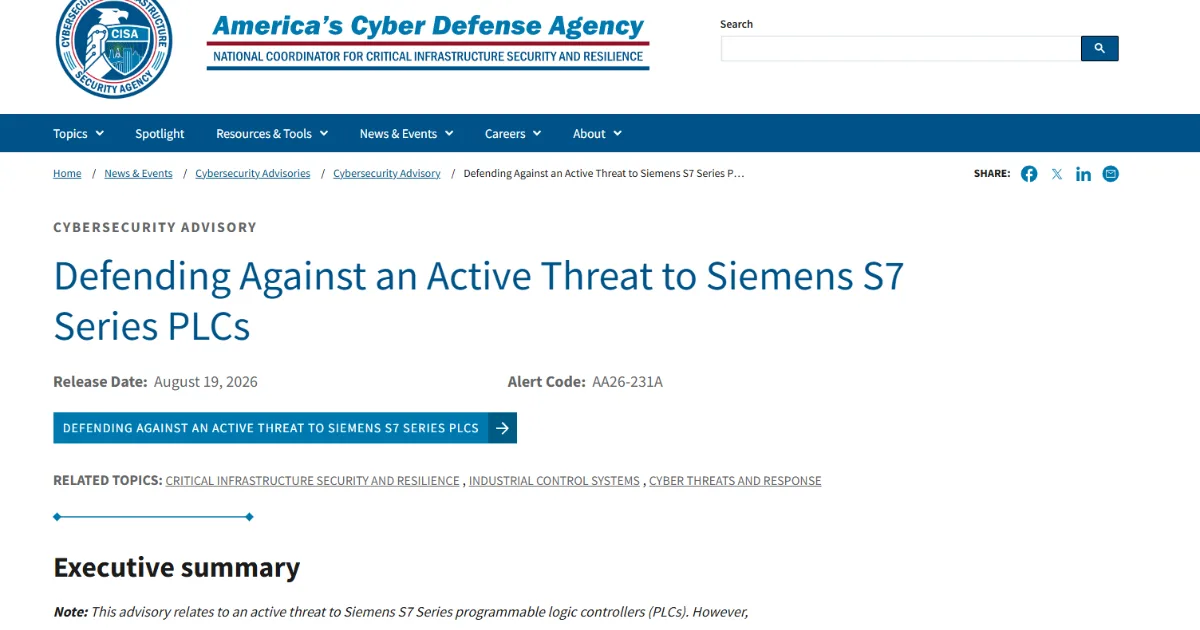
Major U.S. security, intelligence, energy and environmental agencies have issued a joint warning about an active cyber threat targeting Siemens S7 Series programmable logic controllers.
On August 19, 2026, CISA, NSA, FBI, the Department of Energy and the Environmental Protection Agency released a joint cybersecurity advisory warning industrial control system operators of active threats to Siemens S7 Series PLCs. Although the advisory centers on Siemens S7 controllers, the agencies emphasized that PLC-targeting activity is not limited to Siemens devices and that all PLC owners and operators should apply relevant mitigations.
The message is clear.
Threat actors are conducting reconnaissance against Siemens PLC installations in the United States. They are using AI-generated exploitation scripts disguised as legitimate monitoring tools. They are using internet-scanning services such as Censys and ZoomEye to find exposed PLCs. They are taking advantage of outdated software, weak protection and insufficient network segmentation.
The targeted sectors include critical manufacturing, energy, water and wastewater, chemical, food and agriculture, and commercial facilities.
The most important sentence in the advisory is this:
This is not a theoretical risk.
It is an active threat.
Industrial control system risk is no longer a hypothetical scenario. Attackers are already looking for exposed PLCs. They are using AI to build attack code faster. They are combining open-source libraries with scripts that can appear to be legitimate operational tools.
AI is not directly attacking factories by itself.
But AI is making it faster and easier for attackers to build the tools needed to attack factories.
PLCs Are the Hands and Feet of Industrial Sites
A PLC is a core device in industrial environments.
In factories, power plants, water-treatment facilities, chemical plants, food-production sites and logistics facilities, PLCs open and close valves, move motors, adjust pressure, read sensor values and control process sequences. If IT systems process data, PLCs move the physical world.
That is why a PLC compromise is different from an ordinary data breach.
If an email server is compromised, information may leak.
If an ERP system goes down, business work may be delayed.
But if a PLC is manipulated, equipment can stop, product quality can be disrupted, machinery can be damaged and human safety can be threatened.
The joint advisory describes the possible impact of unauthorized PLC access in concrete terms: disruption of essential industrial processes, safety risks, equipment damage and prolonged downtime, exposure of sensitive operational data, cascading impacts across supply chains and connected systems, and regulatory or liability consequences.
This is why OT security carries a different weight from ordinary IT security.
An OT incident does not end on a screen.
It can reach valves, pumps, motors, pressure, temperature and chemical reactions.
Attackers Are Looking Across the Siemens S7 Family
The advisory identifies the Siemens PLC models being actively targeted.
They include the S7-200, S7-300, S7-400, S7-1200 and S7-1500 series, including S7-1500 F-series safety controllers. That means the issue is not confined to one old device line. It reaches across the broader Siemens S7 ecosystem.
Siemens S7 controllers are widely used in industrial environments.
In older factories and infrastructure facilities, equipment replacement cycles are long. PLCs may operate for more than a decade after installation. Security patches may be delayed because of production constraints. System integrators or third-party maintenance providers may also leave remote access paths open.
Attackers look for exactly these gaps.
Old firmware.
Internet-exposed ports.
Default credentials.
Weak network segmentation.
Remote maintenance access.
Poorly managed engineering workstations.
The advisory specifically warns about third-party service providers and system integrators that may have remote access to PLCs. Asset owners may not even know their systems are externally reachable.
One of the largest risks in industrial environments is the illusion that “we are not connected to the internet.”
In reality, external vendor access, remote maintenance, temporary routing, firewall exceptions and old VPN paths may still be open.
AI Has Changed the Speed and Difficulty of Attack
The most striking part of the advisory is its reference to AI-generated exploitation scripts.
Threat actors are using public information about Siemens S7 PLCs and AI assistance to create exploitation scripts. Their goals include initial access, credential access and denial of service. AI helps them collect known vulnerabilities and weaknesses, identify exposed PLCs and generate scripts that act on that information.
The agencies describe this as an evolution in threat actor capability. AI can dramatically reduce the expertise and time required to develop working ICS exploitation scripts and malicious tools. It can also help attackers exploit additional attack vectors more quickly and adapt to defensive measures.
This is the critical shift.
In the past, ICS attacks required specialized knowledge. Attackers needed to understand industrial protocols, differences between PLC models and operational process logic. Nation-state actors and specialized groups could do it, but the barrier for ordinary attackers was high.
AI lowers that barrier.
It can read and summarize public documentation.
It can organize vulnerability information.
It can explain how libraries work.
It can generate Python scripts.
It can debug errors.
It can adapt code to a target device.
It can make a tool look like a monitoring utility.
AI does not do everything for the attacker.
But it reduces the time required to obtain the knowledge and code needed for an attack.
That raises the risk that ICS attacks become more accessible to less-skilled actors.
In industrial control security, AI’s significance is not “superintelligent hackers.”
It is that inexperienced attackers can become dangerous faster.
Why snap7 and S7comm Matter
The advisory says threat actors are using open-source industrial automation libraries, especially snap7.dll and python-snap7. They combine these tools with AI-assisted scripting to create custom tools that masquerade as legitimate OT monitoring solutions.
snap7 is a public library that can communicate with Siemens S7 PLCs. It can be used for legitimate industrial automation and monitoring. The problem is that the same tool can also be used for attacks.
Through the S7comm protocol, such tools may attempt to read or write PLC memory, configuration data and ladder logic programs.
This makes defense harder.
If an attack tool is completely unfamiliar malware, it may be easier to detect. But if it communicates with PLCs in ways that resemble legitimate engineering or monitoring tools, security teams may struggle to distinguish malicious activity from normal maintenance work.
The advisory warns that malicious scripts are masquerading as legitimate monitoring tools.
That is especially dangerous in OT environments.
Many industrial sites rely on maintenance vendors, engineers and scripts. If a new monitoring script appears, it may not be immediately obvious whether it is authorized or malicious.
AI helps here too.
An attacker can ask AI to make code look like a normal monitoring utility. Log messages, variable names, function structure, command-line options and output formats can be made to seem less suspicious.
Attack code no longer needs only to work.
It must look normal.
AI makes that disguise easier.
The Goal May Not Be Immediate Destruction
The advisory characterizes the observed activity as persistent reconnaissance and capability development.
That does not necessarily mean attackers are already conducting large-scale destructive operations. Instead, they appear to be testing and refining techniques against specific PLC models, learning target environments and preparing for possible future write operations.
That distinction is important.
Attackers first read.
They map the environment.
They inspect data blocks.
They review configuration.
They study ladder logic.
They learn what kind of write operation might cause what kind of effect.
Then they prepare for future operational impact.
In OT attacks, reconnaissance is not simple information gathering.
It is the process of understanding a physical process.
An attacker needs to know which data block maps to which valve, which control logic connects to which safety function, and which change can stop production or damage equipment.
The advisory warns that attackers may use read access to understand target environments and prepare future write operations.
That is a major warning to operators.
The fact that “nothing has changed yet” does not mean the system is safe.
Read access alone can be dangerous.
An attacker may simply be learning quietly.
If Port 102 Is Open, You Have a Problem
Siemens S7comm uses TCP port 102.
The advisory repeatedly emphasizes this port in its recommended mitigations. It urges operators to audit firewall rules, identify exposed S7comm services and block TCP port 102 at the perimeter firewall.
This is basic, but critical.
If a PLC is directly visible from the internet, attackers can find it. Search services such as Censys and ZoomEye can identify exposed devices. Attackers can use those services to locate vulnerable PLCs. When AI-generated scripts are added, the attack cycle becomes faster.
The first rule of OT security is simple.
PLCs should not be directly visible on the internet.
Reality is more complicated. Plant data needs to reach corporate systems. Remote maintenance may be necessary. Production data may feed cloud analytics systems. But the need for connection does not justify direct PLC exposure.
The advisory recommends separating OT and IT networks through DMZ architecture, using unidirectional gateways where appropriate for data historian connections, and blocking unauthorized routing between corporate and industrial networks.
Industrial connectivity must be managed.
Connection may be necessary.
Exposure is dangerous.
Detection Starts With Knowing What Normal Looks Like
The advisory also provides concrete detection opportunities.
The key is identifying abnormal S7comm behavior.
Connections from non-engineering workstations to PLCs.
Unusual data block access patterns.
Write operations outside approved change windows.
Sequential IP scanning against port 102.
Repeated connection attempts using varying parameters.
CPU property enumeration.
Use of Snap7.dll or Python scripts with S7comm functions on non-engineering workstations.
Time and geography also matter.
Is S7comm activity happening at night or during holidays?
Does the connection pattern look automated and repetitive?
Did configuration change without a change ticket or work order?
Is access coming from unexpected countries or IP ranges?
In OT environments, knowing normal behavior is the foundation of detection.
Installing security tools is not enough. Operators must know which workstation normally talks to which PLC, when it does so, what data blocks it reads and when changes are allowed.
AI-generated attack scripts may try to look like normal tools.
Defenders must therefore look at behavior, not only tool names.
The First Step in Defense Is Inventory
The advisory’s first top mitigation is inventory.
Operators are urged to immediately identify all Siemens S7 Series PLCs, including S7-200, S7-300, S7-400, S7-1200 and S7-1500 controllers. They should check firmware versions, compare configurations against a known-good backup, identify systems directly or indirectly reachable from untrusted networks, and map all engineering workstations with TIA Portal, STEP 7 or S7 programming access.
This sounds obvious.
In practice, it is difficult.
Many industrial sites do not have accurate asset inventories. Old devices remain in operation. Equipment installed by integrators may not be well documented. Remote-access paths may not be fully known. Plant culture often follows the rule: if it is running, do not touch it.
Attackers do not need your asset inventory to find you.
They use internet search engines, port scans, banners and known weaknesses. While defenders may not know where all their PLCs are, attackers may discover them first.
In OT security, inventory is not paperwork.
It is the first act of reducing the attack surface.
Patching Alone Is Not Enough
The advisory emphasizes applying critical security patches.
Operators should update Siemens S7 PLC firmware, keep TIA Portal and STEP 7 current, and review Siemens ProductCERT advisories. Internet-facing or DMZ-resident controllers should be prioritized. Updates should be tested in development environments before production deployment.
But the advisory also makes clear that CVE remediation alone is not sufficient.
That point matters.
Attackers do not use only known vulnerabilities. They also exploit misconfigurations, weak authentication, internet exposure, insufficient segmentation, default SNMP community strings, unnecessary protocols and excessive remote access.
AI-assisted development can combine known vulnerabilities, public documentation and exposed infrastructure into attack paths quickly. An unpatched vulnerability is dangerous, but even a patched PLC may remain exposed if it is reachable from the internet with weak access controls.
That is why the advisory calls for defense in depth.
Patching.
Network isolation.
Access control.
Monitoring.
Protocol hardening.
Ladder logic integrity.
Threat hunting.
There is no single fix in OT security.
Defenses must be layered.
Access Control and Protection Levels
The advisory also stresses stronger access control.
Access to TIA Portal and STEP 7 should be limited to authorized engineering workstations. PLC password protection should be enabled. Protection levels such as write protection and read/write protection should be configured. Default SNMP community strings should be removed or changed. Application allowlisting should be applied to engineering workstations. Multi-factor authentication should be enabled for remote access into OT networks.
These measures stop the attacker’s next step.
Even if a PLC is visible on a network, not everyone should be able to read or write to it. Unauthenticated access, default passwords and weak protection levels are invitations to attack.
In OT environments, convenience often overpowers security.
Maintenance must be easy.
Vendors must connect.
Emergency repairs must happen quickly.
That is how shared accounts, static passwords, remote-access exceptions and excessive administrator privileges appear.
But in an AI-assisted attack environment, such looseness is more dangerous.
The attacker does not try slowly by hand.
Scripts try quickly.
AI debugs errors.
Libraries communicate with PLCs.
Exposed devices become targets.
Access control is not bureaucratic friction.
It is part of process safety.
Why Ladder Logic Integrity Matters
The advisory specifically mentions ladder logic integrity.
A PLC’s ladder logic is the rulebook for an industrial process. It determines when a motor turns on, when a valve closes, when an alarm sounds and when a safety interlock activates. If attackers read ladder logic, they can understand the process. If they modify it, they can create physical effects.
That is why operators should evaluate changes to ladder logic in both online and offline modes and enable features such as complete restart protection and know-how protection in TIA Portal or STEP 7.
This point reveals the essence of OT attacks.
Attackers are not only trying to steal data.
They are trying to understand and potentially alter the logic of a physical process.
Ladder logic is the source code of the industrial site.
Just as source code is a core asset in IT, ladder logic is a core asset in OT. If it leaks, process knowledge leaks. If it is altered, production and safety are at risk.
In the age of AI-generated attack scripts, ladder logic protection becomes even more important.
An attacker can read ladder logic and then ask AI to analyze it. A question such as “which data block would stop the pump if modified?” becomes more plausible.
OT security is now also code security.
Why This Matters for Korean Industry
Although the advisory was issued by U.S. agencies, the implications are directly relevant to Korea.
Korea depends heavily on industrial control systems across manufacturing, semiconductors, refining and chemicals, power generation, water treatment, food production, automotive, shipbuilding and logistics. Siemens PLCs are used in many industrial environments. Korean factories are also expanding remote maintenance, smart-factory systems, cloud monitoring, data collection and third-party access.
As factories become more connected, the attack surface widens.
Mid-sized and smaller manufacturers may lack dedicated OT security teams. Equipment and network configurations installed by system integrators may not be fully documented. Older PLCs may still be operating. Remote access opened for outside maintenance may unintentionally be exposed to the internet.
Korean companies should be asking concrete questions now.
Which PLCs do we operate?
Which of them are Siemens S7 controllers?
Is TCP port 102 visible from outside?
Who has access to TIA Portal and STEP 7?
How is third-party remote access managed?
Are PLC firmware and engineering software up to date?
Are we monitoring S7comm traffic?
Do we have change history and approval procedures for ladder logic?
Can we detect use of Python snap7 scripts?
If a company cannot answer these questions, it may discover its own systems later than attackers do.
OT Security in the AI Era Is a Management Issue
A PLC attack is not only a security-team problem.
If a factory stops, production stops. If an energy facility is disrupted, supply stability is affected. If a water-treatment facility is attacked, public safety may be at risk. If a chemical process is manipulated, human life may be endangered.
The advisory calls for coordination among security, engineering, executive leadership, plant operations and vendor support teams. That means OT security is an organization-wide responsibility.
If AI lowers the attack barrier, more actors may target industrial sites. Executives must therefore treat OT security not as a technical expense, but as business continuity, safety and regulatory risk management.
Manufacturing companies should handle the following as management-level issues:
OT asset inventory;
network segmentation budgets;
plans for replacing aging PLCs;
third-party remote-access policy;
recovery plans for plant shutdowns;
manual operating procedures;
security logging and monitoring;
and incident reporting and regulatory response.
Factory security in the AI era does not end with one firewall.
It is a question of how the factory is connected.
AI Weaponizes Public Weaknesses, Not Only Zero-Days
The joint Siemens S7 PLC advisory from CISA, NSA, FBI, DOE and EPA shows the new reality of industrial control system security.
Threat actors are using AI to create exploitation scripts for Siemens S7 Series PLCs. They use public libraries such as snap7.dll and python-snap7 to communicate over the S7comm protocol, accessing PLC memory, configuration data and ladder logic. They disguise the tools as legitimate monitoring utilities. They use internet-scanning services such as Censys and ZoomEye to find exposed PLCs. They exploit known vulnerabilities, weak authentication and poor network segmentation.
This is not only a zero-day problem.
Old firmware.
Port 102 exposed to the internet.
Default credentials.
Insufficient segmentation.
Third-party vendor access.
Lack of monitoring.
These basic weaknesses become far more dangerous when combined with AI.
AI increases the attacker’s knowledge and reduces the attacker’s time. It reads public documentation, organizes vulnerabilities, writes scripts, fixes errors and makes code look legitimate. As a result, the barrier to attacking industrial control systems falls.
The defensive principles are clear.
Know your PLCs.
Patch them.
Remove them from direct internet exposure.
Limit access.
Monitor S7comm traffic.
Detect snap7 and Python script usage.
Review ladder logic changes.
Manage third-party integrators and remote access.
The age in which AI attacks factories directly is not the real point.
The more urgent reality is this:
the age in which attackers use AI to prepare attacks on factories has already begun.