When South Korea talks about becoming an AI powerhouse, three terms tend to dominate the conversation.
Large language models.
GPUs.
Data centers.
Building domestic foundation models, securing advanced chips and expanding local compute capacity are all essential. In the generative AI era, competitiveness depends heavily on computing power, model performance and the quality of available data.
Korea cannot afford to fall behind in any of those areas.
But they are not enough.
The real competition in AI is no longer limited to where a model is developed or where a data center is located. It extends to a more difficult set of questions.
Which legal entity signs the customer contract?
Where is the service formally operated?
Which country recognizes the revenue?
Where is intellectual property held and managed?
Who bears responsibility when an AI system fails, exposes data, violates a regulation or creates a security incident?
These are not secondary corporate details.
They are part of AI sovereignty.
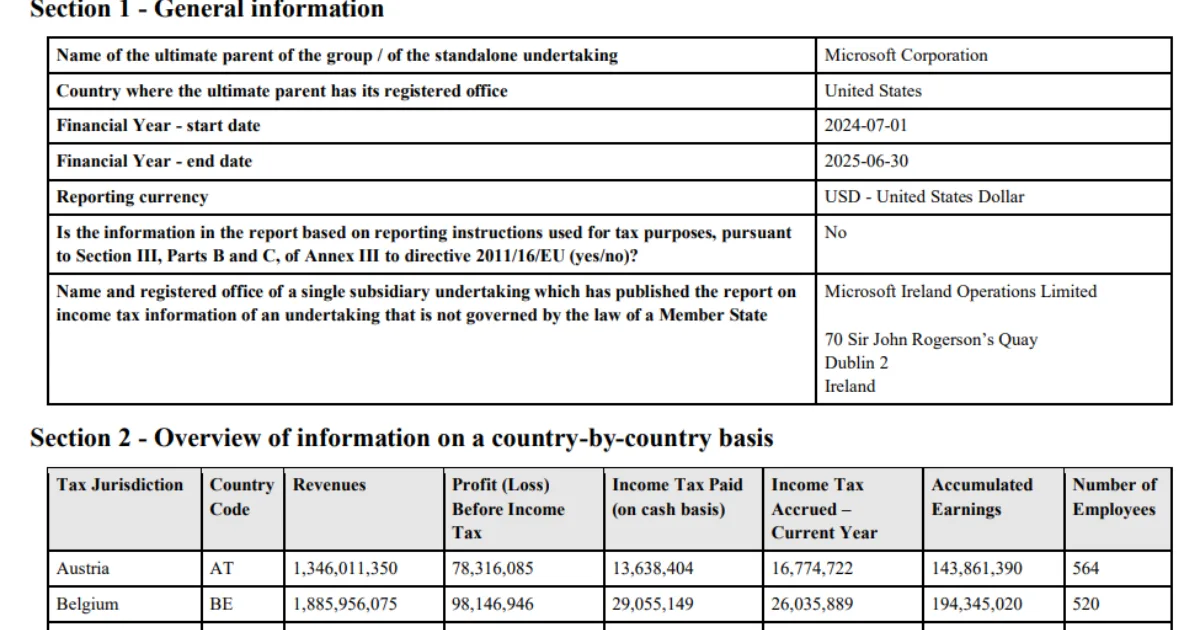
Microsoft’s recently released EU country-by-country tax report offers a useful illustration.
The report showed that Microsoft recorded roughly $196 billion in revenue and about $47.1 billion in pretax profit in Ireland during fiscal year 2025. The company reported 6,654 employees in the country.
The scale is striking, especially when compared with larger European consumer markets such as Germany and France.
That does not automatically prove tax avoidance or wrongdoing. Country-level revenue and profit can be affected by licensing arrangements, internal transactions, R&D costs, intellectual-property ownership, service entities and accounting rules. Microsoft itself has emphasized that its country-by-country report follows EU reporting requirements and aggregates multiple legal entities within each jurisdiction.
The figures should therefore not be treated as a legal conclusion about the company’s tax practices.
But they do reveal something important.
Ireland is not simply a sales branch for Microsoft’s European business.
It is a high-value operational hub.
Ireland Is Not a Branch Office. It Is a European Operating Center
Microsoft’s Irish corporate structure helps explain why the country has become so important.
Ireland is not home only to sales and marketing entities. It also contains companies involved in financing, intellectual-property management, research and development, manufacturing and service delivery, procurement, investment and corporate ownership.
Microsoft Ireland Operations Limited, for example, is associated with administrative and support functions, manufacturing and production, customer-facing service delivery, procurement and sales activity.
Microsoft Global Finance Unlimited Company performs group financing functions.
Microsoft Ireland Research UC is associated with intellectual-property holding and management, research and development, and commercial activities.
The structure sends a clear message.
The highest-value part of a global AI business is not created only at the final moment when software is sold to a customer.
Value is created across a chain of functions.
Research and development.
Intellectual property.
Customer contracts.
Cloud operations.
Data processing.
Billing.
Security.
Compliance.
Procurement.
Technical support.
Finance.
Liability management.
An AI model may look like a single technology product.
But the business behind it is a combination of legal, commercial, operational and technical systems.
To provide an AI service to an enterprise customer, a company must decide which entity signs the agreement. It must decide where customer data is stored. It must determine which legal entity charges for model usage and API calls. It must establish how privacy law, AI regulation, cybersecurity incidents, service-level commitments and model failures will be handled.
The place where these functions are coordinated becomes more than a corporate address.
It becomes an operational hub.
Ireland appears to play that role for Microsoft in Europe.
It is not only a location with an attractive tax environment. It is a place where AI, cloud and software services can be contracted, operated, billed, governed and connected to intellectual-property management.
That is the lesson Korea should draw.
The key issue is not simply corporate tax rates.
It is how a country attracts and retains high-value functions.
Korea Must Move Beyond the Race to Attract Data Centers
Korea’s AI policy has placed growing emphasis on attracting data centers.
That makes sense.
Securing cloud regions, building GPU clusters and strengthening power and telecommunications infrastructure are necessary steps. Korea has strong advantages in semiconductors, telecommunications, manufacturing, finance, gaming and digital content. These industries could support a powerful AI ecosystem.
But a data center alone is not enough.
Data centers consume land, electricity, cooling resources and network capacity. Communities may be asked to accept large increases in power demand, environmental pressure and land development.
If a data center functions only as a remote compute facility for a foreign company, the value retained in Korea may be limited.
The servers may be located in Korea.
But the customer contracts may be signed abroad.
The revenue may be recognized by an overseas entity.
The intellectual property may be held elsewhere.
The highest-value talent and core operational responsibility may remain outside the country.
In that case, Korea risks becoming an energy and infrastructure provider for AI rather than an AI operating center.
What Korea needs is not simply more servers.
It needs more economic functions built on top of those servers.
If a global AI company builds a data center in Korea, policymakers should seek to attract related capabilities as well.
A Korean and East Asian language model-operations hub.
An AI security center for domestic finance, manufacturing and public-sector customers.
A safety-evaluation and red-team organization.
Enterprise AI contracting, billing and customer-support functions.
GPU and API access programs for Korean startups.
Joint development of industry-specific AI models with Korean firms.
AI governance, privacy and compliance teams capable of serving regional markets.
Without these functions, Korea may become the place where AI consumes electricity.
With them, Korea could become an Asia-Pacific hub where AI services are operated, governed and commercialized.
AI Sovereignty Is More Than Domestic Models
Korea often discusses AI sovereignty through the lens of domestic models.
The argument is familiar.
Korea needs Korean large language models, Korean datasets and domestic GPU capacity.
That argument is valid.
For public services, defense, finance, healthcare and other sensitive industries, domestic control over data and infrastructure can be critical.
But AI sovereignty cannot be completed simply by knowing where a model was developed.
AI sovereignty has at least five layers.
The first is models and chips.
The second is cloud infrastructure and data centers.
The third is industrial data and the ability to deploy AI in real operating environments.
The fourth is the structure of contracts, intellectual property, billing and taxation.
The fifth is the capacity to manage security, privacy, safety and legal responsibility.
Korea can strengthen the first and second layers and still lose control of the business if it neglects the fourth and fifth.
Imagine a Korean company that develops a successful AI model.
The model runs on a foreign cloud platform. Customer contracts are handled by an overseas entity. The intellectual property is held outside Korea. Usage fees are charged through a foreign platform. Security and compliance decisions are made abroad.
The technology may be Korean.
But much of the economic value and operational control may not be.
The alternative is different.
Korea could build AI services around its strengths in manufacturing, finance, telecommunications, content and public administration. It could develop industrial data partnerships, security validation systems, model evaluation capabilities, regulatory expertise and operational-accountability structures.
In that model, Korea would not merely consume AI.
It would operate and govern AI.
Korean AI Companies Need Global Functions, Not Just Overseas Offices
The same lesson applies to Korean AI companies expanding abroad.
Many firms think about global expansion in familiar terms: launch an English-language product, establish a foreign subsidiary and find local partners.
Those steps matter.
But exporting AI is more complicated than exporting conventional software.
AI systems may process sensitive customer data. They may produce incorrect information, expose confidential content, create copyright disputes, generate security vulnerabilities or trigger regulatory scrutiny.
Data-transfer rules differ across countries.
AI regulations differ across countries.
Industry-specific security requirements differ across countries.
A Korean AI company entering a foreign market must therefore think beyond translation and local sales.
Which entity signs the customer agreement?
Where will data be stored?
Which jurisdiction governs the service?
How will model usage be billed?
Who bears liability if the AI system produces harmful output?
How will the company respond to local regulators?
What security and privacy commitments can it realistically enforce?
AI exports are not simply software exports.
They are exports of data practices, contractual obligations, security structures, intellectual property and regulatory responsibility.
Microsoft’s European structure shows the importance of organizing these functions as part of a single value chain.
Sales entities, research entities, IP-holding entities, finance entities, service entities and operational-support entities may be legally separate. But together they form the machinery through which a global AI business creates and captures value.
Korean firms that fail to design those functions strategically may generate foreign revenue without retaining the most valuable part of the business.
Tax Incentives Matter Less Than Real Functions
It would be too simple to look at Ireland and conclude that Korea should merely lower corporate taxes.
Countries become global technology hubs for many reasons.
Ireland offers more than tax policy. It has an English-speaking business environment, deep connections to global finance, legal predictability, access to European markets, skilled international talent, corporate-service infrastructure and a long history of hosting multinational technology companies.
Korea can consider tax incentives for AI investment.
But the purpose of those incentives should not be simply to encourage foreign companies to book revenue in Korea.
The goal should be to encourage real functions to take place in Korea.
Research and development.
Highly skilled employment.
Intellectual-property management.
AI safety evaluation.
Industry-specific service operations.
Collaboration with domestic startups.
Secure domestic data infrastructure.
Korean-language and industry-specialized model development.
Enterprise-grade support and compliance operations.
AI tax incentives should therefore be linked to measurable contributions.
How many high-skilled AI researchers are hired in Korea?
Are Korean-language and Korean-industry models being developed locally?
Does the company help Korean startups access GPU and API resources?
Are AI safety, security and red-team functions based in Korea?
Are local data-protection standards respected?
Are Korean operations involved in contracts, billing or IP management?
Is the data center powered by cleaner electricity and connected to local industrial innovation?
The important question is not how much tax a company receives in discounts.
It is what Korea receives in return.
What talent remains?
What technology remains?
What responsibility remains?
What revenue remains?
What intellectual property remains?
An AI Powerhouse Is Not a Country With the Most Servers
AI competition will not be decided by model performance alone.
It will increasingly depend on who can operate models reliably, secure data effectively, manage regulatory responsibility, control contracts, retain intellectual property and capture the economic value created by AI services.
Microsoft’s EU tax report illustrates this quietly.
Ireland is not simply a small country within Europe.
It is a platform state where revenue, contracts, operations, finance and intellectual property intersect.
Germany, France, the Nordic countries and other European markets may contribute sales, research, support, infrastructure and local expertise. But the overall digital value chain is organized through a network of legal and operational functions.
Korea now needs to ask the same question.
How many data centers will Korea build?
How many domestic AI models will it launch?
How many GPUs will it secure?
Those questions matter.
But they are not enough.
The more important question is this:
What role will Korea play in the AI era?
Will it become a country where AI revenue is recognized?
Will it become a country where intellectual property is managed?
Will it become a trusted hub for AI security, safety evaluation, compliance and enterprise operations?
Or will it remain a market that provides power, data and consumers while the value and responsibility of AI are controlled elsewhere?
An AI powerhouse is not simply a country with many servers.
It is a country that can keep AI’s value, responsibility, data and intellectual property within its own economic system.